Global warming "truthers" would self-ignite; Permafrost Results

No, you are missing the main facet of Kyoto where there is actually a mechanism for allowance to create more greenhouse gases, not less! If Kyoto was serious about reduction, this scheme of selling of unused credits would be laughed at and countries that didn't bump up to the limit wouldn't be allowed to create more in a proxy way.

So according to you, Kyoto -- does Kyoto matter anymore, anyway? -- was a scheme to create more greenhouse gases?

And if it did, tell me, how is this a "wealth redistribution" plan? And who was behind it, and why did the alleged "donor" nations go along?

Sounds like a bunch of hare-brained nonsense to me.
 
You're joking, right? If not, it's laughable that you can't distinguish between a "what we do" mission statement and a press release.

Ok, so where is this original science they're funding? Where was it published? And who went on to use it as the basis for further research? And what percentage of the publications on GW was funded by this source and similar sources?
 
Here's another interesting funding item.

"NOAA also gathers the science needed to understand the impacts of global
warming on our nation, yet despite these important roles this agency continues to be critically underfunded. The U.S. Commission on Ocean Policy, the Pew Oceans Commission and the Joint Ocean Commission Initiative all identified the need to provide additional resources for NOAA. A broad coalition of industry, conservation organizations, academic researchers, and scientific organizations among others have joined together to support overall funding for NOAA at $4.5 billion.

Page 89 of the pdf.

http://www.saveourenvironment.org/greenbudget2009.pdf

So you're saying that all "conservation organizations" are part of a leftist "environmental movement", and that their contributions to the NOAA are somehow driving the research done by the NOAA -- under Bush -- which research they choose to fund, and the conclusions reached by the researchers?

Is that what you're saying?
 
If I'm wrong we'll know in 2015. If I'm right we'll probably know before that.

Given what's happened in the Arctic over the last few years, do you think it likely there won't be an ice-free Arctic by 2015?

Nope, not given the fact that this last winter, the Arctic had it's largest run up of ice coverage since satellite records began in 1979.

Nope, not given the fact that the Antartic had the largest area coverage of sea ice last year, when compared to the satellite records we have dating back to 1979.

[SARCASIM]
You certainly sound like a AGW scientist:

If I'm wrong, we'll know in 25 years!

If I'm right, we'll know in five years!

Just keep my funding in place for this year!
[/SARCASIM]

:)
Everyone says that climate has year to year variations that obscure any long term trends in the short term.

What do you do? You talk about short term variation.

Oh look, all that ice has melted, oh gee, what the heck was that short term variation good for anyway?

Oh that's right, it does nothing to buck the long-term trend at all.

And you wonder why we mock you people, after you read something a dozen times and then blithely continue on with your obvious error that has been repeatedly explained to you.

Wait, "long term trend" is now just 30 years , since 1978?

30 years is a minimum measure of climate, isn't it ? So what's this with all the alarming trends?
 
Wait, "long term trend" is now just 30 years , since 1978?

30 years is a minimum measure of climate, isn't it ? So what's this with all the alarming trends?
Wow. Okay. This is either a total misunderstanding of what was said or was a deliberate misunderstanding of what was said. I'm voting for the latter.

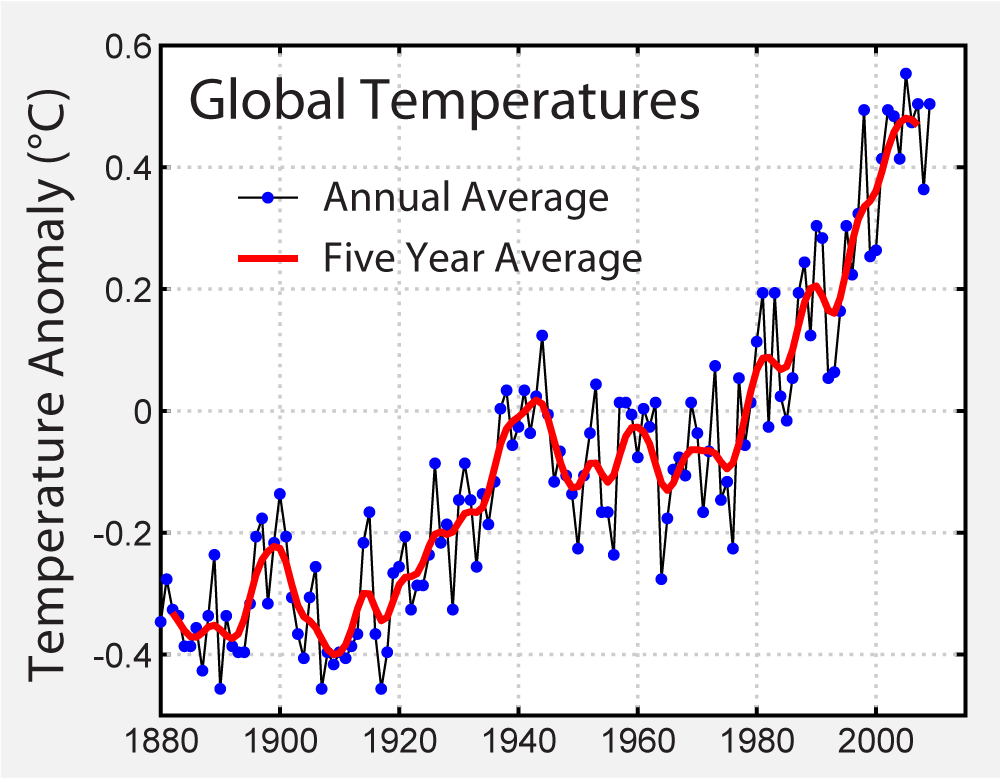
I'm gonna go ahead and use this chart as a demonstration, just to make things clear:

Instrumental_Temperature_Record.png


Okay, now if you're bright, you'll notice that this chart goes from 1860 to 2000.

The overall change has been up.

However, there are those little-to-huge spikes. Those are variations, and happen for a short period of time, but are in no way indications of the long-term projection. Hell, I'm no expert, and even I could figure it out.

Seems there is a yearly spike in about the 1970's, that goes heck way down. But to my mind, I see no reason why to make the assumption that it's somehow an indicator of the overall picture. It's a nice soundbite for the people that either don't notice the bigger picture, though, or the people that purposefully distort the facts by ignoring all the rest of them while bringing up the one thing that looks condemning...

Wangler said:
You certainly sound like a AGW scientist:

If I'm wrong, we'll know in 25 years!

If I'm right, we'll know in five years!
Sure, personally, I like the other solution better.

"Ignore any long-term trends and the experts, bury our noses in the sand, and act like nothing's happening!"
 
Last edited:
Nope, not given the fact that this last winter, the Arctic had it's largest run up of ice coverage since satellite records began in 1979.

If you mean the largest increase in sea-ice extent, that's hardly surprising considering how much open water there was to freeze over after last summer. More to the point is that we're nearly back to last year's minimum.

Nope, not given the fact that the Antartic had the largest area coverage of sea ice last year, when compared to the satellite records we have dating back to 1979.

The Antarctic is a long way from the Arctic, and in no way similar. That said, how's the Antarctic sea-ice doing this winter? I've not heard much mention of it.


[SARCASIM]
You certainly sound like a AGW scientist:

If I'm wrong, we'll know in 25 years!

If I'm right, we'll know in five years!

Just keep my funding in place for this year!
[/SARCASIM]

:)

We already know that AGW is real - that's why the Arctic sea-ice is diminishing and glaciers are retreating across the world. The reason climate change gets funding is that it was predicted and it's happening.

When the Arctic will first be ice-free is still debatable - five years, ten years, twenty years - but that it will be by 2050 is certain (absent massive vulcanism or asteroid strike). The significance of that is mostly iconic (melting permafrost and clathrates is the real kicker) but it will leave the nay-sayers floundering.

They've already been reduced to re-writing the history of the North-West Passage. Re-positioning Santa as a latter-day Noah ... well, I wouldn't put it past them, but it strikes me as unlikely.
 
Where did that nincompoop get the idea that 30 years was a minimum measure of climate?

30 years is a STANDARD measure of climate.
 
Where did that nincompoop get the idea that 30 years was a minimum measure of climate?

30 years is a STANDARD measure of climate.

mhaze has confused Arctic sea-ice with climate, which surprises nobody. Anything to avoid talking about the ice.

Of course, Arctic sea-ice responds to climate, albeit with feedback. An ice-free Arctic in the next two-to-seven years will not require 28-23 years of confirmation before it can be regarded as significant.
 
Looks like we will not exceed last year's minimum as the last 4-5 days have seen no net decrease in ice extent. But we are still well below 2005, the previous minimum. Not good.

I noticed that the 2008 line has levelled off. Not surprising; on the scale of weeks the signal is very noisy. The consensus prediction (less than 2005, more than 2007) seems probable.

I expect a new record in 2009. There, I've said it :eek:.
 
So according to you, Kyoto -- does Kyoto matter anymore, anyway? -- was a scheme to create more greenhouse gases?

And if it did, tell me, how is this a "wealth redistribution" plan? And who was behind it, and why did the alleged "donor" nations go along?

Sounds like a bunch of hare-brained nonsense to me.

It's just as well Clinton sent Vice-President Al Gore to cut the ground out from under it - which he did very well. (I hate to gore my own posts, but sometimes you gotta do what you gotta do.)

Al Gore, Kyoto, greenies, Leninist entryism - anything to avoid talking about Arctic sea-ice and permafrost.
 
If you mean the largest increase in sea-ice extent, that's hardly surprising considering how much open water there was to freeze over after last summer. More to the point is that we're nearly back to last year's minimum.

Yes, this last years minimum was greater than preceeding minima. Last years maximum was greater than the maxima for the last 4 years, this the "largest increase". I would be more alarmed if the maxima were surpressed as much as the minima are.


The Antarctic is a long way from the Arctic, and in no way similar. That said, how's the Antarctic sea-ice doing this winter? I've not heard much mention of it.

Well, it's minima in early 2008 was just about average, and both minima and maxima show no trend of decreasing over the past 30 years.

Sure the Arctic is a long ways from the Antarctic. But you guys claim to support AGW.......what does the G stand for again?

We already know that AGW is real - that's why the Arctic sea-ice is diminishing and glaciers are retreating across the world.

This is why the Antarctic is in no way similar; it's ice is not diminishing, and that fact does not jive with AGW.
 
Yes, this last years minimum was greater than preceeding minima. Last years maximum was greater than the maxima for the last 4 years, this the "largest increase". I would be more alarmed if the maxima were surpressed as much as the minima are.


Well, it's minima in early 2008 was just about average, and both minima and maxima show no trend of decreasing over the past 30 years.

Sure the Arctic is a long ways from the Antarctic. But you guys claim to support AGW.......what does the G stand for again?


This is why the Antarctic is in no way similar; it's ice is not diminishing, and that fact does not jive with AGW.

Ah, the old "ice is building up in the Antarctic" argument.

<sits back, awaits the slaughter>
 
Yes, this last years minimum was greater than preceeding minima. Last years maximum was greater than the maxima for the last 4 years, this the "largest increase". I would be more alarmed if the maxima were surpressed as much as the minima are.

Why?

Well, it's minima in early 2008 was just about average, and both minima and maxima show no trend of decreasing over the past 30 years.

Where do you get that from? And what about the last fifty years?

Sure the Arctic is a long ways from the Antarctic. But you guys claim to support AGW.......what does the G stand for again?

Imagine for a moment that it stands for "Geography". Antarctica is a mountainous continent; the Arctic is an ocean. Antarctic sea-ice is mostly what flows off the Antarctic continent; Arctic sea-ice is mostly frozen sea. Antarctica is surrounded by ocean; the Arctic is almost enclosed by continents.

This is why the Antarctic is in no way similar; it's ice is not diminishing, and that fact does not jive with AGW.

No, Antarctica is in no way similar for the above reasons. It was always predicted that the Arctic would be sensitive to AGW, while Antarctica would be insensitive. And so it has proved.
 

ISF - Join now!

Every member here is approved by hand. No bots, no spam, just people who care about evidence and honest debate.

Membership is free!

Create your free account

Back
Top Bottom