Global warming "truthers" would self-ignite; Permafrost Results

If you dropped the snarkiness you'd come across a lot better. When you ask a question and it's answered, read the answers. If you have questions about the answers, ask them. That's how discussions get done.

Yes well apparently not with you, because it was you who opened with the snark. I'm not going to claim I am above it, in fact I enjoy it occasionally, but I don't lead with it. And when someone does find cause to employ personal attacks it naturally makes me think their case is weak.

IOW, don't try to act now like you're Mr Polite all along. Drop the snark yourself or feel free to GFY. Actually don't bother.

(There's my answer. Read it, ponder it, comment on it if you wish. If you do so wish I will in turn read, ponder, and comment if I wish. That's what good conversation is all about.)

No, I'm not going to bother engaging in discussion with you. Especially when there are people talking who haven't sabotaged their credibility that are willing to do discuss. But I'll be happy to trade 'snark' with you, as you say, since you seem to enjoy it so.

Like I said, you may be right or you may be wrong but you behave like a woo, and I don't see the point in trying to parse out the good info from the bad when there are better sources.
 
The level of CO2 in the atmosphere has increased by about 35% in the last couple of centuries. There's no apparent cause of that increase apart from human activity.

I can't get there yet. CO2 has fluctuated in the past. Why is it reasonable to assume all of this increase in anthropogenic? Shouldn't we more reasonably factor out an amount equivalent to observed historical increases during warming periods?

Couldn't we extrapolate a reasonable amount of CO2 increase associated with warming periods pre civilzation? Don't we have to in order to have a meaningful estimate about an ahthropogenic affect?
 
Yes well apparently not with you, because it was you who opened with the snark. I'm not going to claim I am above it, in fact I enjoy it occasionally, but I don't lead with it. And when someone does find cause to employ personal attacks it naturally makes me think their case is weak.

IOW, don't try to act now like you're Mr Polite all along. Drop the snark yourself or feel free to GFY. Actually don't bother.


No, I'm not going to bother engaging in discussion with you. Especially when there are people talking who haven't sabotaged their credibility that are willing to do discuss. But I'll be happy to trade 'snark' with you, as you say, since you seem to enjoy it so.

Like I said, you may be right or you may be wrong but you behave like a woo, and I don't see the point in trying to parse out the good info from the bad when there are better sources.

One of the problems with that comment is that you left out the "read" and "ponder" stages. Others can read and ponder my post and view your post in the light of it. Frankly, it does you no favours.

Another problem is that your priority contribution is that you're not going to talk to me, while ignoring the answers of lomiller and Pixel42. It's not about you and me. It's about questions and answers, not personalities. You have questions. They have answers. If you have questions about the answers, ask them.

Don't take offence at my talking down to you. I do that a lot; it's nothing personal.
 
I can't get there yet. CO2 has fluctuated in the past. Why is it reasonable to assume all of this increase in anthropogenic? Shouldn't we more reasonably factor out an amount equivalent to observed historical increases during warming periods?

Couldn't we extrapolate a reasonable amount of CO2 increase associated with warming periods pre civilzation? Don't we have to in order to have a meaningful estimate about an ahthropogenic affect?

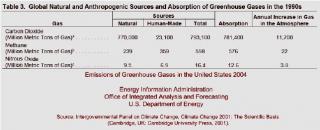
You don’t use estimates based on passed events when you have firm numbers on what’s happening now. The net change from natural sources is currently negative, not only are they not pumping CO2 into the atmosphere they absorb nearly half of what we put it.
 
Don't take offence at my talking down to you. I do that a lot; it's nothing personal.

And you'll forgive me for not having patience to bother with people who post like woos. I've had enough of that in the religion and philosophy forum to be immediately turned off by it. Unless I'm feeling frisky of course and feel like like slapping one around.

Again I'm not saying you're wrong, but your rhetorical style smells of dogma and woo.

As you say, it's nothing personal.
 
You don’t use estimates based on passed events when you have firm numbers on what’s happening now. The net change from natural sources is currently negative, not only are they not pumping CO2 into the atmosphere they absorb nearly half of what we put it.

That seems dodgy to me. If there were CO2 increases associated with warming in the past why on earth would we discount them now?

How many pre-civilization warming periods have there been that did not have an associated CO2 increase?
 
Last edited:
I can't get there yet. CO2 has fluctuated in the past. Why is it reasonable to assume all of this increase in anthropogenic? Shouldn't we more reasonably factor out an amount equivalent to observed historical increases during warming periods?

Couldn't we extrapolate a reasonable amount of CO2 increase associated with warming periods pre civilzation? Don't we have to in order to have a meaningful estimate about an ahthropogenic affect?

http://www.realclimate.org/index.php?p=87
 
That seems dodgy to me. If there were CO2 increases associated with warming in the past why on earth would we discount them now?

How many pre-civilization warming periods have there been that did not have an associated CO2 increase?

There are measurements saying it isn’t happening (yet). What better reason could you ask for? Ocean warming probably will cause CO2 release at some point but it most certainly is not happening now.
 
You don’t use estimates based on passed events when you have firm numbers on what’s happening now. The net change from natural sources is currently negative, not only are they not pumping CO2 into the atmosphere they absorb nearly half of what we put it.

The "missing carbon sink" - We don't know where it goes or why.

You comment unwittingly-
you have firm numbers on what’s happening now
​
We firmly know only the extent of what we don't know.
 
Yep, so how does cooling ever happen then?
Yep = you agree that non-linear warming is possible given the feedbacks, meaning we are in agreement (I think).

As for your question, other drivers take over. It's happened before.

http://www.sciencedaily.com/releases/2008/05/080528140255.htm
Perhaps I misread but it seems they are saying that we could trigger sudden and catastrophic warming.
If the study is correct, yes, for a reason that is well understood: ice melts, lots of methane is released.
 
There are measurements saying it isn’t happening (yet). What better reason could you ask for? Ocean warming probably will cause CO2 release at some point but it most certainly is not happening now.

Hmm. Henry's Law goes something like this:
at constant temperature, the amount of gas dissolved in a liquid is directly proportional to the partial pressure of that gas in equilibrium with that liquid.

Or, in simplified mathematical terms: p=kc

Is it safe to say Henry's Law does not apply to Warmology?

And, sorry to nit pick again, but is it too much to ask for the evidence that atmospheric CO2 has a life cycle of 50-200 years we keep hearing about? I realize asking for evidence is a great inconvenience, but it helps those of us having a limited understanding of AGW whereby Henry's Law is negated.

Inquiring minds want to know.

http://tonto.eia.doe.gov/FTPROOT/environment/057304.pdf
 
Last edited:
Yep = you agree that non-linear warming is possible given the feedbacks, meaning we are in agreement (I think).

As for your question, other drivers take over. It's happened before.

If the study is correct, yes, for a reason that is well understood: ice melts, lots of methane is released.

The fact is, we don't really know what will happen. Scientists have made conservative estimates to the best of their abilities, but when you consider this is Global, and it's a change the Climate, and there is a vast number of systems that are affected by climate, things could be a lot worse than the conservative estimates. Some scientists have complained that by limiting scientists to what they can conservatively predict, we are not warning people of the scope of the problems.
 
The "missing carbon sink" - We don't know where it goes or why.

You comment unwittingly-
you have firm numbers on what’s happening now
​
We firmly know only the extent of what we don't know.

Are you doubting the amount of fossil fuel we have burnt or are you doubting the CO2 concentration in the atmosphere?
 
Hmm. Henry's Law goes something like this:
at constant temperature, the amount of gas dissolved in a liquid is directly proportional to the partial pressure of that gas in equilibrium with that liquid.

Or, in simplified mathematical terms: p=kc

Is it safe to say Henry's Law does not apply to Warmology?


No not safe

wikepedia said:
Because solubility of gases is decreasing with increasing temperature, the partial pressure a given gas concentration has in liquid must increase. While heating water (saturated with nitrogen) from 25 °C to 95 °C the solubility will decrease to about 43% of its initial value. This can be verified when heating water in a pot. Small bubbles evolve and rise, long before the water reaches boiling temperature. Similarly, carbon dioxide from a carbonated drink escapes much faster when the drink is not cooled because of the increased partial pressure of CO2 in higher temperatures. Partial pressure of CO2 in seawater doubles with every 16 K increase in temperature.[5]

Do you drink your soda warm?
 
I can't get there yet. CO2 has fluctuated in the past. Why is it reasonable to assume all of this increase in anthropogenic?
1. There's no record of the CO2 level ever spontaneously increasing by 35% in less than two centuries (we have ice cores that tell us what the level was since long before humanity evolved).

2. We know the fossil fuels we have burnt in the last two centuries have resulted in large amounts of CO2 being released into the atmosphere.

3. None of the known causes of warming I listed in a previous post have occurred in the last two centuries (apart from a small increase in solar radiation, nothing like big enough to account for the observed warming).

If you really want to understand this stuff, there are plenty of free primers on the net. The one I usually recommend is this Open University course:

http://openlearn.open.ac.uk/course/view.php?id=2805
 
Last edited:
And, sorry to nit pick again, but is it too much to ask for the evidence that atmospheric CO2 has a life cycle of 50-200 years we keep hearing about? I

Actually it stays around for a few million years until it can be sequestered by the formation of new carbonate rock. 100-200 years is just the time it takes for CO2 to distribute itself through the ecosystem.
 
Really? Can you show where I did that, liar?
I'm not arguing CO2 is not an insulator. I just don't see any logical, much less scientifically demonstrated (ie like a scientific theory that has been demonstrated, that's falsifiable, etc) that supports the idea that X increase in CO2 will cause more than a linear increase in temp.
There's one point you called it linear.

Now for redefining:

I'm sorry you don't understand the meaning of linear
/geometric/exponential et al. I tried to rephrase so you could answer it and you didn't. As for trying to shut me down you're failing miserably, and the desire to do so is quite telling.

I'd ask "Whose the liar?" except that this thread has shown that the question is both redundant and pointless.

What an absolute failure you are.
I suppose so if you don't know what linear is. But I tried to rephrase using more simple terms, and still get the same woo.
Linear = LINEAR!

There's, I dunno, entire articles on this?
http://en.wikipedia.org/wiki/Linear
The word linear comes from the Latin word linearis, which means created by lines. In advanced mathematics, a linear map or function f(x) is a function which satisfies the following two properties:

* Additivity (also called the superposition property): f(x + y) = f(x) + f(y). This says that f is a group homomorphism with respect to addition.
* Homogeneity of degree 1: f(αx) = αf(x) for all α. It turns out that homogeneity follows from the additivity property in all cases where α is rational. In that case, provided that the function is continuous, it becomes useless to establish the condition of homogeneity as an additional axiom.

Really, really simple to define. And nobody says that increasing carbon fits this definition.
You just said you couldn't answer, but you did answer. You sir have managed to circumvent mere logical paradox. Kudos!
My answer is that your question is a logical fallacy.

You agree. Well, kudos indeed. Now I wonder why you were asking it...
For the record the question has never been answered. In case any non woo's are still bothering to read this I'll try again.
You don't read your own posts? Not surprising, really.
If there is a progressive (each increment of CO2 causes greater than the previous increment, we would call this non-linear but apparently that's confusing) CO2 affect on temperature and if, as is apparently not disputed, warming causes CO2. Even a non progressive effect would become a progressive effect were this so.
But you see each increment causes LESS effect than the last increment. As we have explained a dozen times, at least.

Read this very very slowly: Each. Increment. Has. Less. Effect. Than. The. Last. Increment.

Does it make sense now? You keep failing in exactly the same way.
There have been warm periods and periods of greater CO2. Yet there has been subsequent cooling. So there must be some cooling mechanism that overrides CO2.
Which would make sense if the heating/cooling cycles were natural.

What we're currently in is unnatural. Why would a cooling mechanism suddenly show up to
What is that effect?

Why do we think that effect would be mitigated by more than an amount somewhat less than directly proportional to the extra CO2 we contribute?
Given that we haven't seen any effect like this in the past? Or do we think that at all?
Sentences not in English highlighted.

CO2 levels haven't been this high for 700k year or so IIRC. Yet they were that high. How did they did drop?
Natural feedback mechanisms, as far as we know. Obviously it's reasonably hard to look back 700k years and find the answer.

We do know it didn't happen overnight. When 700k years is the scale, nothing prevents the mechanism from taking millenia to kick in.

And no I don't expect answers by this point. I expect more childish insults but it cost me nothing to try.
Well given that you apparently haven't read a single answer, since you still think the effect is linear why are you surprised?

 
But you see each increment causes LESS effect than the last increment. As we have explained a dozen times, at least.

Read this very very slowly: Each. Increment. Has. Less. Effect. Than. The. Last. Increment.

I'm glad you and I agree on the basic log nature of CO2's response, so let's apply our consensus to the real world .

  • 1750 to today CO2 from 280-> 380 ppm,
  • complete a doubling of CO2 would be 280*2 = 560 - 380 or 180 ppm more
  • Basic CO2 response to doubling let us use Schwartz 2007 of 1.1C.
  • Attributing 100% of 20% century warming to C02, that is 0.7C.
  • Remainder for doubling is 0.4C.
EG, 0.4C max by 2100.

....each increment causes LESS effect than the last increment. As we have explained a dozen times, at least. Read this very very slowly: Each. Increment. Has. Less. Effect. Than. The. Last. Increment.:clap:
 

ISF - Join now!

Every member here is approved by hand. No bots, no spam, just people who care about evidence and honest debate.

Membership is free!

Create your free account

Back
Top Bottom