Global warming "truthers" would self-ignite; Permafrost Results

That is interesting and will take a day or two to study, but my comment wasn't based on Tsonis or Schwartz but obvious relationships. See if you can get this, if not I'll figure a way to make it available.

I can only get the abstract which you posted.

but

can you spot the fallacy in the following quote from that abstact?
http://www.springerlink.com/content/g28u12g2617j5021/?p=5a5fea90861e4a0a9bf4fb915fa31c46&pi=7 said:
Therefore, if CO2 concentration remains constant at present, the CO2 greenhouse effect will be deficient in counterchecking the natural cooling of global climate in the following 20 years.

Not that I would trust the reseach of the Chinese, as in my opinion, they are a threat to us americans.

Slightly off topic, but I sure wish that our balance of trade wasn't so lopsides with respect to the Chinese. I'd like the US to offer them some improvements in the efficiency of their coal burning power plants as long as they are burning coal.

And thanks for checking out the Kirk-Davidoff paper, its pretty fresh, as I found a mispelling and a typo in it. When I posted it there was no discussion on Tamino's blog, or on ACPD.
 
Cranks such as youself, whose lack of knowledge includes the fact that AUP wrote Tsonis and asked the right question, but referenced the wrong paper?

aup referred to "a paper that was supposedly about Tsonis invalidating AGW". Chances are that it was a paper that you supposed invalidated AGW. Or do you have more details?
 
aup referred to "a paper that was supposedly about Tsonis invalidating AGW". Chances are that it was a paper that you supposed invalidated AGW. Or do you have more details?

AUP referenced in his letter this paper.

Now, are you going to surprise us, and get something right for a change?
 
AUP referenced in his letter this paper.

Now, are you going to surprise us, and get something right for a change?

That's not a link to a paper, it's a link to ClimateAudit.

aup can tell us which paper he wrote to Tsonis about. Which paper is it you don't think he wrote about, and which you (presumably) think actually has relevance to AGW?
 
That's not a link to a paper, it's a link to ClimateAudit.

aup can tell us which paper he wrote to Tsonis about. Which paper is it you don't think he wrote about, and which you (presumably) think actually has relevance to AGW?

The one we have discussed in several conversations that you don't recall, so why not start fresh and grab the linky in 842?

Of course google <- tsonis climate might be educatifying.
 
Lets get back to the OP, which the China piece explicitly ignores.

With continued sea ice loss in the arctic, will the permafrost melt within the next 30 years?

How much CO2 will that release to the atmosphere?

How much will that heat the globe?

Will it melt all the inland glaciers by 2100, which is the main water supply for 1 billion people?

If we are in a cooling phase, how come the global ice amomaly is minus 1 million sp. kilometers?

http://arctic.atmos.uiuc.edu/cryosphere/IMAGES/global.daily.ice.area.withtrend.jpg

The article does not address these?

News to me.

For example, it says the next several decades should be cooling, thus the Arctic should go back to conditions such as it was in 1950 -1960.
 
N_timeseries.png


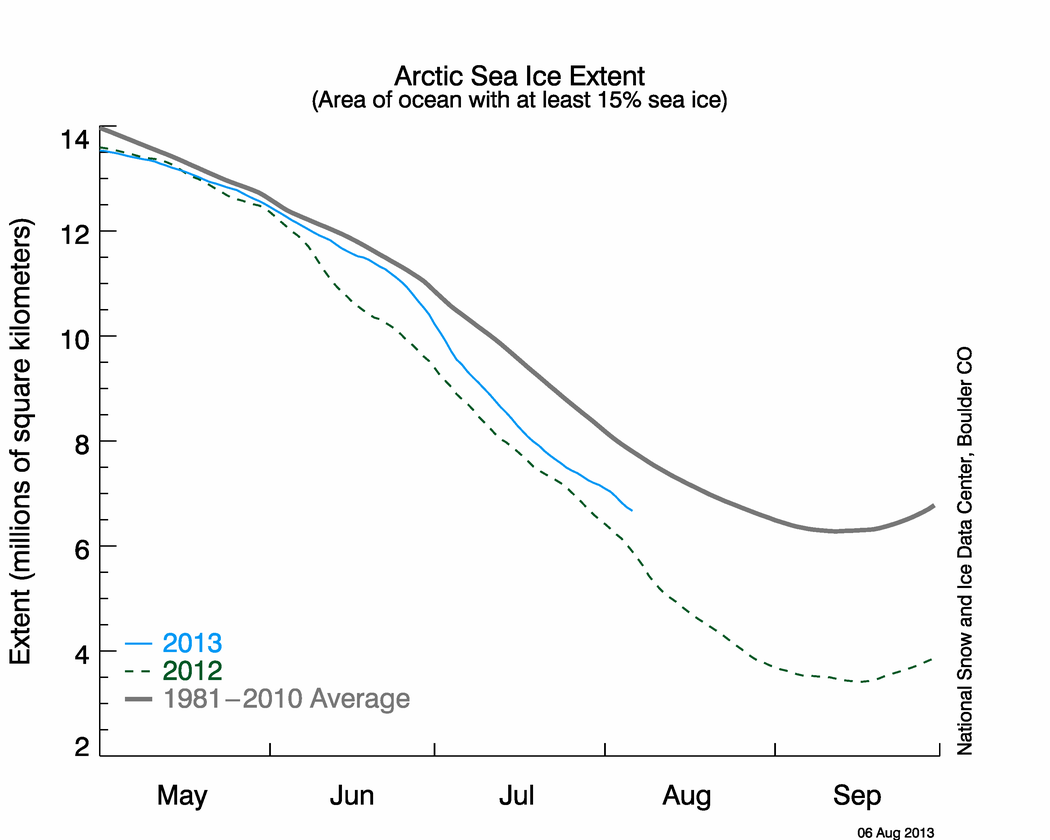
Only another month or so before this year's minimum extent is reached. Apparently there's been a significant loss over the last few days and we're at the second lowest extent ever for this time of year. A minimum somewhere between 2005 and 2007 looks increasingly likely.
 
[qimg]
Only another month or so before this year's minimum extent is reached. Apparently there's been a significant loss over the last few days and we're at the second lowest extent ever for this time of year. A minimum somewhere between 2005 and 2007 looks increasingly likely.

Things had been going pretty well until the last week or so but then some of the thinner ice between Alaska and Russia disintegrated. The NSIDC defines extents as being areas >15% and there is still quite a bit in the 20% - 40% range so it looks like we are set for even more ice loss. :(

http://arctic.atmos.uiuc.edu/cryosphere/NEWIMAGES/arctic.seaice.some.000.png

It looks like the anomaly in the Antarctic has also swung negative.

http://arctic.atmos.uiuc.edu/cryosphere/IMAGES/current.anom.south.jpg

ZOMG!!!! Over the last 6 months the Antarctic sea ice anomaly has been decreasing by 400Km^2/month!!! That’s 5 million Km^2/year!!! This new trend clearly shows there will be no sea ice at all there in 3 years!!!:D:D:D
Since AGW warmers love to splice proxies and instrumental temperatures, how come they don't do it with sea ice?
 

Should we just not go there, perhaps? Avoid making eye-contact?

So anyway, the atmos picture is remarkable. The northern option of the NWP looks wide-open already, and much of what's around it looks like dross. And we can expect almost another month of melt in a normal year, albeit at an ever slower rate.

As to the Antarctic, well, it's always looked like a broken reed in the making. I'm not going to lean on it, and I'll wait until it's digging into their flesh before I'll tell them that it is broken. And give it a little twist, just to watch them wince. (I've never laid claim to being a nice person, m'kay? :cool:)
 
What cooling in the oceans?

http://oceans.pmel.noaa.gov/Pdf/heat_2006.pdf

Abstract. Two systematic biases have been discovered 9 in the ocean temperature
data used by Lyman et al. [2006]. These biases are both substantially larger than
sampling errors estimated in Lyman et al. [2006], and appear to be the cause of the rapid cooling reported in that work.
 
There's this in the Observer, for what it's worth.

http://www.guardian.co.uk/environment/2008/aug/10/climatechange.arctic

Ice at the North Pole melted at an unprecedented rate last week, with leading scientists warning that the Arctic could be ice-free in summer by 2013.

Satellite images show that ice caps started to disintegrate dramatically several days ago as storms over Alaska's Beaufort Sea began sucking streams of warm air into the Arctic.

As a result, scientists say that the disappearance of sea ice at the North Pole could exceed last year's record loss. More than a million square kilometres melted over the summer of 2007 as global warming tightened its grip on the Arctic. But such destruction could now be matched, or even topped, this year.

'It is a neck-and-neck race between 2007 and this year over the issue of ice loss,' said Mark Serreze, of the US National Snow and Ice Data Centre in Boulder, Colorado. 'We thought Arctic ice cover might recover after last year's unprecedented melting - and indeed the picture didn't look too bad last month. Cover was significantly below normal, but at least it was up on last year.

'But the Beaufort Sea storms triggered steep ice losses and it now looks as if it will be a very close call indeed whether 2007 or 2008 is the worst year on record for ice cover over the Arctic. We will only find out when the cover reaches its minimum in mid-September.'

The 2013 prediction isn't regarded as outlandish these days. A lot has happened in the last year or two.
 
I think it won't reach last year's record but it will be close. And there's still a month to go.

The accelerated melting we saw this last week or so may have been a lurch, but even so it demonstrates how the fragile the ice is now. If the rate of melt steadies in the next few weeks we'll see something a little above 2007. If it carries on at the elevated rate for another week we'll see 2007 beaten, no doubt about it.

Is it still stormy in the Beaufort Sea, anybody? I can't see from here :).
 

ISF - Join now!

Every member here is approved by hand. No bots, no spam, just people who care about evidence and honest debate.

Membership is free!

Create your free account

Back
Top Bottom