Global warming "truthers" would self-ignite; Permafrost Results

Well, he seems to have pinned all of his hopes on particle physics, if I understand correctly.

You'll be referring to the bubble-chamber and the Big Experiment at CERN.

RealClimate, as ever, is on the case (as you've no doubt noticed).

Aerosol formation and climate, Part I
http://www.realclimate.org/index.ph...rmation-and-climate-part-i/langswitch_lang/in

"Here, in part I, I’ll review some of the basic processes that are important in determining the climate effects of aerosols, focusing in particular on their formation. This is also relevant in order to better understand –and hopefully quantify- the hypothetical climate effects of galactic cosmic rays which I'll discuss in a follow-up post."

One of those "competing hypotheses, which Warmers avert their eyes from". Another mhaze theory shot down.
 
TellyKNeasuss said:
Yes, it makes one think about why the most recent PDO warm phase is warmer than the previous PDO warm phase. And why the PDO cool phase of the 40's-70's was warmer than the previous PDO cool phase.
Do you understand this PDO theory? On the PDO index graph on the link above I only see one "cool" phase, which seems to me to correspond (with a few years lag) to the Artic temperature graph at http://www.nasa.gov/topics/earth/features/warming_aerosols.html. Which does have the desirable quality of effect following cause, necessary but insufficient in any hypothesis.

Yeah, the "cool" period preceding 1920 was probably too short to qualify as a "phase".
 
Hi all,

Although this thread is fascinating, I ain't got the necessaries to keep up, so I'm unsubscribing...

If you think I've missed replying to and/or reading anything 'important', I'm only a PM away

Thanks
 
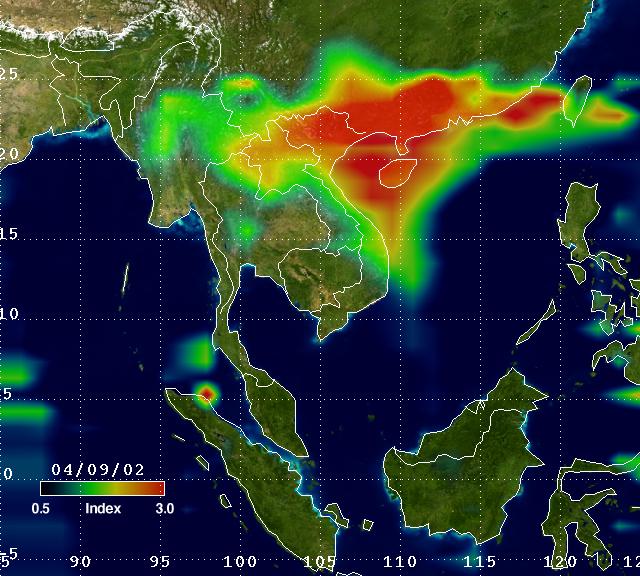
Notice the locations. Here we're discussing the Arctic, so we can discount south and east Asia, South America, Australia, and Africa, since aerosols are unlikely to make it from there to the Arctic in large amounts.
If you fancy the idea that "global dimming" and "global cooling" after WW2 refer to the Arctic, well, that's fine for me. I won't persuade you that your idea is goofy.

Visibility has increased over Europe, and presumably over the Northern US, ... (Herzblut snaps)
Oh really? Visibility has increased over Northern America? Says who? And if not, how would you explain?
 
Says this.....:garfield:

Both anthropogenic and natural emissions are variable from year to year, depending on fuel usage, industrial development, and climate. In some countries where pollution control regulations have been implemented, emissions have been significantly reduced. For example, in the United States sulfur dioxide emissions dropped by about 30% between 1970 and 1992,

http://www.answers.com/topic/air-pollution

Global dimming is well understood just as it occurs with a vulcanism..

..you enjoy your brethering with catsup marinade???

••

This did not START this year

http://www.canada.com/technology/piling+over+Arctic+scientists+find/1235940/story.html

and the NH does not have anywhere near the ozone hole issue nor the glacial mass the SH does....
 
Question you never posed?? Oh really.....:rolleyes:


Oh really? Visibility has increased over Northern America? Says who? And if not, how would you explain?

wow I've head of altered realities but your's is......off the chart...just where are you from anyways????
 
Last edited:
Sure Hertz - what the hell do you THINK SO2 is..
Originally Posted by Herzblut
I never asked for the change of SO2 emission in the US between 1970 and 1992. Your unsolicited "answer" is just spam. Your posts usually are.

Your opinion is worthless as you back it up with nothing. Your ignorance is astounding...go away and learning something - this is a science forum...not a place for a stateless troll to continually strut what they don't know about geo-physical systems
 
Something caused it. And that thing caused it much more in the Norhern Hemisphere than in the Southern. Aerosols are a rational explanation, particularly sulphates. We know that sulphate aerosols increased in the NH because acid rain became a problem where it hadn't been before (and became a greater problem where it already existed, such as parts of Western Europe where damage to marble and limestone architecture became evident relatively early in the Industrial Revolution). We know that sulphates have a cooling impact. When sulphates were reduced the cooling was reversed. Question answered, to all intents and purposes.

Look at the Arctic temperature graph in the NASA study I linked to recently. Temperature up (and volcanic sulphate down) from ~1910 until ~1940, temperature down (and industrial sulphate up) until ~1970, and temperature up again after Clean Air regulation in North America and Western Europe. Makes you think, doesn't it?

You can always add in a large number of above ground nuclear tests with some very large yields. Coal fired plants didn't have soot shakers at the time either...I could go on, but...

glenn
 
Yeah forgot about above ground testing.

Aerosols surely are a major player plus and minus forcing and most are our doing.

Clean up the particulate pollution....slow roast the planet.....:boggled: :mgbanghead
 
If you fancy the idea that "global dimming" and "global cooling" after WW2 refer to the Arctic, well, that's fine for me. I won't persuade you that your idea is goofy.

This thread is about the Arctic, and the NASA report I introduced is also about aerosols in the Arctic. I'm just sticking to the point.

Oh really? Visibility has increased over Northern America? Says who? And if not, how would you explain?

I referred to the Northern US, not Northern America. Do you have reason to think visibility hasn't increased over the Northern US since clean air regulations were introduced?
 
Odd timing......

Eyes in the Sky Show That Air Pollution Is Way Worse Than We Thought

New satellite tracking gives a much more accurate read on global air pollution.
by Boonsri Dickinson

From the May 2009 issue, published online April 13, 2009

airpollutionmedia.jpg

This image from the Terra/MODIS satellite shows thick haze
and smoke in northern India; much of it comes
from burning biomass.


Particulate air pollution is typically measured at ground level. Unfortunately, many of the world’s most polluted areas are in developing countries that cannot afford extensive monitoring To remedy this, Sundar Christopher, an atmospheric scientist at the University of Alabama at Huntsville, compared satellite data with ground measurements in well-studied areas. Using those comparisons, he devised a way to determine surface air quality using satellite data alone. “Remote sensing is the only viable way to monitor global particulate matter,” he says.

Using NASA’s Terra and Aqua satellites, he and his team examined 20 cities with populations greater than 10 million. In 15 of them, pollution levels were five to ten times higher than the World Health Organization’s guidelines. The researchers are now using satellites to track how pollution moves from one region to another.

http://digg.com/d1ocuf

More air pollution lawsuits anyone ( Ontario sued Ohio so it's not new )
 

ISF - Join now!

Every member here is approved by hand. No bots, no spam, just people who care about evidence and honest debate.

Membership is free!

Create your free account

Back
Top Bottom