I understand chaotic systems. I feel that you are picking and choosing the parts you like and ignoring the parts you don't like. I also feel that unless we "know" the exact numbers for our global temperature over the last billion years or so, it's impossible to give an accurate prediction.
We never
will know the conditions of the planet (atmosphere, oceans, geography, biosphere, insolation) to an arbitrary degree of exactness, so this amounts to "we can't know anything until it happens". I find this position to be utterly barren when it comes to formulating policy - and doing nothing is as much a policy as doing
something. I appreciate that some people will find it comforting if unwelcome events which have been predicted actually occur - "no blame".
How do we know the data is correct from CO2 measurements gained from ice core samples? How do we know that the relation we have assumed between global co2 levels has a direct relation to global temperature?
Since the data comes from numerous samples from different locations, taken and analysed by a variety of research teams, this amounts to "science doesn't know anything", since science is based on independent verification of observations and data. Again, a comforting position if stuff does hit the fan, but not one that's useful.
Not to mention this question that no one has been able to answer for me. Why is global warming a bad thing ? It would be an inconvenience to us true ...
That's why many people regard it as a bad thing, especially those who expect to be personally inconvenienced. Those who are terminally inconvenienced can be safely ignored, of course.
... but I would think that a warmer planet would lend itself to a greater bio-diversity by creating a wider temperate and tropical zone, which would create more rainforest and therefor a greater habitat for a greater number of species.
This may well be true in the long-term, and if biodiversity is your benchmark then this would indeed be an improvement. Most people don't take that view, which is why AGW is widely regarded as a bad thing - for individuals and their descendants. I'm neutral on the matter personally.
I dunno, I'm not someone who is hyper interested in this subject as I tend to think that humans think that they have more control over things in the environment than they do...
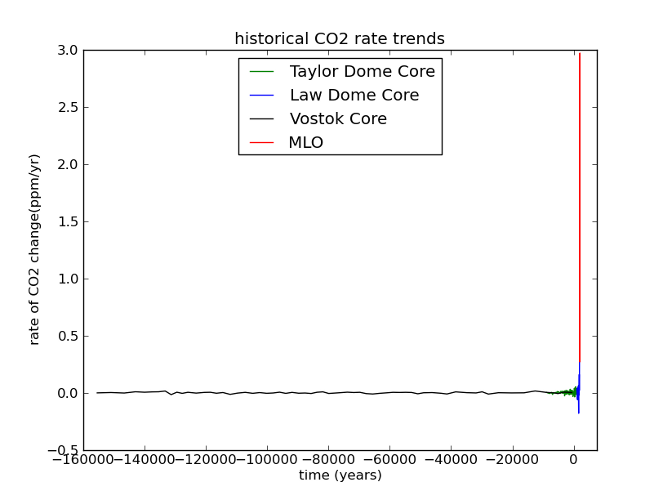
Given the extent to which we've changed the world in the last few thousand years, and the fact that we've increased atmospheric CO
2 by over a third in two centuries and punched holes in the ozone layer, we certainly have a large
influence on the environment. Whether that counts as "control" is debatable.
...however, I don't dismiss the climate change issue. I just question the ideology behind much of it.
Science has no ideology.
I have also grown to not trust many of the people in the natural sciences anymore as colleges have become so overrun by idealogues. (I know this won't go over well as many of you share this same ideology and tend to believe whatever they tell you...)
You must find the world a frightening place with all those ideologues running the show. It doesn't seem to have put much of a brake on science and technology in recent times though. Don't you find that odd?
My own experience of climate scientists in the 70's and 80's was that they were distinctly apolitical, and default conservatives. Glaciologists were apolitical and party-animals (to be expected when you spend half the year living in an ice-bound Norwegian shed). Your experience may be different, but I found it was the Humanities which were the hotbeds of politics.
I'm honestly surprised that on a skeptical web forum , more people aren't skeptical of global warming and all of the "sky is falling" stuff surrounding it.
We
are sceptical. That's why we examine the science and
what's actually happening, rather than assign unwelcome science-based predictions to the influence of ideologues and dismiss them as "sky is falling" scare-stories. Again, I can see how people can take comfort from the fact that whatever happens, however dire, won't be the end of the world. I prefer a more pragmatic approach myself.
An analogy would be predictions (there were many) that the most recent financial bubble would end in tears and quite possibly a recession on the order of the 1930's. This was generally dismissed as predicting the end of the world, which of course it hasn't been. It's just been very inconvenient for a lot of people, and will continue to be for some time yet. That really doesn't justify dismissing the predictions (which were hardly rocket science, after all) because they were unwelcome.



 ).
).