• Quick note - the problem with Youtube videos not embedding on the forum appears to have been fixed, thanks to ZiprHead. If you do still see problems let me know.

Moderated Global Warming Discussion

Status
Not open for further replies.
The bottom line, is that the aforementioned set pattern proves the natural variances of Earth's cyclic climate drama. Combine that with the fact that we are currently well within the pre-established parameters, and human forcing becomes negligible at best, unmeasurable at worst.
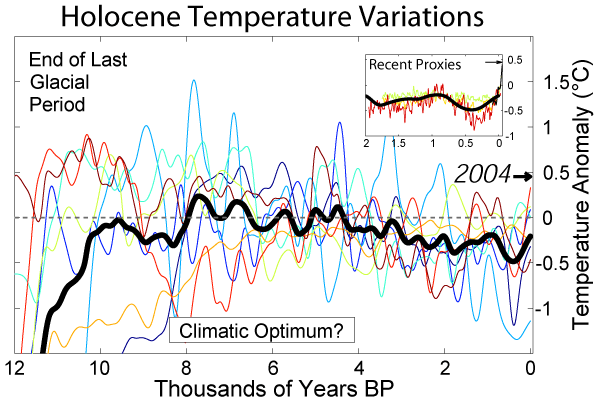
I've found this graph helpful for placing the current warming in context:

http://en.wikipedia.org/wiki/File:Holocene_Temperature_Variations.png

Holocene_Temperature_Variations.png


Compare the rise in temperature in the last century (an almost vertical line up the "now" axis to the point marked by the arrow labelled 2004) with the previous peaks and troughs of the current interglacial.
 
Some studies are suggesting that we are infact already warmer than any point in the last 2 million years, thier argument is that the early Eemian measures of greater than current warmth are based upon lagging indicators and our current warming is so rapid that the indicators have not yet equilibrated to the present temperature. Its been a while since I been through those particular studies, but I'll see if I can dig them up and see if they are still applicable.
There is probably some wording differences. “As warm as” is a lot easier to show then “warmer than”. The former is subject to criticisms that there is overlap in the error bands so it’s possible it isn’t warmer after all.
 
Now, ignoring those who will not accept the evidence science presents, what is the SOLUTION to the problem of fossil fuel carbon?

First let's talk about what the solution is not; Carbon capture and storage for Coal burning power plants simply will never work because it lowers the overall efficiency of a coal-burning power plant well below where a Natural Gas plant would be more cost effective. And Natural Gas, by its nature, has a lot less carbon emission per Kwh generated than does Coal, and overall emissions are comparable with a Coal plant after CCS has been applied.

In other words, CCS is a non-starter.

Now, there are other power sources that are largely carbon neutral;

Biofuels
Hydroelectric
Tidal
Geothermal
Wind
Solar
Cogeneration from waste heat from existing industrial processes
Nuclear

Now Biofuels are probably a part of the solution long term, because liquid fuels are going to be required for some applications no matter what else we do, but they cannot be the whole solution simply because of the tension between land use for food production and land use for BioFuel production.

Hydroelectric is already widely exploited, and in fact there is probably little room for significant new exploitation in developed countries, especially when you consider that a reservoir often comes at the expense of some very fertile agricultural lands.

Tidal is applicable to only a few sites, but where those sites exist, there can be significant generation. However, this solution typically has two outages every day at slack tide. Therefore it needs some other form of generation, or power storage to cover those gaps.

Geothermal is also strongly site dependent. Where it works best is in geologically active regions where a large temperature differential can be achieved. However, it can also be accessed via heat pump technology in many other places, where it serves to make a heating/cooling system more efficient.

Wind and Solar are the things that everybody looks to as the solutions to this problem, but they have major issues to overcome; Sun and wind are not constant, and one is not necessarily available when the other is not, for example on a frigid, still winter night. So, there needs to be some other source of power to back these up, or you need to overbuild capacity and use storage systems. Even a good storage system is not going to get you through a windless week or a cloudy month in midwinter, however.

Cogeneration is already being exploited in almost any place it can be, so it is already factored in to the current situation.

Which leaves us Nuclear. And this is what I propose to be the long-term solution. A significant amount of the electricity used in the United States is now nuclear, and we have enough fuel for centuries just from domestic reserves, especially when you consider the Thorium fuel cycle. The downside here is that people have an unreasonable fear of anything nuclear, and the NIMBY factor is very high.

I'll expound more on the nuclear option in coming days.
 
To melt 100 cu km of ice is 2000 Hiroshima thermal equivalents a day. Both Greenland and the Western Antarctic are net loss 100 + as are the mid latitude glaciers...

•••

The planet is heating up, thanks to human-generated emissions of greenhouse gases. But as a new NOAA-led study, “An observationally based energy balance for the Earth since 1950” (subs. req’d, release here) concluded:
ince 1950, the planet released about 20 percent of the warming influence of heat-trapping greenhouse gases to outer space as infrared energy. Volcanic emissions lingering in the stratosphere offset about 20 percent of the heating by bouncing solar radiation back to space before it reached the surface. Cooling from the lower-atmosphere aerosols produced by humans balanced 50 percent of the heating. Only the remaining 10 percent of greenhouse-gas warming actually went into heating the Earth, and almost all of it went into the ocean.
Note that this Journal of Geophysical Research-Atmospheres study was done “without using global climate models.”
Total-Heat-Content.gif


http://climateprogress.org/2009/10/...ooling-is-still-happening-ocean-heat-content/

Gotta love interjected op-ed statements from self proclaimed scientists outside their field...most amusing. Too bad they don't back anything up. What next, pejorative comments about Nature I suppose.

Nature Robust warming of the global upper ocean


Journal name:NatureVolume: 465 ,Pages:334–337Date published:(20 May 2010)DOI:doi:10.1038/nature09043 Received08 December 2009Accepted22 March 2010 A large (~1023 J) multi-decadal globally averaged warming signal in the upper 300 m of the world’s oceans was reported roughly a decade ago1 and is attributed to warming associated with anthropogenic greenhouse gases2
http://www.nature.com/nature/journal/v465/n7296/abs/nature09043.html

Picture244.jpg


Indeed, the ‘best estimate’ for the changes in the top 700m seems to be a greater warming than seen in the NODC data and more than even the models were suggesting:

http://www.realclimate.org/index.php/archives/2010/05/ocean-heat-content-increases-update/

and just in

Deep ocean heat

Posted by Ari Jokimäki on September 20, 2010

Newly published research on deep ocean temperatures has found warming during 1990′s and 2000′s. The observed warming is generally stronger in the south and it appears that a large part of the heat in the deep ocean is transferred through the Southern Ocean. The finding is important for global energy budget and for global sea level estimates.
http://ilmastotieto.files.wordpress.com/2010/09/purkey2010.gif
Cross-section from one measurement route. Different colors represent the temperature change.
Earth’s climate has warmed during recent decades. This is most likely due to top of atmosphere energy imbalance caused by the increases in the greenhouse gases in the atmosphere. About 80% of the energy from the imbalance has gone to heating the oceans due to their large heat capacity.
The slow reaction of the oceans to warming also slows the reaction of the surface temperature to the forcing. Even if we would keep greenhouse gases unchanged, the oceans would keep warming for centuries.
continues....
http://agwobserver.wordpress.com/2010/09/20/deep-ocean-heat/
 
additional methane source unexpected

Reservoirs: A Neglected Source of Methane Emissions

ScienceDaily (Oct. 11, 2010) — Substantial amounts of the greenhouse gas methane are released not only from large tropical reservoirs but also from run-of-the-river reservoirs in Switzerland, especially in the summer, when water temperatures are higher. This was demonstrated by Eawag scientists at Lake Wohlen, near Bern -- a finding which slightly tarnishes the reputation of hydropower as a climate-neutral way of generating electricity.
http://www.sciencedaily.com/releases/2010/10/101011090139.htm
 
Coral Records Show Ocean Thermocline Rise With Global Warming

ScienceDaily (Oct. 13, 2010) — Researchers looking at corals in the western tropical Pacific Ocean have found records linking a profound shift in the depth of the division between warm surface water and colder, deeper water traceable to recent global warming.
The finding is the first real evidence supporting what climate modelers have been predicting as the effects of global climate change on the subsurface ocean circulation.
more
http://www.sciencedaily.com/releases/2010/10/101011220123.htm
 
Politics and conflict are human choice and as such not part of the discussion.

As for the circulation changing -- SO? This would hardly be the first time it has been ice free. The last time it was ice free for a long time Britain had a tropical climate -- so did the tropics. The palm tree franchise I bought for DC back in the 70s might finally pay off.

And Britian wasn't in it's present latitude at the time, hardly comparable.


The land is the land. It is the same as it is in places less frozen. The northern limit of farming is determined by temperature not soil. The soil does not magically change just north of the current temperature limit.

As to the land there is an asterisks load of it in Canada and Siberia that is flat and virgin. The young US advertised for immigrants selling the virgin farm land available for the taking.

Try growing wheat (or even rice) on a peat bog - soil type is vital and defrosted tundra is not good arable land

Cost: A hell of a lot less than lining the coast with wind farms.

Failure? That is why we hire the Dutch to teach us how to do it right.

Ok - so please explain this the flooding in 1953, with increased sea levels there are greater risks of storm surges exceeding the capacity of dykes (as in Europe in 1953, or in NO during Katrina). Besides which the Dutch may well be too busy reinforcing their own dykes to worry about anyone elses.

Bangladesh? Their dikes are built with very cheap labor. Or they get on with modernization and move inland. Can't solve everyone's problem. And they will be the last to stop burning fossil fuels so they don't get to claim innocence.

Nice to know you feel that they are as equally guilty as ourselve (in the UK) who produce over 30 times as much carbon per capita. Or the US producing 70 time more per capita.

Nuclear power and desalinization plants solve everything but the Jane Fonda School of Nuclear Physics is against the obvious solution. Shows what happens when melters ally themselves with such experts.

Not likely to happen any time soon, just look at the snails pace the nuclear program is taking in the UK

For India in particular they have already screwed themselves overusing their groundwater.

For the Himalayas, the height determines how cold even in the tropics as Kilimanjaro shows. Its glaciers are going away because of farms replacing jungle on the windward side.

That may have been true upto the 70s, but not now: http://en.wikipedia.org/wiki/Retreat_of_glaciers_since_1850#Asia
You are aware the nonsense about the Himalayas losing there glaciers "real soon" has been exposed as another melter fraud are you not?

Please don't be patronising, I've said nothing about timescale

My comments in bold.
 
We know how to prevent another glaciation, and it's hard to see what we'd gain from it, then assuming (as I do myself) that we survive as a technological civilisation the next glaciation, should we permit one, will be performance art on a really large scale.

Something to distract people from how horriby wrong the terraforming of Mars went perhaps ... :cool:

LOL, managing climate, isn't really the current goal, merely reversing the symptoms of our own ignorance and greed.
 
Ah, thank you! I had posted that as a part of another post that was more-or-less off-topic.

No tribble at all! I've experienced some similar issues myself.

We have known the effects of CO2 for 115 years, and suspected them for much longer than that. Note that Arrhenius was shown to have underestimated the magnitude of a doubling increase because he did not consider the knock-on effects.

Doesn't surprise me in the least, he was a pretty smart cookie, even if handicapped by his era. If you are implying that you have seen a modern revisit and analysis of Arrhenius' paper, I'd love to take a look at it, got link?
 
The piece of data that the author fails to consider is how CO2 is changing:
[qimg]http://i899.photobucket.com/albums/ac198/nnn24/co2evolution.png[/qimg]

Nice Graph!!

got a link to the original source?
 
There is probably some wording differences. “As warm as” is a lot easier to show then “warmer than”. The former is subject to criticisms that there is overlap in the error bands so it’s possible it isn’t warmer after all.

Quite true.
It has actually been several years since I've been through those particular studies, however, so I will try to dig them out and review them this weekend, it is entirely possible that data and analyses from the last few years has already rendered the issue largely moot.
 
Odd. I always had the idea that CO2 was the only source of carbon for plants. And as it gets warmer plants grow for more months and further north increasing the total quantity of CO2 removed from the atmosphere and oddly things stay in balance with the positive feedback.

Atmospheric CO2 is rising, so there is an imbalance.

Warmer plants don't necessarily have longer growing seasons : some plants govern their growth cycles by day-length rather than temperature, and of course "warmer" often means "drier". There's less and less land the further North you go (don't let the Mercator Projection fool you), and in the Southern Hemisphere there's a great deal of ocean in the deep South.

Things are not as simple as you seem to think.

Yet the world is still here. How sad.

"Sad" is definitely the word. The world will keep turning whatever happens on the surface (where weather and life happen). That's a tiny part of the world as a whole and has barely any impact on it.
 
Odd. I always had the idea that CO2 was the only source of carbon for plants. And as it gets warmer plants grow for more months and further north increasing the total quantity of CO2 removed from the atmosphere and oddly things stay in balance with the positive feedback.

Don't mind me too much, just lurking in the thread trying to educate myself.

Matt, do you have the equation for plant growth as a function of temperature? It seems to me that you could in principle start from there, combine with the equation for CO2 uptake from plants and stick a minus sign in front (because "things stay in balance") and you'd have the equation of temperature as a function of CO2 you've been asking for.
 
Research Highlights
Nature Reports Climate Change
Published online: 22 April 2010 | doi:10.1038/climate.2010.40

Warming waterways

Alicia Newton
Front. Ecol. Environ. doi:10.1890/090037 (2010)
Warming waterways

Streams and rivers across the United States have warmed significantly over the past few decades, a trend that could be detrimental to the nation's aquatic ecosystems.
http://www.nature.com/climate/2010/1005/full/climate.2010.40.html

••••

Carbon Dioxide Controls Earth's Temperature, New Modeling Study Shows

ScienceDaily (Oct. 14, 2010) — Water vapor and clouds are the major contributors to Earth's greenhouse effect, but a new atmosphere-ocean climate modeling study shows that the planet's temperature ultimately depends on the atmospheric level of carbon dioxide.

who knew...:rolleyes:

continues
The study, conducted by Andrew Lacis and colleagues at NASA's Goddard Institute for Space Studies (GISS) in New York, examined the nature of Earth's greenhouse effect and clarified the role that greenhouse gases and clouds play in absorbing outgoing infrared radiation. Notably, the team identified non-condensing greenhouse gases -- such as carbon dioxide, methane, nitrous oxide, ozone, and chlorofluorocarbons -- as providing the core support for the terrestrial greenhouse effect.

Without non-condensing greenhouse gases, water vapor and clouds would be unable to provide the feedback mechanisms that amplify the greenhouse effect. The study's results are published Oct. 15 in Science.

more
http://www.sciencedaily.com/releases/2010/10/101014171146.htm
Good read....filling in the details
 
I've found this graph helpful for placing the current warming in context:

http://en.wikipedia.org/wiki/File:Holocene_Temperature_Variations.png

[qimg]http://i297.photobucket.com/albums/mm222/Pixel42/Holocene_Temperature_Variations.png[/qimg]

Compare the rise in temperature in the last century (an almost vertical line up the "now" axis to the point marked by the arrow labelled 2004) with the previous peaks and troughs of the current interglacial.

You found it helpful you say. Then you can explain how the values for the "anomaly" were determined. Exactly what does it mean?

BTW: As the thick line represents smoothing by long term averaging only the thick line can be compared. You can't switch from the thick to the thin line in the same context.
 
To melt 100 cu km of ice is 2000 Hiroshima thermal equivalents a day. Both Greenland and the Western Antarctic are net loss 100 + as are the mid latitude glaciers...

Discovery Channel talk again. The point of the bomb, any explosive for that matter is the rate of release. It is nothing but "Ghee Whiz, Mr. Wizard" to pretend to use the bomb as a measure of anything.
 
American Institute of Physics Statement

Just adding a few more links to mainstream scientific, business and governmental perspectives on human-induced climate change.

Statement on Human Impacts on Climate Change


In April 2004, the Governing Board of the American Institute of Physics endorsed a position statement on climate change adopted by the American Geophysical Union (AGU) Council in December 2003. The statement follows:
"Human activities are increasingly altering the Earth's climate. These effects add to natural influences that have been present over Earth's history. Scientific evidence strongly indicates that natural influences cannot explain the rapid increase in global near-surface temperatures observed during the second half of the 20th century.

"Human impacts on the climate system include increasing concentrations of atmospheric greenhouse gases (e.g., carbon dioxide, chlorofluorocarbons and their substitutes, methane, nitrous oxide, etc.), air pollution, increasing concentrations of airborne particles, and land alteration. A particular concern is that atmospheric levels of carbon dioxide may be rising faster than at any time in Earth's history, except possibly following rare events like impacts from large extraterrestrial objects.

"Atmospheric carbon dioxide concentrations have increased since the mid-1700s through fossil fuel burning and changes in land use, with more than 80% of this increase occurring since 1900. Moreover, research indicates that increased levels of carbon dioxide will remain in the atmosphere for hundreds to thousands of years. It is virtually certain that increasing atmospheric concentrations of carbon dioxide and other greenhouse gases will cause global surface climate to be warmer.

"The complexity of the climate system makes it difficult to predict some aspects of human-induced climate change: exactly how fast it will occur, exactly how much it will change, and exactly where those changes will take place. In contrast, scientists are confident in other predictions. Mid-continent warming will be greater than over the oceans, and there will be greater warming at higher latitudes. Some polar and glacial ice will melt, and the oceans will warm; both effects will contribute to higher sea levels. The hydrologic cycle will change and intensify, leading to changes in water supply as well as flood and drought patterns. There will be considerable regional variations in the resulting impacts...
(rest at:http://www.aip.org/gov/policy12.html

As is oft repeated in this thread the AIP's sponsorship of Steven Weart's online book "The Discovery of Global Warming" is an excellent, hyperlinked exposition of the history of the science of anthropogenic climate change stretching back to its roots more than a century ago.
 
American Geophysical Union Statement

Human Impacts on Climate
The Earth's climate is now clearly out of balance and is warming. Many components of the climate system—including the temperatures of the atmosphere, land and ocean, the extent of sea ice and mountain glaciers, the sea level, the distribution of precipitation, and the length of seasons—are now changing at rates and in patterns that are not natural and are best explained by the increased atmospheric abundances of greenhouse gases and aerosols generated by human activity during the 20th century. Global average surface temperatures increased on average by about 0.6°C over the period 1956–2006. As of 2006, eleven of the previous twelve years were warmer than any others since 1850. The observed rapid retreat of Arctic sea ice is expected to continue and lead to the disappearance of summertime ice within this century. Evidence from most oceans and all continents except Antarctica shows warming attributable to human activities. Recent changes in many physical and biological systems are linked with this regional climate change. A sustained research effort, involving many AGU members and summarized in the 2007 assessments of the Intergovernmental Panel on Climate Change, continues to improve our scientific understanding of the climate.

During recent millennia of relatively stable climate, civilization became established and populations have grown rapidly. In the next 50 years, even the lower limit of impending climate change—an additional global mean warming of 1°C above the last decade—is far beyond the range of climate variability experienced during the past thousand years and poses global problems in planning for and adapting to it. Warming greater than 2°C above 19th century levels is projected to be disruptive, reducing global agricultural productivity, causing widespread loss of biodiversity, and—if sustained over centuries—melting much of the Greenland ice sheet with ensuing rise in sea level of several meters. If this 2°C warming is to be avoided, then our net annual emissions of CO2 must be reduced by more than 50 percent within this century. With such projections, there are many sources of scientific uncertainty, but none are known that could make the impact of climate change inconsequential. Given the uncertainty in climate projections, there can be surprises that may cause more dramatic disruptions than anticipated from the most probable model projections.

With climate change, as with ozone depletion, the human footprint on Earth is apparent. The cause of disruptive climate change, unlike ozone depletion, is tied to energy use and runs through modern society. Solutions will necessarily involve all aspects of society. Mitigation strategies and adaptation responses will call for collaborations across science, technology, industry, and government. Members of the AGU, as part of the scientific community, collectively have special responsibilities: to pursue research needed to understand it; to educate the public on the causes, risks, and hazards; and to communicate clearly and objectively with those who can implement policies to shape future climate.


###

Adopted by AGU Council, December, 2003

Revised and Reaffirmed, December, 2007

As per Wiki:
The American Geophysical Union (or AGU) is a nonprofit organization of geophysicists, consisting of over 50,000 members from over 135 countries. AGU's activities are focused on the organization and dissemination of scientific information in the interdisciplinary and international field of geophysics. The geophysical sciences involve four fundamental areas: atmospheric and ocean sciences; solid-Earth sciences; hydrologic sciences; and space sciences.

The mission of the AGU is

to promote the scientific study of Earth and its environment in space and to disseminate the results to the public,
to promote cooperation among scientific organizations involved in geophysics and related disciplines,
to initiate and participate in geophysical research programs,
to advance the various geophysical disciplines through scientific discussion, publication, and dissemination of information.
 
Status
Not open for further replies.

Back
Top Bottom