• Quick note - the problem with Youtube videos not embedding on the forum appears to have been fixed, thanks to ZiprHead. If you do still see problems let me know.

Moderated Global Warming Discussion

Status
Not open for further replies.
And, even assuming the extreme climate sensitivity included in modern climate models are correct, the levels of greenhouse gases could not possibly explain the massive extinction. e.g. this paper.

But you said it yourself (my highlight of your text above): Anoxia was most likely to be the main cause. Anoxia is not climate change, it is anoxia. The fact that a climate event coincided with it is not a big deal: life adapts well to changing climate, not so much to large changes in oxygen levels in the atmosphere. That begs the question, of course, what caused the drop in oxygen levels. There are many possible causes, of which volcanic activity (not climate change) is one of the more likely candidates.

Anoxia doesn't just occur for no reason, it is the result of the conditions which also instigated and forced climate change, namely increased levels of atmospheric carbon and the heat such retain in the environment.
"Paleophysiology and end-Permian mass extinction" goes into this a bit, and so does "How to kill (almost) all life:the end-Permian extinction event" and "Dynamics and distribution of natural and human-caused hypoxia"
 
New research is always only provisional.

How what interests me is it actually orthodoxy that the Maunder Minimum was a miminum of solar activity and this was the main cause of the Little Ice Age?

When I tried to state this everyone jumped all over me, but this snippet seems to suggest it is commonly scientifically accepted: that there is a correlation between low sunspot activity, low solar output and cooler temperatures on earth.

Does anyone dispute this?

There is correlation, but it insufficient, on its own to account for conditions being attributed to the generally regional fluction some call the "little Ice Age." Many years ago, when we generally only looked at N. Atlantic records and accounts and believed the LIA was a much more significant global event, the Maunder Minimum seemed like a reasonable explanation. Since then careful research has largely ruled out the effects of sunspots as a major player in modern and historic climate change events. Increased volcanic activity in the northern hemisphere, however, is well evidenced and a viable source of the climate issues both locationally and temporally.
 
Of course, we do have a viable alternative in some of the H-K stuff I've posted in the past. Unfortunately it is impossible to have a rational discussion on the H-K work on JREF - too many people desperate to disprove it without actually understanding even what it is and what the claims are. Itia are continuing to advance this work as we speak, with a number of publications and presentations in 2010. I can't blame you for not keeping up with it, it is cutting edge stuff :D
Please, specify some posts -many, if you could- where this H-K stuff was posted by you.
 
The more capable scientists that I know don't do telepathy, so tend to prefer to assess the evidence themselves rather than trying to second guess what other scientists think.

That's what scientists do, and the majority of them have come to conclusion (quite independently) that AGW is real and does present real problems to societies. No call for telepathy : the majority emerged from its component parts. Individual scientists.

And the fact that you can't come up with a plausible alternative is merely an argument from ignorance / argument from incredulity. There are enough inconsistencies in the data to merit questioning the high sensitivity claims even if we didn't have an alternative.

No there aren't, if by "high" you mean the consensus view of about 3C for a doubling of CO2 in the medium term (a century or so). 6C is questionable, as is 1C. 2C is pretty much guaranteed. Wouldn't your time be better spent arguing why 2C isn't a problem?

There's any amount of room for extremism above 3C, but not much room below it.
 
There is correlation, but it insufficient, on its own to account for conditions being attributed to the generally regional fluction some call the "little Ice Age." Many years ago, when we generally only looked at N. Atlantic records and accounts and believed the LIA was a much more significant global event, the Maunder Minimum seemed like a reasonable explanation. Since then careful research has largely ruled out the effects of sunspots as a major player in modern and historic climate change events. Increased volcanic activity in the northern hemisphere, however, is well evidenced and a viable source of the climate issues both locationally and temporally.


I think you are confusing cause with correlation or symptom. No one in their right mind would say sunspots cause planetary warming. Rather sunspots are a symptom or indicator of increase solar activity and increased solar output leads to warmer or cooler earth. We also know that the 11 year peak of sunspot activity corresponds to the peak in the oscillation of solar radiation flux output. Yet the oscillation seems rather small.

NASA at least seems to have no doubt as to the significance in sunspots absence to the Maunder Minimum

The Maunder Minimum

Early records of sunspots indicate that the Sun went through a period of inactivity in the late 17th century. Very few sunspots were seen on the Sun from about 1645 to 1715 (38 kb JPEG image). Although the observations were not as extensive as in later years, the Sun was in fact well observed during this time and this lack of sunspots is well documented. This period of solar inactivity also corresponds to a climatic period called the "Little Ice Age" when rivers that are normally ice-free froze and snow fields remained year-round at lower altitudes. There is evidence that the Sun has had similar periods of inactivity in the more distant past. The connection between solar activity and terrestrial climate is an area of on-going research.
http://solarscience.msfc.nasa.gov/SunspotCycle.shtml
 
I think you are confusing cause with correlation or symptom. No one in their right mind would say sunspots cause planetary warming. Rather sunspots are a symptom or indicator of increase solar activity and increased solar output leads to warmer or cooler earth. We also know that the 11 year peak of sunspot activity corresponds to the peak in the oscillation of solar radiation flux output. Yet the oscillation seems rather small.

NASA at least seems to have no doubt as to the significance in sunspots absence to the Maunder Minimum


http://solarscience.msfc.nasa.gov/SunspotCycle.shtml

Yet the Earth s still warming...

From Skeptical Science: Should the Earth be cooling?

picture.php
 
The connection between solar activity and terrestrial climate is an area of on-going research.
http://solarscience.msfc.nasa.gov/SunspotCycle.shtml
I'm afraid you -and others- think that quotation means that there's a hidden factor soon to explain all the warming during the last, say, 50 years, that is, a speculation regarding what is yet to be known somewhat canceling what is already known for sure.

You'd be quite wrong if you'd think that "Maunder minimum 'corresponds' with LIA" is something curious that has been set aside waiting for a more mature stage of climate science to reveal its significance.

It surprises me that being in a time of low solar activity together with record warming -and the peak contemporary solar activity is not 10 or 12 years ago but some decades ago- anyone should explain why the LIA -that 'corresponds' and not 'coincides' with Maunder minimum- has been used among other elements as one of many means to understand how solar variability contributes to global temperatures and it is part now of the evidence for ongoing AGW. Be sure MM hides nothing relevant to a dramatic change in what actual science knows -being it 'cutting edge' or just plain 'modern'-.

By the way, I live in a city that was established twice (1536 and 1580). One of the causes for abandon her in 1541 were long and extreme winters the settlers suffered, with a long period of frosts and a few snowstorms. The climate began to warm at about 1620.
 
Standard mainstream climate science attributes up to 25% of global temperature swings to solar influence - however that is an overlay on the AGW trend.

Just as there are weak and strong ENSO and NAO cycles so there are weak and strong solar influences within the know cycles.
Solar is a primary driver....but again within known limits.
There is no magic rabbit going to pop out of a hat and declare AGW over.

We've altered the climate out as far perhaps as the next 1/2 million years. Deal with it.
 
I'm afraid you -and others- think that quotation means that there's a hidden factor soon to explain all the warming during the last, say, 50 years, that is, a speculation regarding what is yet to be known somewhat canceling what is already known for sure.

What is quite frustrating dealing with Warmists is they seem unable to separate any issue from the broader political strategy and just discuss an issue on its merits.

Whether or not the Maunder Minimum has a correlation with the Little Ice Age is an issue which stands outside the current situation.

It seems that many people seem willing to deny a correlation for the simple reason that it complicates their political agenda.

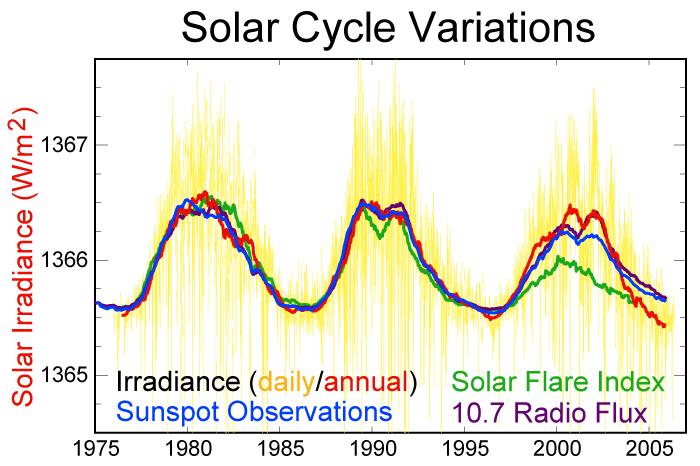
So to restate the question, if the Maunder Minimum was a symptom of lower solar activity, how did this feed into the cooling of the little ice age - when we consider that measurements of solar irradiance, shows it to be a remarkably regular but small oscillation

Solar-cycle-data.png
 
I think you are confusing cause with correlation or symptom. No one in their right mind would say sunspots cause planetary warming. Rather sunspots are a symptom or indicator of increase solar activity and increased solar output leads to warmer or cooler earth. We also know that the 11 year peak of sunspot activity corresponds to the peak in the oscillation of solar radiation flux output. Yet the oscillation seems rather small.

NASA at least seems to have no doubt as to the significance in sunspots absence to the Maunder Minimum


http://solarscience.msfc.nasa.gov/SunspotCycle.shtml

I was under the impression that we were both conversant enough with the subject matter that we could speak at a more casual level, and that "anyone in their right mind" would follow the conversation without too much pedantic confusion, but I may have been mistaken on these counts and therefore apologize for my presumptions.

Yes, there is a direct correlation between sunspots and solar activity, but the amount of difference between high sunspot frequency solar intensity and low sunspot frequency solar intensity is too small and otherwise inappropriate to act as a causative agent in accounting for the types of temperature changes most often associated with the "LIA."
 
What is quite frustrating dealing with Warmists is they seem unable to separate any issue from the broader political strategy and just discuss an issue on its merits.

Whether or not the Maunder Minimum has a correlation with the Little Ice Age is an issue which stands outside the current situation.

It seems that many people seem willing to deny a correlation for the simple reason that it complicates their political agenda.

So to restate the question, if the Maunder Minimum was a symptom of lower solar activity, how did this feed into the cooling of the little ice age - when we consider that measurements of solar irradiance, shows it to be a remarkably regular but small oscillation
Your posts (#403, #416, #479, #487 and #491) cover a wide range on the same specific topic: you started asking in a casual manner and as the answers seem to have not pleased you, you ended with the message I quoted above, containing terms like "Warmists", "broader political strategy", "deny" and "political agenda", and you went back to your preferred graphic:
Let's then analyze it a bit more.

About total irradiation, no problem as differences between highs and lows are less than 0.07% and through a wide set of mechanisms linked to it -look for explanations on the in the IPCC documents- it is accounted for some 0.2°C variation in the last 120 years (an influence as intense as sulphate but with an opposite sign).

About sunspot observation, a very interesting twisting of values in that graphic to make it fit irradiation. Let see sunspots alone:

http://sidc.oma.be/html/wolfmms.html

and it's good to see where the zero is (and a Maunder minimum would be).

So, all the scales have been distorted and values suffered different smooths just to make clear that ... the sun is coherent with itself!

Why a graphic developed for the sun with a pedagogic sense in mind conveys a secret inquiry about earthly temperature? I don't know (nahh! I do ;))

What is quite frustrating dealing with Warmists is they seem unable to separate any issue from the broader political strategy and just discuss an issue on its merits.
The problem could better be people going rogue because of their lack of background in a wide range of sciences and mathematics.

As a matter of a serious debate you should summarize what the IPCC documents said about solar influence in global climate, and state clearly what you contest and why you do so, providing some justification. That is better than saying bare words again and louder, yet again and even louder.

 
Say Goodbye to Sunspots? (… And Global Warming?)
14 September 2010

Scientists studying sunspots for the past 2 decades have concluded that the magnetic field that triggers their formation has been steadily declining. If the current trend continues, by 2016 the sun's face may become spotless and remain that way for decades—a phenomenon that in the 17th century coincided with a prolonged period of cooling on Earth.

… snip …

The last solar minimum should have ended last year, but something peculiar has been happening. Although solar minimums normally last about 16 months, the current one has stretched over 26 months—the longest in a century. One reason, according to a paper submitted to the International Astronomical Union Symposium No. 273, an online colloquium, is that the magnetic field strength of sunspots appears to be waning.

… snip …

The phenomenon has happened before. Sunspots disappeared almost entirely between 1645 and 1715 during a period called the Maunder Minimum, which coincided with decades of lower-than-normal temperatures in Europe nicknamed the Little Ice Age. But Livingston cautions that the zero-sunspot prediction could be premature. "It may not happen," he says. "Only the passage of time will tell whether the solar cycle will pick up." Still, he adds, there's no doubt that sunspots "are not very healthy right now." Instead of the robust spots surrounded by halolike zones called penumbrae, as seen during the last solar maximum (photo), most of the current crop looks "rather peaked," with few or no penumbrae.
http://news.sciencemag.org/sciencenow/2010/09/say-goodbye-to-sunspots.html
Let's see the date.

Let's take a look to current solar activity looking for this assertion

picture.php
(page retrieved 20sep2010)

If the current trend continues ... we will experience the next solar cycle.

Let's analyze this assertion.

You can consider the minimum to stretch any number of months as you define what a minimum is. By seeing this image (from SIDC, the world data center for the Sunspot Index) one may understand what 16 or 26 months mean and why it is compared with other event a century ago.

Yet: The number is raising from January on. The number of sunspots for the date was surpassing almost all minimums in all the previous cycles. (In case you want to follow the values daily)

My conclusion is that a decade ago a lot of people -I won't use labels- argued that global warming was because solar activity and pointed their fingers to cycles 21 and 22 in SIDC's image. A couple of years ago, that the cause was cycle 23 and a delay from previous cycles. Now they say the we are going to a cooling cycle -I hope so!!! :) but I think not :( as I don't use to change what I know because what I want-, that 1998 blah-blah, and much blah. The fact is that temperature will raise because of AGW and this year's temperatures tie values from 1998 or 2004 where the sun was spotting full gear.

No secret influence and categorical, defining driver to be discover.
 
What is quite frustrating dealing with Warmists is they seem unable to separate any issue from the broader political strategy and just discuss an issue on its merits.

Where on earth do you get that from?

[
Whether or not the Maunder Minimum has a correlation with the Little Ice Age is an issue which stands outside the current situation.

So why do you think it matters?

It seems that many people seem willing to deny a correlation ...

The Maunder Minimum occurred between the mid-17th and early-18th centuries. The LIA is a moveable feast, but generally regarded as spanning the early-14th to mid-19th centuries. What correlation do you expect to find?

for the simple reason that it complicates their political agenda.

You're the one who's brought up "political agendas" to complicate matters with.


So to restate the question, if the Maunder Minimum was a symptom of lower solar activity, how did this feed into the cooling of the little ice age - when we consider that measurements of solar irradiance, shows it to be a remarkably regular but small oscillation

http://upload.wikimedia.org/wikipedia/commons/0/0d/Solar-cycle-data.png

The point about the Maunder Minimum is that there was not an oscillation but an absence. We've had an absence of sunspots quite recently, with no great impact on climate. Which is rather more relevant to the current situation, isn't it?
 
I was under the impression that we were both conversant enough with the subject matter that we could speak at a more casual level, and that "anyone in their right mind" would follow the conversation without too much pedantic confusion, but I may have been mistaken on these counts and therefore apologize for my presumptions.

You may be sufficiently conversant, I am not. I have no expertise in climate science, but in those areas of science I do have expertise I would not be casual in my language.
I know, personally, when I first heard of a theory that "sun spots caused global warming" it made no sense to me at all. If I had been told it was a theory that "sun spots are an indicator of greater solar output and greater solar output causes global warming" I would have at least of understood what its proponents were getting at. It may be right or wrong, but at least its not a ridiculous suggestion.
Hence, I think precision of language is of some importance here.

[1]Yes, there is a direct correlation between sunspots and solar activity,[2] but the amount of difference between high sunspot frequency solar intensity and low sunspot frequency solar intensity is too small and otherwise inappropriate [3]to act as a causative agent in accounting for the types of temperature changes most often associated with the "LIA."

I agree with [1], I also agree with [2], but it seems to me your conclusion [3] is premature.
If the LIA WAS primarily driven by lower solar activity indicated by sunspot absence, would we not have to investigate if our assumption that all energy delivered by the sun was delivered by solar irradiance was correct?
Hence, my question if solar winds could be delivering energy to the earth by means of convection.
 
I know what you mean, but syncretic thinking always do many magical tricks: one of them is playing with the concepts of derivative and integral without ever knowing what they are, so the oscillation in your first graphic is "felt" as "vitality" and that "vitality" integrates as higher temperatures in your second graphic. For feverish minds, the first graphic could be sort of a bicycle pump that blow heat in the atmosphere for it to keep, and any hint of this -or any similar substitute notion- being a load of tosh is disguised by playing down with it but taking even higher "stakes" such as "solar wind convection".

Be sure there are people that really believe in the "obvious" link they perceive between both graphics.
 
Hence, my question if solar winds could be delivering energy to the earth by means of convection.

convection?????!!!!!!

Do you think space is a fluid??

First you admit you know nothing about climate science.

Then you say you are familiar with other aspects of science......

What possible means of conveyance can you postulate as delivering net energy gains to the atmosphere by way of solar wind that is not irradiance and has any signiifiance......the upper atmosphere in the earht has areas that are tremendously hot....but they are tenuous in the extreme...:boggled:

Perhaps this my clarify things for you.

http://news.discovery.com/space/how-does-the-sun-affect-the-earth.html
 
You may be sufficiently conversant, I am not. I have no expertise in climate science, but in those areas of science I do have expertise I would not be casual in my language.
I know, personally, when I first heard of a theory that "sun spots caused global warming" it made no sense to me at all. If I had been told it was a theory that "sun spots are an indicator of greater solar output and greater solar output causes global warming" I would have at least of understood what its proponents were getting at.

If they weren't being casual in their use of language the theory would be stated as "sun-spot incidence is a direct indicator of solar output, and solar output directly influences climate".


(And that should be "at least have understood", not "of".)

It may be right or wrong, but at least its not a ridiculous suggestion.

It isn't, if put clearly. It has no relevance to the current warming, of course, because sunspot incidence has not been increasing.

Hence, I think precision of language is of some importance here.

I'm in total agreement.

If the LIA WAS primarily driven by lower solar activity indicated by sunspot absence, would we not have to investigate if our assumption that all energy delivered by the sun was delivered by solar irradiance was correct?

No.

Hence, my question if solar winds could be delivering energy to the earth by means of convection.

No. Or yes. Or maybe. It's irrelevant. An imaginary explanation required for an imaginary effect.

Neither Sun, nor solar wind, nor dark of night is causing the current global warming. That's being caused (just as predicted) by AGW.
 
Status
Not open for further replies.

Back
Top Bottom