Moderated Global Warming Discussion

Status
Not open for further replies.
The thing that gets me about AGW deniers is that it is at the point where it is incredibly conspiratorial.

For their conclusions to be true then there must be an incredibly intricate global conspiracy that no one is spilling the beans on. Oh, and the conspiracy doesn't even have a purpose! Why say the climate is changing if it isn't?!
 
Oh I would agree there are some serious problems ahead. They just aren't global warming problems.
 
According to The Galileo Movement, this question is "kryptonite" to people who actually agree with the scientific consensus on AGW:
"Ask for empirical scientific evidence and logical scientific reasoning that HUMAN CO2 caused Earth's latest modest cyclic global ATMOSPHERIC warming that ended in 1998."

It's especially effective if you keep pasting that question in response to every time someone answers it.

It's easy to claim the high ground of "reason and evidence" if you ignore people that provide evidence and use reason to contradict you.

facebook.com/101728306584541/posts/427714993972095
 
Nobody said the weather had no impact, which is clear from reading the fact based article I provided, for your education. Straw man is useless...

LOL, if this is the manner of your "education," I would demand a tutition refund, if I were you.

The eight best harvest, despite a terrible year for rain, and really bad heat.

How does the ratio of crop yeild to acreage cultivated compare to those other seven years?

It shows how people who actually produce something ignore authors who try to sell books (and themselves it seems) by scaring weak minds.

Or, it shows how if you select your data carefully enough, looking only for that which you can misrepresent and exaggerate, while ignoring the overwhelming majority of data and trends, you can spin, twist and contort support for virtually any fringe construction your disconnected from reality ideology requires,...see the 9/11 "no-plane" conspiracies for a good example of such.

The worst economic losses in US history have been from record cold, not record heat.

And basketball scores are generally higher than football scores. Comparing apples to oranges generally isn't a very productive effort when trying to estimate apple yeilds.

It seems some people think a part of the US cornbelt is the only place that matters.

boy howdy, look at them goalposts sprint!!

Then you won't succumb to irrational fears from some nobody, who offers no facts, just opinions.

You shouldn't be so hard on yourself, you aren't alone in your misunderstandings.

China's harvests are increasing because they are cultivating more acres, not because yeilds per acre are increasing.

http://www.ers.usda.gov/ImageGen.ashx?image=/media/985529/china_corn__2_.png&width=450

http://cornandsoybeandigest.com/corn/crop-production-2012-summary-corn-13-below-2011-soybeans-down-3

And beyond issues of the crops actually harvested comes concern about how much of the harvested yeild is actually usable:

"Fortified by Global Warming, Deadly Fungus Poisons Corn Crops, Causes Cancer" - http://www.scientificamerican.com/article.cfm?id=deadly-fungus-poisons-corn-crops

...Last year’s drought increased the spread of a carcinogenic mold called aspergillus (Aspergillus flavus), a fungal pathogen that poisons cattle, kills pets and has infected the 2012 corn crop, rendering significant portions of the harvest unfit for consumption.

Whereas the deadly organism mainly affects countries like China and developing African nations, many U.S. states have experienced an increase in corn contamination since 2011. Farmers are likely to see more of the carcinogen as temperatures continue to rise and droughts become more frequent...
(please read entire (short) article at link)

 
Last edited:
Link from #7620.

Link from #7623.

Welcome to the forum, lukefreeman.


Edited by Loss Leader: 
Edited after merging to correct post numbers
 
Last edited by a moderator:
Had a quick look at the '8th highest harvest' idea. It seems that only applies to corn...

http://www.farmanddairy.com/news/yi...ighth-largest-corn-crop-nationally/42005.html and still managed to provide this:

U.S. corn production is forecast at 10.7 billion bushels, down less than 1 percent from the August forecast and down 13 percent from 2011. This represents the lowest production in the United States since 2006. Based on conditions as of Sept. 1, yields are expected to average 122.8 bushels per acre, down .6 bushel from the August forecast and 24.4 bushels below the 2011 average.

If realized, this will be the lowest average yield since 1995. Area harvested for grain is forecast at 87.4 million acres, unchanged from the August forecast but up 4 percent from 2011.
So the area harvested is the same, but productivity is down 13% and that's OK....?

Higher prices may be Ok for maintaining income for the farmers, but it's not good for ANYONE else, particularly those least able to pay for the price rises in corn, wheat, bread and any other related product.
 
Fixed what, it just suggests that the harvest plus the stored grain is OK last year, it does not suggest that it is sustainable, especially with a greater than 10% deficit in the harvest! You really are grasping at straws.
 
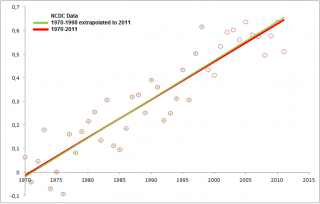
That question is not so much kriptonite as pure stupid. The anthropogenic CO2 has a specific isotopic signature that shows we are responsible for the accumulation over the last decades; there is no cyclic atmospheric warming that ended in 1998. The atmospheric warming did not end in 1998, as you can see


and the heat content of the ocean has been accumulating brutally.
 
How does the ratio of crop yeild to acreage cultivated compare to those other seven years?

A word of warning : crop yields are often calculated against area harvested, not area planted, so if a farmer abandons some fields in order to adequately irrigate the others it doesn't show up in the yield. Something to look out for, since (as you so rightly say)


... if you select your data carefully enough, looking only for that which you can misrepresent and exaggerate, while ignoring the overwhelming majority of data and trends, you can spin, twist and contort support for virtually any fringe construction your disconnected from reality ideology requires ...
 
A word of warning : crop yields are often calculated against area harvested, not area planted, so if a farmer abandons some fields in order to adequately irrigate the others it doesn't show up in the yield. Something to look out for, since (as you so rightly say)

Sounds reasonable, so I should have asked "... ratio of crop yeild to acreage cultivated harvested compare to those other seven years...," which would have still forced the same point I was aiming for, primarily that yeild per acre is actually decreasing in many areas of the globe due to weather extremes, and that farmers are actually putting larger amounts of acerage into certain crop production in the hopes that they can produce the same (or greater) net yeild.
 
In the world of reason and accountability, people who grow the food we eat, and keep the machines we depend on running, they matter a lot more than some doomsayer trying to scare people. And sell books.

Actually, the authors of doom and disaster don't really matter at all. They contribute nothing, and live off of those who produce.
 
In the world of reason and accountability, people who grow the food we eat, and keep the machines we depend on running, they matter a lot more than some doomsayer trying to scare people. And sell books.

Actually, the authors of doom and disaster don't really matter at all. They contribute nothing, and live off of those who produce.

yur darn rite darn them book ritin ivry tower intalecchewals:rolleyes:

The recipient of 26 honorary degrees and a MacArthur Fellowship, Brown has been described by the Washington Post as "one of the world's most influential thinkers."

Shortly after earning a degree in agricultural science from Rutgers University in 1955, through the International Farm Youth Exchange Program, he spent six months living in rural India where he became intimately familiar with food and population issues. "His experiences in Indian villages changed his life," wrote biographer David De Leon. "Although he went back to growing tomatoes when he returned to the United States, this no longer seemed like exciting work." ."[9]

Brown decided that to work on the global food issue, he would need to work for the U.S. Department of Agriculture's (USDA) Foreign Agricultural Service (FAS). .[10] He learned that before they would hire him, he needed to have a degree in agricultural economics. Brown took nine months to earn a masters degree in agricultural economics from the University of Maryland and in 1959 joined FAS as an international agricultural analyst in the Asia branch.[9] A year or so later, he took a nine-month leave to earn a master of public administration from Harvard's John F. Kennedy School of Government.

http://en.wikipedia.org/wiki/Lester_R._Brown
 
Status
Not open for further replies.

Back
Top Bottom