• Quick note - the problem with Youtube videos not embedding on the forum appears to have been fixed, thanks to ZiprHead. If you do still see problems let me know.

Global warming discussion IV

Status
Not open for further replies.
I can't add anything to the points in the article, but I'll note briefly that it's about increased rainfall in a previously arid area.

It gives the measured data on rainfall across northern Africa above the equator, showing that the warming climate has brought more rain to that reason, possibly on a permanent basis.

The reason for the significance is the size of the area - a huge belt of a million square km or so.


Do you know how big India is? :confused:
 
Perhaps you then understand that the tropics are expanding poleward.

What happens when the desert band moves poleward....

Water Shortages Turning Spain into the New Africa | Center ...
csis.org ›
May 30, 2015 ... Today the New York Times reported that parts of southeast Spain and other areas in Southern Europe are drying to the point ... The United Nations estimates that desertification resulting from climate change has the potential to .

http://csis.org/blog/water-shortages-turning-spain-new-africa

This is a nasty combination of land use/abuse and shifting climate bands.


Water stress and scarcity, however, is certainly not an issue unique to Spain. The United Nations estimates that desertification resulting from climate change has the potential to eventually force 135 million people off their land, primarily in developing countries. The NYT article states, “The battles of yesterday were fought over land... Those of the present center on oil.

But those of the future — a future made hotter and drier by climate change in much of the world — seem likely to focus on water.”

Shifting climate bands have enormouse implications, some positive others negative...most are negative.

It will be a long while before we reach a new radiative equlibrium and the world will be changed.

Better visit Venice....
 
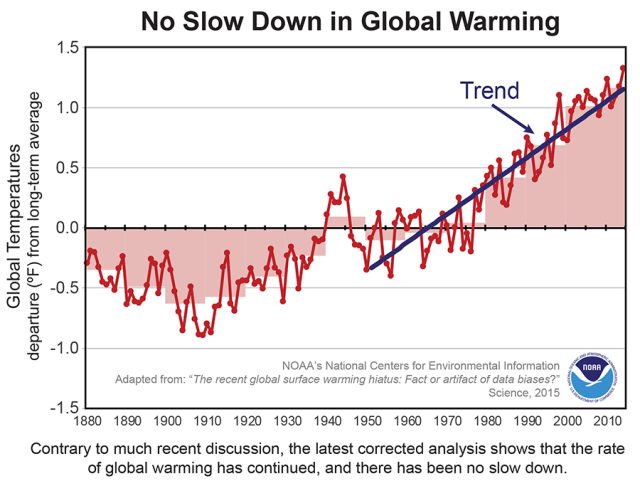
There was no “Hiatus”
Most of the climate scientists I read and communicate with have been making this case since the idea of a “hiatus” was first discussed 5 years ago. It has taken this long, however, to gather enough published support for them to compellingly make the case that has been discussed and debated among the climate science community for at least the last half decade.
http://www.reportingclimatescience....revision-eradicates-global-warming-pause.html


Full text of paper: "Possible artifacts of data biases in the recent global surface warming hiatus" available at: http://www.sciencemag.org/content/early/2015/06/03/science.aaa5632.full


Not so fast Trakar :)

Climate alarmists are in a cat fight about the Pause / Hiatus :D

The climate warming pause goes AWOL – or maybe not
Oh boy! Get ready to watch yet another big fight about climate change – this time mainly among different groups of climate alarmists. Is there a “pause”? Did global climate really stop warming during the last dozen years, 18 years, or even 40 years – in spite of rising levels of the greenhouse (GH) gas carbon dioxide?
 
I can't add anything to the points in the article, but I'll note briefly that it's about increased rainfall in a previously arid area.

It gives the measured data on rainfall across northern Africa above the equator, showing that the warming climate has brought more rain to that reason, possibly on a permanent basis.

The reason for the significance is the size of the area - a huge belt of a million square km or so.

That is a peculiar reading of the study, seemingly at odds with what the abstract states as well as the review by working climate scientists as I presented initially in response to your link to the abstract.
Abstract - Sahelian summer rainfall, controlled by the West African monsoon, exhibited large-amplitude multidecadal variability during the twentieth century. Particularly important was the severe drought of the 1970s and 1980s, which had widespread impacts Research into the causes of this drought has identified anthropogenic aerosol forcing and changes in sea surface temperatures as the most important drivers. Since the 1980s, there has been some recovery of Sahel rainfall amounts, although not to the pre-drought levels of the 1940s and 1950s. Here we report on experiments with the atmospheric component of a state-of-the-art global climate model to identify the causes of this recovery. Our results suggest that the direct influence of higher levels of greenhouse gases in the atmosphere was the main cause, with an additional role for changes in anthropogenic aerosol precursor emissions. We find that recent changes in SSTs, although substantial, did not have a significant impact on the recovery. The simulated response to anthropogenic greenhouse-gas and aerosol forcing is consistent with a multivariate fingerprint of the observed recovery, raising confidence in our findings. Although robust predictions are not yet possible, our results suggest that the recent recovery in Sahel rainfall amounts is most likely to be sustained or amplified in the near term.

Your statements also seem at odds with the lead researcher's statements regarding the study's findings:

"Scientists often study how greenhouse gas levels in the future will influence the climate. These findings show how even the greenhouse gases already emitted by humans, while only a fraction of those projected for the future, have nevertheless affected rainfall on a continental scale.

"This shows how climate change can hit specific countries and regions in a much more complicated way than the simple idea of ‘global warming' might suggest. In particular, we are beginning to discover how climate change is influencing rainfall patterns. What we are learning shows that human activity is already having a major impact."

Professor Sutton added: "These positive short-term impacts were accidental. No-one was trying to bring them about. Nevertheless, such major changes show that by continuing to emit greenhouse gases, we are seriously upsetting a natural system that we don't even fully understand, and this system is our home.

"Our new study shows that our activities are not just causing problems for future generations. They are causing major changes now.

"Continuing on the current path of greenhouse gas emissions will lead to more serious and widespread impacts. I trust the governments meeting later this year in Paris will appreciate the gravity of this message."
excerpted from - http://www.reportingclimatescience....ch-co2-causing-recovery-of-sahelian-rain.html
 
In accordance with recent discussions...

Anthropogenic contribution to global occurrence of heavy-precipitation and high-temperature extremes
E. M. Fischer & R. Knutti

Nature Climate Change 5, 560–564 (2015) doi:10.1038/nclimate2617 Received 27 November 2014 Accepted 18 March 2015 Published online 27 April 2015

http://www.nature.com/nclimate/journal/v5/n6/full/nclimate2617.html

Climate change includes not only changes in mean climate but also in weather extremes. For a few prominent heatwaves and heavy precipitation events a human contribution to their occurrence has been demonstrated1, 2, 3, 4, 5. Here we apply a similar framework but estimate what fraction of all globally occurring heavy precipitation and hot extremes is attributable to warming. We show that at the present-day warming of 0.85 °C about 18% of the moderate daily precipitation extremes over land are attributable to the observed temperature increase since pre-industrial times, which in turn primarily results from human influence6. For 2 °C of warming the fraction of precipitation extremes attributable to human influence rises to about 40%. Likewise, today about 75% of the moderate daily hot extremes over land are attributable to warming. It is the most rare and extreme events for which the largest fraction is anthropogenic, and that contribution increases nonlinearly with further warming. The approach introduced here is robust owing to its global perspective, less sensitive to model biases than alternative methods and informative for mitigation policy, and thereby complementary to single-event attribution. Combined with information on vulnerability and exposure, it serves as a scientific basis for assessment of global risk from extreme weather, the discussion of mitigation targets, and liability considerations.

Supplemntary Information - http://www.iac.ethz.ch/people/fischeer/docs/fischer_knutti_2015_SI.pdf

Readable link for full primary study - http://www.readcube.com/articles/10...vLib0tAiZHdcW_IxxQuecv-iSaZQ1v-fhwmlbpXA6rY4=
 
Not so fast Trakar :)

Climate alarmists are in a cat fight about the Pause / Hiatus :D

Citing OT articles from hyperpartisan political blogs neither support nor confirm your off-topic assertions and pseudoscientific beliefs.
 
Citing OT articles from hyperpartisan political blogs neither support nor confirm your off-topic assertions and pseudoscientific beliefs.


Actually it's ON topic Trackar

"The problem is nobody can find a graph showing a positive correlation between increasing CO2 from the beginning of reliable measurements at Mauna Lua in 1958 and ANY temperature anomalies data set from that date up to now. None exists. So such cannot be shown for claiming that CO2 is responsible to temperature anomalies increase.
The best you can find is from 1959 to 1978 (or so) CO2 was increasing while temperature anomalies were decreasing.
Then from 1978 or so until 1998 or so, both CO2 and temperature anomalies were increasing, good correlation for this phase.
After this, the third phase (the pause, hiatus you name it) shows CO2 continuing to increase to this day while temperature anomalies, again pick your data set, are barely doing anything."
 
Actually it's ON topic Trackar

"The problem is nobody can find a graph showing a positive correlation between increasing CO2 from the beginning of reliable measurements at Mauna Lua in 1958 and ANY temperature anomalies data set from that date up to now. None exists.

You know you could have been sceptical enough to fact check this claim for yourself

picture.php
 
In order for there to be a straightforward correlation between CO2 levels and global temperature, CO2 levels would need to be the only thing that affects global temperature. We know this isn't the case. It's the cause of the underlying warming trend of the last 150-odd years, but there are many other factors which will either amplify or obscure that trend over periods of a decade or two.

The cause of the underlying warming trend between January and July in the Northern Hemisphere is the earth's axial tilt, but there are other factors which either amplify or obscure that trend over periods of a week or two. By Haig's logic we should doubt that the winter to summer warming is due to the earth's axial tilt if March 15th happened to be no warmer than March 1st, because the correlation wasn't perfect for those two weeks.
 
Actually it's ON topic Trackar

"The problem is nobody can find a graph showing a positive correlation between increasing CO2 from the beginning of reliable measurements at Mauna Lua in 1958 and ANY temperature anomalies data set from that date up to now. None exists. So such cannot be shown for claiming that CO2 is responsible to temperature anomalies increase.
The best you can find is from 1959 to 1978 (or so) CO2 was increasing while temperature anomalies were decreasing.
Then from 1978 or so until 1998 or so, both CO2 and temperature anomalies were increasing, good correlation for this phase.
After this, the third phase (the pause, hiatus you name it) shows CO2 continuing to increase to this day while temperature anomalies, again pick your data set, are barely doing anything."

Provide links to legitimate journal published research that compellingly supports your assertions.
 

www.masterresource.org seriously?

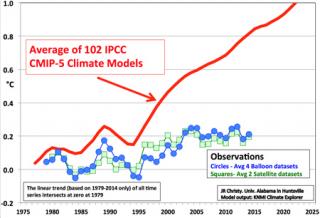
Please properly cite and reference the journal published study by John Christy supporting that graph.

CO2 is not the only climate forcing agency, it has grown to be an important and currently dominant long-term forcing agency, but it isn't even the only GHG.

Oh and as to a published journal correlation between Temp and CO2, this one by the BEST research group seems to demonstrate a very tight correlation:

picture.php


http://berkeleyearth.org/summary-of-findings/
 
Last edited:
www.masterresource.org seriously?

Please properly cite and reference the journal published study by John Christy supporting that graph.

CO2 is not the only climate forcing agency, it has grown to be an important and currently dominant long-term forcing agency, but it isn't even the only GHG.


What about bit_pattern's source for his graph ?

Double standards ! :eek:

Text of Professor Christy's Testimony
With the evidence in these examples above, it is obviously difficult to establish the claims about worsening conditions due to human-caused climate change, or more generally that any change could be directly linked to increasing CO2. This point also relates to the issue of climate model capability noted earlier. It is clear that climate models fall short on some very basic issues of climate variability, being unable to reproduce “what” has happened regarding global temperature, and therefore not knowing “why” any of it happened. It is therefore premature to claim that one knows the causes for changes in various exotic measures of weather, such as rainfall intensity over short periods, which are not even explicitly generated in climate model output.
 
Last edited:
Got a source for that graph or did you make it up yourself ? ;)

If I thought for a second that a credible source would lead you to retract you claim and apologise for posting blatant lies the, believe me, I would go to the effort digging it up - as that will never happen, and because Trakar has already provided such a source and you have predictably dismissed it, I'm not going to waste my time.


Can you please explain which part of that graph you believe represents CO2 levels?
 
If I thought for a second that a credible source would lead you to retract you claim and apologise for posting blatant lies the, believe me, I would go to the effort digging it up - as that will never happen, and because Trakar has already provided such a source and you have predictably dismissed it, I'm not going to waste my time.


Then why should I waste my time ? But I will :p

First : Trakar edited his post with the graph "source" AFTER my last post ! So how could I have "already rejected it" ? as you say ?

Will you apologise for your mistake ?

Second : Actually I will reject it now that I see it. ;)

This source clearly isn't the sourse for YOUR graph. It just doesn't appear anywhere there and the graphs on Trakar's source are for land-surface temperature ( and we know what a fudge THAT data is! ) NOT Global temperature as your own graph states.


Can you please explain which part of that graph you believe represents CO2 levels?


The red line of course ! I would have thought that was obvious to ALL warmists who believe temperature follows Co2 :D

I thought it a bit ironic that Trakar (who doesn't believe in the Pause / Hiatus ) posts a link to a source that has (imho) some not too unfair and un-balanced views on the Pause / Hiatus :)

Global Warming Pause?
“The global warming crowd has a problem. For all of its warnings, and despite a steady escalation of greenhouse gas emissions into the atmosphere, the planet’s average surface temperature has remained pretty much the same for the last 15 years.”

“In this memo I give my personal perspective on the widely discussed slowing of global warming over the past decade.

“Global surface temperatures have warmed more slowly over the past decade than previously expected. The media has seized this warming pause in recent weeks, and the UK’s Met Office released a three-part series of white papers looking at the causes and implications. While there is still no definitive cause identified,


Nice one Trakar ;)
 
The red line of course ! I would have thought that was obvious to ALL warmists who believe temperature follows Co2 :D

You mean the line with the arrow pointing at it with the big red label clearly describing it as representing - and I quote - an "Average of 102 IPCC CMIP-5 Climate Models"? That red line?

The mind boggles, it really does... :boggled:
 
Last edited:
You mean the line with the arrow pointing at it with the big red label clearly describing it as representing - and I quote - an "Average of 102 IPCC CMIP-5 Climate Models"? That red line?

The mind boggles, it really does... :boggled:


You did see the smiley ! right ? :p
 
So we can assume whenever you use a smiley you are talking crap? That kind of works because you do use a lot of them.
 
Status
Not open for further replies.

Back
Top Bottom