Global warming discussion III

Status
Not open for further replies.
It's a clever strategy Monckton has cooked up. Just as the news about 2014 being the hottest year on record breaks, he releases a **** article, deflecting his mindless followers attention and giving them something to spam around the web. Thus far, the article seems to have had absolutely zero effect in the scientific world, but even this is a positive for Monckton, as he's able to say that his article goes unchallenged until someone bothers to eviscerate it. That, in turn, lets him start a comment war in the scientific press.

It's sad that there are people with so little regard for the scientific process as Monckton that he's willing to abuse it for money.
 
So how do you explain the interglacial cycles? Can you please describe how changes solar irradiance alone are enough to warm the planet to the degree that it does between ice ages? And if not the sun then what does explain the balmy conditions we've enjoyed throughout the Holocene?


Maybe you didn't understand NASA when they said this ... my bold
Of particular importance is the sun's extreme ultraviolet (EUV) radiation, which peaks during the years around solar maximum. Within the relatively narrow band of EUV wavelengths, the sun’s output varies not by a minuscule 0.1%, but by whopping factors of 10 or more. This can strongly affect the chemistry and thermal structure of the upper atmosphere.

So around the Solar Maximum extra output is due to whopping factors of 10 or more and the converse is ALSO true at Solar Minimum and much MORE so at Grand Solar Minimum when the lack of these whopping factors of 10 or more and so ... Global Cooling sets in. :eek:

Do you acknowledge the 400 year cycle of the Grand Solar Minima and Global Cold periods ? http://www.vukcevic.co.uk/GrandMinima.gif


Last edited:
It's a clever strategy Monckton has cooked up. Just as the news about 2014 being the hottest year on record breaks, he releases a **** article, deflecting his mindless followers attention and giving them something to spam around the web. Thus far, the article seems to have had absolutely zero effect in the scientific world, but even this is a positive for Monckton, as he's able to say that his article goes unchallenged until someone bothers to eviscerate it. That, in turn, lets him start a comment war in the scientific press.

It's sad that there are people with so little regard for the scientific process as Monckton that he's willing to abuse it for money.

Potholer54's series on 'Monckton Bunkum' is highly entertaining - check them out if you have some time to burn

https://www.youtube.com/watch?v=fbW-aHvjOgM
 
WASHINGTON (AP) — The global heat streak of the 21st century can be explained with statistics that defy astronomical odds.

First, the National Oceanic Atmospheric Administration calculates global average temperature going back to 1880. That's 135 years. So if no other forces were in play and temperatures last year were totally at random, then the odds of 2014 being the warmest on record are 1 in 135. Not too high.

But record and near record heat keep happening. Climate scientists say it's not random but from heat-trapping gas spewed by the burning of coal, oil and gas. You know, global warming. And one of their many pieces of evidence is how statistically unlikely it is for the world to have warmed so much.

So how likely are these temperatures to be random? The Associated Press consulted with statisticians to calculate the odds of this hot streak happening at random. Here are some statistics and the odds they calculated, with the caveat that high temperatures tend to persist so that can skew odds a bit:

The three hottest years on record — 2014, 2010 and 2005 — have occurred in the last 10 years. The odds of that happening randomly are 3,341 to 1, calculated John Grego of the University of South Carolina. Kai Zhu of Stanford University, Robert Lund of Clemson University and David Peterson, a retired Duke statistician, agreed.

Nine of the 10 hottest years on record have occurred in the 21st century. The odds of that being random are 650 million to 1, the statisticians said.

Thirteen of the 15 the hottest years on record have occurred in the last 15 years. The odds of that being random are more than 41 trillion to 1, the statisticians said.

All 15 years from 2000 on have been among the top 20 warmest years on record. They said the odds of that are 1.5 quadrillion to 1. A quadrillion is a million billion.

And then there's the fact that the last 358 months in a row have been warmer than the 20th-century average, according to NOAA. The odds of that being random are so high — a number with more than 100 zeros behind it — that there is no name for that figure, Grego said.

http://bigstory.ap.org/article/7a5b...figure-figuring-odds-earths-global-hot-streak

 
That doesn't even begin to address my question - let's just say I'm not surprised at your inability to answer it.

I wasn't trying too ;) The variable Sun (TSI, UV, X-ray, Magnetic) that does the job nicely :p


The link before this wasn't working, but the graph linked here doesn't seem to show a 400-year cycle. It looks most like 120 years?

Yes, fair point. I didn't explain my 400 year claim very well.

Not every Grand Solar Minimum in the chart brought the same intensity of cold here ... http://www.vukcevic.co.uk/GrandMinima.gif

So, the answer, as I understand it, is the last severe one is 400 years ago being the Maunder Minimum i.e. the Little Ice Age.

In between we had the Dalton Minimum but that cold period there was a variation of temperature of about 1°C but just not as bad as the previous one.

And in the 1970s when there was this The 1970’s Global Cooling Compilation – looks much like today
During the 1970s the media promoted global cooling alarmism with dire threats of a new ice age. Extreme weather events were hyped as signs of the coming apocalypse and man-made pollution was blamed as the cause.


So, you're right to point out 120 years between low points in the chart but you have to go back three low points (3 x 120 = 360 years) to the last severe "Little Ice Age" and a bit like the 11 year Sunspot Cycle it's only an AVERAGE and so approx 400 years between the worst cold conditions. Also note there is a "lag" between the "low points" in the chart and when the cooling kicks in due to the heat stored in Earth's Oceans taking some time to cool !
 
Haig do you really think that anyone in the science section of a sceptic forum is going to be impressed by a constant flow of links containing nonsense from climate disinformers Lord Monckton, Ross Mckitrick, Marc Morano and now Anthoney Watts with their various anything but CO2 theories. You asked us to be more sceptical try linking to some real science because this is getting tedious. Scepticism isn't accepting what every fossil fuel funded blog tells you.
 
Last edited:
Haig do you really think that anyone in the science section of a sceptic forum is going to be impressed by a constant flow of links containing nonsense from climate disinformers Lord Monckton, Ross Mckitrick, Marc Morano and now Anthoney Watts with their various anything but CO2 theories. You asked us to be more sceptical try linking to some real science because this is getting tedious. Scepticism isn't accepting what every fossil fuel funded blog tells you.


No I don't greybeard, but do you think "nature" actually cares whither or not the science section of a sceptic forum is going to be impressed ? ;)

Just remember ... a fact is still a fact no matter who says it. Just as The Pause surprised the Alarmists and NONE of their predictions forecast it. So will the New Little Ice Age and you and yours will spin all you can to try explain it and how it's still our fault. :cool:

The Sun is looking down and laughing :D


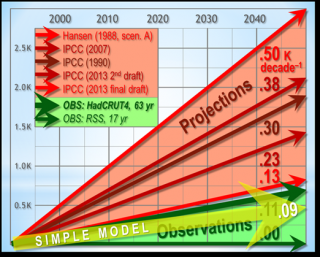
Why models run hot: results from an irreducibly simple climate model Christopher Monckton • Willie W.-H. Soon • David R. Legates • William M. Briggs

Fig. 6 Near-term global warming projections (brick-red region) on
[0.13, 0.50] K decade–1, compared with observations (green region)
that fall on [0.0, 0.11] K decade–1, and the simple model’s 21stcentury
warming projections (yellow arrow), falling on 0.09 [0.06,
0.12] K decade–1
 
I wasn't trying too ;) The variable Sun (TSI, UV, X-ray, Magnetic) that does the job nicely :p

No it doesn't. It has absolutely no bearing on how a weak solar forcing can melt kilometres of ice covering two thirds of the planet's surface. All it does is proves that you don't even understand the question, much less be capable of answering it. Quick, why don't you run off to WUWT and see if Anthony has a prepackaged answer for you to regurgitate!
 
No I don't greybeard, but do you think "nature" actually cares whither or not the science section of a sceptic forum is going to be impressed ? ;)

Just remember ... a fact is still a fact no matter who says it. Just as The Pause surprised the Alarmists and NONE of their predictions forecast it. So will the New Little Ice Age and you and yours will spin all you can to try explain it and how it's still our fault. :cool:

The Sun is looking down and laughing :D


Why models run hot: results from an irreducibly simple climate model Christopher Monckton • Willie W.-H. Soon • David R. Legates • William M. Briggs
[qimg]http://www.internationalskeptics.com/forums/imagehosting/thum_3823654b974f781521.png[/qimg]
Fig. 6 Near-term global warming projections (brick-red region) on
[0.13, 0.50] K decade–1, compared with observations (green region)
that fall on [0.0, 0.11] K decade–1, and the simple model’s 21stcentury
warming projections (yellow arrow), falling on 0.09 [0.06,
0.12] K decade–1

Even if anyone were daft enough to believe Monckton, their paper contradicts your views anyway. Monckton agrees that CO2 is a greenhouse gas he just tries to make out that climate sensitivity is low contrary to what the vast majority of scientific research shows.

ETA nor IIRC does he claim that the earth is about to go into a period of cooling.
 
Last edited:
No it doesn't. It has absolutely no bearing on how a weak solar forcing can melt kilometres of ice covering two thirds of the planet's surface. All it does is proves that you don't even understand the question, much less be capable of answering it. Quick, why don't you run off to WUWT and see if Anthony has a prepackaged answer for you to regurgitate!

Look, you need to stop focusing only on the 0.1 variability of TSI.

The Solar variability of UV and solar-induced changes in ozone may have an effect on radiative forcing but additionally may affect climate through a dynamical response to solar heating of the lower stratosphere. Also the magnetic Sun-Earth connection in effects such as so called "flux tubes" and how the polarity of each body does influence the result and there is some evidence this and Solar outputs such as CME's, Flares, Coronal holes etc may trigger earthquakes and volcanism. (how much heat can that introduce ?)

I expect the above solar events to "account for" this too ... (but I also know warmists are trying very hard to blame it on us ;) )
What is a Polar Stratospheric Warming?
A stratospheric sudden warming is perhaps one of the most radical changes of weather that is observed on our planet. Within the space of a week, North Pole temperatures can increase by more than 50 K (90°F). For example, on 17 January 2009 the temperature at the North Pole near 30 km was about 200 K. Over a 5-day period, the temperature increased to 260 K (a change of 60 K or 108°F).


NASA say this ...
Solar Storm and Space Weather - Frequently Asked Questions

The effects of solar variability on the Earth’s climate PDF Haigh 2002
6. Conclusions

It is important to understand how solar variability affects climate, so that human and natural signals may be disentangled in the observational record and thus more reliable predictions of the effects of human activity on future climate may be made. However, the absolute value of total solar irradiance is not known to better than ca. 4 W m¡2, and reconstructions of past values are uncertain, even over the 20th century and certainly over longer periods.

Analyses of global mean temperature records suggest a detectable signal of solar influence on decadal, centennial and millennial time-scales. Geographical variations of this influence are poorly known but almost certainly do not consist of a uniform surface warming in response to increased solar activity. Vertical patterns of temperature change may provide a method for differentiating solar from other climate perturbations. The warming that occurred during the latter half of the 20th century cannot be ascribed entirely to solar influences.

Mechanisms for the amplification of solar forcing are not well established. Variations in UV and solar-induced changes in ozone may have an effect on radiative forcing but additionally may affect climate through a dynamical response to solar heating of the lower stratosphere. The vertical structure of the ozone response to solar variability is not well known. General circulation models are able to produce some of the observed patterns of response to solar activity but generally underestimate the magnitude.


Even if anyone were daft enough to believe Monckton, their paper contradicts your views anyway. Monckton agrees that CO2 is a greenhouse gas he just tries to make out that climate sensitivity is low contrary to what the vast majority of scientific research shows.

ETA nor IIRC does he claim that the earth is about to go into a period of cooling.

What you mean there is NO consensus among Skeptics ? :p

We need to take a vote on that to make sure our science is right :rolleyes:
 
Comedy gold.

Some more gold facts for you :D

On the Biases Caused by Omissions in the 2014 NOAA State of the Climate Report
CLOSING

According to NOAA definitions, global surface temperatures for 2014 were “More Unlikely Than Likely” the highest on record, but they failed to note that on the main page of their State of the Climate report. NOAA used a specific ENSO index to claim that El Niño conditions did not exist in 2014, when at least one other index says El Niño conditions existed. And NOAA failed to discuss the actual causes of the elevated global sea surface temperatures in 2014, while making it appear that there was a general warming of the surfaces of the global oceans.

NOAA never stated specifically that 2014’s record high surface temperatures were a result of human-induced global warming, but they implied it…thus all the hoopla. NOAA has omitted key discussions within that report, which biases it toward human-induced global warming. In other words, the NOAA State of the Climate report was misleading. NOAA has once again shown it is a political entity, not a scientific one. And that’s a damn shame. The public needs openness from NOAA about climate; we do not need to be misled by politically motivated misdirection and misinformation.


a comment that should give you pause for thought :)
Ivor Ward January 17, 2015 at 9:51 am
Once again the Gore effect has dampened their “GOTCHA” At the same time they announce that 2014 is the “HOTTEST YEAR EVAH!!!!!” the snow comes down all over Northern England, the frost sets in and the only reaction amongst the normal people (i.e. people who’s salaries do not depend on hyping the heat) is a universal, “So what?

They have managed to cobble together a 0.04 degree rise within an error bar of 0.09 and instead of announcing a tie they have issued a statement which, quite frankly, is corrupt. Neither RSS or UAH agrees with their mantra. In reality they have announced that the cessation of warming has continued within the errors stated and dressed it up as a huge increase, (By implication)

I have hovered on the fence for a while but now I am given no choice but to recognise that the deception is deliberate. I was hoping against hope that they would give an honest assessment of the state of the climate and even I have to agree that they have not.

BEST came out with an honest assessment….basically saying that 2005, 2010 and 2014 were much of a muchness so from now on I will treat them as the terrestrial authority and the two satellite sets as the lower atmospheric authority.

It is a great disappointment to me that NOAA and NASA have proven that they are advocates and not scientists
 
Last edited:
What you mean there is NO consensus among Skeptics ? :p

We need to take a vote on that to make sure our science is right :rolleyes:

I'm saying that even most climate science deniers wouldn't associate themselves with your pet theories. There is a reason for that. They know if they don't want to appear to barmy they have to accept that CO2 is a greenhouse gas and will cause the earth to warm. They get around that by claiming that climate sensitivity is low in spite of all the scientific research that shows that it is high enough that it could cause serious changes this century. Nor are there many who would associate themselves with theories that we are about to go through a period of global cooling.
 
I'm saying that even most climate science deniers wouldn't associate themselves with your pet theories. There is a reason for that. They know if they don't want to appear to barmy they have to accept that CO2 is a greenhouse gas and will cause the earth to warm. They get around that by claiming that climate sensitivity is low in spite of all the scientific research that shows that it is high enough that it could cause serious changes this century. Nor are there many who would associate themselves with theories that we are about to go through a period of global cooling.


Your assuming greybeard :)

I accept that CO2 is a greenhouse gas and will cause the earth to warm. It's just the effect, as I too understand, it is so small as to be insignificant. As for the Sun defining the climate and causing Global Cooling ... that will become all too obvious very soon.

THE SUN DEFINES THE CLIMATE
 
Guys it's simply another Solar Cycle .... a 400 year one.

That is completely unrelated to the question I asked.

thum_3823654a948f72e0e4.png


What does the blue line mean, and why is it at 0.2 and not the 0.00 the graph claims?
 
Then why, if the sun is at the coolest it has been in 50 years, is the Earth at the hottest it has been in over a thousand years?

Lets look at this chart ehcks,

You see the peaks of the 20th century Solar Cycles are the largest of all, particularly the second half of the century. THAT gave us a HOT Earth + Oceans and the myth of AGW.


Then the Grand Solar Maximum was over with the end of the century and SC22 was the last "big" one and we entered the Pause or Simmer as I called it and it has lasted 18 years. You say in 2014 the Earth is at it's "Hottest" !!! Really ? a 0.04 degree rise within an error bar of 0.09 I'd say for 2 decades there has been "NO STATISTICALLY SIGNIFICANT WARMING"

Now look at this chart ehcks,

You see in red the first peak is SC22 then a smaller SC23 and then a MUCH smaller SC24 (the present Solar Cycle 24 just passing Solar Maximum the weakest one in a century or two ) and the forecast is that SC25 will be even weaker.


NASA Admits Solar Cycle Is The Weakest In 200 Years: The Link Between Sunspots, Global Cooling and Agenda
Solar cycle 25, which will peak between 2022 and 2025 could, according to Hathaway, be the “weakest in centuries”. This does not bode well. NASA published this information in 2006 yet the public has not been warned in any way that there’s a distinct possibility that life is going to get cold, very cold


You should get it NOW ehcks,

But I'll re-cap for you anyway :)

Global Warming ended with the passing of the "HOT" Sun in the 20th century. Due to our massive Oceans we enter a Pause and a Lag as the heat tops out and we begin the Grand Solar Minimum slide down with the "COOL" Sun into another New Little Ice Age.

Did you actually read Abdussamatov in THE SUN DEFINES THE CLIMATE ?
The most significant solar event in the 20th century was the extraordinarily high level and the prolonged (virtually over the entire century) increase in the intensity of the energy radiated by the Sun (Fig. 3). A similar rise in solar radiation has not been observed in at least 700 years. However, its consequence - the global warming of climate - that followed, was not an anomalous event in the life of the Earth. Climate on the Earth has periodically changed, and our planet during the course of the well studied,
most recent millennia has repeatedly survived global warming, comparable to that of the current period, after each of which episodes the temperature has dropped deeply, in a bicentennial cycle. Neither temperature drop nor warming lasts longer than the 200-year fluctuations of size and luminosity of the Sun.
Consequently, we should fear a deep temperature drop, but not catastrophic global warming. Humanity must survive the serious economic, social, demographic and political consequences of a global temperature drop, which will directly affect the national interests of almost all countries and more than 80% of the population of the Earth. A deep temperature drop is a considerably greater threat to humanity than warming. However, a reliable forecast of the time of the onset and of the depth of the global temperature drop will make it possible to adjust in advance the economic activity of humanity, to considerably weaken the crisis.


That is completely unrelated to the question I asked.

[qimg]http://www.internationalskeptics.com/forums/imagehosting/thum_3823654a948f72e0e4.png[/qimg]

What does the blue line mean, and why is it at 0.2 and not the 0.00 the graph claims?


The blue line is the average over the 18 year three month period of the graph and that is 0.2 above the mean.

The graph legend gives a Trend of 0.00 C per century

Why do you ask ?
 
Last edited:
The blue line is the average over the 18 year three month period of the graph and that is 0.2 above the mean.

The graph legend gives a Trend of 0.00 C per century

Why do you ask ?

The average of what, though?

But no, if the blue line is the average, then the blue line is the trend line. The trend line is at just over .2, not 0. It is not talking about the change over time of the blue line.
 
Status
Not open for further replies.

Back
Top Bottom