Merged Global Warming Discussion II: Heated Conversation

Status
Not open for further replies.
The usual response to this will be either

The oceans are still warming, the warming didn't stop

or

Natural variation can cause a pause, the warming hasn't stopped

or

NO IT'S NOT HAPPENING

or

We can't measure the arctic where the warming is the greatest and if we could the warming hasn't stopped
 
I suggest you go check the data instead. But then, I'm all scientific like that.

I don't care what somebody says, it's what actually happens that matters.
 
No, I'm not going to read a few hundred replies to earn the right to ask you questions.
That isn't what I said, is it?

I said it would all become clear.

This is because I already posted the evidence to support this a year ago. It won't make any difference to post it again. But if you really want to know, it's all been posted already.

I stopped spoonfeeding a while back. You have to go out and hunt.
 
Originally Posted by r-j
But it's the temperature that creates the snow, not the moisture.
no it is not in boreal regions and in Antarctic - once more you show not the faintest hint of understanding how weather or climate works.

The coldest place on the earth is a desert...central and eastern Antartica.

here - learn something

Lake-effect snow is produced during cooler atmospheric conditions when cold winds move across long expanses of warmer lake water, providing energy and picking up water vapor, which freezes and is deposited on the leeward shores. The same effect also occurs over bodies of salt water, when it is termed ocean-effect or bay-effect snow. The effect is enhanced when the moving air mass is uplifted by the orographic influence of higher elevations on the downwind shores. This uplifting can produce narrow but very intense bands of precipitation, which deposit at a rate of many inches of snow each hour, often resulting in copious snowfall totals.
http://en.wikipedia.org/wiki/Lake-effect_snow

Same wind, same temps, no snow.
Hit's the lake or bay - gets warmer and moister = lake effect snow

NH winters ARE NOT GETTING WARMER>>>>

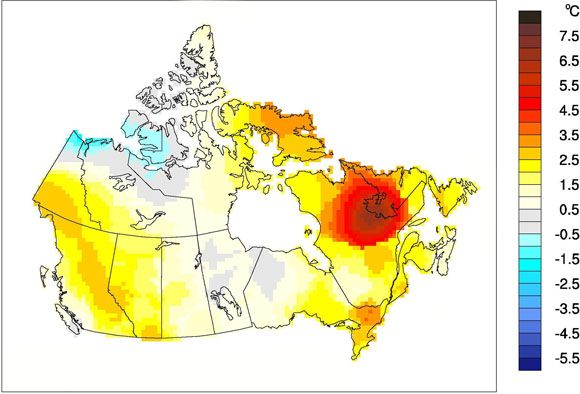
this is 60 years in Canada - a very large portion of the boreal environment.
there is one small corner that showed some cooling - overall it's 3.6 C warmer winters on average.....3 times the global average and exactly what would be expected with Arctic amplification of AGW

CTVB_Winter_2013_temp_map_E_zps51bfb7dc.jpg


It's okay to be wrong.....it's NOT okay to cling to something that is proven wrong.

NH winters are getting colder. < your statement It's factually incorrect.

Move on.
Some of us here would like to have a climate science discussion without constant flooding posts of repetitious nonsense and baiting.
 
Last edited:
Are you having trouble with comprehension?
I think it is a bad idea for you to question someone else's ability to comprehend.

I was clear about what I said.
A simple "yes" or "no" would be very clear.

IIt's srtill right there, the same as before.
When someone misunderstands you, merely repeating yourself is not helpful.

Among climate researchers, there is no disagreement that the global mean hasn't continued to rise since 1995, or 1998, or 2002, that isn't a dispute at this point.

macdoc posted this:

last time I checked there was more ocean than atmosphere.....

No pause there .
heat_content2000m.png


I have not seen your reply.

I said it would all become clear.
Based on what I have read of your posts so far, I do not believe reading a few hundred more of your posts will make anything clear.
 
If that was actually what I was claiming, then yes, that is very ambiguous.
Then what ARE you claiming?

your refusal to detail exactly what you are trying to say is why he's saying you are being ambiguous. The fact that you are being ambiguous deliberately is no defense against this charge.

If that was actually what I was claiming, then yes, that is very ambiguous. You are commiting the fallacy that a lot of people fall into, which is not understanding what somebody says, nor looking at the evidence they use to explain why they said it. I always support my points with evidence, and ask others to do the same. At the time I was telling you the NH winters have been trending colder, I posted evidence that clearly shows this. Multiple times. In this this thread.

Here's my evidence for claiming I posted the evidence already. At the time I told you about the winters.

From 16th March 2013, 01:12 PM


I posted a dozen sources to support my points. Claiming I do not provide evidence is actually a lie, if anyone tried to do it at this point.

Everyone found your evidence wanting the time and you have done nothing the address the many criticisms other than to keep switching between claims of general cooling that doesn't exist and regional cold event that have been repeatedly addressed. Your ambiguity in these discussion is precisely why he called you out.
 
Last edited:
I'm more interested in HOW it does.

This was already explained to you. you didn't listen then and kept trying to take the conversation down ever deeper rabbit holes in you attempts to deny conservation of energy.
 
Certainly warm oceans and warm tropics often provide the moisture that results in snow, and the warmer the air mass meeting the cold front, the more rain, ice, sleet and snow there will be. But it's the temperature that creates the snow, not the moisture.

If the cold front is weak, not that cold, there is much more rain than snow. When the cold front is very cold, there is more snow and ice, and no rain at all on the cold side of the frontal boundary.

This is basic basic meteorology.


Get the facts right before you try explain them. Precipitation require a warm air mass and a cold air mass. It normally has to be relatively close to freezing to snow, but in much of the northern hemisphere in winter close to freezing is above normal temperature not below normal.

This can be above normal and dropping or warming to above normal but at some point you need to have that above normal air mass in order for it to snow.

Regardless, don't confuse snowfall with snow accumulation.
 
Originally Posted by r-j
Certainly warm oceans and warm tropics often provide the moisture that results in snow, and the warmer the air mass meeting the cold front, the more rain, ice, sleet and snow there will be. But it's the temperature that creates the snow, not the moisture.

If the cold front is weak, not that cold, there is much more rain than snow. When the cold front is very cold, there is more snow and ice, and no rain at all on the cold side of the frontal boundary.

This is basic basic meteorology.

more :dl:

Any open body of water will produce snow when a cold front crosses it. That's what lake affect is......cold air without moisture does not produce snow....period full stop...
That's why the Antarctic is the largest driest desert in the world.

A cold front crossing land or glacier generally will not as it is too dry tho snow can result from orthogonic features - no I'm not going to explain.

....last time I checked there was not snow in the tropics - what a seriously stupid attempt at explaining yourself.
Do you really think you have a shred of credibility left with comments like that.
 
I don't know why you can't just be clear that Cohen et al are talking about regions and not the entire Northern Hemisphere.
That is understandable, considering two things. First, I expect anyone interested in a subject, like the colder winter trend, to actually read the links provided as evidence. Refusing to do so, and asking me to quote and point at the parts you call "lies", isn't going to happen. I tried that, multiple times here. People here claimed it was confusing, or that I was wrong, or worse, after I did eventually educate them, they moved the goal posts and began asking, "So what?", or worse, "We already knew that".

Even worse, links and sources vanished from the topic. Leaving gaping holes in the conversation. Here is an example of my efforts at the time..
...
It's so obvious, there is no logical reason anyone would act like they don't understand.

Warmer summers cause colder winters, scientists say
http://www.reuters.com/article/2012/01/13/us-climate-winter-idUSTRE80C0A520120113

All the while the ignorant keep asking for evidence.

Cold Winters Driven By Global Warming
Melting Arctic ice is to blame for the change in weather patterns, scientists say.
http://news.discovery.com/earth/cold-winter-snow-weather-global-warming-101222.htm

Now how can anyone still try to make it about me, and ignore what is right there? Now that's a mystery..

I think I understand now what was going on, and since it is still going on, repeating the same thing I did last year isn't going to work.

If somebody disagrees with peer reviewed science, and claim they know better, well good luck with that. I'm almost always going to align myself with the best evidence. OK make that always.

These recent claims with no sources, they sound woo woo to anyone familiar with the actual data we have. I have to laugh when I hear somebody claiming something that is the exact opposite of what the science teaches.
 
I have yet to see anyone who supports the mainstream scientific position on climate change ignore legitimate understandings of climate science. What I have seen is a select few deniers try to twist and distort legitimate mainstream climate science (usually through selective quote mining and word games) and often using secondary and tertiary source reporting references (aka newspapers, political blogs, obscurant extremist websites etc.,) about climate science issues. When challenged on their bizarre interpretations of the science they leap upon their hobby horses and begin a modern posting Tarantula occasionally spewing streams of irrelevant scientific papers (often copied and pasted from canned denialist political blogs) to distract and obfuscate the discussion. I generally stay involved in such exhibits long enough to add sufficient meritorious and relevant primary source mainstream science references to give those who actually stumble across such a discussion the opportunity to seriously research and understand the mainstream science on their own. After that there are more important and interesting discussions about climate science to be had.
 
US, British science academies: Climate change is real
23 hours ago

US and British scientific academies said Wednesday there was a clear consensus that climate change is real and will have serious disruptive effects on the planet.

The US National Academy of Sciences and Britain's Royal Society said they were making the joint declaration in hopes of moving the public debate forward—to the question of how the world responds, instead of whether climate change is happening.

"It is now more certain than ever, based on many lines of evidence, that humans are changing the Earth's climate," the joint publication said.

"The atmosphere and oceans have warmed, accompanied by sea-level rise, a strong decline in Arctic sea ice, and other climate-related changes."

The academies cautioned that science inherently cannot settle every detail and that debate remained on some specifics, including how much climate change is linked to extreme weather events.

But it said scientists were "very confident" that the world will warm further in the next century and that a rise by just a few degrees Celsius would have "serious impacts" that are expected to include threats to coasts and food production.

Amid a bitter winter in several parts of the world, the academies stressed that global warming is a "long-term trend" and that day-to-day weather can still be unusually cold or warm.
Read more at: http://phys.org/news/2014-02-british...-real.html#jCp
 
Precipitation require a warm air mass and a cold air mass.

or an elevation change which is effectively the same thing, dew point etc.
This is a tricky area and chaotic which is why we don't have much in the way of very reliable predictive capability - even for something so obvious as the monsoon.

Reliable is a cold air mass moving quickly over open water will drop snow downwind of the open water.
That is also a complex interaction of water vapour, latent heat and phase changes.
The Greenlanders have 20 words for snow ;)
 
Are you having trouble with comprehension? I was clear about what I said. It's srtill right there, the same as before.

Since the data is free and available, it's easy to simply show the above isn't true. Or that it is true. It's not some mystery.

If you check, and see that I am right, of course, then you if you disagree with the data, that's not my problem. Among climate researchers, there is no disagreement that the global mean hasn't continued to rise since 1995, or 1998, or 2002, that isn't a dispute at this point.

It's WHY it happened that is so interesting to me.

The data called. It wants you to know you are wrong and spreading nonsense


Does this look like global warming stopped...????

heat_content2000m.png


Surface temps are a minor aspect of AGW and are transient. When you can show ice and ocean "pausing" in the human induced changes ....then let us know.

Until then ....it's getting warmer, we're responsible"

move the discussion into te truly difficult area as the science academies noted above are requesting.

The US National Academy of Sciences and Britain's Royal Society said they were making the joint declaration in hopes of moving the public debate forward—to the question of how the world responds, instead of whether climate change is happening.

•••

Did you ever answer the question?
"Does CO2 trap IR"?
 
Last edited:
about those colder NH winters......Alaska would beg to differ...

Alaska's Warm Weather Could Mean Mushy Iditarod Race
By Becky Oskin, Staff Writer | February 28, 2014 11:40am ET

The Iditarod National Historic Trail encompasses several connecting trails extending from Seward to Nome.

Thanks to a few inches of fresh snow, the route for Alaska's venerable Iditarod sled dog race, which kicks off on Saturday (March 1), may be in much better shape than race organizers feared just a week ago. The state's unusually warm winter, with record-setting high temperatures and rain instead of snow, meant Iditarod racers faced icy trail conditions and open water as recently as Sunday (Feb. 17)

more

http://www.livescience.com/43751-iditarod-race-alaska-warm-weather.html
 
Digging in...

Climate science
Inescapable truths
Feb 27th 2014, 15:12 by O.M.


THE National Academies of Science (NAS) and the Royal Society—the elite scientific fellowships of America and Britain, respectively, respectively—released today a rather handy “Frequently Asked Questions” resource on climate change. It seems designed to act as a sort of counterbalance to op-ed pieces like this one by Charles Krauthammer of the Washington Post, which take aim at “those scientists who pretend to know exactly what [carbon-dioxide emissions] will cause in 20, 30 or 50 years.”

The scientists of Mr Krauthammer’s scorn don’t actually exist: No one pretends to such precision. But no matter, Mr Krauthammer’s real complaint is more general. His target is anyone who believes that “science is settled”—a belief he tries to ascribe to Barack Obama. “There is nothing more anti-scientific,” he says, “than the very idea that science is settled, static, impervious to challenge.”

This sounds good in a Popperian way; but it is not really true. While science is more unsettled than some feel comfortable admitting, it nevertheless depends on some things being settled irrevocably. The earth has a crust, a mantle and a core. Plants photosynthesise. Air is made of molecules. All these things were once not known and are now accepted as fundamental.
And it was in among such fundamentals that the president put climate change when he said during his state-of-the-union speech that The debate is settled. Climate change is a fact.”

more
http://www.economist.com/blogs/democracyinamerica/2014/02/climate-science
 
IRemember that this ridiculous claim is a sidetrack from the actual scientific data I posted, showing the snow trend matches the cooling trend for the NH boreal winters.
There is no cooling trend for boreal winters.

No intelligent half educated person with even a tiny bit of knowledge thinks increased snow cover, and increased snow fall is connected to warmer temperatures.
Most would. Whether you're an exception is still an open question.

Certainly warm oceans and warm tropics often provide the moisture that results in snow ...
The only snow sourced from warm tropical waters is on mountains. Practically all water-vapour destined to become snow comes from water surfaces, and the amount that's up there is some measure of how warm those surfaces are.

... and the warmer the air mass meeting the cold front, the more rain, ice, sleet and snow there will be.
Other things being equal.

But it's the temperature that creates the snow, not the moisture.
The temperature of what? The cold air mass, the warm air mass, the atmosphere at the height the snow forms, surface temperature?

Snow is composed of water, which is to say, moisture. More moisture, more snow. Air can easily reach freezing-point at a few thousand metres in winter, where snow can form.

If the cold front is weak, not that cold, there is much more rain than snow. When the cold front is very cold, there is more snow and ice, and no rain at all on the cold side of the frontal boundary.
Precipitation comes from the warm air mass as it rides up over the cold air mass, cooling as it does. It falls through the cold air mass; if that's warm enough snow will melt on the way down. At a few degrees above zero it'll land and demonstrate just how much moisture was in the warm air mass.

Snow's best indication of surface temperatures is how long it lies before melting.

This is basic basic meteorology.
Not clearly explained, I'm afraid. I've tried to fix some of that.
 
Status
Not open for further replies.

Back
Top Bottom