• Quick note - the problem with Youtube videos not embedding on the forum appears to have been fixed, thanks to ZiprHead. If you do still see problems let me know.

Gage and Szamboti to speak at New Jersey Institute of Technology

Ozzie,
I know what happened and that heat made it collapse. My problem has been my inability to understand / visualize the column failure(s). I've seen no examples of those failed columns save that one bent into a horseshoe. I read the NIST assertion of beam expansion... but I thought the col 79 was supposedly a buckling from loss of bracing... But a single floor collapse leading that that column buckling seems counter intuitive to me.
Sander you do tend to wander all over the place - in this one completely changing the subject of discussion.

We (as in you and I) were discussing issues with T Szamboti's "Missing Jolt" which is definitely a WTC Twin Towers - WTC1 and WTC2 - issue and focussed on WTC1.

You start your post continuing our MJ Twin Towers discussion THEN manage to change to WTC7 without pausing for breath. And everyone goes along with you.

Except me. :) - and I'll avoid the temptations to EITHER switch to WTC7 which was not subject of "Missing Jolt" OR continue with the ambiguous references to either or both that you are so fond of. :rolleyes:

I don't see anything to support CD...
I'm aware of that - no need to keep repeating unless there is a risk of misunderstanding.
but I am having a hard time understanding how it goes from lots of heat to the whole thing collapsing. What I an saying is... even if it is not precisely what happened... I want to be able to "see" / conceptualize in slo mo in my mind... how these towers started to become undone. I don't expect anyone to do a gif or vid of it.....
Believe me I fully comprehend your difficulty. (And I'm assuming from the "it" and "these towers" you are back discussing the Twin towers.) That is why I have spent effort posting explanations. I have not dismissed you with suggestions that you read NIST - whether for WTC1/WTC2 OR WTC7. That will not help your comprehension - especially when you have many times expressed your doubts about NIST. You are looking for explanations but you do not come to grips with the explanations that have been posted, repeated, amplified and - on request - clarified.
and "column" buckling is not doing it for me. Sorry
Well you have a big barrier and comprehension problem because column buckling was the dominant component of the cascade failure for "initiation stage" for each of the Twins.

And if you do not read or cannot process explanations and don't follow up the bits of misunderstanding by seeking more explanation - there is little I or anyone else who is prepared to explain can do to help you.
 
Last edited:
Wow......after not posting for months, peaked in only to find the same few desparate troofers tilting at windmills and apparently dickie gage is still funding his vacation travels with other gullible peoples money. It is like a flash back to 2012.
 
First off, thanks for taking the time to respond.
No problem. Some of the answers will be just as quick. BUT there are two (Edit: Ooops - THREE :blush:) areas where - to avoid confusion - we will need to define what scenario or stage of collapse we are actually discussing. I'll give the short and easy answers by << coloured comments interspersed with your post. I'll break the quote where I need to address those more fundamental issues.

Here Goes:


"which scenario?" The scenario for "Missing jolt' was explicitly the Bazant Limit Case scenario involving ALL columns. So if some of the columns did not have sections removed the "Missing Jolt" conclusion is falsified. And your suggestion of "only core removed" changes from the scenario that T Sz used for "Missing Jolt". Nice effort to help him solve the weaknesses of his hypothesis. BUT that change makes it NOT T Sz's Missing Jolt hypothesis. (BTW Be warned - Szamboti apologists tend to avoid that simple truism by conflating/confusing.)
Well, I'm trying to look at it from his scenario. And in his scenario he claims that if CD was not used, there should have been a Jolt correct? I understand that in the actual scenario we would not and could not have had a Bazant Style Limited Case and if TZ is basing his work on that, then it's a non starter anyway, correct?

"what stage?" The Twin Towers collapses both involved two distinct stages with vastly different mechanisms. The "initiation stage" which ran from Aircraft Impact to "Top Block starts to drop". The progression stage was the global collapse which you describe as "... all the way down the building." Missing Jolt does confuse - it somewhat conflates the two.
I'm not sure it confuses the two from TZ's point of view because if you suppose there was CD, then there was no initiation followed by descent. It's all one stimulus (explosives) that starts and continues all the way down. My point is, if you follow his very flawed reasoning, that the explosives were internal and a Bazant style collapse (which it quite obviously wasn't) should cause a Jolt which we didnt see (because of the explosives, which we also didnt see :rolleyes:), how on earth would he expect to see the jolt if its happening inside the structure anyway?!

We need to keep them clear and it is "initiation stage" which we are currently discussing. "Initiation Stage" was a cascade sequence of columns failing in axial compression >> buckling. "Progression Stage" (or "all the way down the building ") was by shearing of floors off the columns. One main problem underpinning the nonsense of Missing Jolt is Tony's lack of understanding of the "cascade failure" process of the "initiation" stage. I can link you to more comprehensive descriptions of both (plus the stage where they "transition" from one to the other) BUT let's set aside those details for now.
Presumably there was no cascade failure of the initiation stage for TZ because it was initiated artificially.

So let me take a rain check on your references to "all the way down the building" AKA "progression" at this stage. We can come back to it if necessary.
coolio


In recent posts - and similar ones going back to when "Missing Jolt was first published - I have sought to distinguish TWO scenarios - the bastardised Bazant scenario that T Sz misapplied in "Missing Jolt" from the "real event". You have now postulated a third scenario. It is NEITHER the T Sz fantasy NOR the real event. I'm willing to work through it with you but IMO it wouldn't work - I think you are heading to that conclusion. But the big issue here and now is that it is not T Sz's Missing Jolt and I'm trying to distinguish Missing Jolt from "real event" AND falsify "Missing Jolt".
I understand. I don't think I'm suggesting a third scenario though. I presume TZ is not suggesting the perimeter columns were exploded was he? If not then why does he think a Jolt would be visible?

As for the real event, I follow you're explanation and it makes sense to me (though I'm not qualified probably to comment either way). I also think I understand the initiation stage. By "cascade failure process" process, I presume you mean how a number of the columns lost their strength over time until the load above which was being transferred to the remaining columns bit by bit was too much and buckling then cascaded presumably very quickly around the remaining columns, initiation completed.. ?

OK - that got a bit more serious than either of us expected. No apology - we need to get those foundation scenarios clear or we will follow the mob - T Sz and his entourage of followers - around in circles.
no dramas as they say down under.

If that lot of overkill hasn't confused you even further - any questions? :)
No overkill. thanks.
 
I presume TZ is not suggesting the perimeter columns were exploded was he? If not then why does he think a Jolt would be visible?

As I understand it, Tony thinks the corners of the exterior frame were cut by explosives, and claims to be able to identify the explosions that did this. But it gets confusing here, because that's completely separate to his missing jolt; he thinks that, if the collapse had been initiated by fire damage, there would have been a jolt, but even if it wasn't there must still have been destruction of the lower structure after initiation to prevent one. At least, that's the nearest I can understand what he thinks to be, because it isn't exactly as coherent as he likes to make out.

Dave
 
I'm just waiting for the return of Willie "Keymaster" Rodriquez and his truth show.
I liked the no planers best, it amazed me how far and irrational people would go/get to try and prove their point. Talk about trying to drive a square peg into a round hole.

square_peg_round_hole.jpg
 
As I understand it, Tony thinks the corners of the exterior frame were cut by explosives, and claims to be able to identify the explosions that did this. But it gets confusing here, because that's completely separate to his missing jolt; he thinks that, if the collapse had been initiated by fire damage, there would have been a jolt, but even if it wasn't there must still have been destruction of the lower structure after initiation to prevent one. At least, that's the nearest I can understand what he thinks to be, because it isn't exactly as coherent as he likes to make out.

Dave
quite, lol.
 
First off, thanks for taking the time to respond.
No problem - thanks for the opportunity to present some serious comments. I'll continue the style of answers by << coloured comments interspersed with your post.

Well, I'm trying to look at it from his scenario. << Understood. The problem is that his scenario is neither complete or logically coherent - so it won't always be possible to base logical answers on the foundation of confused illogic which are his assertions. And in his scenario he claims that if CD was not used, there should have been a Jolt correct? << Yes. I understand that in the actual scenario we would not and could not have had a Bazant Style Limited Case << Correct on both "would not" and "could not" and if TZ is basing his work on that, then it's a non starter anyway, correct? << Yes – it is that simple. There is “no case to answer” BUT a lot of 'debunkers' enjoy arguing with truther nonsense – and – sadly – some debunkers don't comprehend the simple reality.


I'm not sure it confuses the two from TZ's point of view because if you suppose there was CD, then there was no initiation followed by descent. << Agreed BUT don't even imply that T Sz's claims are a “view” in the sense of a coherent overall model of what he is claiming. His claims have no coherent rationale – so trying to draw logical consequences from the claims as if they were logically coherent is given more credit than the claims deserve. It's all one stimulus (explosives) that starts and continues all the way down. My point is, if you (try to ;)) follow his very flawed reasoning, that the explosives were internal << He hasn't thought it through. He is trapped because the Bazant scenario he bases his claim on does not allow “only hidden inside columns" to be involved. and a Bazant style collapse (which it quite obviously wasn't) should cause a Jolt which we didnt see (because of the explosives, which we also didnt see :rolleyes:), how on earth would he expect to see the jolt if its happening inside the structure anyway?! << All those points are true as far a they can be true when the T Sz material you are trying to address is so incoherently confused illogic. I agree where you are trying to come from. It will always be problematic trying to extend his assertions to their logical consequences because the foundation of T Sz “logic” is not a legitimate starting point.


Presumably there was no cascade failure of the initiation stage for TZ because it was initiated artificially. << Yes – but recognise that his claims do not comprehend the artificiality OR the reasoned explanation of the “real event” in its two stages. So his claims are not supported by valid arguments based on clear understanding of his premises.

coolio <<:thumbsup:


I understand. I don't think I'm suggesting a third scenario though. I presume TZ is not suggesting the perimeter columns were exploded was he? << His claims show no evidence that they have even been thought through to that level. If not then why does he think a Jolt would be visible? <<Same response as preceding. And I repeat my caution – there is little to gain in applying validly reasoned argument as if the "Missing Jolt" claims were based on valid argument. They aren't.

As for the real event, I follow you're explanation and it makes sense to me (though I'm not qualified probably to comment either way). I also think I understand the initiation stage. By "cascade failure process" process, I presume you mean how a number of the columns lost their strength over time until the load above which was being transferred to the remaining columns bit by bit was too much and buckling then cascaded presumably very quickly around the remaining columns, initiation completed.. ? << Exactly – it is somewhat like a toppling of a row of dominoes – as each one falls it tips over the next. EXCEPT it is two orders more complex. The basics are simple. Some column or other – doesn't matter which and we will never know which – gets heated enough to weaken it so it cannot support the load it was carrying. It crushes/buckles – fails so it no longer supports the load. The load is still there so other columns have to take it up. And how the load is shared is a bit of relatively complicated engineering. BUT bottom line is extra load goes onto another column which then fails. You comprehend the process. I can explain in more detail but it gets complicated – remember that it is a lot of columns spread out in a 2D array and the extra load doesn't necessarily cause the nearest columns to fail. More explanation if you need it but you are already clear on the principle.

no dramas as they say down under. << Most of my favourite Aussie words get spelled “*****” in this US dominated forum. :boggled: :blush:


No overkill. thanks. <<Great.
 
Last edited:
Ozzie,
Why must you insist... or repeat over and over again that the columns failure cascade began from a column being heat weakened and buckling?

I certainly accept that there was a progress through the core of columns "failures".. and the rate of failures would accelerate.

However there are other "mechanisms" to cause a column failure aside from literally weakening it from heat. You ignore this constantly. NB I am not asserting that the column failures did not involve lowered axial capacity as a result of elevated temps. I am asserting that there were likely other mechanisms and it's impossible to know which and how much the other factors contributed to column "failure".

Consider the implication of what you present with this idea. Fires and heat weakening got to one column "first" and then along with load redistribution got to other columns next and so on.

Could the buckling be more load redistribution and no heat weakening?

Can we explore how load redistribution actually "worked" inside the core? Conceptually it's not difficult... axial loads don't disappear so they are "directed" to other columns. Let's have more light on this...
 
Ozzie,
Why must you insist... or repeat over and over again that the columns failure cascade began from a column being heat weakened and buckling?

I certainly accept that there was a progress through the core of columns "failures".. and the rate of failures would accelerate.

However there are other "mechanisms" to cause a column failure aside from literally weakening it from heat. You ignore this constantly. NB I am not asserting that the column failures did not involve lowered axial capacity as a result of elevated temps. I am asserting that there were likely other mechanisms and it's impossible to know which and how much the other factors contributed to column "failure".

Consider the implication of what you present with this idea. Fires and heat weakening got to one column "first" and then along with load redistribution got to other columns next and so on.

Could the buckling be more load redistribution and no heat weakening?

Can we explore how load redistribution actually "worked" inside the core? Conceptually it's not difficult... axial loads don't disappear so they are "directed" to other columns. Let's have more light on this...
Talking towers? The columns probably did not fail by single cause. Even if a column had been heated to only lose 2% original strength, it may well have suffered impact damage, and/or damage to Lateral connections at impact, and/or nonaxial loading, and/or redistributed loads due to other column failure, creep or loss at impact

We do tend to simplify things and attempt to determine if one mechansim dominated.
 
Talking towers? The columns probably did not fail by single cause. Even if a column had been heated to only lose 2% original strength, it may well have suffered impact damage, and/or damage to Lateral connections at impact, and/or nonaxial loading, and/or redistributed loads due to other column failure, creep or loss at impact

We do tend to simplify things and attempt to determine if one mechansim dominated.

Well yea... obviously as this was coming apart up there.... lots of things were going on... clearly not a single mechanism.

Coming apart... means the frame was getting itself "unconnected" one piece of steel from the ones it was connected to. Buckling columns pull down a lot with them obviously... in fact columns would HAVE to get "messed up" for the top to "collapse". The top was not a ROOSD leaving behind the columns to topple from instability.

Although I can't see inside the tops... I suspect that parts of the structure was collapsing in both towers... core columns were getting pushed out of alignment.... the frame was also warping and twisting from heat... connections were failing. bolts shearing, welds fracturing... local floor areas were collapsing.

But it looks like enough of a frame remained intact and unsupported and probably subjected to "asymmetrical" lateral forces which rendered what was still "connected together" into the destructive mass which kicked off the better understood by the visual record... ROOSD process or whatever one calls it.

My sense is "loss of column strength" from heat was probably NOT the major undoing. But I have nothing other than a hunch to base this on. Warped frames probably don't perform very well.
 
My sense is "loss of column strength" from heat was probably NOT the major undoing. But I have nothing other than a hunch to base this on. Warped frames probably don't perform very well.

Question is though, if there were no fires, would they have collapsed?

Presumably after impact, many columns would have been damaged and some were left in an undamaged state. The building still stood after impact, for quite some time too.

After the fires raged for some time collapse initiation started. What else but fire caused that? Some of the previously (post impact) intact columns would have lost their strength and bracing due to heat. Eventually what was left that had not been significantly affected due to heat or impact damage would buckle would they not?

1. Does it matter
2. What else could lead up to collapse initiation after 45 mins or whatever it was other than fires?

I cant imagine that they were on a knife edge of collapse, just waiting for a strong gust of wind or for some supports to slowly give way because it happened to both buildings. Maybe you're correct but the fires causing steel to lose their strength seem to me to be the most likely scenario.

Put it this way, as a thought experiment. If we take one of the twins, remove a number of columns (no impact), then start a bunch of uncontrolled fires, would the buildings eventually collapse?
 
Last edited:
.....

My sense is "loss of column strength" from heat was probably NOT the major undoing. But I have nothing other than a hunch to base this on. Warped frames probably don't perform very well.

Ok, look at it this way;
Initial impact caused immediate damage, that's a given. The building stood for dozens of minutes after that then underwent a rapid runaway progtessive collapse.

Something had to drive damge that continued to occur in the interim. If there were strong winds that could be a factor but there wasnt.

The only known driver of continued stresses in the structure was the fires. So while heat did not directly cause all the continuing, additive, damage, it was the driver of it.

At some point the loads are redistributed causing immediate failure of some column(s) causing loads to again redistribute, causing immediate column(s) failure, etc in rapid succession. That what we refer to as collapse initiation.

Seems this is just another way of saying the same thing you are.
 
Last edited:
There is a method of taking down two trees at once. Topple one onto the other. Did chopping chunks of wood bring down the second tree? Not directly but the answer is still yes, it did.
 
Well the issue I am driving at is... after the initial loss of axial capacity from the plane strike.... we know the tower had enough capacity at the plane strike zone to support the 22 or so floors above. This is obviously because "reserve" capacity is always present in mechanical design. Structures perform well under their ultimate failure strength.

But it DID fail and it was what the heat did and what the heat did was some manner of cumulative effect.. or in the case of the tower a progressive eroding of capacity.

The eroding of capacity we are led to understand from the failure of complex systems proceeds with failures that do not fail the entire system... that is they are eroding capacity. But in the case of structure the function of structure is to support loads which remained more or less the same.

So we consider that one additional column failure means the loads it supported must be supported by the remaining columns and this is accomplished by "redistribution" of loads.

However there are other possibilities such as the loads of the failed column drop free and so there is no load redistribution at the level of the plane damage where the fires were... with a reduced capacity. But then again when there is no floor to literally support the fires... the frame would not longer be subject to weakening.. at least where the floors had collapsed.

Another mechanism for capacity destruction from heat would be warping and mis alignment of column ends. Fires raging on floors obviously also heated bracing which would expand... and in so doing the columns in the fire zone could be pushed around such that alignment and bearing area was driven below spec and there would be a column failure of some sort... web and flange crippling..

What seems to have been going on is the process was progressive and accelerating. This sounds less like directly heat driven and more like mechanically driven... such as how a row of dominoes fails.

As we don't have the core columns from this zone... to my knowledge... we can only guess at the failure mode. We don't seem to have the bracing beams either. But we do know that after 1.5 hrs the frame lost capacity.... first evidence being the IB of the SE corner and then the descent of the tower INTO the upper structure where the hat truss was... and then the top collapses into / onto the lower cold section kicking off the better understood runaway floor collapse.

We are led to believe this was a mutual destruction at the plane strike level until the UPPER section was no more.., but it couldn't have just piled up on the 96-98 floor and then ROOSD... there had to be some manner of "shift" to ROOSD or ROOSD was beginning earlier.

What was happening to the floor mass of the upper section in 1wtc in the 3.75 seconds it took to "disappear into" the lower section?

The answer is not "column buckling"... it's more complex than that.
 
More comments for consideration.
Question is though, if there were no fires, would they have collapsed? << Almost certainly No!

Presumably after impact, many columns would have been damaged and some were left in an undamaged state. The building still stood after impact, for quite some time too. << That is a key factor . It WAS stable THEN something changed and no-one - especially Sander - has demonstrated any agent of change other than fire >> heating as the trigger for that first column to fail thus initiating the cascade sequence.

After the fires raged for some time collapse initiation started. What else but fire caused that? << EXACTLY the point I have made and supported with reasoning. Sander keeps repeating "why?" despite multiple explanations. Some of the previously (post impact) intact columns would have lost their strength and bracing due to heat. Eventually what was left that had not been significantly affected due to heat or impact damage would buckle would they not? << I'm not clear on your point. As I have explained it the first column to fail in the cascade MUST be triggered by heat BUT subsequent column failures could well result purely from load redistribution and may not have depended on heat - or "more heat" than they had already had . (Remember also it is temperature that is critical - not heat - we could correct the terminology if we start to confuse ourselves. :o)

1. Does it matter << In general - "No!" - it only matters to those persons who are interested in the details.

2. What else could lead up to collapse initiation after 45 mins or whatever it was other than fires? << EXACTLY the point I have made and Sander disputes without identifying a valid alternate. (His speculated beam expanding pushing columns out of line IMO does not survive scrutiny. The extreme heat needed to cause such beam expansion would already have weakened the column beyond the point of failure in axial overload. Remember that the beam is attached to the column and must be in near enough the same heating regime.)


I cant imagine that they were on a knife edge of collapse, just waiting for a strong gust of wind or for some supports to slowly give way because it happened to both buildings. << I agree with you Badboy - it is highly improbable that a collection of random effects could produce such a precise "knife edge" situation - TWICE??? Maybe you're correct but the fires causing steel to lose their strength seem to me to be the most likely scenario. << I'm even more certain - it is the only viable hypothesis - no one had falsified it OR proposed a viable alternative. For that first column to fail in the cascade sequence. After the first one is triggered by heat all bets are off as I have consistently maintained in my previous and fuller explanations.

Put it this way, as a thought experiment. If we take one of the twins, remove a number of columns (no impact), then start a bunch of uncontrolled fires, would the buildings eventually collapse? << We cannot say - it depends on the scale and intensity of the fire ad its location in the building. BUT we do know that the fires succeeded in the context of WTC1 and WTC2 on 9/11 - that is the extant hypothesis for this discussion. Sander has objected but so far not posted a valid falsification or alternate hypothesis
 
Ozzie,

We certainly are on the same page... heat was the driver post plane strike. We clearly agree that the aggregate capacity of the columns ... however many remained after the plane strike was driven below the service loads or... the loads above had no load paths to the columns below (part of my theory of lateral displacement).

I am clearly totally stupid about how fire works inside of a steel high rise. We know heat does at least 2 things to steel...

it causes the steel to expand
it causes the steel to lose strength

and enough of heat can cause plastic deformation.

"Compressive failure

"Usually, compressive stress applied to bars, columns, etc. leads to shortening.

Loading a structural element or specimen will increase the compressive stress until it reaches its compressive strength. According to the properties of the material, failure modes are yielding for materials with ductile behavior (most metals, some soils and plastics) or rupturing for brittle behavior (geomaterials, cast iron, glass, etc.).

In long, slender structural elements — such as columns or truss bars — an increase of compressive force F leads to structural failure due to buckling at lower stress than the compressive strength."

So if I understand the behavior of steel... under heat stress from the above quote... there would be shortening but failure occurs from an increase in compressive force...

So this becomes a bit of a conundrum... the initial over heated column shortens but where does the increase load come from? THAT can only happen if columns are removed and loads redistributed.

And that DID happen post plane strike... but this was not enough to drive that first column failure... or was capacity driven lower and lower by heat?

++++

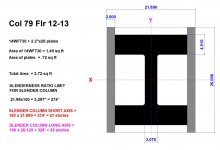
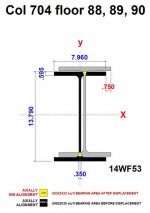
When I raised the notion of beam expansion and referred to the NIST bit about the girder at column 79.... why was this not in play in the top of the twin towers? For one the columns were probably in the order 1/40 the strength of col 79.

col 79 weighed 1,000#/ft and "buckled" from a single floor collapse around it.... and column 704 weighed 53#/ft?????? I suppose it too buckled from a local floor collapse.
 

Attachments

  • col 79.jpg
    col 79.jpg
    50.5 KB · Views: 2
  • Core column flr 88-90.jpg
    Core column flr 88-90.jpg
    32.3 KB · Views: 2

Back
Top Bottom