French protests about raising retirement age.

I've just heard on the radio that the reason why students are protesting is that they feel that the workers who will be required to work until they are 67 until they are entitled to their full state pension (if you take your pension at 62 you only get 50%) are sitting in jobs that'll be otherwise available to the youth.

In other words, they're not angry about having to work two years longer, they're worried about not having jobs now.
 
I don't know the details of the situation in France but I assume that the people set to retire soon won't be affected at all, the people set to retire in 20 years will be affected only somewhat and the people set to retire in 40 years will be affected more substantially.

I'm sure it will be as you describe. In 1995 the British government decided to standardise retirement ages for men and women - previously 65 and 60 - at 65 and a formula was devised that spread the transition over a long period. My wife (now just coming up to 60) has to wait until 60.5 , so it's not a serious blow.
 
Last edited:
I've just heard on the radio that the reason why students are protesting is that they feel that the workers who will be required to work until they are 67 until they are entitled to their full state pension (if you take your pension at 62 you only get 50%) are sitting in jobs that'll be otherwise available to the youth.
That fear is as flimsy as any other one that urges people to support protectionism of one sort of another, and is founded on the wrong belief that trade and economic activity is a zero-sum competition.

The irony is that they are effectively protesting in favour of being taxed more themselves in order to buy off the retiring generation to exit the labour market. Turkeys, Christmas.
 
That fear is as flimsy as any other one that urges people to support protectionism of one sort of another, and is founded on the wrong belief that trade and economic activity is a zero-sum competition.
No, it's not. But that doesn't take away the fact that employer A, faced with a 65-year old employee retiring, will hire a new employee without even thinking about it (or even could pay for two young employees just entering the job market), while employee B, with a 65-year old who continues working, will first have a hard look at the current profits he makes and the prospects before hiring extra personnel.

It is undeniable that raising the retirement age at once will adversely affect the job market for youngsters; and that gradually raising it will soften that blow.
 
It is undeniable that raising the retirement age at once will adversely affect the job market for youngsters; and that gradually raising it will soften that blow.
Correct, but it is not obvious how large the impact would be, or if it would be detectable. Analagous arguments--for example--are made by vested-interests that raising minimum wages will increase unemployment and prices, but there is a paucity of evidence that any country that has done this has suffered those outcomes.

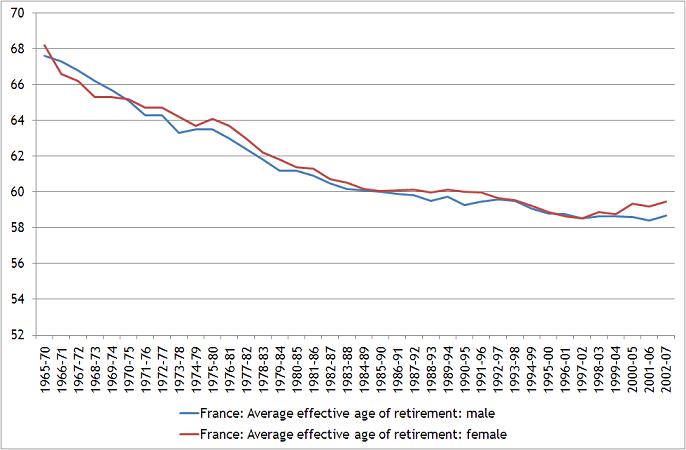
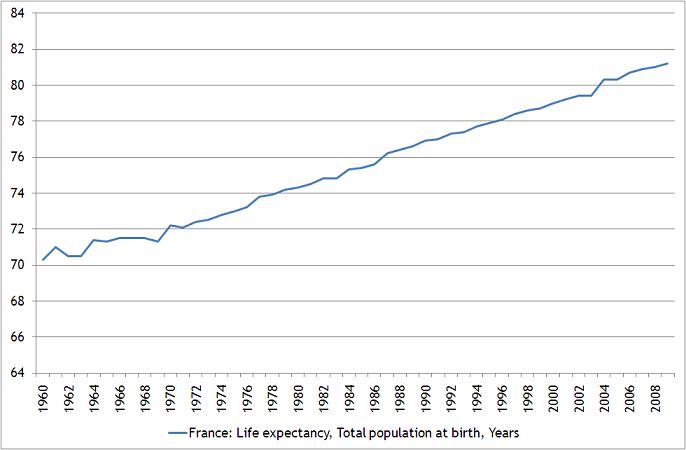
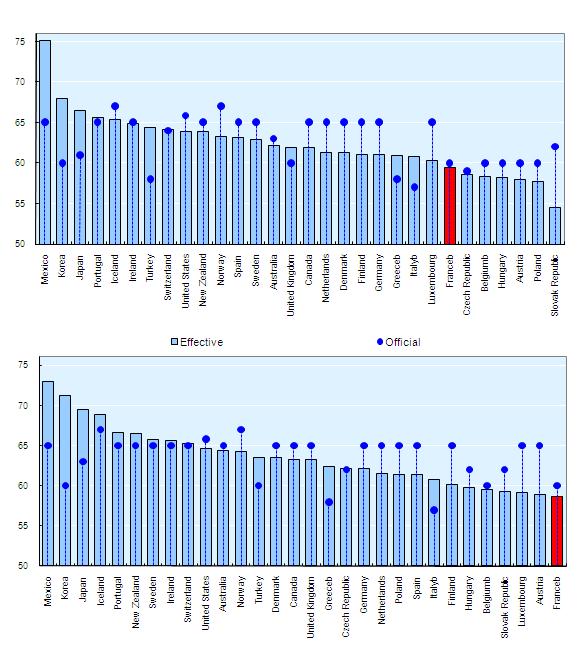
Charts below are for (i) effective retirement age in France [Source OECD], (ii) life expectancy in France [Source OECD Health Data 2010] and (ii) unemployment rate in France [Source INSEE, IMF World Economic Outlook 2010 and Bloomberg (no link)]

127464cc16f6e86d08.jpg


127464cc16f6e9a453.jpg


127464cc16f6eab388.jpg
 
Last edited:
I don't think that not allowing retirement until later necessarily translates into fewer jobs for young people. Wasn't the reasoning in France behind going to a 35 hour work week that employers would then need to hire more workers and as a result unemployment would go down? That didn't happen. Plus, even if people can't officially retire until they're older it doesn't mean employer will employ them instead of younger people.
 
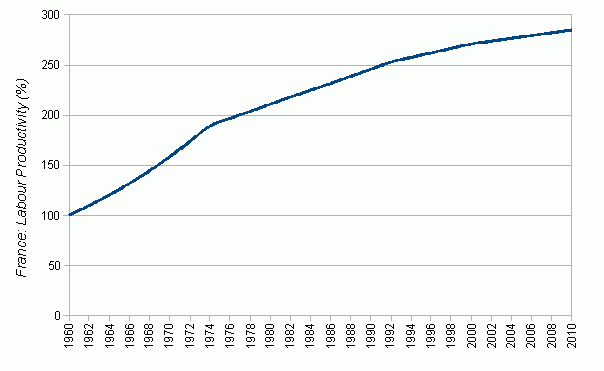
That shows productivity growth slowing down BTW. The table on that page also has the US, Germany and the UK; where it accelerated fom 1980 to 2001, and Japan, where it also slowed but was faster than France. "One of the highest worldwide" would show up in GDP per person or GDP per hour worked, and I don't think France wins that race, although rich countries are obviously at the top of the tree. Just sayin'

There is more detailed productivity growth data (you need to navigate to "GDP per capita in constant local currency units") in the World Bank's World Development Indicators database. I have it somewhere in excel but not handy.
 
OECD blog post on the students' involvement: http://oecdinsights.org/2010/10/22/strike/

One particularly striking (being the operative word) fact in France is that young students are demonstrating against the rise in the retirement age. No one seems to be trying to explain to them that if these reforms do not happen they are the ones who will be hit hardest and have to pay in the long run

[ . . . ]

the students are mixing the issue with other matters – notably arguing that if the older generation work 2 years longer, they will have to wait 2 years more until these jobs are ‘freed up’ and they can start work. Yet the experiment of the 1980s and 1990s recessions, when early retirement was used as a policy tool to try to fix unemployment, showed that these policies did not free up jobs, but in fact had the opposite effect, as the number of jobs within an economy is not a fixed pie to be shared out.

This is the author's bio; she is based in Paris.

France's upper house passed the law yesterday.
 

ISF - Join now!

Every member here is approved by hand. No bots, no spam, just people who care about evidence and honest debate.

Membership is free!

Create your free account

Back
Top Bottom