
Fractal Time

Anders Lindman

Penultimate Amazing
Joined
Sep 17, 2010
Messages
13,833
A movie consists of many separate frames. And we can store a whole movie as timeless information such as on a DVD. Similarly, reality can be thought of as a single moment divided into an infinite number of sub moments.

The first sub moment is n=1 at the Big Bang (or the starting singularity). Each consecutive sub moment contains the information for all previous sub moments plus new information for the change. And all sub moments, for all past and future, an infinite number of them, can fit into a single composite moment using a geometric series such as 1/2 + 1/4 + 1/8 + 1/16 + ... 1/2infinity.
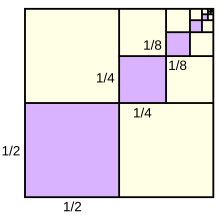
220px-GeometricSquares.svg.png

http://en.wikipedia.org/wiki/Geometric_series

This means that time has a start at sub moment n=1, yet reality as a single moment has no beginning and just timelessly is.
 
Time isn't infinitely divisible.
 
That's basically what you get if you choose to interpret time as being a spatial dimension.

ETA: Apart from your idiosyncratic divisions of time.
 
Last edited:
That's basically what you get if you choose to interpret time as being a spatial dimension.

ETA: Apart from your idiosyncratic divisions of time.

Except that infinite information can be represented by a single number. Such as Pi = 3.1415926...

Fractal time resolves the paradox of a beginning of time. In fractal time there is a beginning such as the Big Bang yet all of time is represented as a single timeless geometric series unfolding in the now.
 
Except that infinite information can be represented by a single number. Such as Pi = 3.1415926...


Pi doesn't represent infinite information. Sure, it takes infinite digits if you try and represent it numerically, but PI can also be represented as a formula that precisely describes the same number using finite information. For example...

picture.php

Other forumlas for PI can be found here: http://mathworld.wolfram.com/PiFormulas.html

Fractal time resolves the paradox of a beginning of time. In fractal time there is a beginning such as the Big Bang yet all of time is represented as a single timeless geometric series unfolding in the now.


I don't think it resolves anything, it just sidesteps the question. Instead of why is there a first moment of time, you're now having us as why there's a largest sub-moment of time.

Why not just have time represented as a ray? It'd be much simpler. What advantage does your suggestion have over this?
 
Last edited:
Pi doesn't represent infinite information. Sure, it takes infinite digits if you try and represent it numerically, but PI can also be represented as a formula that precisely describes the same number using finite information. For example...

[qimg]http://www.internationalskeptics.com/forums/picture.php?albumid=721&pictureid=7557[/qimg]​

Other forumlas for PI can be found here: http://mathworld.wolfram.com/PiFormulas.html


I don't think it resolves anything, it just sidesteps the question. Instead of why is there a first moment of time, you're now having us as why there's a largest sub-moment of time.

Why not just have time represented as a ray? It'd be much simpler. What advantage does your suggestion have over this?

But just as Pi, fractal time can be presented in a simple formula. The actual values however are unknown until they have been calculated. This is actually similar (or as I suspect identical) to the uncertainty principle in quantum mechanics.

By having a large enough number n for the n:th decimal of Pi, the value is unknown! It's an example of what Stephen Wolfram calls computational irreducibility, which states that even a simple deterministic algorithm can have values that cannot be predicted in any other way than to calculate the actual values.

Reality could be similar to that, and that even though it's defined by a simple algorithm, the actual future values cannot be predicted and we must use our 'free' will etc for the future values to become actual.

Yes, fractal time as I have defined it here has a largest sub moment of time. If the first sub moment, the singularity at the Big Bang is the Alpha, then the largest sub moment is Omega. But it's a clear state! Precisely defined. But because reality is a computationally irreducible process, future moments must be "calculated" in the now so to speak to become actual.
 
Last edited:
Time isn't infinitely divisible.

Even if there is a smallest possible time span, say the Planck length, the idea of fractal time can deal with that too! Just assign the Planck time length to each sub moment in fractal time.

And that's a pretty interesting idea, since the actual number of sub moments from the Big Bang to today can be calculated with the age of the universe divided by Planck time. Total number of sub moments so far (in our universe): 14 billion years / Planck time = 8.19x1060 sub moments.
 
Last edited:
With fractal time Hilbert's paradox of the Grand Hotel (also called Hotel Infinity) becomes resolved, because the infinities unfold ongoingly in the now.

"It is also possible to accommodate a countably infinite number of new guests: ...

It is even possible to accommodate countably infinitely many coach-loads of countably infinite passengers each. The possibility of doing so depends on the seats in the coaches being already numbered (alternatively, the hotel manager must have the axiom of choice at his or her disposal). First empty the odd numbered rooms as above, then put the first coach's load in rooms 3n for n = 1, 2, 3, ..., the second coach's load in rooms 5n for n = 1, 2, ... and so on; for coach number i we use the rooms pn where p is the (i + 1)-st prime number." -- http://www.princeton.edu/~achaney/tmve/wiki100k/docs/Hilbert_s_paradox_of_the_Grand_Hotel.html
 
A movie consists of many separate frames. And we can store a whole movie as timeless information such as on a DVD.

Nonsense. The information stored on the DVD contains all kinds of timing information about the movie, e.g. frames-per-second and audio sample rate.

Similarly, reality can be thought of as a single moment divided into an infinite number of sub moments.

Similarly, nonsense. So a single moment is a whole lot of other moments? What does that even mean?
 
No.

|ψ> = c1|Φ1> + c2|Φ2> + c3|Φ3>+ ... + c(n-1)|Φ(n-1)> + cn|Φn> are n states |Φi >

This is the correct formula for a single moment divided into an infinite number of sub moments.
 
No.

|ψ> = c1|Φ1> + c2|Φ2> + c3|Φ3>+ ... + c(n-1)|Φ(n-1)> + cn|Φn> are n states |Φi >

This is the correct formula for a single moment divided into an infinite number of sub moments.

Where's the infinity? :confused: (unless it's a joke post...)
 
Where's the infinity? :confused: (unless it's a joke post...)
Oh, golly, you're right! I was sure it's in there somewhere. Actually, it must be since I modestly named it the 'I Am The Greatest Formula'.

"You may all now bow to my keen insight and rapier-sharp wit."
-Norseman
 
Nonsense. The information stored on the DVD contains all kinds of timing information about the movie, e.g. frames-per-second and audio sample rate.


Similarly, nonsense. So a single moment is a whole lot of other moments? What does that even mean?

Scientists today have increasingly started to view the universe as information. And a DVD, although a crude comparison, consists of pure information.

The single moment is the now moment. Defined by a geometric series that unfolds as that moment. The geometric series just is and doesn't need a start of time in the sense that there was nothing before it. And therefore it resolves the paradox of how time could have started. Time didn't start. Time is.
 
Infinite amount of information can be represented as a single point on a normalized line of length 1. No dimension in the ordinary sense is needed.

And that number can in turn be represented as a bit string. For example 0.5 in decimal representation becomes 0.1 in binary representation. And the higher the resolution of the point the longer the binary string, such as: 0.1100010111001

And from the single bit string our enter universe can be a mapping from the bit string to the 3D reality we experience. The holographic principle in physics is a similar idea:

"In a larger and more speculative sense, the theory suggests that the entire universe can be seen as a two-dimensional information structure "painted" on the cosmological horizon, such that the three dimensions we observe are only an effective description at macroscopic scales and at low energies." -- http://en.wikipedia.org/wiki/Holographic_principle
 
Scientists today have increasingly started to view the universe as information. And a DVD, although a crude comparison, consists of pure information.

Yes, but it's not timeless information. It has all the timing information it needs to play back the frames and audio samples.

The single moment is the now moment. Defined by a geometric series that unfolds as that moment. The geometric series just is and doesn't need a start of time in the sense that there was nothing before it. And therefore it resolves the paradox of how time could have started. Time didn't start. Time is.

You got me there for a moment. But no. As far as I can tell, your geometric series consists of moments. So how can there be just one moment?
 
Infinite amount of information can be represented as a single point on a normalized line of length 1. No dimension in the ordinary sense is needed.

And that number can in turn be represented as a bit string. For example 0.5 in decimal representation becomes 0.1 in binary representation. And the higher the resolution of the point the longer the binary string, such as: 0.1100010111001

And from the single bit string our enter universe can be a mapping from the bit string to the 3D reality we experience.

Show your mapping function. Without it, all you've said is that there are an infinite number of points between any two points on a line. Well, color me unimpressed.
 

ISF - Join now!

Every member here is approved by hand. No bots, no spam, just people who care about evidence and honest debate.

Membership is free!

Create your free account

Back
Top Bottom