
You are using an out of date browser. It may not display this or other websites correctly.
You should upgrade or use an alternative browser.
You should upgrade or use an alternative browser.
Forum birdwatching 2009
- Thread starter Kotatsu
- Start date
-
- Tags
- birds birdwatching

bruto
Penultimate Amazing

No new species here, but spring has arrived in the form of nesting birds. We have a pair of ducks on our pond, for the first time, phoebes on the light over our front door (they seem pretty relaxed about our comings and goings), a pair of mourning doves nesting in a tree about 6 feet further out, wrens in a little house right near by, robins in the boat trailer (late launch this year, I guess), chickadees in a hole in my workshop building, and trying desperately to open up some other holes in outbuildings, and the swallows are back in the barn. This is going to be a fun spring for watching little birdies!
sphenisc
Philosopher

- Joined
- Jul 14, 2004
- Messages
- 6,253
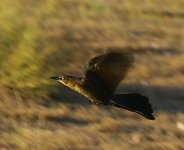
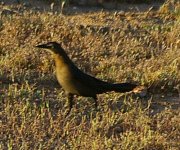
Boat Tailed Grackle...Quisculous major.. allegedly an East Coast bird, but I've seen it here and in Nevada.
I think they might be Great-tailed Grackle Quiscalus mexicanus
http://stealthispicture.com/images/grackle-great-tailed-fm/index.htm
Distribution map
http://www.mbr-pwrc.usgs.gov/bbs/htm96/map617/ra5139.html
davefoc
Philosopher

I think they might be Great-tailed Grackle Quiscalus mexicanus
http://stealthispicture.com/images/grackle-great-tailed-fm/index.htm
Distribution map
http://www.mbr-pwrc.usgs.gov/bbs/htm96/map617/ra5139.html
I went back and forth between pictures of great tailed and boat tailed grackles trying to figure out how they can be distinguished. In the end I didn't end up with a way to determine which one the picture was.
The color was surprising in that I believe the males of both species appear iridescent black and this bird appear a bit brown. But maybe that is just the light or maybe this is a female?
sphenisc
Philosopher
- Joined
- Jul 14, 2004
- Messages
- 6,253
I went back and forth between pictures of great tailed and boat tailed grackles trying to figure out how they can be distinguished. In the end I didn't end up with a way to determine which one the picture was.
The color was surprising in that I believe the males of both species appear iridescent black and this bird appear a bit brown. But maybe that is just the light or maybe this is a female?
If you look at these two pictures
http://en.wikipedia.org/wiki/File:Boat-tailed_Grackle_female.jpg
http://en.wikipedia.org/wiki/File:Great-tailed_Grackle_-_female.jpg
you can see the difference in tone, Boat-tailed is has a more russet-brown plumage than Great-tailed's plain brown. The head shape is also different, Boat-tailed being more domed, peaking well behind the eye, whereas great-tailed is flatter. The lores of Great-tailed generally show a distinct dark triangle between the eyes and beak, and the iris colour is a strong pale yellow in Great-tailed, dark in the Gulf Coast form of Boat-tailed, the form most likely to be in the range of Great-tailed.
I think all the features on your bird, and the distribution, point to Great-tailed
the only point against is the slightly russet tone on the throat of the bird in your second picture - and I think that can be explained by the low angle of the sun.
Your hummingbird I think is Anna's Calypte anna.
http://www.sierrafoothill.org/images/Gallery/FemaleAnnaHummingbird.jpg
It's the only one I can find with the right density of spotting on the throat and the mottled dusky underside. And it does seem to occur in California.
Rolfe
Adult human female

My goldfinches appear to be staying. I saw a flock of 5 or 6 at my bird feeder one evening a week or two ago, and every day a pair seem to turn up. They like the peanuts but I'm going to buy them some actual goldfinch nosh.
The yellowhammers are frequent visitors too, and I saw some greenfinches yesterday along with the obligatory chaffinches and blue tits. Quite a colourful crew!
I'm still not sure if all the dull chaffinch-looking birds are female chaffinches. Some of them seem rather different and perhaps to have small crests, but they're not any bigger than the average chaffinch, possibly slightly smaller. Any ideas?
Rolfe.
Do you mean niger thistle. It seems to me that the finches are just as happy with sunflower seed, so I quit feeding thistle.My goldfinches appear to be staying. I saw a flock of 5 or 6 at my bird feeder one evening a week or two ago, and every day a pair seem to turn up. They like the peanuts but I'm going to buy them some actual goldfinch nosh. {snip} Rolfe.
davefoc
Philosopher
sphensic,
Thanks for the reply.
I'm pretty sure that you're right about the hummingbird. When I decided what it was the first time I went back and forth between the two birds and then made the wrong decision. Now when I look again, it seems like anna's is clearly a better choice and that added to the fact that the black-chinned is listed as rare in my area seems like pretty strong evidence.
As to the two grackles (not my pictures), I see what you're talking about, but the eye color looks like it might be definitive. The boat-tailed seems to have a dark eye and the great-tailed has a yellowish eye.
I Ratant
Penultimate Amazing

- Joined
- Apr 8, 2008
- Messages
- 19,258
I used to see the Boat Tailed Grackle back east, and those were much blacker than the ones I see out here.
My bird book didn't have the Great Tailed.. the photo it had of the Boat Tailed matched this one almost perfectly in shape and color.
My bird book didn't have the Great Tailed.. the photo it had of the Boat Tailed matched this one almost perfectly in shape and color.
Rolfe
Adult human female
Do you mean niger thistle. It seems to me that the finches are just as happy with sunflower seed, so I quit feeding thistle.
Maybe, not sure what's in it as I haven't bought any of it yet. Funny, they seem at the moment to be keener on the peanuts than the seed feeder, which has some sunflower seed in it.
I have a problem with one of my two fat-ball feeders, which is so close to the bird-table and water-bowl fittings on the bird feeder that carrion birds can stand on these fittings and stuff their faces with fat ball. I'm not that interested in encouraging a bunch of rooks, thankyouverymuch. So my plan is to replace that feeder with another item, something the rooks won't be that interested in, and either a goldfinch-treat or a sunflower seed feeder would probably fit the bill.
Rolfe.
Last edited:
I Ratant
Penultimate Amazing
- Joined
- Apr 8, 2008
- Messages
- 19,258
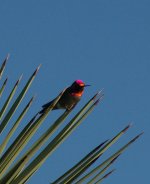
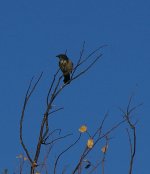
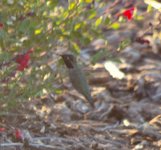
A Costa's, and a Scrub Jay Aphelocoma calofronica..
The total bright red (and sometimes flashing orange head) really catches the eye on the Costa's.
And probably an Anna's...
The total bright red (and sometimes flashing orange head) really catches the eye on the Costa's.
And probably an Anna's...
Attachments
EHocking
Penultimate Amazing

A trip to Scotland over the bank holiday yielded a few species I've not seen for quite a while, namely the Eider, Guillemot and Goosander, here's the rest.
2nd May, Helensburgh, Scotland
Eider, Somateria mollissima
Great Cormorant, Phalacrocorax carbo
Shelduck, Tadorna tadorna
Mallard Anas platyrhynchos
Buzzard, BUteo buteo
Kestrel, Falco tinnunculus
Oystercatcher, Haematopus ostralegus
Great Black-backed Gull, Larus marinus
Common Gull, Larus canus
Sky Lark, Alauda arvensis
Jackdaw, Corvus monedula
Rook, Corvus frugilegus
Hooded Crow, Corvus corone cornix
Raven, Corvus corax
Starling, Sturnus vulgaris
House Sparrow, Passer domesticus
3rd May, Loch Lomond, Scotland
Goosander, Mergus merganser
Grey Heron, Ardea cinerea
Canada Goose, Branta canadensis
Mute Swan, Cygnus olor
Coot, Fulica atra
Moorhen, Gallinula chloropus
Great Spotted Woodpecker, Dendrocopos major
Green Woodpecker, Picus viridis
Barn Swallow, Hirundo rustica
House Martin, Delichon urbica
Pied Wagtail, Motacilla alba
Chaffinch, Fringilla coelebs
Coal Tit, Parus ater
Greenfinch, Carduelis chloris
Siskin, Caruelis spinus
4th May, Port Glasgow, Scotland
Black Guillemot, Cepphus grylle
Northern Gannet, Morus bassanus
Shag, Phalacrocorax aristotelis
I'll have to follow up with Kotatsu on my Easter and NY lists.
Rolfe
Adult human female
Saw a pair of lapwings on my way to work this morning. This was just to the west of the A702 on the foothills of the Pentlands, between West Linton and Carlops.
Did I mention I have the most beautiful drive to work every morning?
By the way, when I claimed to have hoodie crows in my garden, I'm not so sure. I'm not certain I can distinguish between jackdaws and hoodie crows. I need more practice. I definitely have rooks and jackdaws, and crows of some sort as well. But most of the black carrion birds I see seem to be rooks or jackdaws.
Rolfe.
EHocking
Penultimate Amazing
Practice is obviously the best approach.the way, when I claimed to have hoodie crows in my garden, I'm not so sure. I'm not certain I can distinguish between jackdaws and hoodie crows. I need more practice. I definitely have rooks and jackdaws, and crows of some sort as well. But most of the black carrion birds I see seem to be rooks or jackdaws.
Rolfe.
A couple of hints.
Size: Hooded are about the same size as Rooks. Jackdaw are smaller - think more in the region of a Blackbird than a Rook.
Colour: Jackaw really only have a shade of grey on their nape and chest, where Hooded Crow have a distinctly grey body, with black head and wings.
Bill Size: Jackdaw has a much smaller bill - quite un-crowlike, actually.
Eye Colour: Jackdaw has a white iris contrasting quite well with it's plumage colour, whereas Rooks and Crows predominantly have black eyes.
Hope those help.
sphenisc
Philosopher
- Joined
- Jul 14, 2004
- Messages
- 6,253
Saw a pair of lapwings on my way to work this morning. This was just to the west of the A702 on the foothills of the Pentlands, between West Linton and Carlops.
Ah Carlops, the village you can drive through holding your breath.

Aviemore area, Highland, Scotland 02/05/09
Capercaillie Tetrao urogallus
Osprey Pandion haliaetus
Dipper Cinclus cinclus
Common Sandpiper Actitis hypoleucos
03/05/09
Black Grouse Tetrao tetrix
Common Tern Sterna hirundo
Rolfe
Adult human female
Ah Carlops, the village you can drive through holding your breath.
And you probably need to, given the local parking habits....
It used to be "Oh, this is Breich, was it", but they've built a bit more of that now. I suspect they'll build more of Carlops over the locals' dead bodies. This is the place that won't have street lights because it would spoil their view of the night sky, and has no mobile phone reception because when they put up a mast it was found the next day neatly disassembled and stacked by the roadside. "The witches did it."
Most of the houses look as if they're derelict, but the place has its own orchestra, jazz band and film society, and the place is heaving with university professors. I was in the village hall at the weekend rehearsing the Monteverdi Vespers of 1610.
Mind you, Silverburn isn't much bigger. I get the giggles when the media get that one mixed up with the new shopping centre over Glesca way.
Now I need to find some way to drag in birds so as to stop this being off topic.
I've been identifying the jackdaws by the smaller bill. They seem to me to be intermediate in size between the rooks and the blackbirds.
Rolfe.
EHocking
Penultimate Amazing
It's official - summer is here
Just spotted my first Swifts (Apus apus) of the year down here in London.
Just spotted my first Swifts (Apus apus) of the year down here in London.
Dragon
Graduate Poster

- Joined
- Mar 20, 2002
- Messages
- 1,639
I often go to Reading with Mrs D to see her elderly father. I've been there 4 times so far this year and every time I've seen one or more Red Kites (Milvus milvus ). Most recently on Saturday 2nd May I saw a pair near father-in-law's house in Caversham and later another single bird when we went out for a pub lunch. They often beat up and down not far above the rooftops. The one near the pub swooped into a garden at one point but didn't seem to catch anything.
I can remember when these beautiful birds were down to a few pairs in mid-Wales. Thanks to conservation and re-introduction from continental Europe they're across much of central England and up into to Scotland.
I can remember when these beautiful birds were down to a few pairs in mid-Wales. Thanks to conservation and re-introduction from continental Europe they're across much of central England and up into to Scotland.