• Quick note - the problem with Youtube videos not embedding on the forum appears to have been fixed, thanks to ZiprHead. If you do still see problems let me know.

Flight 93 impact forces

jaydeehess

Penultimate Amazing
Joined
Nov 15, 2006
Messages
20,849
Location
40 miles north of the border
On another forum there is a debate about the force of the impact of flight 93 especially compared to the Sandia Labs test of an F4 into a concrete block.

I idealized the two and compared the impact forces.

Could someone with a little more physics or engineering comment on what i wrote.
I believe that as far as direct comparisons this is Ok.

....the force of impact, in a perfectly elastic collision, that is calculated by taking the kinetic energy of the object and dividing it by the distance through which the decelleration took place. (or the change in momentum divided by the time of decelleration) and this has to be done vectorially.

Idealizing the collision between aircraft and Earth
the Boeing (flight 93) has a mass of 100,000Kg
it is travelling at 255 meters per second
The trench and crater are 2-3 meters deep(call it 3m)

0.5 X 100,000 X 2552 / 3 = 1.1 X 10⁹ Newtons

A Boeing 757 just sitting on a runway exerts about 1 X 10⁶ Newtons
on the ground beneath it. Thus the force of the impact was approx 1000 times that due to gravity.

The F4 ( in the Sandia test) has a mass of 13,500 Kg
was travelling at about 210 meters per second
and the collision lasted about 0.05 seconds
13,500 X 210/ 0.05 = 57 x 106 Newtons
an F4 sitting on the Earth exerts about 13 X 104Newtons on the ground
Thus the impact was just under 500 times the force due to gravity.
 
Last edited:
NOTE: Your superscript 2 didn't copy into this forum, but I got the point.

I actually checked your math the first time (on the other board). I didn't repeat your calculations, but I checked the formulas and it looked kosher to me.

It doesn't matter because the people you are arguing with literally ignore math. They will quote your post, edit out all the math, argue with the text intro, and directly contradict the position your math just provided.

They don't understand that your math is trying to account, quantitatively, for things like the "softness" of the ground versus the "hardness" of concrete. They'll just say "the f4 video doesn't apply because the ground is softer". And you'll say "I just showed you the math that your objection is insufficient" and they'll reply, "You have no common sense. Stick a shovel into the ground and then try to stick one into concrete. All the math and the physics don't matter if you have no common sense". This will continue for twenty posts or so, until you get tired, frustrated, and just start posting "lie" with righteous indignation.... like me.
 
Perhaps you might explain what each of the terms are of your equations.
 
Thanks, AS. But am I wrong in highlighting this?
Idealizing the collision between aircraft and Earth
the Boeing (flight 93) has a mass of 100,000Kg
it is travelling at 255 meters per second
The trench and crater are 2-3 meters deep(call it 3m)
0.5 X 100,000 X 2552 / 3 = 1.1 X 10⁹ Newtons

ETA. Should that really be 255m/S2
 
Last edited:
I tried to bring that up in my NOTE in my first post.

It should be 255^2. Kinetic energy being 0.5mv^2. In his original post, it was a superscript 2. In the copy&paste it got un-superscripted.
 
Ah, OK. Thanks! I was a bit left behind wondering for a moment there.

Missed the Note bit, AS. Damn, I need better eyewear...
 
It's actually a pretty interesting result that the 757 into the ground results in higher average force than the f4 into the wall (even when normalized for mass).

My main objection to your calculation would be that you didn't account for the 40-degree impact angle, and as such, the "path" through the ground of flight 93 is actually diaganol, so 3m may be an underestimate, may not. Difficult to say.

The other issue is that neither plane actually comes to complete rest, so if you un-idealize the model a little bit, you'd need to account for this, as well. It's my intuitive guess that a square impact would result in less energy "loss" to redirected mass than an oblique impact. In this sense, the angled impact would have more energy in re-directed mass then in damaging the airplane. This is another quantity that is virtually impossible to estimate.
 
NOTE: Your superscript 2 didn't copy into this forum, but I got

edited to correct it

This is another quantity that is virtually impossible to estimate

Hence my idealization of the two collisions.

The path through the ground would have the effect of keeping some redircted parts of the plane in contact with the ground much longer. The longer the contact time the more energy transfered into tearing those parts apart.

As anti-sophist knows, I have also made the arguement that flt 93 did not encounter only 'soft' soil. Rather, since it is reclaimed strip mine land the top cover is sand and gravel but below that is rubble left over from the removal of the overburden from the coal trench, heavy, rough , blast rock. At 580 mph and at a high angle it would behave pretty much like a solid mass. That is partly the rational of why I arrived at a 3 m depth of the crater. That and the pictures of the crater.
 
The problem is you are arguing using mathematics with TerrorCell and Killtown.

Terrorcell will literally ignore math. It's like kryptonite.

Killtown has never met a planecrash that has actually happened. All 4 flights on sep11, the Sandia F4 test, and Corey Lidle's crash, in his opinion, are all faked. You should read his Lidle-crash analysis and realize how his fallacious approach can litterally be used anywhere and at any time to disprove anything.
 
It's actually a pretty interesting result that the 757 into the ground results in higher average force than the f4 into the wall (even when normalized for mass).

My main objection to your calculation would be that you didn't account for the 40-degree impact angle, and as such, the "path" through the ground of flight 93 is actually diaganol, so 3m may be an underestimate, may not. Difficult to say.

The other issue is that neither plane actually comes to complete rest, so if you un-idealize the model a little bit, you'd need to account for this, as well. It's my intuitive guess that a square impact would result in less energy "loss" to redirected mass than an oblique impact. In this sense, the angled impact would have more energy in re-directed mass then in damaging the airplane. This is another quantity that is virtually impossible to estimate.

There's also the point that the two aircraft have very different frontal surface areas. Again, idealised, the 757 is about 6 or 7 metres in diameter across the body alone, not counting engines, etc. So:
A = pi*(d/2)^2
=3.141*3^2
= 3.141*9
~=30sqm frontal area

Where as the F4 would be lucky to be 2 metres diameter:
~3.5sqm frontal area

So the force per square meter hitting the ground directly is actually less for the 757 than the F4.
 
A = pi*(d/2)^2
=3.141*3^2
= 3.141*9
~=30sqm frontal area

Where as the F4 would be lucky to be 2 metres diameter:
~3.5sqm frontal area

So the force per square meter hitting the ground directly is actually less for the 757 than the F4.

I don't think so. Even if we (almost absurdly, now, heh) assume that the force that brought the planes to rest was distributed evenly in those areas (keeping in mind that in reality these areas are hollow). He calculated forces seperated by a factor of 10^2 (he had 10e9 vs 10e7), or so. Your area difference is only 10^1.

Only after he normalized for mass did he get a factor of 2. You are trying to normalize the force to area, whereas he used mass. Yours is an estimate of "force per unit area" of the impact region, and his is sort of "force per unit mass" of the jet. In either case, the 767 gets more. I think.. anyway.. unless I made a boneheaded mistake or misread something.
 
Last edited:
I agree with all that. My point was really that for the big jet you were expending the force of deceleration of mass over a much bigger area than for the F4. Therefore the displacement of force through the airframe will be significantly different.

Parallel: A five tonne elephant dropped from 100 metres behaves a lot differently when it impacts than a five tonne rocket dropped nose-first from the same height. (Animal rights people can stop right there - in real life I would NEVER hurt a rocket like that!)

And I was wondering just how idealised you could take this situation before it becomes unrepresentative of reality anyway. That is, the model breaks down.
 
And I was wondering just how idealised you could take this situation before it becomes unrepresentative of reality anyway. That is, the model breaks down.
Depends entirely on the question we are asking.

Foir the original question, this ideal model is sufficient to put the two events into the same ballpark and demonstrate some scientific value to a comparison between the two events -- especially in regards to the macro-behavior of the matter (ie, the "vaporization"). It's especially good because it shifts the onus of refutation to the conspiracy theorists. This is a double win because they'll instantly admit defeat (by changing the subject).
 
Last edited:
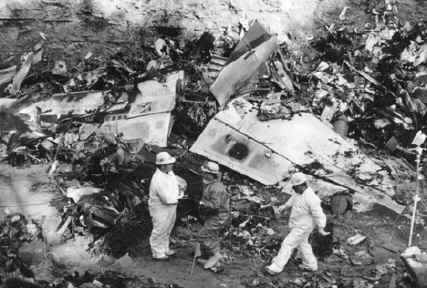
US Air 427...


usair427.jpg


BW-Wreckage.jpg
 
US Air 427 was on landing approach when it went down. Its last recorded indicated air speed was 272 knots at 1188 feet. Its main ground scar was 25 feet long and 14 inches deep. ETA: according to Aviation Safety Network, flight 427 hit the ground at 261 knots.

UA flight 93 struck the ground at over 500 knots.

Your point, Skeptic4Sure?
 
Last edited:
US Air 427 was on landing approach when it went down. Its last recorded indicated air speed was 272 knots at 1188 feet. Its main ground scar was 25 feet long and 14 inches deep. UA flight 93 struck the ground at over 500 knots.

Your point, Skeptic4Sure?

You know what my point is.

Do you have proof, that is what 93 did?

Do you have a FDR that recorded that? How many witnesses do you have that corroborate that?
 
You know what my point is.

Do you have proof, that is what 93 did?

Do you have a FDR that recorded that? How many witnesses do you have that corroborate that?
Why don't you read the FDR data like everyone else has done, Mr. "elite researcher?"
 

Back
Top Bottom