Extraordinary Claims Require Ordinary Evidence?

Second, why does an extraordinary claim require a higher level of evidence than any other claim? Why isn't ordinary evidence enough? When people claim telepathy, for example, we'd be satisfied if they could just correctly identify items they can't see at a percentage higher than chance. That's not extraordinary in my book.

This is easier to answer than the rest, and the rest of the answers stem from this one. The answer is that extraordinary claims by their nature need to explain not only the novel data/outliers it intends to explain, but also all the other data that the ordinary claims explain. Take, for example, an alternative theory to evolution (any will do). These not only need to explain whatever anomalies the researcher proposing the idea feels are important, but also all the data that evolutionary theories already explain. If it fails to do so, parsimony will dictate that we accept the established paradigm.

That's what cranks always seem to forget: you need to explain ALL the data, not just the anomalies. And doing so is extremely hard for many areas of science, because the paradigms have a huge amount of data supporting them. Hard, but not impossible--string theory and epigenetics are examples of ideas that are widely accepted (or at least not dismissed as outright insane) and which violate what was previously accepted as the dominant paradigm. That was Einstein's and Darwin's great accomplishment: basically, what they did boiled down to an explanation that explained ALL the data. It's a rare mind that can do that.

First, what is an extraordinary claim?
The simplest answer is "Any claim that's proposed as an alternative to the dominant paradigm." It'll get bogged down at the fringes, but as a rule of thumb it'll work just fine.

So--third--what is extraordinary evidence, anyway?
Again, the simplest answer is "Any evidence that's not explainable by the current paradigm." And again, it'll get hard to deal with at the fringes, but will work for most purposes.

That said, one fringe is that the dominant paradigm can be held long after it should have rationally been discarded. Uniformitarianism sensu stricto lasted far longer than it should have, for example. But odds are, unless you're involved in the debate you won't deal with such situations, so the rules of thumb above should work out just fine.
 
Sagan seems to have underestimated the lengths pedantic literalists will dive when presented with semantics.

Sagan coined the phrase because it was catchy to the ear, not because he was claiming such a thing as ordinary and amazing evidence intrinsically exists apart from each other.

For something that is extraordinary, you need a higher degree of scrutiny for a claim than you would for a claim that is mundane. You may accept someone has a car in their garage on anecdote, but something like a claim that dragon eating ghost yeti is in your garage would require something more than an anecdote.

Sagan coined the phrase as an answer to something like people who seem to think lots of eye witness testimony of alien abductions are compelling evidence to believe in alien abduction. But that would be irresponsible of an honest mind for such an out of the ordinary claim. You need more than testimony to consider such a claim persuasive.

As well, by virtue of proving the extraordinary, any evidence which could do so would be extraordinary for doing so. Touching something's hand is not inherently extraordinary, but touching the hand of an alien life form is. To believe something paradigm shifting and fantastic is true, you need a very thorough example of evidence. Basically he's just saying you need something more thorough than faith in testimonials to accept something that is incredible.
 
Last edited:
A more down to earth case would be the Missoula Badlands.....the claim that this occurred in a few days....

[qimg]http://i106.photobucket.com/albums/m269/macdoc/junk%20album/Drumheller_Channels.jpg[/qimg]

took a while..... the claimant was correct.


http://en.wikipedia.org/wiki/J_Harlen_Bretz

but he was castigated in the 20s and for decades beyond

Look up black swan events for other "overturns"

I followed your link and from there to http://en.wikipedia.org/wiki/Channeled_Scablands

The Channeled Scablands are a unique geological erosion feature in the U.S. state of Washington. They were created by the cataclysmic Missoula Floods that swept periodically across eastern Washington and down the Columbia River Plateau during the Pleistocene epoch.

How do you understand that to mean "in a few days"?
 
I followed your link and from there to http://en.wikipedia.org/wiki/Channeled_Scablands


How do you understand that to mean "in a few days"?

Sometimes. you just have to go beyond Wikipedia, to the links the writers of the Wiki article have supplied as their sources....

http://www.nps.gov/history/history/online_books/geology/publications/inf/72-2/sec5.htm

"The duration of the flood is not known, but a reasonable guess is that at any one point on the lava field it consisted of a series of surges, and that the crest was short-lived—perhaps lasting only a day or two. At Wallula Gap, where the maximum flow was calculated at nearly 40 cubic miles per day, the main part of the flood probably lasted 2 to 3 weeks."
 
Thanks for the heads-up!
I'd understood the flooding to be a repeated event, not a one-off.

ETA:
From your link
"The duration of the flood is not known, but a reasonable guess is that at any one point on the lava field it consisted of a series of surges, and that the crest was short-lived—perhaps lasting only a day or two. At Wallula Gap, where the maximum flow was calculated at nearly 40 cubic miles per day, the main part of the flood probably lasted 2 to 3 weeks.

The maximum rate of flow at the site of the ice dam has been estimated at 9.5 cubic miles of water per hour. If this rate were sustained, Glacial Lake Missoula would have drained in little more than two days. The maximum rate of flow at Wallula Gap has been estimated at 39.5 cubic miles per day, which would drain the lava field in about two weeks. But these maximum rates of flow probably could not have been maintained for that long. A realistic estimate of the duration of the flood, from the time when water first spilled over the ice dam to the time when scabland streams returned to normal flow, was probably about a month."

I still don't quite see that this tremendous event can be called one lasting a few days.
 
Last edited:
For something that is extraordinary, you need a higher degree of scrutiny for a claim than you would for a claim that is mundane. You may accept someone has a car in their garage on anecdote, but something like a claim that dragon eating ghost yeti is in your garage would require something more than an anecdote.

Well, no. This simply requires the same level of evidence. Open the garage door, and there is a car there or not. Or there is a dragon eating ghost yeti there or not.

As far as the car is concerned, my first thoughts are, well, he/she probably does. But I do not care enough to look and find out, so if anybody makes this claim, well, who actually cares enough to look for the evidence. On the other hand, if somebody made the dragon eating ghost yeti claim, I would probably quietly back away and leave the room, or I would do the same thing - Open the garage door and look.

In both cases it is exactly the same level of evidence. The car or the yeti are either there or not there. So I tend to agree with the OP, that extraordinary claims require precisely the same level of evidence as any claim. If a claim is mundane (I have a lawn mower in my garage) who really cares enough to look?

Norm
 
"Extraordinary evidence" literally means "more than ordinary", which goes to the OP. Extraordinary claims should be supported by more than ordinary evidence.

Nope, the usual usage of scientific evidence is sufficient as is the application of controls, protocols and replication.

Every extraordinary claim will rise or fall on that.

There is no evidence for bigfoot, alien abductions, psychic powers or homeopathy.
 
I still don't quite see that this tremendous event can be called one lasting a few days.

Conventional wisdom had been that the region was eroded to the way we see it today gradually over a period of many hundreds of thousands of years. It was Harlen Bretz who first proposed that the landscape was changed dramatically by catastrophic flooding over a period of just a few days.

Yes, the floods (or more correctly, megafloods) were repeated events, thought to have occurrede every 30 to 60 years. The point is though, every time it happened, it changed the landscape in dramatic fashion. What you see now is the result of the last megaflood that occurred approximately 13,000 years ago.
 
Well, no. This simply requires the same level of evidence. Open the garage door, and there is a car there or not. Or there is a dragon eating ghost yeti there or not.

As far as the car is concerned, my first thoughts are, well, he/she probably does. But I do not care enough to look and find out, so if anybody makes this claim, well, who actually cares enough to look for the evidence. On the other hand, if somebody made the dragon eating ghost yeti claim, I would probably quietly back away and leave the room, or I would do the same thing - Open the garage door and look.

In both cases it is exactly the same level of evidence. The car or the yeti are either there or not there. So I tend to agree with the OP, that extraordinary claims require precisely the same level of evidence as any claim. If a claim is mundane (I have a lawn mower in my garage) who really cares enough to look?

Norm

I disagree. If I open the door and see a car there is a high probability there is a car there and a small probability I'm hallucinating a car.
If I see a yeti there is a high probability I'm hallucinating and a low probability it's really a yeti - and that's why I need more evidence.
 
Sagan seems to have underestimated the lengths pedantic literalists will dive when presented with semantics.

Sagan coined the phrase because it was catchy to the ear, not because he was claiming such a thing as ordinary and amazing evidence intrinsically exists apart from each other.
Indeed. I think Laplace's phrasing
Laplace said:
The weight of evidence for an extraordinary claim must be proportioned to its strangeness.
makes it clearer there is a quantitative not qualitative difference here.

Marcello Truzzi is probably the one to be credited with the Sagan-style phrasing:
Truzzi said:
An extraordinary claim requires extraordinary proof.
 
I disagree. If I open the door and see a car there is a high probability there is a car there and a small probability I'm hallucinating a car.
If I see a yeti there is a high probability I'm hallucinating and a low probability it's really a yeti - and that's why I need more evidence.
That's how I see it. I could have accidently eaten some magic mushrooms and be stoned out of my mind, I could have hit my head and be in urgent need of medical attention, a practical joker could have dressed up as a yeti in order to have a bit of fun with me ....

All these possibilities also exist for the car, but all my past experience of the world tells me that by far the most likely explanation for me seeing a car is that there really is a car there. It also tells me that the most likely explanation of me seeing a yeti is not that there really is a yeti there, so I need better evidence before concluding that I'm really seeing a yeti than I do before concluding I'm really seeing a car.
 
Post 4

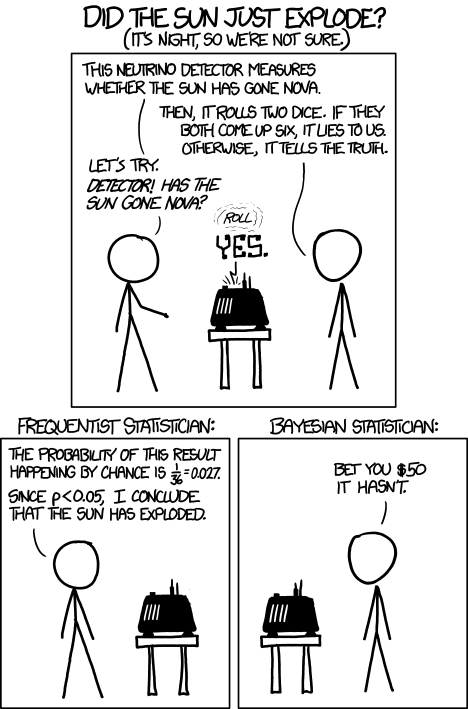
It's really Bayesian reasoning. .

does put the support for this claim in a nutshell. If your prior probability is small, then evidence carries little weight... And it take a great deal of evidence to shift that. Extraordinary claims will always have vanishing small prior probabilities, no?

Of course if her prior is zero, no amount of evidence can shake a Bayesian's beliefs...
 
Many Bayesians believe that representation of beliefs by probability is "common sense reduced to calculation." That's from Laplace.

ECREE does have a Bayesian interpretation, but if that is what Sagan meant, then it lacks much oomph. In Bayesian terms, ECREE would just mean that the less believable you think something is, the more surprised you'd be to find persuasive evidence in its favor.

Well, duh.

All Bayes adds to bits of common sense like that, in this case a near tautology, is a representation of an interior mental state using numbers and arithmetic, just as Laplace said.

Some people think that Sagan meant to propose a more muscular interpretation, for example, an impeachment for some uncertainties of certain kinds of evidence that would ordinarily be acceptable for other uncertainties. For example, Hume ruled out personal testimony in the case of religious miracles, even though personal testimony is good enough to get people killed in the American (and UK) legal system, where the prosecutor's burden of proof of criminal guilt is described as "beyond a reasonable doubt." Nevertheless, Hume wrote

... [T]herefore we may establish it as a maxim, that no human testimony can have such force as to prove a miracle, and make it a just foundation for any such religion.

~ An Enquiry Concerning Human Understanding; section 10, part 2, paragraph 10

Bayes, as such, does not rule out any kind of real-world event from serving as evidence, including testimony, nor is there any distinction about the kinds of uncertain questions upon which a particular type of evidence, like testimony, might bear.

So does Sagan mean to do something like Humes meant to do for testimony about miracles?

Sagan uses the phrase in Episode 12 of the 1990 television version of Cosmos: A Personal Voyage.

What counts is not what sounds plausible, not what we would like to believe, not what one or two witnesses claim, but only what is supported by hard evidence rigorously and skeptically examined. Extraordinary claims require extraordinary evidence.

He also applied ECREE in an interview about his rejection of alien abduction claims,

http://www.pbs.org/wgbh/nova/space/sagan-alien-abduction.html

He seems to be doing for alien abduction claims precisely what Hume described for religious miracles: looking past testimony, even critically analyzed and cross-examined testimony, and holding out for evidence that is different in kind, the "hard" evidence of the 1990 TV quote.

If so, then he would not merely be restating the almost tautological Bayesian position that relates confidence to surprise at being persuaded otherwise. I do not take Sagan to be denying the ability of Bayes to model rational belief, including his own, but rather he is talking about adding another principled heuristic to the general-purpose Bayesian principles.
 
A claim that runs counter to the current understanding of the world, often having been repeatedly disproven already, is extraordinary.

The patent office doesn't accept applications for perpetual motion machines anymore. Barring, of course, a working model :)
 
I think xkcd sums it up pretty well:

frequentists_vs_bayesians.png
 
If your prior probability is small, then evidence carries little weight... And it take a great deal of evidence to shift that. Extraordinary claims will always have vanishing small prior probabilities, no?
Fortunately evidence accumulates in a multiplicative manner - probabilities multiply together and you can usually rapidly accumulate strong evidence. Extraordinary claims that are actually true can be established more easily than might naively be thought.

Of course if her prior is zero, no amount of evidence can shake a Bayesian's beliefs...

No Bayesian would ever allow a probability to reach 1 (or equally 0) except for things that can be mathematically or logically established as genuinely certain. This is Cromwell's Rule.
 
The Channeled Scablands are a unique geological erosion feature in the U.S. state of Washington. They were created by the cataclysmic Missoula Floods that swept periodically across eastern Washington and down the Columbia River Plateau during the Pleistocene epoch.
Small world--I was just reading about Lake Missoula yesterday!

I think (given the rest of the stuff I've read) the argument is that the lake catastrophically emptied on occasion. The landscape wasn't entirely formed in a few days, but significant hunks of it were.

This is an example of an extraordinary claim actually providing extraordinary evidence. Uniformitarianism was the dominant paradigm in geology for a hundred years or so. And it's great, as far as it goes--things generally DO form slowly and gradually. But things like the K/Pg Mass Extinction, the glacial grooves in Lake Erie, Lake Missoula, etc. simply can't be explained by slow, gradual processes. The Neocatastraphists provided extraordinary evidence--extraordinarily well-documented, extraordinarily precise, and extraordinarily voluminous. The idea has since come to dominate sedimentology.
 
I think we should discriminate between evidence that proves a claim (positive) and evidence that disproves it (negative).

A claim that is extraordinary is , pretty well by definition, one that takes extraordinary positive evidence to confirm it.

But it may be disproven by one trivial counterexample, just like any other claim, unless the extraordinary part includes a clause disqualifying trivial negative evidence.
It all depends what "extraordinary" means.

Most religious claims are like this. The claimants also claim that scientific evidence simply does not count, unless it supports the claim. Given a claim of that nature, the only evidence able to disprove it would itself be miraculous.
 
Soapy Sam said:
But it may be disproven by one trivial counterexample,
I hesitate to support that criteria. It works fine in physics, but once you get into o-chem, biology, or geology it rapidly starts to break down. The issue is that those fields often deal with population statistics, and in those situations outliers are expected. In geology we expect 5% of the data to be screwy--and in paleontology if it's less than 25% we're often ecstatic. Sometimes in biology the answer is "That one's just weird. He's always been a bit off", which no biologist would take as an extraordinary claim but which your criteria would force us to accept as one.

Of course, in biology ordinary evidence can often support extraordinary claims. For example, a bit of fur would certainly be accepted as ordinary evidence by any biologist, but it would also be sufficient to prove the existence of bigfoot (if, of course, it was collected in a suitably well-controlled excursion). A photograph of an organism is often sufficient to prove it's not actually extinct. A handful of shells--just about the most ordinary data you can get in marine invert bio--was sufficient to make a range extension of more than a hundred million years in a number of cases--which is fairly extraordinary, you have to admit.

Perhaps each science will have to define these terms for themselves.
 

ISF - Join now!

Every member here is approved by hand. No bots, no spam, just people who care about evidence and honest debate.

Membership is free!

Create your free account

Back
Top Bottom