• Security incident: ISF was recently accessed by intruders. Please change your password, and change it anywhere else you used it. Read more

Explosions in Tianjin, China

Probably more likely a BLEVE than a FAE, but similar mechanism. BLEVEs are more destructive.

If the vapor is flammable and ignites, then what you get after the boiling liquid expanding vapor explosion pretty much is a fuel air explosion.
 
If the vapor is flammable and ignites, then what you get after the boiling liquid expanding vapor explosion pretty much is a fuel air explosion.

I think the main distinction is whether the fuel is dispersed before ignition or not.
 
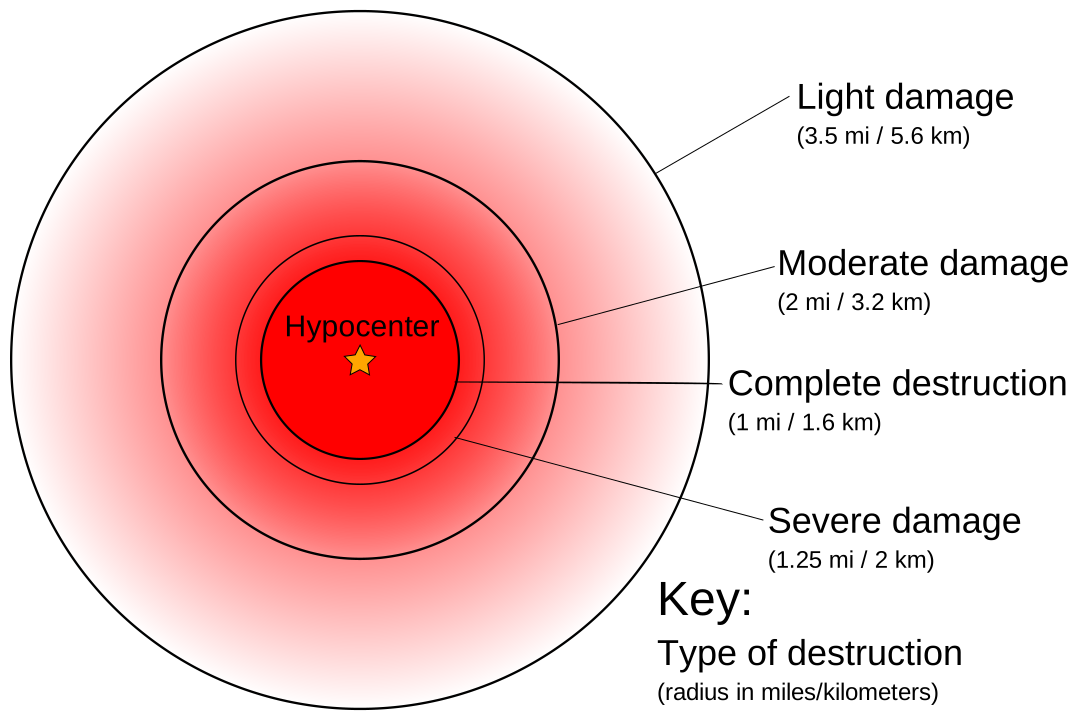
Here is a picture of how powerful the two nuclear blasts that hit Japan in WW2.

Abombdamage1945.svg

Now compare that with this disaster. I think they are not too much different in size.

Reference for the picture is (this is a condition of hotlinking).

"Abombdamage1945". Licensed under CC BY-SA 3.0 via Wikimedia Commons - https://commons.wikimedia.org/wiki/File:Abombdamage1945.svg#/media/File:Abombdamage1945.svg
 
Last edited:
Depends on your definition of "not too much". The nuclear explosion resulted in total destruction at a distance this explosion only caused some destruction.
 
Depends on your definition of "not too much". The nuclear explosion resulted in total destruction at a distance this explosion only caused some destruction.
True...but the destruction from a nuclear bomb blast isn't just from the blast, it's also from radiation. Someone fairly close to this blast could, conceivably, survive if they had adequate shelter; whereas someone close to a nuclear blast will be dead regardless.

That being said, I don't think that this is quite up there with nuclear explosions, although it'd be much closer to a small nuclear explosion than what we would usually see in most other non-nuclear situations. And I think that's the point that people are trying to make...that if we're comparing this to other explosions, the closest reference point is likely a small nuclear explosion.

 
Not sure how to interpret this statement, as you're implying the Hendetson blast was rather small. These figures are only for the first explosion. 17-45kg of TNT isn't much (only around 100 lbs, and a simple satchel charge is 40lbs). The net explosion total was around 1,000 tons.

I didn't mean to imply anything like that. The poster whom I quoted had refered to estimate of the first Henderson blast bein 17-45 kg, and the second Tianjin blast to be 21 tons, and saying that Tianjin was thus toward the lower end of Henderson. It seemed obvious that the poster was erroneously comparing kg with tons, and meant to correct that.

I understand that the first Henderson blast was perhapes from just one barrel and not the largest of them all.
 
FAE, Fuel-Air Explosive, that kind of thing probably happened here. A gas leak, a spark, go boom.

Accident or terrorism, the pundits will be babbling today.
Yep. Though there doesn't seem to be much suggetsion of a deliberate act.
A surplus of human stupidity (as with the Fort Stikine seems most likely.

I think the main distinction is whether the fuel is dispersed before ignition or not.
And whether it's deliberate?
 
I didn't mean to imply anything like that. The poster whom I quoted had refered to estimate of the first Henderson blast bein 17-45 kg, and the second Tianjin blast to be 21 tons, and saying that Tianjin was thus toward the lower end of Henderson. It seemed obvious that the poster was erroneously comparing kg with tons, and meant to correct that.
That was just me posting before the coffee kicked in.
 
Wow. I have been in Tianjin a lot of times. Actually, the hotel I usually stayed in must have had an absolutly panoramic view of the disaster. I wonder if the windows held.:eek:

Hans
 
On the radio earlier they said the warehouse stored Calcium Carbide which reacts explosively when exposed to water. The firefighters may have inadvertently caused the explosion when they sprayed water on the fire.

Steve S
 
True...but the destruction from a nuclear bomb blast isn't just from the blast, it's also from radiation. Someone fairly close to this blast could, conceivably, survive if they had adequate shelter; whereas someone close to a nuclear blast will be dead regardless.

That being said, I don't think that this is quite up there with nuclear explosions, although it'd be much closer to a small nuclear explosion than what we would usually see in most other non-nuclear situations. And I think that's the point that people are trying to make...that if we're comparing this to other explosions, the closest reference point is likely a small nuclear explosion.
These are images from the Texas City explosion. The are eerily similar.

http://digital.lib.uh.edu/collection/p15195coll4
 
Dodged a bullet there. I'm amazed that after the second blast he doesn't back up faster.
I'm thinking shell shocked, this persons ears had to be ringing*. The dash cam was the only thing calm in that car. Everyone else was in full WTF mode.

* having been fairly close to large explosions, it was likely an airy silence (as your ears recover).
 
Last edited:
These explosions are the biggest I've ever seen apart from some nuke tests or the old Hiroshima footage. It's totally nuts, it looks apocalyptic. Even Michael Bay would be thinking that's too much. It's hard to shock me due to years of desensitisation but this did.

I couldn't help but think about 911 truthers and all the arguments I've had telling them how real bombs would look like. The amount of time trying to explain about how they couldn't tell us there were absurd amounts of explosives blasting the WTC apart but also not go boom or cause shock waves. Urgh.

I find it hard to believe less than 100 died, it looked like it look out half the damn city!
 
Last edited:

ISF - Join now!

Every member here is approved by hand. No bots, no spam, just people who care about evidence and honest debate.

Membership is free!

Create your free account

Back
Top Bottom