• Security incident: ISF was recently accessed by intruders. Please change your password, and change it anywhere else you used it. Read more

Evolution a hoax?

Ok, look it up and show me it's descendants or even that the common consensus among evos is that it is ancestral (peer-review lit or quotes from it please).

What you will find is it is called an intermediate but not considered to have left descendants.


I don't have to look up anything since I'm not the one defending the claim that evolution is a hoax. You, on the other hand, are apparently unable to effectively defend that position without resorting to the dishonest tactic of deflecting the burden of proof. Shall we accept your inability to support that evolution-is-a-hoax position as your admission of defeat?
 
Here are more details on the data:

However, there are considerable anatomical differences between these and Pakicetus and Ambulocetus. No matter how much National Geographic tried to reduce these to a minimum by slight touches of the brush, when we look at the fossils it is clear they are not ‘transitional forms’ linking each other:

The backbone of the quadrupedal mammal Ambulocetus ends at the pelvis, and powerful rear legs then extend from it. This is typical land mammal anatomy. In whales, however, the backbone goes right down to the tail, and there is no pelvic bone at all. In fact, Basilosaurus, believed to have lived some 10 million years after Ambulocetus, possesses the latter anatomy. In other words, it is a typical whale. There is no transitional form between Ambulocetus, a typical land mammal, and Basilosaurus, a typical whale.

Under the backbone of Basilosaurus and the sperm whale, there are small bones independent of it. National Geographic claims these to be vestigial legs. Yet that same magazine mentions that these bones actually had another function. In Basilosaurus, these bones ‘functioned as copulary guides’ and in sperm whales ‘[act] as an anchor for the muscles of the genitalia.’[6] To describe these bones, which actually carry out important functions, as ‘vestigial organs’ is nothing but Darwinistic prejudice.

http://www.trueorigin.org/ng_whales01.asp
 
So as someone that actually has read and reviewed the changing claims related to this organism, I am the ignorant one. Yet you have not and simply believe some simplistic claims are the informed one.


The question was, "Your qualifications to speak with any authority or expertise on the issue of paleontology are...?" Your transparently dishonest evasion is noted.
 
For those of you interested in randman's repetition of what he said about whales back in March, you can start here (be sure to keep reading to see where randman wonders why bacteria didn't evolve into whales, and his complete and utter misunderstanding of what a niche is).

For those of you interested in whale evolution, here's a paper that gives a good overview of recent evidence and theories (including a number of transitional species oh-so-conveniently ignored by randman's trueorigins link).
 
Last edited:
The question was, "Your qualifications to speak with any authority or expertise on the issue of paleontology are...?" Your transparently dishonest evasion is noted.

Uh huh. So no one can read and quote scientists in a field unless they are in the field?

Doesn't that mean no one can accept or believe evo theory unless they are evolutionary biologists? And they cannot even comment on the fossils?

You guys will do anything not to discuss the details of the data, won't you?
 
No, the whale fossils do not.
We seem to have 2 different ways of looking at the same evidence.

There are some ways we can settle this!

1. Make predictions about where we will find new fossils, and what features they will have. Evolution can help us do this: It can help us estimate where new transitional forms are found. Creationism does not lend itself to such predictions. But, if you want to try, be my guest.

I predict new fossils will fall into patterns predicted by the evos.

2. We can devise strategies for whale conservation. Again, the knowledge gained through evolution studies helps contribute towards this. I predict it will. I also do not think Creationism would be able to help in any way.

3. Genetic research. We can see if the genes of modern whales have traces of their land-based ancestors. In a similar way, we can look at morphology, but you can just dismiss that in various ways.

Etc.

Can anyone suggest other strategies for settling the issue?

Do-While Jones is not helping us settle the issue:

The first problem, known for 60 years, is that the evolution from Mesonychids to Pakicetus happens much too quickly, even for evolutionists.
Fossils between the two have been found. Look at the material I linked to you.

We know the rate of evolution changes. Incidentally: You even claimed "punctuated equilibrium" debunked evolution. Now, you seem to be linking to an article implying that the concept would support evolution, if it were true?

If you think there was a Design between those two stages, tell us how it happened.

Fossil dating isn’t an exact science.
It is a science that improves in accuracy over time. And, the dating of the fossils can be confirmed through other lines of investigation, if the original measurements are called into question.

there aren’t very many early whale fossils. Does
This does not debunk evolution. If you think whales were designed, point to when, where, how, and/or why they were designed.

It’s the geographical gap that makes the “transitional form” argument even less convincing.
Whales move around. Wow, that really smacks against everything in evolutionary thinking, doesn't it?! ;)

Modern whales have different shaped teeth than Basilosaurus.
Of course they do! We have transitions between the two.

Speaking of baleen whales, they differ from dolphins in another very important respect.
Dolphins branched off from whales, by then, so this is a non-issue.

If true, Himalayacetus completely throws out the evolutionists’ claimed sequence of transitional fossils that show how a land-dwelling mammal (Pakicetus) that occasionally ventured into fresh water turned into a mammal that swims in salt water all the time.
New discoveries change our view of evolution. It also changes the creationist views of life.

(But, I remind you that creationism does not change the views of evolution. It does not provide evidence for its claims.)

MORE IMPORTANTLY:

Do-While Jones is NOT promoting an alternative theory that fits the data better. He is just trying to bash evolution. And, that is not sufficient to prove Creationism.

His arguments are flimsy, to say the least. Do you understand why scientists would want to stick with ideas that are more reliable?

 
From your own link, ANT:

Externally, pakicetids look nothing like a modern cetacean. They are more similar to a wolf with a long nose and tail (Thewissen et al. 2001; www.neoucom.edu/DEPTS/ANAT/Thewissen/whale_origins/whales/Pakicetid.html). However, the details of the pakicetid skeleton tell a different story; this was not an ordinary land predator. The skulls show that the orbits (the sockets of the eyes) of these cetaceans were located close together on top of the skull, as is common in aquatic animals that live in water but look at emerged objects. Just like Indohyus, limb bones of pakicetids are osteosclerotic (Madar 2007), also suggestive of aquatic habitat, an interpretation consistent with stable isotope evidence (Roe et al. 1998; Clementz et al. 2006).

Now since the creature did not live in water and look at emerged objects (as was first believed), how would natural selection have acted upon this trait in the first place?

The truth is it was oversold as ancestral to whales; actually initially believed to be a fully aquatic whale and evos don't want to admit they were wrong.
 
For those of you interested in randman's repetition of what he said about whales back in March, you can start here (be sure to keep reading to see where randman wonders why bacteria didn't evolve into whales, and his complete and utter misunderstanding of what a niche is).

For those of you interested in whale evolution, here's a paper that gives a good overview of recent evidence and theories (including a number of transitional species oh-so-conveniently ignored by randman's trueorigins link).


Oh, so now you're resorting to actual peer reviewed scientific research. That's hardly fair! Any more of that and the bare assertions and arguments from incredulity offered by the evolution-is-a-hoax proponents might start to look pretty silly. :p
 
Make predictions about where we will find new fossils, and what features they will have. Evolution can help us do this: It can help us estimate where new transitional forms are found. Creationism does not lend itself to such predictions. But, if you want to try, be my guest.

Actually creationists already predicted the fossil record would exhibit stasis and sudden appearance and were proven right. Their predictions dating to well over 100 years ago were correct, and evos had it wrong.

Moreover, that's typical. Evos have consistently made false predictions based on their theory only to revise it and pretend they were never wrong. They say, well, that's good science and never consider that a theory whose predictive value sucks again and again just might not be a good theory in the first place.
 
From your own link, ANT:


Now since the creature did not live in water and look at emerged objects (as was first believed), how would natural selection have acted upon this trait in the first place?

The truth is it was oversold as ancestral to whales; actually initially believed to be a fully aquatic whale and evos don't want to admit they were wrong.

Either you didn't read the whole thing, or you're dishonestly quote-mining again.

The sediments at Locality 62 can inform us about the environment in which pakicetid whales lived (Aslan and Thewissen 1997) and in which more than 60% of the fossils are pakicetids (Thewissen et al. 2001). It was a shallow stream, and the climate was hot and dry. Rains came only a few times per year, but they were torrential. The stream bed broke up into shallow pools most of the year, and water was only flowing during the rainy periods.

...

Pakicetids have teeth with cusps (the elevated bumps on a tooth) that are high, separated by deep valleys from other cusps (Fig. 13). Pakicetids also have tooth wear that is highly unusual, with large polished areas on their enamel, caused by tooth-to-tooth contact. This wear pattern has been correlated to fish eating (O'Leary and Uhen 1999). In addition, the part of pakicetid skulls behind the eyes (orbits) and the joints for the lower jaw (mandibular fossa) is very narrow (Fig. 14). This affects the attachment of the masticatory muscles but also the path of the nerves going to eyes and nose. This implies that pakicetids ate different food and processed it differently from raoellids and that they had different sense organs. Scientists are still trying to understand what exactly these differences mean, but they must have affected function of the animals in a major way. The transition from raoellid to pakicetid and thus from artiodactyl to cetacean was a remarkable event that included the wholesale rebuilding of the skull and its food-processing equipment.

...

Summarizing, pakicetids inherited the aquatic lifestyle from their raoellid ancestors. The position of the eyes, osteosclerosis of the limb bones, sedimentological data, and stable isotope data are consistent, and all suggest that pakicetids were waders in shallow freshwater.
 
Now since the creature did not live in water and look at emerged objects (as was first believed), how would natural selection have acted upon this trait in the first place?


Once again, your admitted lack of understanding the science involved in evolution does not constitute reasoned criticism of it.
 
So you just ignore the basic fallacy of their analysis and conclusions?

ok

The "fallacy" of them disagreeing with you, and instead drawing on actual evidence from a variety of sources that lead to their supported conclusion, you mean?
 
The "fallacy" of them disagreeing with you, and instead drawing on actual evidence from a variety of sources that lead to their supported conclusion, you mean?

Strange, I can't seem to find that fallacy defined anywhere...
 
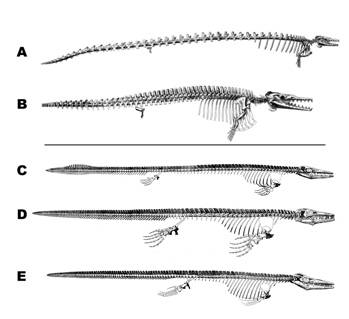
Question: is this an illustration showing an evolutionary link?

evolution-of-whales-4-349-319-13.jpg


http://www.macroevolution.net/evolution-of-whales.html#figs-4-5

If not, why?
 
Last edited:
The Story Thus Far

IDer: Macro-evolution is a myth!

Evo: Here is some evidence of a macro-evolution!

IDer: One of those creatures looks nothing like one of the later ones!

Evo: Yes, I know. It is a macro-evolution, not a micro-evolution.

IDer: Well, that evidence has other problems. Here is a paper about them.

Evo: Does that paper provide solutions to those problems, using another theory?

IDer: Yes!

Evo: (reads paper).. where?

IDer: I don't got to show you where!

Evo: He seems to be debunking evos. He is not invoking a Creator.

IDer: So? It's still relevant towards creationism.

Evo: How?

IDer: I don't got to show you how!

Evo: Here are new discoveries your paper did not take into account. It points to a new idea about macro-evolution.

IDer: You see? Evos changed their mind about something based on new data! Their old ideas were lies after all!! Therefore ID must have been right all along!

Evo: Ermm, okay: Here is what our understanding of Evo can do for the world... what can ID do for the world?

IDer: It can expose the lies of the evos!!
 
The fossil between the one labelled B and the one labelled C is way to straight and skinny to be a whale.
Didn't say it was a whale. Does it show an evolutionary relationship between the shared characteristics?
 

ISF - Join now!

Every member here is approved by hand. No bots, no spam, just people who care about evidence and honest debate.

Membership is free!

Create your free account

Back
Top Bottom