• Quick note - the problem with Youtube videos not embedding on the forum appears to have been fixed, thanks to ZiprHead. If you do still see problems let me know.

Electric Vehicles

Status
Not open for further replies.
Just one month's sales data, and comparing last month with the strange Covid times of Jan 2022? Hmm.

I see from the source* of the figures, SMMT, that sales of all types of cars rose 14.7%. So the 14.6% for petrol cars is actually a slight decline in proportion.

It might be interesting to see how many of those petrol car buyers are, as the Sun claims, ditching an EV and returning to petrol. The number doing that ("in droves") could literally be nil.

* https://www.smmt.co.uk/vehicle-data/car-registrations/
 
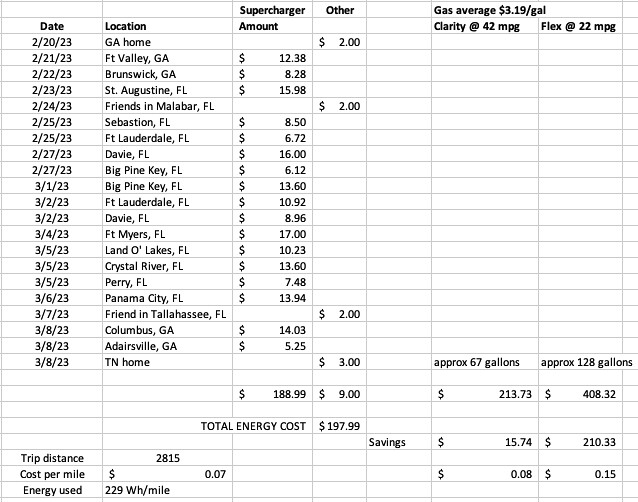
We recently did a trip in our Model 3LR from our TN home, down the FL east coast as far as Key West, back to Pompano, then across the state and up the west coast. Then Tallahassee then home.

I don't always log or analyze trips like this, but did for a friend who asked.

52764789013_71d6f2286d_z.jpg


I guessed at the $3.19/gal figure, though it seemed to be about average for this trip. I compared the cost with the two cars we also travel or traveled with. Looks like the cost of the trip in gas for our Clarity would have been very close to the same as the Tesla mostly Supercharging. So, for any car doing better than 42 mpg, or if gas prices fall a bit more while electric rates remain the same, one might be slightly ahead with a gas car.
 
We recently did a trip in our Model 3LR from our TN home, down the FL east coast as far as Key West, back to Pompano, then across the state and up the west coast. Then Tallahassee then home.

I don't always log or analyze trips like this, but did for a friend who asked.

[qimg]https://live.staticflickr.com/65535/52764789013_71d6f2286d_z.jpg[/qimg]

I guessed at the $3.19/gal figure, though it seemed to be about average for this trip. I compared the cost with the two cars we also travel or traveled with. Looks like the cost of the trip in gas for our Clarity would have been very close to the same as the Tesla mostly Supercharging. So, for any car doing better than 42 mpg, or if gas prices fall a bit more while electric rates remain the same, one might be slightly ahead with a gas car.

Nice analysis.

Note that the petrol vehicles need a lot more servicing than electric vehicles though.

Counting only the cost of the fuel misses most of the savings.

Even with my hybrid, the engine is likely to be practically brand new when the rest of the car dies.

It's an annual tradition for the dealer to complain that I haven't used any of the brake pads yet when I take the car in for its service.

(Regenerative braking is magical, the car slows beautifully, handles perfectly and doesn't use any consumables.)

:)

NB. You could also try to factor in the cost of replacing the battery after x recharges.
For most people, that will occur for the next owner, but it is something that you could consider for accuracy. I've noticed that newer cars are coming out with very long warranty periods for the drive batteries now.
 
You could also try to factor in the cost of replacing the battery after x recharges.
For most people, that will occur for the next owner, but it is something that you could consider for accuracy. I've noticed that newer cars are coming out with very long warranty periods for the drive batteries now.

True. But when one buys an ICE car, does one factor in the cost of an eventual engine replacement? Stipulated a battery will likely need replacing eventually, and sooner than the average gas engine, but most folks just hand wave away such future costs. I know I do!

Plus, with recycling the old battery will have some residual “core value”. And they may have value for stationary applications. And battery cost and efficiency should improve over time. But still a good point.
 
True. But when one buys an ICE car, does one factor in the cost of an eventual engine replacement? Stipulated a battery will likely need replacing eventually, and sooner than the average gas engine, but most folks just hand wave away such future costs. I know I do!

Plus, with recycling the old battery will have some residual “core value”. And they may have value for stationary applications. And battery cost and efficiency should improve over time. But still a good point.

:)

My plan is to repurpose my traction battery to be a 'home battery'.

I've seen kits online to achieve this for Nissan Leaf batteries, so I'm hoping that it won't be a big deal by the time I need to do this for my car (Outlander PHEV).

Note that the 'cells' in my battery are just rectangular batteries, quite similar to the batteries in the couple of UPS devices that I own.
 
I think there's a lot to look forward to here. Indeed, traction batteries must have a good deal more power per pound than would be required of backup batteries in your basement, so there's plenty of life left in them. And gas will become more expensive, and batteries cheaper, and charging infrastructure better, and so forth. It's not a compelling tradeoff here yet, but wait a few years.

I think engine life is not a big factor these days for new purchases, because most people trade cars in before the engines fail. As more electrics hit the used market, that will start becoming more of an issue if they're cheap enough. But around here a car lasts only as long as the body, so an eternal engine is not necessarily the thing you need.
 
:)

My plan is to repurpose my traction battery to be a 'home battery'.

My hope and expectation is that this will be norm in a few years time.

Mrs Don recently had a Zappi charger installed in the garage and now as long as there is a surplus of at least 1kW from the solar panels then it is directed to the car. As long as there is sufficient light, as there likely will for 8-10 months a year then she will be charging for "free".

When and if this is the case then it's likely that we'll use her car more (at the moment it covers 50-100 miles a week) because free power is the cheapest. :)
 
So, for any car doing better than 42 mpg, or if gas prices fall a bit more while electric rates remain the same, one might be slightly ahead with a gas car.
The costs for electricity has also increased quite a lot in Sweden over the last months. So I've seen calculations like yours also here.

For me my usage profile means that I charge mostly at home (and from solar panels), and therefor at a lower cost compared to Supercharger costs. So the EV still results in lower running costs compared to a fossil car over, even if longer trips are more expensive.

And since we have two EVs, options are limited...
 
In the past, I’ve often kept vehicles a long time. I have 3 motorcycles 20+ years old, and I’m still driving a 2005 Honda Element and a 2006 Honda Ridgeline. And they’re all still motoring along just fine, though certainly showing their age.

But with modern EV’s, I doubt I’ll attempt anything similar. The technology is changing so rapidly, trading for something newer every 3 to 5 years seems like a reasonable plan. We have no firm plans for getting rid of the Tesla - we’ve only had it just over a year - but I don’t feel committed to it for the long haul like I have in the past with other vehicles.
 
But with modern EV’s, I doubt I’ll attempt anything similar. The technology is changing so rapidly, trading for something newer every 3 to 5 years seems like a reasonable plan.
I'm not sure how to think here.

If I compare the 2019 Model 3 I used to drive with the 2023 model Y I just took delivery of I can see improvements. But those improvements are mostly related to noise levels, build quality and things like that. And of course software updates. But the battery, charging and engine technology hasn't really changed significantly.

Looking at other manufacturers, for example KIA and Hyundai (as well as others) have come with the 800V system that allows for shorter charging times, but I'm not so sure that we will see any major shifts above this over the next couple of years.

The change that really made a difference is the Tesla price cuts. Suddenly a year-old car would would drop significantly in what it can be sold for. We have historically seen high 2nd hand prices for Teslas (and other EVs), but if Tesla can keep delivering cost-cuts for new cars, that will increase the over all cost-of-ownership since you will get less if you want to trade the old model in.
 
GM is ending the Camaro. At least, the all gas one.

GM has been heavily investing EVs and executives have hinted at an EV muscle car prototype coming soon.

To me, one of the defining features of a real "muscle car" is you can modify it in your own driveway or garage. How exactly do you do that in the current gas powered cars that are full of sensitive electronics, much less a full EV?
 
NB. You could also try to factor in the cost of replacing the battery after x recharges.
For most people, that will occur for the next owner, but it is something that you could consider for accuracy. I've noticed that newer cars are coming out with very long warranty periods for the drive batteries now.

This hasn't become a factor in Norway, even though it's well over 10 years ago now we started adopting electric cars.

There's plenty of second, third, fourth and probably fifth and beyond hand owned electric cars on the roads.

I just sold my 2013 Nissan Leaf to a third hand owner. It's still going strong, and the battery hardly degraded at all.

I know early adopters for Tesla as taxi, and some of them have been in the business for nearly ten years and 700 000+km.

ETA: Nissan's study on older Leafs show the battery will outlive the car by many years. Based on a study of 400 000 Nissan Leafs in Europe, they reckon the battery will last for around 22 years.
 
Last edited:
This hasn't become a factor in Norway, even though it's well over 10 years ago now we started adopting electric cars.

There's plenty of second, third, fourth and probably fifth and beyond hand owned electric cars on the roads.

I just sold my 2013 Nissan Leaf to a third hand owner. It's still going strong, and the battery hardly degraded at all.

I know early adopters for Tesla as taxi, and some of them have been in the business for nearly ten years and 700 000+km.

ETA: Nissan's study on older Leafs show the battery will outlive the car by many years. Based on a study of 400 000 Nissan Leafs in Europe, they reckon the battery will last for around 22 years.

Nice to know.

It's hard to draw comparisons, because the Prius battery is so small, but this article states that only two Prius batteries had been replaced in Australia (as at 22 July 2008), one at 350,000km and the other at 500,000km.

https://www.drive.com.au/news/toyota-prius-the-taxi-champion/

Since I'm just sneaking up on 31k I probably have a long time to go before I worry.

:D

Note that the Prius is not a 'plug in hybrid' like mine, nor a fully electric car like the LEAF or Tesla, so I'm not sure how much comparison we can make.
 
Nice to know.

It's hard to draw comparisons, because the Prius battery is so small, but this article states that only two Prius batteries had been replaced in Australia (as at 22 July 2008), one at 350,000km and the other at 500,000km.

https://www.drive.com.au/news/toyota-prius-the-taxi-champion/

Since I'm just sneaking up on 31k I probably have a long time to go before I worry.

:D

Note that the Prius is not a 'plug in hybrid' like mine, nor a fully electric car like the LEAF or Tesla, so I'm not sure how much comparison we can make.

It's also a Toyota. If Rover Group had built them it might be a very different story. ;)
 
These studies of battery longevity are great for EV owners like Mrs Don but they look like putting the kybosh of my hopes of there being a glut of ex-EV battery packs providing cheap household electricity storage. :o
 
These studies of battery longevity are great for EV owners like Mrs Don but they look like putting the kybosh of my hopes of there being a glut of ex-EV battery packs providing cheap household electricity storage. :o
I think you can pin your hope on batteries that come from totaled cars. If they are 100% fine they will probably be used as replacements for other cars, but if they are partially damaged I think there will be a market for companies to remove the damaged parts and sell the rest.

But then there is the recycling trends - several battery factories seem to establish recycling units, where the want to extract the key rare substances from old batteries and use them for new ones.

So I'm not sure we will see cheap storage until we see different types of battery chemistry coming out - for example by trading increased weights for lower costs. Weight is not a major issue when you use in stationary.
 
This Wednesday will mark four years since I got my hands on my TM3 LR. It’s still a stupendous car and I’m really looking forward to my road trip up to the UK in a few weeks.
 
I think you can pin your hope on batteries that come from totaled cars. If they are 100% fine they will probably be used as replacements for other cars, but if they are partially damaged I think there will be a market for companies to remove the damaged parts and sell the rest.

But then there is the recycling trends - several battery factories seem to establish recycling units, where the want to extract the key rare substances from old batteries and use them for new ones.

So I'm not sure we will see cheap storage until we see different types of battery chemistry coming out - for example by trading increased weights for lower costs. Weight is not a major issue when you use in stationary.

I think the different types of battery chemistry is happening.

Home/power grid batteries don't need to be small or light.

I've heard of a couple of household installations from this company for example:

https://redflow.com/

My instinct is that they would be for much larger homes than mine though.
(Although... I can see that they advertise that they start at 10kWh and that's pretty small)

The battery tech is zinc/bromine and uses a salt water electrolyte (I think).
 
I think the different types of battery chemistry is happening.

Home/power grid batteries don't need to be small or light.

I've heard of a couple of household installations from this company for example:

https://redflow.com/

My instinct is that they would be for much larger homes than mine though.
(Although... I can see that they advertise that they start at 10kWh and that's pretty small)

The battery tech is zinc/bromine and uses a salt water electrolyte (I think).
That's interesting to see!


I got this report on EV battery health sent to me: https://www.recurrentauto.com/research/how-long-do-ev-batteries-last

Recurrent Auto said:
Study takeaways by Recurrent's team of battery scientists:


* Battery replacements are quite rare. In our community of 15,000 cars, only 1.5% have been replaced (outside of big recalls like Chevy Bolt).

* Degradation is not linear. We're including battery degradation curves that illustrate how well these batteries hold up over time. There's some drop in the beginning then it levels out for a long period.

* Most replacements occur under warranty. For example, a new Rivian has battery coverage for 175,000 miles or 10 years. The federal minimum warranty is 8 years or 100,000 miles.
 
Status
Not open for further replies.

Back
Top Bottom