• Quick note - the problem with Youtube videos not embedding on the forum appears to have been fixed, thanks to ZiprHead. If you do still see problems let me know.

Electric Vehicles

Status
Not open for further replies.
My wife had a gas Fiat 500 and really liked it. Her use was similar and it was a very good fit. On the highway the gas one would be lucky to get over 200 miles range, and it was not what I would call a great long distance car. But the interior is quite flexible and we have loaded it up with far more than I thought possible quite often. The back seat was even tolerable for adults for short trips. And to beat all the odds, it has been fairly reliable, knock on wood.

All that to say, I hope the e500 works as well for your family.
I think the e500 is a little bigger than the old petrol model and the ev architecture means even more space. I'm six foot three and north of 100 kg, but didn't feel cramped, apart from my feet. Why they have that intrusion into the foot well is anyone's guess

Sent from my SM-G991B using Tapatalk
 
Nice car, see comments above about space by the pedals. Might not be an issue if your wife doesn't have massive plates

Sent from my SM-G991B using Tapatalk

I think the e500 is a little bigger than the old petrol model and the ev architecture means even more space. I'm six foot three and north of 100 kg, but didn't feel cramped, apart from my feet. Why they have that intrusion into the foot well is anyone's guess

Sent from my SM-G991B using Tapatalk

I've sat in the thing in the showroom bit not driven it. I'm longish (1.87m) but narrow (<75kg) and it felt roomy with great visibility.

I'll never get to drive it anyway :o
 
Well, at least there's the hope that the electric Fiat will be more reliable than the gas one, which at least in the US is generally rated as one of the least reliable cars one can get. Unfortunately, its main weak points seem to be electrical, so....

I rented one once, and found it a very nice car to drive. Of course it was nice and new and I didn't have to pay to fix it. I suspect that if I do get an electric car in the near future it's more likely to be a Hyundai.
 
Well, at least there's the hope that the electric Fiat will be more reliable than the gas one, which at least in the US is generally rated as one of the least reliable cars one can get. Unfortunately, its main weak points seem to be electrical, so....

I rented one once, and found it a very nice car to drive. Of course it was nice and new and I didn't have to pay to fix it. I suspect that if I do get an electric car in the near future it's more likely to be a Hyundai.

I joked with Mrs Don about the wisdom of buying an Italian electric car. She reminded my of our own Fiat (or FIAT) ownership experience.

We owned a Fiat Coupe from 1998 until 2008. In that 1 years of ownership the only issue we had apart from routine servicing (and replacing the front tyres every 5,000 miles if driven too enthusiastically :o) was that the passenger electric window switch became borked and which was fixed under warranty.
 
Well, at least there's the hope that the electric Fiat will be more reliable than the gas one, which at least in the US is generally rated as one of the least reliable cars one can get. Unfortunately, its main weak points seem to be electrical, so....

I rented one once, and found it a very nice car to drive. Of course it was nice and new and I didn't have to pay to fix it. I suspect that if I do get an electric car in the near future it's more likely to be a Hyundai.

Fix It Again, Tony.
 
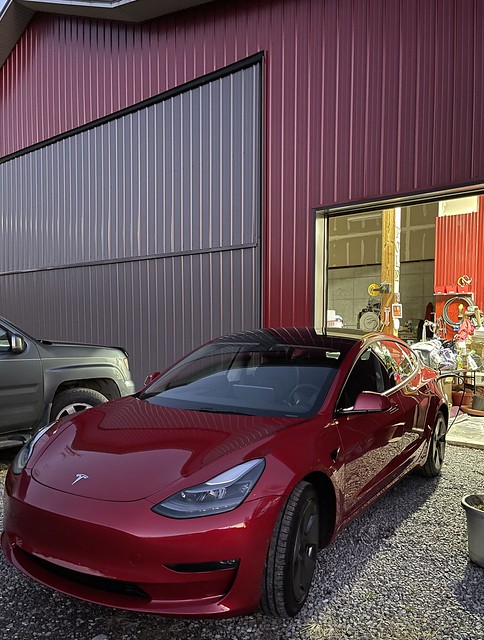
We ordered our Tesla Model 3 Long Range. one month ago today, and had a revised estimated delivery date of 2/19 to 3/19. But yesterday afternoon we got an email saying “our“ car was ready to be picked up. I put “our” in quotes, since it was one that someone did not or could not take delivery of and we got matched up with it.

Taking delivery today would have been a bit of a crunch, plus it was cold and drizzly. So we’re scheduled for tomorrow at 4PM. But we did have a chance to stop by this afternoon on the way to a soccer game.


51862539346_d82fa4e1e2_z.jpg


Sure is purty. And the car, too!
 
As planned, we took delivery this afternoon at the Knoxville location. Even after watching dozens of videos, it was still like drinking from the proverbial firehose.

Drove around a bit. It took a pretty long while for the autopilot to calibrate, but I’m told that’s normal. It will take a while for simple things to become intuitive, but I have no doubt they will. Road noise is a little higher than expected, on par with our Clarity. Getting the music and podcasts to play reliably via Bluetooth may take a while to figure out, making me really miss the simplicity of CarPlay.

Car’s home, we’re going to take turns driving around tomorrow to get a better feel of the car. So far, we like it a lot.

51863448847_7b304175e4_z.jpg
 
How exciting for you.

Mrs Don is getting positively giddy at the prospect of her new car in a couple of months.
 
How much does running the AC or heat kill EV range? A crisp 7 degrees F this morning when I left for work.

I drive a 2015 Leaf which I bought used, and keeping warm hasn't been a problem. Even on sub-freezing days the seat warmer is usually good enough and doesn't register on the range meter. My model even has a steering wheel warmer, which has been surprisingly useful.

There are rare occasions when I turn on the heat, and yes the range drops maybe 7-10 miles (10% drop maximum), but I only keep it on long enough to heat the cabin and might lose a mile or two for it. The Leaf also has a timer that can turn on the heat at a chosen time when the car is plugged in. If you know when you're leaving in the morning, you set the timer and will walk out to a car that's warm, defrosted and fully charged.

For very long trips I guess it could be an issue. But I didn't buy a low range 2015 Leaf for very long trips, and overall I've been really happy with the car.
 
What I've seen is that in very cold climates, the mileage decreases by about 12 percent with the heater off, and 30 or 40 percent with it on. This is one of the reasons why I think, even if I were to get an electric car, it would not be the only thing I had for winter use.
 
Electric Cars are becoming more viable! I purchased a Tesla Model Y Last December, and I documented on this thread the trip my wife and I took from Seattle to Yellowstone. The Tesla Supercharge network makes long trips *very* viable.

It cannot be viable for lots of electric cars, though.

Here's the thing about supercharging. You're willing to wait for the car to charge, gives you a chance to eat and use the restroom, right? Well, that's if you're not in a line to USE the charger. If becomes a rather different prospect if you've got to wait for a couple of cars ahead of you to charge up first.

And that's where we face a massive problem with widespread adoption. A gas station pump has a huge throughput. You can fill up a lot of cars in an hour. But even with a supercharger, you cannot charge a lot of cars in one hour. That's fine if you've got the capacity so cars don't have to wait to use one. But you cannot build the capacity to charge nearly as many electric cars as you can fill up gas on IC engine cars. Even just the physical footprint of asphalt you would need is huge, and prohibitive. So all-electric cars for long distance driving are pretty much guaranteed to remain a niche product.
 
Coincidentally, we tried out a Supercharger today. We really didn’t need to at all, just wanted to make sure it worked as advertised.

The station we used was in Turkey Creek, located about 14 miles east of us between our home and Knoxville proper. 8 stations. On a Sunday afternoon there were 1 or 2 in use. Plugged in and got a very quick charge back to 80%, where they recommend setting it for daily use.

51866755509_dcf1f9b35d_z.jpg


51866438991_486fa92ca1_z.jpg


That’s some charge rate! And forgive my horrendous parking!

Tesla discourages Supercharger use except when traveling or in emergencies. The very fast charge rate is hard on batteries. Most folks will just charge at home or at work or both most of the time.

Earlier we had tried out the free charging at Melton Hill Dam, a TVA project near our home. Used the adapter that came with the car, and charged at a rate of about 20 mph.

51866516173_f1542351da_z.jpg


Handy for picking up a few miles if we happen to go there for a picnic or to walk the dog.

Anyway, I expect hiccups, but the charger network is building out pretty rapidly. Businesses and shopping areas will see the benefit of them drawing customers in. I think, overall, supply will rise to meet demand, but we’ll have to see, won’t we.

 
Last edited:
How much does running the AC or heat kill EV range? A crisp 7 degrees F this morning when I left for work.

Technology Connections dude has done some videos on owning a EV. One was comparing the range when driving in a Chicago winter. I think some of the raw numbers are in the comments if you don't want to actually watch the piece.


And the summer and A/C version:
 
Last edited:
It cannot be viable for lots of electric cars, though.

Here's the thing about supercharging. You're willing to wait for the car to charge, gives you a chance to eat and use the restroom, right? Well, that's if you're not in a line to USE the charger. If becomes a rather different prospect if you've got to wait for a couple of cars ahead of you to charge up first.

And that's where we face a massive problem with widespread adoption. A gas station pump has a huge throughput. You can fill up a lot of cars in an hour. But even with a supercharger, you cannot charge a lot of cars in one hour. That's fine if you've got the capacity so cars don't have to wait to use one. But you cannot build the capacity to charge nearly as many electric cars as you can fill up gas on IC engine cars. Even just the physical footprint of asphalt you would need is huge, and prohibitive. So all-electric cars for long distance driving are pretty much guaranteed to remain a niche product.

This is ground breaking information that few have ever considered. Thank you for being such a bold leader in this field.
 
Anyway, I expect hiccups, but the charger network is building out pretty rapidly. Businesses and shopping areas will see the benefit of them drawing customers in. I think, overall, supply will rise to meet demand, but we’ll have to see, won’t we.

The kind of opportunistic charging that you did at Melton Hill Dam may be something that people increasingly do. Tesco, the UK's leading supermarket chain, offers free 7kw or 22kw charging thanks to a sponsorship tie-in with Volkswagen.

Mrs Don intends to charge her car there whenever she's in town and in need of a bit of a top-up (as long as that little-and-often approach to charging doesn't bork the batteries). As electric car use increases, especially among people without off-street parking, this may be a pattern we'll see more of. It is dependent on charging points being available in public parking spaces but IMO that will come.
 
So all-electric cars for long distance driving are pretty much guaranteed to remain a niche product.

It would be interesting to know what proportion of people routinely engage in long distance driving.

I know that even for the UK, the driving patterns of Mrs Don and I, and our friends, are atypical. Our total distance travelled a year is low and our journeys are short.

There have been times in my life when I've been driving a fair amount by UK standards, say 50,000 miles a year, but this tended to be 200 miles a day, 5 days a week so as long as charging was available at work and/or at home I'd be fine. Then again, from what I've gleaned here, most people in the US drive several times that distance every year - which is what makes use of electric vehicles impossible. :rolleyes:
 
(snip)

Mrs Don intends to charge her car there whenever she's in town and in need of a bit of a top-up (as long as that little-and-often approach to charging doesn't bork the batteries). As electric car use increases, especially among people without off-street parking, this may be a pattern we'll see more of. It is dependent on charging points being available in public parking spaces but IMO that will come.

The first thing that comes to mind is the memory effect. Wikipedia indicates it's a problem with nickel-cadmium and nickel–metal hydride rechargeable batteries. Electric vehicles use lithium ion, which don't seem to suffer from it.

I'm not sure if there are other issues with constant top-ups of partially discharged Li-Ion batteries. Anecdotal evidence (one cell phone I own) is that after several rounds of this, the battery tends to discharge more quickly. Letting it get to the point where it no longer powers the phone, then recharging it, restores the prior performance. Note that this is n=1; your mileage may vary. :)
 
Here’s Tesla’s recommendation:

Home Charging Behavior

What's a best practice for charging a Tesla at home?

We recommend plugging in every evening to top off the battery.

What percentage should I charge the battery to?

For regular use, we recommend keeping your car set within the 'Daily' range bracket, up to approximately 90%. Charging up to 100% is best saved for when you are preparing for a longer trip. You can adjust how full the battery charges from the charge settings menu.

Should I wait for the battery to fully deplete before charging?

Tesla uses lithium ion batteries so there is no memory effect, this means there is no need to deplete the battery before charging. We recommend plugging in as often as possible.

Source: https://www.tesla.com/support/home-charging-installation/faq#charge

Interesting tidbit. When we put the Supercharger location into navigation, the car got noisier and we saw a notification along the lines of “Battery being preconditioned for rapid charging”. Clever that it knew to do that. Also, charging in general slows down a lot over the last bit of battery capacity. We’ve set 80% for daily use, which provides about 285 miles of range - it may go up a bit in warmer weather.
 
Last edited:
Status
Not open for further replies.

Back
Top Bottom