• Quick note - the problem with Youtube videos not embedding on the forum appears to have been fixed, thanks to ZiprHead. If you do still see problems let me know.

Cont: Electric Vehicles II

I would expect the replacement battery industry to be a good bet for growth. One of the things I noticed in looking around at some coming vehicles, and especially at another little electric truck whose name I forget, is that many, though they use various configurations and packagings and whatnot, are using the same basic cells. I would expect a third-party battery industry to develop as the need for more batteries grows, as it has for other battery-using things like power tools.
You would think so. ....Except the proprietary nature of the industry. How companies protect their turf. It's very hard to even do minor repairs to a Tesla without violating warranties and patent infringement.
 
You would think so. ....Except the proprietary nature of the industry. How companies protect their turf. It's very hard to even do minor repairs to a Tesla without violating warranties and patent infringement.
I don't think Tesla is going to be the face of the industry for long. I might be wrong, but there's a pretty strong industry of after-market automotive products and services, and "right to repair" is a growing concern. As batteries become more of a consumable item like tires and mufflers and shock absorbers, I think a third party industry is likely to appear, and although warranty coverage might get in the way, patent will be harder to maintain.
 
I don't think Tesla is going to be the face of the industry for long. I might be wrong, but there's a pretty strong industry of after-market automotive products and services, and "right to repair" is a growing concern. As batteries become more of a consumable item like tires and mufflers and shock absorbers, I think a third party industry is likely to appear, and although warranty coverage might get in the way, patent will be harder to maintain.
It's a factor whether it is Tesla or Dodge or Toyota, or John Deere or Caterpillar or any big company. I've gone through hell selling third party equipment in the computer and data communications industry. And for all the people fighting for the right to repair, the corporate world spends millions lobbying politicians to oppose it.
 
Last edited:
You would think so. ....Except the proprietary nature of the industry. How companies protect their turf. It's very hard to even do minor repairs to a Tesla without violating warranties and patent infringement.
That doesn't just apply to cars.

Manufacturers are understandably wary of unauthorized repairs when their products are under warranty, for several reasons. Most obvious is that their reputation rides on the job being done right. Secondly a botched repair job could cost a lot more to put right, and they shouldn't have to pay for that. Another is that authorized service agents need a considerable amount of infrastructure and training to provide that service, and are expecting a return on it. The company and its customers need those guys, so if they go out of business due to lack of work it's a problem. The service agents get access to all the information and parts they need through a special program set up for them. Providing the same stuff to random people off the street could be a lot more costly and difficult to manage. Finally there's the matter of proprietary information that could be misused, either by bad actors or simply due to incompetence.

In the 1980's I was doing freelance electronic repairs. Even back then getting service manuals and proprietary spare parts for consumer electronic devices wasn't easy. In many cases it just wasn't worth my time trying to repair stuff I wasn't familiar with. The local authorisized agent (who BTW is still the same guy today!) had the experience to diagnose common faults in minutes and already had the parts on hand. Furthermore he knew about important stuff that I wouldn't, such as all the capacitors in Sony video equipment that were required to be replaced under warranty whenever one was brought in for repair...

Tesla do supply the information needed to repair their vehicles, and many of their patents are open source so other manufactuers could make compatible parts if they wanted. But it would be silly to do your own repairs on things that are covered by warranty.

So I don't know why you are singling out Tesla or even car makers in general for this criticism. The nature of mass produced high tech equipment practically guarantees that these issues will be present. I watched some videos done by 'the car car nut', who is a trained Toyota mechanic. Some of the repairs he has done are mind-bogglingly complex and full of traps. My own car repairs have often not turned out well either, which is why I take my 13 year old Leaf to the Nissan service center, who have technicans trained to work on them.

'Right to repair' sounds great until you realize what's involved in repairing a lot of modern equipment. The desire for higher performance at lower price has led to much greater complexity and trickier construction. I tried repairing a smartphone and even though I followed a YouTube video showing how to disassemble the phone I still broke it. Then I discovered that replacing the USB socket would be impossible without $1000 worth of equipment anyway... That's not the fault of the manufacturer. Nobody wants a phone that's twice as thick and does half as much just to make it easier to repair.

 
Last edited:
I would expect a third-party battery industry to develop as the need for more batteries grows, as it has for other battery-using things like power tools.
It's happening. Chinese outfits are already repacking Leaf batteries and shipping them world-wide. The thing that people excoriated the Leaf battery for - no thermal management - is actually a big advantage here. With no 'plumbing' to worry about, swapping out cells and packs is easier. Using the latest cells you get 2-3 times the capacity with little or no weight increase. I'm waiting for them to make packs with the same capacity but lower weight, since 150km range is plenty enough for me...

Cars with structural packs may be more difficult because you can't just put in any cells. Tesla packs are glued together making replacing more than a cell or two quite difficult. However the batteries in modern EVs generally last the lifetime of the vehicle. By the time the battery needs replacing you probably want a new vehicle anyway.
 
That doesn't just apply to cars.

Manufacturers are understandably wary of unauthorized repairs when their products are under warranty, for several reasons. Most obvious is that their reputation rides on the job being done right. Secondly a botched repair job could cost a lot more to put right, and they shouldn't have to pay for that. Another is that authorized service agents need a considerable amount of infrastructure and training to provide that service, and are expecting a return on it. The company and its customers need those guys, so if they go out of business due to lack of work it's a problem. The service agents get access to all the information and parts they need through a special program set up for them. Providing the same stuff to random people off the street could be a lot more costly and difficult to manage. Finally there's the matter of proprietary information that could be misused, either by bad actors or simply due to incompetence.

In the 1980's I was doing freelance electronic repairs. Even back then getting service manuals and proprietary spare parts for consumer electronic devices wasn't easy. In many cases it just wasn't worth my time trying to repair stuff I wasn't familiar with. The local authorisized agent (who BTW is still the same guy today!) had the experience to diagnose common faults in minutes and already had the parts on hand. Furthermore he knew about important stuff that I wouldn't, such as all the capacitors in Sony video equipment that were required to be replaced under warranty whenever one was brought in for repair...

Tesla do supply the information needed to repair their vehicles, and many of their patents are open source so other manufactuers could make compatible parts if they wanted. But it would be silly to do your own repairs on things that are covered by warranty.

So I don't know why you are singling out Tesla or even car makers in general for this criticism. The nature of mass produced high tech equipment practically guarantees that these issues will be present. I watched some videos done by 'the car car nut', who is a trained Toyota mechanic. Some of the repairs he has done are mind-bogglingly complex and full of traps. My own car repairs have often not turned out well either, which is why I take my 13 year old Leaf to the Nissan service center, who have technicans trained to work on them.

'Right to repair' sounds great until you realize what's involved in repairing a lot of modern equipment. The desire for higher performance at lower price has led to much greater complexity and trickier construction. I tried repairing a smartphone and even though I followed a YouTube video showing how to disassemble the phone I still broke it. Then I discovered that replacing the USB socket would be impossible without $1000 worth of equipment anyway... That's not the fault of the manufacturer. Nobody wants a phone that's twice as thick and does half as much just to make it easier to repair.
Here's the problem. That's generally bullcrap. I know it's bullcrap because of 30 years of heaing the same arguments in the Tech industry. I can't begin to count the battles my company fought to sell identical parts in Sun, HP and Compaq servers. Not to mention Cisco. Cisco would sell a memory upgrade to some of their routers for thousands of dollars. I use to buy that same memory for $20 and sell it fror a 75% of what Cisco did. Thats how we made a killing. And when I say the same parts I mean exactly that. Memory made by TSMC, Nippon, or Intel that these companies outsourced their components from. We tore apart just about every high end IT product made and catalogued it. We were more than capable enough to do board level repairs on just about everything (if it was expensive...no money in it if it wasn't)

How long did the car companies fight telling the world their OBD codes? Most of this stuff isn't rocket science. On ICE or EVs. There are almost no secrets when it comes to mass produced vehicles.
 
You would think so. ....Except the proprietary nature of the industry. How companies protect their turf. It's very hard to even do minor repairs to a Tesla without violating warranties and patent infringement.
Judging by the many complaints about long wait times, just 'repairing' a Tesla at all is going to be an issue (spare parts are notoriously slow in arrival, in fact thats what happened to the one Tesla that was out here- its long gone, bought by another Tesla owner and stripped for parts after what 'should' have been a minor roo strike- after six months the owner sold it 'as is' and bought a BYD instead...)

Tesla is supposed to have the longest range, yet are conspicuously absent from the local EV's out here- where they should in theory be the most common...
 
Judging by the many complaints about long wait times, just 'repairing' a Tesla at all is going to be an issue (spare parts are notoriously slow in arrival, in fact thats what happened to the one Tesla that was out here- its long gone, bought by another Tesla owner and stripped for parts after what 'should' have been a minor roo strike- after six months the owner sold it 'as is' and bought a BYD instead...)

Tesla is supposed to have the longest range, yet are conspicuously absent from the local EV's out here- where they should in theory be the most common...
Doesn't surprise me. But frankly. I'vee heard similar stories about Toyota here in the US and they generally have a great reputation.

Tesla is still it in the US when it comes to EVs. At least before Musk almost single handed destroyed the Tesla brand the last year. It probably is still the best value proposition for an EV in the US but I refuse to put a dollar in that man's pocket. So I wouldn't buy a Tesla. I wouldn't buy Tesla Solar. Not Powerwall and not Starlink. He can just go screw himself.
 
I may yet be wrong, but I think although there are many attempts to destroy it through copyrighting and warranty-canceling, the aftermarket auto repair industry is so large and economically important, and serves such a large portion of the general population, that it is unique, and I am guessing that third party replacement parts as well as rebuilding enterprises, will remain an important part of the future automotive industry. For one thing, dealerships are so few and far between in some places that if dealer-only service were made mandatory, some brands would simply cease to sell. Of course that varies with location, but there are brands of cars I see all over whose dealers are 50 or 60 miles from here. I could hardly afford to own even my cheap little Hyundai if I couldn't buy parts at NAPA or O'Reilly's, or if I had to tow it to the nearest dealer who is 40 miles from here.

Of course there are a lot of things happening these days that I thought wouldn't, so I'm certainly not betting my life.
 
Judging by the many complaints about long wait times, just 'repairing' a Tesla at all is going to be an issue (spare parts are notoriously slow in arrival, in fact thats what happened to the one Tesla that was out here- its long gone, bought by another Tesla owner and stripped for parts after what 'should' have been a minor roo strike- after six months the owner sold it 'as is' and bought a BYD instead...)

Tesla is supposed to have the longest range, yet are conspicuously absent from the local EV's out here- where they should in theory be the most common...
As to longest range claims, that’s probably due to their odometers are “speeded up”, so as to show more kilometres than have actually been driven. As per this class action, Tesla defends this by declaring that their odometers , well, are not,

“The lawsuit points to a Tesla patent (U58054038B2) which allegedly confirms that the odometer readings are not direct measurements but are: “derived from energy consumption data, driving behavior patterns, and predictive algorithms“.

This patent reportedly describes a “miles-to-electrical energy conversion factor” that dynamically varies.”
 
I may yet be wrong, but I think although there are many attempts to destroy it through copyrighting and warranty-canceling, the aftermarket auto repair industry is so large and economically important, and serves such a large portion of the general population, that it is unique, and I am guessing that third party replacement parts as well as rebuilding enterprises, will remain an important part of the future automotive industry. For one thing, dealerships are so few and far between in some places that if dealer-only service were made mandatory, some brands would simply cease to sell. Of course that varies with location, but there are brands of cars I see all over whose dealers are 50 or 60 miles from here. I could hardly afford to own even my cheap little Hyundai if I couldn't buy parts at NAPA or O'Reilly's, or if I had to tow it to the nearest dealer who is 40 miles from here.

Of course there are a lot of things happening these days that I thought wouldn't, so I'm certainly not betting my life.
It's always a damned if they do, damned if they don't situation. They need a good reputation. But they don't they want to undermine their repair profits. They also want to sell you another car. And if you can keep that car for 10, 20, 30 years, they might not see that as profitable. They wouldn't want the used car market eating into the market for their new cars. I wouldn't exactly call it a conspiracy but planned obsolescence is a real thing. Companies don't want you to repair that car forever. And why would they? This is all kind of tricky, so I am at best guessing about their calculations
 
As to longest range claims, that’s probably due to their odometers are “speeded up”, so as to show more kilometres than have actually been driven. As per this class action, Tesla defends this by declaring that their odometers , well, are not,

“The lawsuit points to a Tesla patent (U58054038B2) which allegedly confirms that the odometer readings are not direct measurements but are: “derived from energy consumption data, driving behavior patterns, and predictive algorithms“.

This patent reportedly describes a “miles-to-electrical energy conversion factor” that dynamically varies.”
I don't like the way that sounds. Seems as if it would be very easy to create a sensor to measure actual wheel rotation. And be prevented from screwing with it. My experience is companies will get away with anything if they think it is more profitable.
 
I suggest you read the article.
You’ll dislike the sound of this even more.

ETA: I worked in an auto part place in my youth and did a fairly robust sale on speedo “gears”. These being physical gear driving off rear wheels to a speedo by a cable. By law you’d need to change this driven gear if you changed the wheel/tyre diameter in order to maintain the speedo’s accuracy.
I seem to recall that legal indicated speed tolerances then were much tighter than the current 10%
 
Last edited:
I don't like the way that sounds. Seems as if it would be very easy to create a sensor to measure actual wheel rotation. And be prevented from screwing with it. My experience is companies will get away with anything if they think it is more profitable.
If only someone could think of a way of doing that....
1746080961939.png
 
As to longest range claims, that’s probably due to their odometers are “speeded up”, so as to show more kilometres than have actually been driven. As per this class action, Tesla defends this by declaring that their odometers , well, are not,

“The lawsuit points to a Tesla patent (U58054038B2) which allegedly confirms that the odometer readings are not direct measurements but are: “derived from energy consumption data, driving behavior patterns, and predictive algorithms“.

This patent reportedly describes a “miles-to-electrical energy conversion factor” that dynamically varies.”
Seriously? Without checking the regulations, I'd have thought that would be against the law, at least in the UK.
 
It's always a damned if they do, damned if they don't situation. They need a good reputation. But they don't they want to undermine their repair profits. They also want to sell you another car. And if you can keep that car for 10, 20, 30 years, they might not see that as profitable. They wouldn't want the used car market eating into the market for their new cars. I wouldn't exactly call it a conspiracy but planned obsolescence is a real thing. Companies don't want you to repair that car forever. And why would they? This is all kind of tricky, so I am at best guessing about their calculations
Well Tesla seems to think they don't need a good reputation- or they would have dumped Elon months ago...
As it is, they look likely to be limited to the US only (as long as he can keep the Euro and Chinese EVs out)- elsewhere a Tesla is as welcome as a turd in a swimming pool- both as a new purchase, on the secondhand market and even for their current owners...

Their sales in other markets overseas are dropping like a whale from the sky....
https://www.abc.net.au/news/2025-04...-plunge-elon-musk-cuts-back-on-doge/105205320
Sales down for Tesla, with record profit losses, while every other EV manufacturer is reporting record sales figures for the same period...

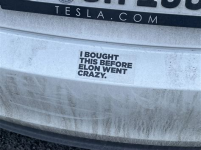
(look at the number of bumperstickers on the existing ones like this...)
1746081400466.png
https://duckduckgo.com/?q=i+bought+my+tesla+before+elon+went+crazy&t=newext&atb=v473-1&iar=images

musk is really THAT unpopular outside the US atm (and probably for he rest of his life) no sane company will want to have anything to do with him after this...

Funny how outing yourself as a far right extremist A.H. will do that...
 
I would expect the replacement battery industry to be a good bet for growth. One of the things I noticed in looking around at some coming vehicles, and especially at another little electric truck whose name I forget, is that many, though they use various configurations and packagings and whatnot, are using the same basic cells. I would expect a third-party battery industry to develop as the need for more batteries grows, as it has for other battery-using things like power tools.

Yes. We're hearing a lot from the EV haters about how these cars are disposable because you'll have to replace the battery in five years at the cost of £40,000 or so, which is absolute nonsense but sounds scary. But consider the scenario where you have maybe a ten year old car which is doing just fine but someone is offering a replacement battery with twice the range and twice the DC charging speed for a couple of thousand. Starts to get a bit tempting.

Much like the current situation with the 1st generation Leafs.

ETA: I see the discussion about warranties and "right to repair", but I'm talking about vehicles out of warranty which are simply performing as they have done all along, maybe a bit of range loss, but there is the prospect of transforming them by a relatively inexpensive modification. My MG4 SE SR has a 51 kwh battery and a maximum DC charging speed of about 85 kw. It's fine. But maybe in 8-10 years that will be looking silly and I could have a new battery fitted that would give me a 400-mile range and a 15-minute DC charging time. At that point, if it's not expensive, why wouldn't you?
 
Last edited:
I don't like the way that sounds. Seems as if it would be very easy to create a sensor to measure actual wheel rotation. And be prevented from screwing with it. My experience is companies will get away with anything if they think it is more profitable.

an encoder. while they can be mounted and implemented in a variety of ways, when they're built into a motor as a part of the package, it's what differentiates a standard electric motor from a servo motor. they're mostly used in industry to either monitor position and/or speed. obviously in robotics they're used to determine a joint position to determine where the robot arm is, they are also frequently mounted to shafts to determine speed in relation to the timing of something else. for example, when applying a spray lot code to a package, if you mount one on a conveyor drive shaft and trigger a photo eye you can determine the speed of the conveyor, where the package will be, and apply the lot code consistently, and it can be done dynamically so you can run at different speeds without having to change timings and move equipment around.

anyway, they're pretty handy and the kind of the backbone of moving from machines driven mechanically to electronics

of course, you have to write some code to take the pulses and convert them into a measurement of distance. none of that is difficult and encoders are very accurate, especially when you're thinking terms of miles instead of thousandths of an inch.

derived from energy consumption data, driving behavior patterns, and predictive algorithms

and that makes it sound like they're lying and messing with the odometer readout. which, it being tesla, of course they are.
 
Seriously? Without checking the regulations, I'd have thought that would be against the law, at least in the UK.
After checking, it appears there's not even a requirement for an odometer, nor that if one is present that it should be working to a certain standard. You're not allowed to report a false reading or tamper with it, but that's a different matter.
 
Tesla’s core business plunged 20 per cent year-on-year to $14 billion, making its weakest performance since 2021.

Net income slid 71 per cent to $409 million compared to $1.39 billion a year earlier.

The company was only able to pull $400 million in operating profits thanks to $595 million in regulatory credits, essentially free income earned from gas-powered rivals paying Tesla to comply with emission rules.
Tesla delivered just 336,681 vehicles for the quarter, a 13 per cent drop from the previous year and far lower than the 390,000 expected.

It was Tesla’s worst revenue performance since Q2 2022 and its least profitable quarter since Q1 2021.

The stiff drop compared to 12 months ago comes off the back of declining sales as a result of fierce EV competition out of China as well as severe political backlash against Mr Musk both in the US and abroad.

Powerhouse Chinese brands like BYD have swamped Tesla in a number of markets, including Australia, by offering cheaper EV alternatives with just as many tech upgrades.

Ouch...
https://www.news.com.au/technology/...s/news-story/4f1f45f518fd96511f5a6be7178077a0
 

Back
Top Bottom