Electric universe theories here.

Status
Not open for further replies.
(Again I predict not a single finger will be lifted to offer objective evidence supporting the half baked surface of the Sun crap. Ignorance, lying, and/or bitching will follow. Woohoo! I've been right every time so far with these predictions. Can I apply for the JREF million, or is this too easy? :D)


Looks like Michael has chosen to be ignorant this time. And I'm still batting a thousand! :)

Hey, Michael, when are you going to take that LMSAL running difference graph down from your web site? It doesn't in any way support your crazy claim that the Sun has a solid surface. Everyone knows it. I think even you do, but your pride is stopping you from admitting it. Come on, kid, just remove it nice and quietly, no fanfare, no announcement. Probably go unnoticed by virtually every scientist in the world because, really, none of them even care about that looks-like-a-bunny, true-because-I-say-so pretend science stuff you crackpots dabble in anyway. :)

And I'd be one of the only people taunting you about it, Michael, reminding you that you were so wrong for such a long time, and how you looked so foolish by letting your silly pride overtake your sense of reason. And then you could put me down with a snappy retort like, "I'm a scientist, and as a scientist I can readily admit when I'm wrong about something. And I took the graphic down because I was wrong about it. It doesn't show anything like a solid surface. It can't. The data used to make that graph was obtained many thousands of kilometers away from the place where I was claiming there was a surface."

Then you'd get a bunch of high-fives from people who actually understand this stuff that you don't understand. And you'd have one less thing to be constantly lying about. Imagine how much of a burden that alone would eliminate.

And then we could move on to that ridiculous claim you make about the next running difference graph, the SOHO one. That's the one that, if it was actually showing surface features, mountains, valleys, etc., they'd have to be dozens of thousands of kilometers high and deep to create that kind of texture. And there would have to be light sources way out beyond the Sun itself lighting those features to create those highlights and shadows. No sane person would believe it!

We'd all have a good laugh at your expense, again, as we do now with your ignorant assessment of the LMSAL graphic. Then we'd shred that second one even more easily than we shredded the first one. You'd beg and plead and throw tantrums and lie about it for a few years, then you'd eventually admit you're wrong and take that one off your web site, too. And you'd get the pleasure of acting like a real scientist for perhaps only the second time in your life, and admitting you were wrong again!

Good stuff for your future, Michael. See how cool that would be? :D
 
Last edited:
I don't think an infinite universe/continuous spectrum changes anything, although I acknowledge my argument is no longer so transparent in that case. But it's still true the FT is dominated by modes with wavelength around a meter.

The FT should be dominates by modes with wavelengths about the characteristic size of our high-field area. This could be on the meter scale, but it most definitely doesn't need to be.

It's just that the question - how many photons are there - becomes ill-defined in the sense that one may need to specify how the measurement is being made. If it's made with an instrument with an energy resolution around an inverse meter, I think the answer is more or less exactly as I said. If it's made with an instrument with a much finer energy resolution, I think the answer is still as I said, although I agree it's less obvious.

This answer makes little sense to me. I know of no way to directly measure the number of photons that make up a static magnetic field. The only way to obtain this number that I can think of is to measure the field strength over an area and take the Fourier transform of it - sticking any kind of photodetector in a static field will do nothing. And in the FT analysis, the answer will depend upon the size of the field. Any energy sensitivity will only arise from spatial sensitivity (ie, you need to resolve the size of the field).
 
The FT should be dominates by modes with wavelengths about the characteristic size of our high-field area. This could be on the meter scale, but it most definitely doesn't need to be.

Of course - I was taking a meter-scale field (in infinite volume) for definiteness.

This answer makes little sense to me. I know of no way to directly measure the number of photons that make up a static magnetic field. The only way to obtain this number that I can think of is to measure the field strength over an area and take the Fourier transform of it - sticking any kind of photodetector in a static field will do nothing.

A photodetector measures something even in a vacuum, so it certainly will measure something in a non-zero field. And I'm quite sure it will measure more photons near a peak in the FT.

And in the FT analysis, the answer will depend upon the size of the field.

Of course it will - if it didn't, this wouldn't make any sense. But I don't understand why you keep bringing that up - that dependence (plus the field strength) is the whole point.

Any energy sensitivity will only arise from spatial sensitivity (ie, you need to resolve the size of the field).

Again, I'm not sure we're on the same page. If it only depended on the size and not on the boundary conditions, my first answer was correct and we're done. I thought you were worried that it might also depend on the size of the space the localized field lives in. I'm arguing it doesn't depend on that either, but now I'm not sure that's what you were after.

If you accept it doesn't depend on that, we're done - my original example suffices. The 1m is simply illustrative - the answer in general would be 1 Tesla squared times the size scale of the field to the fourth power.
 
http://homepages.ihug.co.nz/~fiski/sundry/15 April 2001 WL.gif
VERY COOL! Just out of curiosity, how did you capture the image, and what DVD playing software did you use? I'd like to be able to capture a number of images, particularly the image directly before and directly after that image so we can discuss all three images at once and look at the changes between the three images.
Most PC's ahave a Print Screen button. Press that. Open your image eitor (I use PSP) and paste.

I am not sure what relevence this image has for your Iron Sun idea. We seem to agree that it looks like a standard magnetic flux tube of a coronal loop. It seem to have emerged from the photosphere just like all the other coronal loops. The only oddity is that it has a very fast velocity since you say that the event only covers 3 frames (a few seconds).

Perhaps you are under the impression that the photoshere cannot be seen into at all? That would explain why you are surprised to see that there are signs of the coronal loop emerging before that frame.
The articles that you have read on optical depth and limb darkening in your textbooks will tell you differently. The posts in this thread will tell you differently.

ETA:
You have known this since at least 8 July 2009:
The mention of limb darkening raises a question for a real astronomer in this thread:

What happens to limb darkening if the density of the Sun has a higher density (of solid iron) at ~0.99Ro (~4800 km below the photosphere) and at the same point the Sun has a temperature that is < 2000 K that then increases to ~6000 K at the Sun's visible surface.

My guess is that there would be a ring seen on the Sun's limb, i.e. instead of the smooth change in intensity that we see and measure, there will be a discontinuity in the intensity.

ETA:
More reading suggests that this is limited to the first 500 km of the photosphere. It also shows that the temperature at that depth in the photosphere is 6400 K as opposed to 5777 K at the top. This may be a problem for MM's solid iron surface.
(emphasis added)
 
Last edited:
And that is exactly what we would expect to observe if the loops come up through the photosphere. The loops light up the photosphere due to the increased electrical activity inside those loops.
It is more exact to say that the plasma that coronal loop emits light that we see through the photosphere as expected.

What? You don't see those bright loops?
I see a bright hoop that looks like a coronal loop. It is not a flare

How about posting the image directly before that one so we can all see the changes that occur in the photosphere as a result of the emerging flare?
How about you doing some work instead?
In fact the question really is - why did you not do this work years ago?

It would be nice to see an interesting example of standard solar physics in action.
 
For the record RC....

Now that you have actually located the frame in question, who turned out to be a more reliable observer of these images, me, Tim or tusenfem? Hell, they couldn't even find the frame that you evidently found pretty easily once you finally downloaded the DVD.
tusenfem could not find it due to your vague instructions. As you state on the 29th July 2009:
I listed) are rough estimates relative to the DVD player. In retrospect it would probably have been better for me to provide the specific LMSAL timestamp on each of the images in question. It should not have been something I had to nail down to a specific image however if he was being the least bit attentive to detail. It's pretty darn obvious when the flare occurs and it does occur during that segment.
Hopefully he will look again

Tim found it.
You called it a flare when it is actually a loop.
I would say that Tim was the more reliable observer of these images.
 
Well, it's not even all together clear exactly what the "mainstream" position is as it relates to the location of the bases of the loops. Nasa's animations make it clear they expect these loops to originate under the photosphere. LMSAL seems certain they start ABOVE the photosphere. Whom shall I believe based on that image Tim?
I can answer this.
The "mainstream" position is that the locations of the bases of the loops in the images depends on the wavelength of light images and is never the position of the "base" of the loop - loops do not have bases.

NASA animations make it clear they expect these loops to originate under the photosphere. This states nothing about the "bases" of the loop. Loops do not have bases.


The "LMSAL seems certain they start ABOVE the photosphere" statement is wrong
  1. LMSAL are certain that coronal loops never start above the photosphere. They are loops. The visual portion is matched by the other haplf of the loop,
  2. The rest is your misunderstanding of astronomical terms.
  • The base of a feature in an image is the lowest portion of that feature seen in the wavelength of the light making the image.
  • The footprint of a coronal loop is its effect on the photosphere. This includes light from plasma below the photosphere that the loop has heated up (AFAIK).
    Occasionally astronomers use this instead of base (bad, bad astronomers :)!)
Thus LMSAL are correct when that say that the TRACE 171A images that show coronal loops with their base ABOVE the photosphere. They are less correct if they use "footprint" rather than "base".
LMSAL should be using "footprints" about the white light images
 
Last edited:
These are some of the questions that MM has been asked and seems incapable of answering other than by spouting unsupported assertions.

  1. What is the amount of 171A light emitted by the photosphere and can it be detected?
    First asked 6th July 2009
  2. A post that seemed to retract his "mountain ranges" on the TRACE 171A RD animation evoked this question:
    What discharge rates and processes come from your hypothetical thermodynamically impossible solid iron surface to show up as records of change in the RD animation in the corona.
    First asked 6th July 2009
  3. From tusenfem:
    Where is the the solar wind and the appropriate math in Birkelands book?
    First asked 7th July 2009
  4. Please cite where in his book Birkeland identified fission as the "original current source" and in the same post
  5. Please cite where in his book Birkeland identified a discharge process between the Sun's surface and the heliosphere (about 10 billion kilometers from the Sun).
    First asked 7th July 2009
  6. Is your solid iron surface thermodynamically possible?
    First asked 8 July 2009
    See this post for a fuller explanation of the thermodynamic problems with MM's solid iron surface.
  7. Coronal loops are electrical discharges?
    First asked 10 July 2009
  8. Can Micheal Mozina answer a simple RD animation question?
    First asked 10 July 2009
  9. More questions for Michael Mozina about the photosphere optical depth
    First asked 13 July 2009
  10. Formation of the iron surface
    First asked 13 July 2009
  11. How much is "mostly neon" MM?
    First asked 13 July 2009
  12. Just how useless is the Iron Sun model?
    First asked 13 July 2009
  13. Coronal loop heating question for Michael Mozina
    First asked 13 July 2009
  14. Coronal loop stability question for Michael Mozina
    First asked 13 July 2009
    He does link to his copy of Alfvén and Carlqvist's 1966 paper (Currents in the Solar Atmosphere and A theory of Solar Flares). This does not model what we now know a real solar flare acts like.
  15. Has the hollow Iron Sun been tested?
    First asked 14 July 2009
  16. Is Saturn the Sun?
    First asked 14 July 2009
    (Birkelands Fig 247a is an analogy for Saturn's rings but MM compares it to to the Sun).
  17. Question about "streams of electrons" for Micheal Mozina
    First asked 14 July 2009
    MM has one reply in which is mistakenly thinks that this question is about coronal loops.
  18. What is the temperature above the iron crust in the Iron Sun model?
    First asked 17 July 2009
  19. What part of the Sun emits a nearly black body spectrum with an effective temperature of 5777 K?
    (MM states that it is not the photosphere)
    First asked 18 July 2009
  20. Is the iron surface is kept cooler than the photosphere by heated particles?
    First asked 18 July 2009
  21. How does the "mostly neon" surface emit white light?
    First asked 19 July 2009
  22. Same event in different passbands = surface of the Sun moves?
    First asked 22 July 2009
  23. Evidence for the existence of "dark" electrons
    First asked 28 July 2008
    Seems to think that 3 pixel differences (full Sun image) or 10's of pixels (limb image) are not detectable. Astronomers would disagree.
  24. MHD also treats plasmas as particles and circuits according to Alfven
    First asked 29 July 2009
    Can you give a citation to where Alfven states that he derives the equations of MHD from collections of particles rather than a fluid?
  25. Why neon for your "mostly neon" photosphere?
    First asked 30 July 2009
  26. Where is the "mostly fluorine" layer?
    First asked 30 July 2009
  27. What is your physical evidence for "mostly Li/Be/B/C/N/O" layers?
    First asked 30 July 2009
  28. What is your physical evidence for the "mostly deuterium" layer?
    First asked 30 July 2009
Actual Answers From Michael Mozina::dl::dl:
Unsupported Assertions as Answers from Michal Mozina:
  1. How are these items of evidence for dark matter incorrect?
    First asked 23rd June 2009
    So far just an unsupported assertion that astronomers have got the visible masses of galaxies wrong (and another reply with his usual "if we cannot detect it on Earth then it does not exist" non-science).
    Now he is on about dark electrons (see above) as an example of matter that cannot be detected!
  2. Why do the composition of the "mostly neon" photoshere and the corona differ?
    First asked 22nd July 2009
    It is "mass separation" - no actual physics cited or experiments. No understanding of the consequences - see the latest questions.
 
Last edited:
A photodetector measures something even in a vacuum,

Only thermal radiation, unless you've got some other light source.

so it certainly will measure something in a non-zero field.

I don't see how it could. What kind of photodetector would you use?

Of course it will - if it didn't, this wouldn't make any sense. But I don't understand why you keep bringing that up

Because a photodetector won't be sensitive to the size of the field. But the number of photons does depend on that (a larger field size means more photons).
 
tusenfem could not find it due to your vague instructions. As you state on the 29th July 2009:

Ya, I evidently gave you folks too much credit the first time. I didn't think you would need me to hold your hand every step of the way. I also pointed out the exact frame and timestamp for both of them and *STILL* they could not find it. Why?

Hopefully he will look again

Hopefully you will also all look again that image that precedes that image too, particularly the area under the emerging loops.

Tim found it.

Ya, but only *after* claiming there were no white light images on the whole DVD and only *AFTER* you accused me of being incompetent for seeing something that wasn't there.

ETA:
Rather than trusting your dubious citations I went to the TRACE web site. The files that make up the DVD are listed in folders under http://trace.lmsal.com/POD/bigmovies/
And the only files I can find for April 15th, 2001 are:
http://trace.lmsal.com/POD/bigmovies...urgeN0_Cap.mov
http://trace.lmsal.com/POD/bigmovies...urgeWO_Cap.mov

Guess what MM? T171 = the TRACE 171A pass band, i.e. activity in the corona not the photosphere. Most of the DVD files are for the 171A or 195A pass bands.

That image wasn't in the 171A pass band now was it?

This was really my favorite line though from that post:

But it looks like you are just incompetent rather then lying about the movie.
There is a list of movies that includes:
Quote:
Movie 32 (description): X14.4 flare in AR9514, 15 April 2001, in 171Å.
Movie 33 (description): X14.4 flare in AR9514, 15 April 2001, in 1600Å.
The second movie is not in "white light" but does include plasma emitting light at the termperature of the photosphere. There is however no frame timestamped "April 15th, 2001, 13:55:01".
It is obvious that you are looking at the first movie (TRACE 171A pass band, i.e. activity in the corona not the photosphere) which does havve a frame timestamped at "April 15th, 2001, 13:55:01".

You folks were the ones that turned out to be incompetent downloaders and incompetent observers, not me. For the record nobody lied to you, not even Tim when he said they all looked like EUV images. He was simply wrong and so were you. That didn't stop you from personally attacking me as an individual and accusing me of incompetence. Even the very term "lying" was meant to be a personal "put down". How about having a "fair" debate for a change, one that focuses only on the scientific issues? How about admitting that you blew it for not even bothering to get off you lazy butt and download the images *BEFORE* accusing me of incompetence or lying to you?

You called it a flare when it is actually a loop.

It is a flare event as you can readily see in the various wavelengths were you to actually watch them in their entirety.

I would say that Tim was the more reliable observer of these images.

I would say that is an absolutely *PITIFUL* rationalization. Even you were a better "observer" than either of them after I finally shamed you into downloading the video. Your incompetence was due to your strong tendency to argue your points from a place of pure ignorance. You never even bothered to look for yourself before *ASSUMING* something about me that was not true.

FYI the print screen feature doesn't work with my DVD player software. What program are you using to run the DVD? I'd like to capture the image right before and after the image you posted so that we can look at the region of the photosphere directly under the loops both before the event, during the event, and after the event.
 
Last edited:
It is more exact to say that the plasma that coronal loop emits light that we see through the photosphere as expected.

As WHO expected?

I see a bright hoop that looks like a coronal loop. It is not a flare

It is a bunch of coronal loops, and that's what caused the flare and blew material off the photosphere.

How about you doing some work instead?

I've been doing more than my share. At least I look at, read and respond to the material you folks cite.

In fact the question really is - why did you not do this work years ago?

You and Zig seem to be under the false impression that I've had all of this all figured out for many years. That is simply untrue. I wasn't even aware of this particular image "years ago".

It would be nice to see an interesting example of standard solar physics in action.

Checkout Birkeland's work.
 
[/lurk]
That was one question.

Excuse me MM, you said that the allegedly solid layer of iron in the sun is cooled by the electrons coming off of the iron surface, or that the quantity of electrons is so high they carry away the heat radiation. How many electrons would that take?
[/lurk]

For the record, it's not only electrons that carry heat away from the surface it's protons too.

The only way to scientifically answer Zig's question would be to construct a series of concentric mass separated plasma layers and introduce the notion of "thermoclines" inside the various plasma layers. The plasma double layers would have to be arranged with the hottest and lightest plasma layers on top of cooler more dense plasma layers as we approach the surface.

The total energy output of the sun would have to be equal to the current solar estimates for energy output, however in this solar model, the majority of the light from plasma layers comes from the "current flow" through the double layer, not necessarily because it radiates at a specific temperature. The only requirement is that that total energy output is the same as standard theory but any other variations from standard theory are acceptable in this model.

You'll also note that Zig's fixation on the temperature of the photosphere fails to correctly predict a 20,000 degree chromosphere, or a million degree corona, so if we are going to be "fair" to all models, neither the standard solar model or the Birkeland solar model currently passes his "test" as it relates to the flow of energy and heat distribution. For some reason he gives standard theory a free pass. What's that double standard all about?
 
Again, I'm not sure we're on the same page. If it only depended on the size and not on the boundary conditions, my first answer was correct and we're done. I thought you were worried that it might also depend on the size of the space the localized field lives in. I'm arguing it doesn't depend on that either, but now I'm not sure that's what you were after.

If you accept it doesn't depend on that, we're done - my original example suffices. The 1m is simply illustrative - the answer in general would be 1 Tesla squared times the size scale of the field to the fourth power.

FYI, I appreciate your efforts sol and your solution even if Zig does not. I realize you answered this question for his benefit, not mine, but that effort was motivated by pure scientific interest and that is a noble cause. It's too bad Zig wasn't actually interested in the answer because it was a creative (and accurate) solution to his question.
 
You don't understand the answer, Michael. And it's the understanding of the answer which is important.

Actually, I found his answer to be quite elegant. I seem to be having no trouble at all accepting his answer whereas you are the one that seems to be refusing to "understand" it, or are incapable of understanding it:

This answer makes little sense to me.
 
My Interpretation of the Images

Whereas I would say your callous disregard for imagery analysis is your primary weakness.
I analyze images for a living (at least I did before I retired), and I am well aware of how to do it. You, however, are not. if you think that what we are doing is "image analysis", you're crazy. There is a really big difference between "looking at" and "analyzing" an image. You/We are looking at, but not analyzing, the image.

I suppose I'll have to wait to hear you explain why you disagree with my interpretation.
Both bright features, especially the one above the loop, look to me like they are suspended above the sunspots. I don't see any reason to believe that they extend below the photosphere. The loop is obviously suspended above the sunspot, and does not even look like it touches the surface at all, though the imagery is not really clear enough to tell.

As for the photosphere around the sunspots, it looks like some of the high contrast features are brighter in the flare image than they are before or after. That could be a real physical effect, or it could be the result of a change in the gain of the instrument as a response to the bright flare (the change in brightness is visible but small). Without knowing more about the instrument, I can't tell.

It would be nice to have higher time resolution data to see which comes first, the flare of the brighter features. As it is, the pre-flare frame precedes the flare by 19 minutes, and the post flare image follows over 29 minutes later. The entire event sits in just one frame, so it is quite impossible to know how the events are ordered in time. Certainly the time order is crucial to understanding the details of the physics involved. This would certainly shed "light" on the changes in the photosphere, if they are physically real changes (do they come before or after the flare?)

The problem is that this is not an objective "analysis", but rather a purely subjective interpretation of what the image "looks like". Furthermore, you are trying to lay claim to a physical process ordered in time, from a single snapshot image. We have no image data, just pictures. Is the brightening of the photosphere real, and /or significant? If we had real image data, we could ratio or difference the images and see at once. If we knew how or if the gain of the instrument changes from frame to frame we would know a lot more. If we had higher time cadence data we could actually see the timeline of events. Real image analysis requires real data and real data processing. There was a time in history when looking at an image was all that one could do. But those days are long gone. If you are seriously trying to seriously advance a serious scientific alternative to standard physics, then you have to act serious; stop playing with pictures and start really analyzing images. The "callous disregard for imagery analysis" here is all yours, along with a callous disregard for science and physics.

I have already spent more time on this today than it's worth. Other things call.
 
This bears repeating...

if you think that what we are doing is "image analysis", you're crazy.


... but Michael won't touch actual analysis. The total extent of his ability to analyze amounts to, "It looks like a bunny," and, "It's true because I say so."

Michael, if you were right, some legitimate scientist somewhere would agree with you. None do. You're wrong.

And when are you going to remove that LMSAL running difference graph from your web site so we can start working on that next one?
 
For the record, it's not only electrons that carry heat away from the surface it's protons too.

I included those when I did my calculation.

The total energy output of the sun would have to be equal to the current solar estimates for energy output, however in this solar model, the majority of the light from plasma layers comes from the "current flow" through the double layer, not necessarily because it radiates at a specific temperature.

"Current flow" doesn't generate light, Michael. It can trigger other mechanisms which do, but current itself doesn't. So what current-triggered light emitting mechanisms emit blackbody spectra? Why, heating does.

The only requirement is that that total energy output is the same as standard theory but any other variations from standard theory are acceptable in this model.

You also need the interior to not heat up. Which you can't accomplish.

You'll also note that Zig's fixation on the temperature of the photosphere fails to correctly predict a 20,000 degree chromosphere

No, Michael. We've been over this before. The chromosphere is transparent to the vast majority of light being emitted from whatever is under it. Whatever is under it is therefore thermally coupled to deep space, and can radiate away far more heat than it recieves from the chromosphere. The same is NOT true for anything underneath the 6000 K layer.

so if we are going to be "fair" to all models, neither the standard solar model or the Birkeland solar model currently passes his "test" as it relates to the flow of energy and heat distribution. For some reason he gives standard theory a free pass. What's that double standard all about?

The chromosphere and corona are transparent. The 6000 K layer is not. No double standard at all, Michael, just a recognition of a rather fundamental difference, a difference which we can observe, and which has significant consequences.
 
I analyze images for a living (at least I did before I retired), and I am well aware of how to do it. You, however, are not. if you think that what we are doing is "image analysis", you're crazy.

How can we "analyze" anything if you can't find the image Tim?

Both bright features, especially the one above the loop, look to me like they are suspended above the sunspots.

Well, clearly some of the loop is located above the sunspot and photosphere. The fact the photosphere is brightly lit up at the point where the loops come though suggests that the loops traverse the surface of the photosphere too. Why else is the photosphere lit up like that with a pattern that relates to the sunspot features in the photosphere?

I don't see any reason to believe that they extend below the photosphere.

Why is the photosphere itself "lit up" like that? Did you look at the image before this image and look at the area under the loops, at the surface of the photosphere? Did you notice any changes between the frames?

The loop is obviously suspended above the sunspot, and does not even look like it touches the surface at all, though the imagery is not really clear enough to tell.

Well, if the loops traverse the surface of the photosphere that would certainly explain why the photosphere is brightly lit up on both sides of the loops.

As for the photosphere around the sunspots, it looks like some of the high contrast features are brighter in the flare image than they are before or after.

There are two primary features I expect you to observe in that image. First there is a "ribbon" of light visible in that image that precedes the actual flare image. Prior to these two images, the photosphere in that area looks "normal". Only in two frames does the photosphere "light up" and it's not in the same pattern. Why?

Secondly the photosphere material under the loops is visually "different" under the loops between the previous frame and this image. That is consistent with the idea of a the coronal loops blowing this material up and away from the surface in that area.

It would be nice to have higher time resolution data to see which comes first, the flare of the brighter features. As it is, the pre-flare frame precedes the flare by 19 minutes,

Even 19 minutes earlier we can see changes occurring in the light patterns of the photosphere.

and the post flare image follows over 29 minutes later.

So the whole show is over in less than an hour and we have three frames to work with, four if you count the frame precedes the preflare image. Every detail counts.

The entire event sits in just one frame,

Well, actually it's two frames. There is a change in the photosphere in the preflare frame that is not visible in the previous image. Something is happening even in the preflare frame that is "different' from previous frames.

so it is quite impossible to know how the events are ordered in time.

Well, the image we have or ordered in time and whatever physical model we come up with should fit these observations.

The problem is that this is not an objective "analysis", but rather a purely subjective interpretation of what the image "looks like".

Not completely. It's no longer "subjective" as to whether or not loops are visible in WL images. That wasn't true last week, but this week at least, we all seem to see the loops in white light. The "look like" coronal loops to me, do they look like coronal loops to you? Some things we can already agree upon.

Furthermore, you are trying to lay claim to a physical process ordered in time, from a single snapshot image.

No, I'm trying to point out that the white lit up regions around the loops where they reach the photosphere suggests that the loops are "lit up" far below the photosphere. I'm not actually doing any of this from a "single" image, but rather at least three images, and actually the image prior to the preflare image. It's also based upon watching what happens in this even on *ALL THE OTHER WAVELENGTHS*. I've actually sat through the whole video at least twice in the past week, and I doubt any of you have actually see the whole DVD even once.

We have no image data, just pictures.

We can get all the "image data" we need, but there are physical things that can be observed in "just pictures". A 'picture" can show us a lightening bolt too.

Is the brightening of the photosphere real, and /or significant?

Yes and yes. It is real because the loops traverse the photosphere and there is additional current flowing through these regions than other areas of the photosphere. It is significant because it demonstrates that the loops originate (and could therefore be visible) far *below* the photosphere.

If we had real image data, we could ratio or difference the images and see at once. If we knew how or if the gain of the instrument changes from frame to frame we would know a lot more. If we had higher time cadence data we could actually see the timeline of events. Real image analysis requires real data and real data processing. There was a time in history when looking at an image was all that one could do. But those days are long gone. If you are seriously trying to seriously advance a serious scientific alternative to standard physics, then you have to act serious; stop playing with pictures and start really analyzing images. The "callous disregard for imagery analysis" here is all yours, along with a callous disregard for science and physics.

You know Tim, none of that grandstanding sounds particularly impressive coming from you after you were so sloppy in your original "analysis' that you had no clue that there were even any white light images on the whole DVD. I think you better come down off that soapbox and also start 'acting serious' if you expect to really analyze these images.

I have already spent more time on this today than it's worth. Other things call.

I hear you on that point.

FYI, I see that I missed one of your earlier responses to my questions about Kosovichev's Doppler video. I have several comments to make about that post, but it will have to wait.

 
Michael, if you were right, some legitimate scientist somewhere would agree with you. None do. You're wrong.

As it relates to solar atmospheric discharges, *MANY* scientists agree with me, including Birkeland, Bruce and Alfven. I'm sure there are many others too.

And when are you going to remove that LMSAL running difference graph from your web site so we can start working on that next one?

Graph? What graph? :)
 
I included those when I did my calculation.

Did you include themoclines in ever more dense and cool plasma layers? Did you look at the heat emissions as being a "combination" of all the emissions from all the atmospheric layers?

"Current flow" doesn't generate light, Michael. It can trigger other mechanisms which do, but current itself doesn't.

If we run current through many ordinary materials like ordinary metals and neon like we find in a neon bulb, we get white light. The emissions of the neon bulb, in other words it's white light 'color' is not necessarily indicative of it's physical temperature.

So what current-triggered light emitting mechanisms emit blackbody spectra?

You mean besides that xenon arc lamp we talked about earlier?

You also need the interior to not heat up. Which you can't accomplish.

This is like insisting that because the air temperature above the ocean is 89 degrees that the temperature at the bottom of the ocean can't reach 33 degrees. Thermoclines form and all sorts of strange things happen once we get below the surface. Why is the top of the chromosphere cooler at bottom than where it meets up with the corona?

No, Michael. We've been over this before. The chromosphere is transparent to the vast majority of light being emitted from whatever is under it.

So if the loops originate under it, we should have not problem seeing through it, right?

Whatever is under it is therefore thermally coupled to deep space,

So how do you know that more dense layers under the photosphere aren't also "coupled to deep space again"?

The same is NOT true for anything underneath the 6000 K layer.

You just *ASSUME* this to be the case. You also "assume" that the color of that layer indicates it actual temperature rather than the average temperature of all the particles leaving the surface.

The chromosphere and corona are transparent. The 6000 K layer is not.

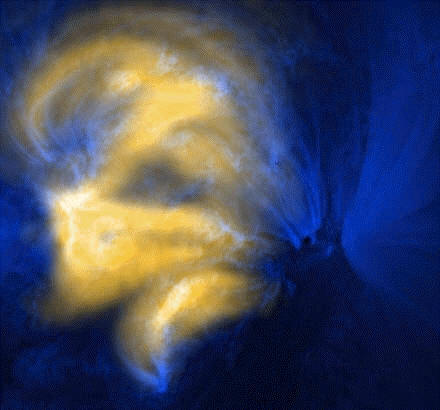
Then this composite images shows us what is underneath the photosphere.

mossyohkoh.jpg


But I suppose you'll want to have your cake and eat it too, right?
 
Status
Not open for further replies.

Back
Top Bottom