Micheal Mozina - In your web site you refer to the paper
"Changes in the subsurface stratification of the Sun with the 11-year activity cycle" by Sandrine Lefebvre and Alexander Kosovichev in this
assertion:
.
Can you tell us where in the paper it is stated that any of the subsurface layers are solid?
That paper certainly does not say that this stratification subsurface layer is necessarily solid but it demonstrates that sound travels faster and differently through this region, and this region shows significant and measurable changes over the course of solar cycle. Kosovichev's work with sunspots has also demonstrated that the down-drafting of plasma underneath of a sunspot is a relatively shallow affair and at about 4800KM the plasma flow starts to flatten out and go horizontal. Why is that? Sound would travel faster through a solid and a crust would certainly change over the solar cycle, particularly during the active phases, and particularly closest to the equator where all the action is happening. It would also explain why movement in the atmosphere is a relatively shallow process, why we observe "rigid features" under sunspots in Doppler images, why we observe "rigid features" in RD images, etc.
If not then how can you show your calculation that any of the layers is solid?
I can (actually Kosovichev's math) shows "calculations" of all the aforementioned items. All those calculations look good to me, and his images certainly show rigid outlines under the photosphere with lifetimes far in excess of the "structures" of the photosphere which come and go in roughly 8 minute intervals and change in a very fluid-like (MHD-like) way.
My guess is that you assume that your hypothetical, invisible, thermodynamically impossible solid iron surface exists.
It's not thermodynamically impossible. Heat is carried away from the surface in the electrons coming from the surface. The atmospheric (plasma) layers of the sun are arranged by atomic weigh with the thickest and coolest layers underneath and the lightest and hottest layers in the helium chromosphere and the hydrogen corona. By your way of thinking the photosphere could not possibly be cooler than the chromosphere, but it is.
You thus guess that the behavior of 0.99 Ro point shows a solid and maybe unvarying surface (it in fact varies by ~10 km between 1977 and 2004). You forget that you do not need to have solids in order to have stratification. You can also have stratification in liquids, gasses and plasma.
Ok, fine, I absolutely agree. We can have a "stratification" process occurring in anything. In fact I assume that is the case since I assume that the layers above and below the photosphere are arrange by atomic weight. We must ask ourselves:
What type of stratification would A) block plasma flow downdrafts at about 4800KM below the surface of the photosphere, show up in Doppler images as "rigid shapes" and create RD images?
The sentence in bold is of course your delusion that the TRACE instrument's 171 Angstrom pass band can see below the photosphere[/QUOTE]
How can you logically or rationally know that not a single photon at that wavelength penetrates the photosphere?
when this is physically impossible.
It is not "physically impossible". It was "physically demonstrated" in a lab by Birkeland and his team over 100 years ago. He had "loops" going right through his plasma layers. You can't tell me it's physically impossible because I've seen experiments where it was done. Get real.
And ...
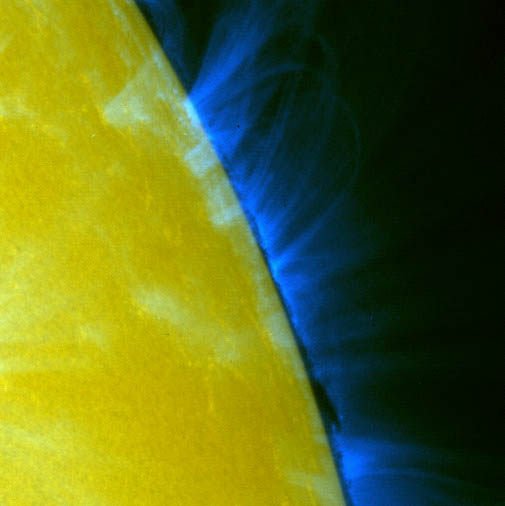
Notice how in the image below the coronal loops (blue) on the limb do not actually touch the visible surface (yellow) of the Sun.
So now we just need to know exactly how these two types of images were calibrated, now don't we? I've not had a lot of luck getting help with any images from LMSAL on their various images, but perhaps you could ask them for us and elaborate as to their response when you get it?
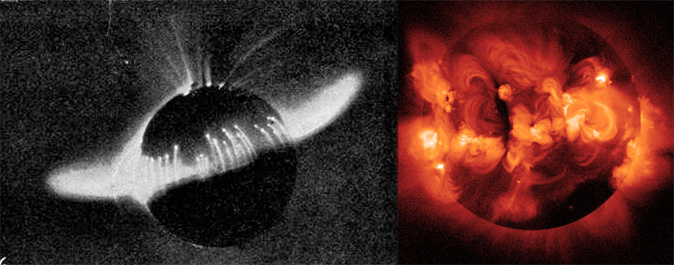
Whereas it's easy enough to see how they put together the Yohkoh and Trace images and lined up the coronal loops, it's far less obvious how the put together the two types of images or how they might be "aligned" either via software or camera hardware. Someone with more clout than me will have to get those answers, but I'd personally love to hear them. Hint: FYI, I've got similar questions about some Hinode limb images (movies actually) that have been released.

They stop at the layer of solar moss (the bright lines). Astronomers describe this as position as the "base" of the coronal loops as seen in the image. The TRACE 171A images never extend to the photosphere.
I do not know that from that single image, nor can I know that without knowing many more of the details of how they compiled that specific image. I see no obvious way to align them as I see with the Yohkoh, Trace composite. I also can't tell from such a low resolution image how many of those loops may indeed protrude into the photosphere even in that image.
Anyone who knows basic physics will see that the
TRACE 171 Angstrom filter being used excludes radiation from material cooler then 160,000 K
In Birkeland's experiments, the "hot zones" were the physical (solid) bumps on the spheres where electrons peeled off parts of the sphere and ionized particles of the sphere. The whole "loop" was "lit up" due to the electron flowing in the plasma, like an ordinary plasma filament in a plasma ball. The light is related to the "current flow", not necessarily a specific location in the solar atmosphere. You are *ASSUMING* that the sun is a *SIMPLE* and *COOPERATIVE* and *NICE* environment that is thermally isolated and thermally layered with nothing unusual going on. Any x-ray image, or 171A image, or combined image of the sun can demonstrate that this is not a "simple" process, nor does a loop span a single part of the atmosphere.
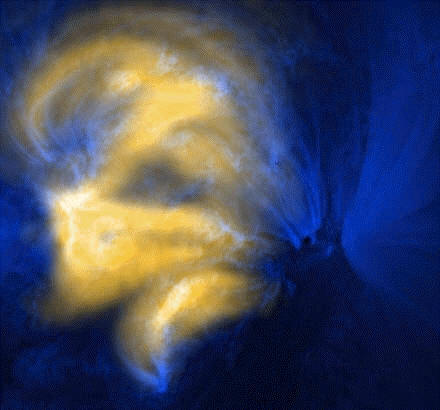
While the loop is lit from top to bottom, it radiates more x-rays as the loops reach the corona. The heating takes place throughout the loop, not only at the base of the loops. That is why the light doesn't taper off with the height of the loop and that demonstrates it's not a "simplified" thermal layered system.


 !
!