Electric universe theories here.

Status
Not open for further replies.
No, nor is the sun surrounded by such an optically opaque layer.

Unless the radiation we see is coming from the solid shell (in which case it's the shell which is at 6000 K), then yes, it's surrounded by something optically opaque. We can see that it's optically opaque.

And I'm still waiting for you to quantify any of your ideas.
 
Last edited:
Why should I re-invent the wheel?

Because the magnetic reconnection wheel was never invented.

The general topic of magnetic reconnection has been covered quite extensively here in the JREF Forum,

And so far not a single one of you have identified it's unique energy signature or release mechanism. All of these energy exchanges can easily be explained with:

A) circuit reconnection (short circuits in current carrying filaments)
B) particle reconnection (where particles collide
C) induction

No new form of energy exchange has ever been demonstrated or explained. Care to give it a whirl?
 
Unless the radiation we see is coming from the solid shell (in which case it's the shell which is at 6000 K), then yes, it's surrounded by something optically opaque. We can see that it's optically opaque.

BS.

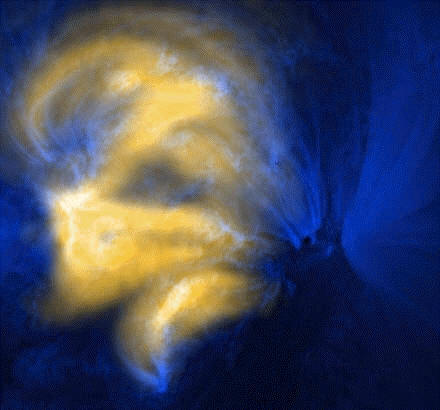
mossyohkoh.jpg


I can see through the photosphere to where the footprints of the loop touch the surface.
 
BS.

http://www.thesurfaceofthesun.com/images/mossyohkoh.jpg

I can see through the photosphere to where the footprints of the loop touch the surface.
BS
You cannot say that until you show that the photosphere is transparent to the wavelengths in the image down to your hypothetical, thermodynamically impossible iron surface/crust.

Until then all you can say is that in your personal opinion (and not backed by any physics) you and only you "can see through the photosphere to where the footprints of the loop touch the surface".

ETA:
What I "see" is an electric discharge starting from your surface and heating the plasma in the photosphere to about a million degrees. This of course blows a hole in the photosphere that is 4800 kilometers deep and easily seen in visible light images of any coronal loop or flare. This electrical discharge then loops over to bore down through the photosphere again and ground on your surface. This of course blows another hole in the photosphere that is 4800 kilometers deep and easily seen in visible light images of any coronal loop or flare.
I then look at actual visible light images of coronal loops or flares, see that there are no such holes and conclude that what I see is not what is going on. Anyone who states that coronal loops or flares are electric discharges from an iron surface/crust must then be ignoring the evidence and be extremely deluded.
 
Last edited:
[...]

And so far not a single one of you have identified it's unique energy signature or release mechanism. All of these energy exchanges can easily be explained with:

A) circuit reconnection (short circuits in current carrying filaments)
B) particle reconnection (where particles collide
C) induction

No new form of energy exchange has ever been demonstrated or explained. Care to give it a whirl?
Sure ...

The specific magnetic reconnection topic that got us here has been well addressed by tusenfem (and in the papers he cites).

Did you read that material MM? Can you say, sincerely, that you could at least follow it, if not actually understand it?

With your indulgence, I shall refrain from posting a more detailed answer to your question, pending:

a) the publication, on your website, of the math (numbers, whatever) that you have promised,

b) a satisfactory answer to Ziggurat's questions concerning quantification of your ideas, and

c) an answer to my, now very old, question concerning the stiffness of the solid surface of the Sun, per your claims (if you no longer remember the question, please say so ... I'll be more than happy to provide a link, and repeat the question).

(that's a copy of part of my last post, in case you didn't read it the first time).
 
BS.

[qimg]http://www.thesurfaceofthesun.com/images/mossyohkoh.jpg[/qimg]

I can see through the photosphere to where the footprints of the loop touch the surface.


No, you can't.

See how easy that was? I guess if a simple declaration makes one right, I'm right, too.

But you've made the claim. Prove it. Show us the experiment that supports your ridiculous claim that you're seeing through the photosphere in that composite image. Make sure it can be lab tested, right here on Earth, no fudge factors, nothing metaphysical, quantitative, mathematically sound, repeatable, physically consistent, and objective so that other people can reach the same conclusion that you've reached.

Your repeated tantrums and crybaby whines proclaiming that you can see through the photosphere by looking at composite images of data taken from thousands of kilometers above the photosphere are just that, Michael, crybaby whines and tantrums. Show us how you've reached that conclusion, objectively, so that other people can agree that's what you're seeing. You've never been able to do that. Never. And in fact it's been shown, to the satisfaction of virtually every other participant in all these discussions, that what you're showing is clearly several thousand kilometers above what you're claiming to see. Unless you've been posting the wrong image over and over and over again, it looks like you're just plain wrong.
 

Not BS. It's simple thermodynamics. Blackbodies are opaque, even inperfect blackbodies. The sun is a blackbody at approximately 6000 K. Either that's an opaque layer above your solid surface, or it's the solid surface itself that's at 6000 K. In the former case, the gas/plasma around Birkeland's sphere was never opaque (and I doubt it was at 6000 K, but feel free to correct me if I'm wrong). And in the latter case, well, the sphere itself was certainly not close to 6000 K. So in no case did Birkeland perform an experiment with conditions close to what you are proposing.

And I'm still waiting for you to quantify any of your ideas.
 
Photosphere or Chromosphere?

I simply reject the notion that you can point at things in the sky without ever demonstrating anything in a controlled test.
No, you reject physics, we all know that already.
A test of exactly what? The existence of absorption? The existence of optical depth? Since you have never once defined any parameter you use, I have no idea what I am supposed to test, or what you think you are actually saying. But so far what you have said squarely violates the most fundamental principles of physics, so we can easily dismiss it as the ravings of a mad pseudo-scientist.

Yes, as a matter of fact, I do. Birkeland already demonstrated his model works in a lab.
Fat chance. Birkeland never even came close to demonstrating that the sun might possibly have a crust, so if that's the best you can do, you lose. You have no laboratory experiments of any kind to back any of your claims, as all of Birkeland's work is quite irrelevant to the physics of the sun. All of Birkeland's work.

You're supposed to be looking a flares in white light ...
As far as I can see there are no white light images on that DVD. They are all EUV images.

and noticing that:

A) the bases of the loops light up the photosphere as they come through the photosphere and the loop comes up *THROUGH* the photosphere.
B) the mass ejections from a flare blow material up and through the photosphere during the flare process.
What makes you think you are looking at the photosphere? The base I see is the chromosphere, not the photosphere.

I guess I'll hunt copy and paste the specific images for you all after work today since none of you seem to be able to find them even with the DVD timelines specified for you and everything.
What are you talking about? I have not seen you specify any such thing, which is why I asked in the first place.
 
Not BS. It's simple thermodynamics.

I've noticed that you attempt to *OVERSIMPLIFY* pretty much everything.

Blackbodies

Blackbodies are a figment of your imagination. Nothing like them actually exist in nature. It's a mathematical construct that rarely if ever actually matches observation 'perfectly'. Solid carbon is the only element that actually comes close to "perfection'.

are opaque, even inperfect blackbodies. The sun is a blackbody at approximately 6000 K.

That is pure speculation on your part. You've never demonstrated this claim but that hasn't stopped you from repeating it over and over again like a broken record.

Either that's an opaque layer above your solid surface,

It's simply a *plasma layer* above the surface just like Birkeland had "plasma layers" above his surface.

or it's the solid surface itself that's at 6000 K.

This is called a false dichotomy fallacy. There are other options but you don't wish to hear them evidently.

In the former case, the gas/plasma around Birkeland's sphere was never opaque

Correct.

(and I doubt it was at 6000 K, but feel free to correct me if I'm wrong).

Actually I agree with you on that point. Whereas the particles flying off the sphere may have been "hot", the ambient plasma temperature was probably quite a bit lower.

And in the latter case, well, the sphere itself was certainly not close to 6000 K. So in no case did Birkeland perform an experiment with conditions close to what you are proposing.

If I were proposing that the surface was 6,000K, you might have a point. As it stands, you don't.
 
No, you reject physics, we all know that already.

No, I reject "point at the sky and add math" exercises, not empirical physics. Big difference.

A test of exactly what? The existence of absorption? The existence of optical depth? Since you have never once defined any parameter you use, I have no idea what I am supposed to test, or what you think you are actually saying.

Let's try it this way. I don't believe that the the photosphere:

A) is made of mostly hydrogen and helium
B) acts like a "black body"
C) is optically "opaque" to all wavelengths, including the iron ion wavelengths.

But so far what you have said squarely violates the most fundamental principles of physics, so we can easily dismiss it as the ravings of a mad pseudo-scientist.

This coming from the guy peddling inflation and dark energy....... Big yawn.

Fat chance. Birkeland never even came close to demonstrating that the sun might possibly have a crust,

You mean except for the fact that every model he created had one?

so if that's the best you can do, you lose.

The only person losing anything here Tim is you. IMO you got suckered into this debate due to your disagreements with Dr. Scott's solar model. Birkeland's solar model is very different Tim and you therefore need to judge it based upon it's own merits.

You have no laboratory experiments of any kind to back any of your claims, as all of Birkeland's work is quite irrelevant to the physics of the sun. All of Birkeland's work.

That is simply not true Tim. Everything he did was specifically related to solar processes and solar physics as we observe it in satellite images.

As far as I can see there are no white light images on that DVD. They are all EUV images.

I'll post some images tomorrow. I'm looking for a good screen capture program at the moment, but as soon as I find one I like I'll post the images. That image at 30:04-10 seconds is the image that more or less blows your whole show. There are many images in the white light spectrum that show "discharges" in the photosphere.

What makes you think you are looking at the photosphere? The base I see is the chromosphere, not the photosphere.

Well, then at least for the time being let us agree that the base of the loops is located *below* the corona. You might take a gander at all those 1600A images that *CERTAINLY* show that the bases of the loops cannot possibly be located in the corona.

What are you talking about? I have not seen you specify any such thing, which is why I asked in the first place.

I posted time lines for you already, but I can see from playing with the images on the DVD that the timeline changes due to the DVD player I'm using. I'll post the images as soon as I've captured them and posted them to my website. The timeline on the frame I want you to look at first is the white light image from 2001-Apr-15 at 13:55:01. In that specific frame it we can observe the loop in white light coming up through the photosphere and the effect of the loops on the photosphere as they light up the ares around the bases of both sides of the loops.

As we get into this discussion I really want you to take a look at all the images (all the various wavelengths) related to the Bastille Day flare, particularly the white light images.

 
Last edited:
I've noticed that you attempt to *OVERSIMPLIFY* pretty much everything.

Because certain things are simple. Like the idea that heat flows from hot things to cold things. If your model can't handle the simple things, it's no good. That's why I focus on simple stuff: because you can't even do that much.

Blackbodies are a figment of your imagination. Nothing like them actually exist in nature.

Wrong. Oh so terribly wrong.

It's a mathematical construct that rarely if ever actually matches observation 'perfectly'.

It doesn't need to be an exact match. A rough match is plenty good enough for our purposes. You have been informed of this before. Your continued ignorance on this point, along with repeated strawmen, are rather pathetic.

That is pure speculation on your part. You've never demonstrated this claim but that hasn't stopped you from repeating it over and over again like a broken record.

Really? I thought I've linked to the blackbody spectrum of the sun before. Well, if you insist I haven't in the past, I will do so now:
http://en.wikipedia.org/wiki/File:EffectiveTemperature_300dpi_e.png
Surely you've seen such graphs before.

It's simply a *plasma layer* above the surface just like Birkeland had "plasma layers" above his surface.

I don't care what it's made of: it's a blackbody, which means that it's opaque. That's a thermodynamic requirement, unless you don't believe in the 2nd law.

This is called a false dichotomy fallacy. There are other options but you don't wish to hear them evidently.

Other options? Please, do tell. Because nothing you said has presented an actual alternative. Remember, this alternative must produce blackbody radiation.

If I were proposing that the surface was 6,000K, you might have a point. As it stands, you don't.

If the surface isn't 6000 K, then an opaque layer above it is at 6000 K.

Unless you think that the solid surface is transparent, and the 6000 K blackbody source is below your solid surface. That would neatly solve the temperature problem of how the surface can be at a lower temperature. Would you like to try to pursue that avenue, Michael?

And I'm still waiting for you to quantify any of your ideas.
 
Why does the composition of the "mostly neon" photoshere and the corona differ

Michael Mozina:
First asked 22nd July 2009
The composition of the corona is determined by spectroscopy to be hydrogen (74.9%), helium (23.8%) carbon (0.3%), neon (0.2%), and iron (0.2%) of the mass of the Sun. Astronomers assume that this material comes from the photosphere.
You state that the photosphere is "mostly neon". 0.2% is a lot smaller than "mostly".

What stops neon getting from your photosphere into the corona in amounts large enough to turn 0.2% into 0.4% (for example)?
 
Michael Mozina:
First asked 22nd July 2009
The composition of the corona is determined by spectroscopy to be hydrogen (74.9%), helium (23.8%) carbon (0.3%), neon (0.2%), and iron (0.2%) of the mass of the Sun. Astronomers assume that this material comes from the photosphere.
You state that the photosphere is "mostly neon". 0.2% is a lot smaller than "mostly".

What stops neon getting from your photosphere into the corona in amounts large enough to turn 0.2% into 0.4% (for example)?

The short answer is "mass separation".

The helium chromosphere and hydrogen corona are both considerably hotter (and emit more photons) than the other layers of the atmosphere. More importantly, they are also sitting on top of all the other plasma layers and therefore they tend to absorb and emit the most light. Spectral analysis of the upper atmosphere is therefore going to show that the upper layers of the sun are composed of primarily hydrogen and helium.

All of the spectral percentage numbers *assume* that there is little or no mass separation of elements in the solar atmosphere and therefore they interpret these spectral numbers to be indicative of the surface of the photosphere.
 
The short answer is "mass separation".

The helium chromosphere and hydrogen corona are both considerably hotter (and emit more photons) than the other layers of the atmosphere.

This is rather obviously wrong, Michael. Look at the sun sometime. I suggest you use a filter to avoid hurting yourself. Very little of the sun's light comes from the corona. Everyone knows this (well, except you), and it's rather easy to confirm by direct observation. You don't even need any fancy scientific equipment. Should be exactly the sort of experimental evidence you're so fond of, yet you are apparently ignorant of it. Strange.

Hell, look at my avatar. Ponder upon it. It's a clue. Can you figure it out?

All of the spectral percentage numbers *assume* that there is little or no mass separation of elements in the solar atmosphere

And how much mass separation should we expect? It's actually a rather simple thermodynamics problem, Michael. You can quantify it rather easily if you assume no convection. Since convection would serve to decrease mass separation, such an estimate would only be an upper bound, but it would be a good starting place. So what amount of mass separation do you expect? Let's see if you can quantify it.

I'm still waiting for you to quantify any of your ideas. This is another one for the stack. If you ask nicely, perhaps I'll even do the mass separation calculations for you.
 
Last edited:
Status
Not open for further replies.

Back
Top Bottom