Do we agree the towers were designed to withstand jetliner crash?

I never said it was a conspriracy if the experts refused to discuss the issue. What I am saying is that if the most important event of the last 50 years cannot be discussed openly by the public then we have lost a functioning democracy.
So, the NIST colloquia, public hearings, freely distributed WTC report do not count as an open discussion by the public?
If the experts claim only they can understand the real issues and then refuse to discuss them, where does that leave us ?
It's been my experience that experts are more than willing to discuss the issue, but the general public does not have the most basic understanding of calculus, inorganic chemistry, materials science and structural mechanics necessary to engage experts on that level. What we're left with is experts attempting to explain to the laity that something that they themselves needed 3 years to figure out.

I would remind you that professional is someone who has knowledge and experience far beyond what is part of general knowledge. Professionals are not cashiers, department store sales clerks, hamburger flippers or lawn mowers. Professionals are doctors, lawyers, accountants, teachers, surveyors, architects and engineers, many of whom have post collegiate educations and years of relevant work experience.

For the conspiracy theory community, it is not sufficient to simply say, "The towers fell down too quickly," or, "The floor structure should have provided more resistance," without calculations, evidence and publishable scientific data. It seems to me that the overwhelming majority of experts have made numerous, valid objections based on their knowledge of physics, and the conspiracy community patently ignores it.

Were the conspiracy community interested in engaging in a debate on the same intellectual level as the experts, they would take the time to become educated. Dylan Avery and Jason Bermas would be back at school, this time majoring in Civil Engineering. They would cite textbooks, documents published in technical journals and their own calculations. To date, no conspiracy theorist has ever produced an argument on this level, and that's why the majority of experts have been silent on the matter.
You must have an informed citizenry to have a true democracy. I hope those terms ring some sort of a bell
Excellent idea! I would highly suggest becoming educated on the relevant topics in materials science and structural mechanics. You'll need to have taken calculus through partial differential equations, and physics through optics and light.
 
How do you get De Martini's statements as saying the planes would bounce off the building? I mean you guys have wierder theories than the most outlandish conspiracy theorist.
By assuming he thought his simile of a mosquito and mosquito netting was a good one. The reason for mosquito netting is so that mosquitos don't get through it.
If the aircraft didn't penetrate the wall of the building, it would fall down.
"Bounce off" is perhaps a little hyperbole, but not very much. Clearly De Martini was mistaken.
 
In lieu of posting another thread, I'll ask my question here: Where can I find the analysis of Robertson's calculations for what the WTC Towers can withstand? Any assistance will appreciated.
 
In lieu of posting another thread, I'll ask my question here: Where can I find the analysis of Robertson's calculations for what the WTC Towers can withstand? Any assistance will appreciated.
There are no calculations from what I understand.
 
In lieu of posting another thread, I'll ask my question here: Where can I find the analysis of Robertson's calculations for what the WTC Towers can withstand? Any assistance will appreciated.
 
Blender Head:

I believe some calculations were done by Robertson and/or his associates; however, they have never been made available to the public as far as I know. I suspect that's probably because they were very crude "back of the envelope" type calculations.
 
Blender Head:

I believe some calculations were done by Robertson and/or his associates; however, they have never been made available to the public as far as I know. I suspect that's probably because they were very crude "back of the envelope" type calculations.

Robertson did some calculations, and know the strength of steel he could use the KE to make some good ideas what would be damaged.

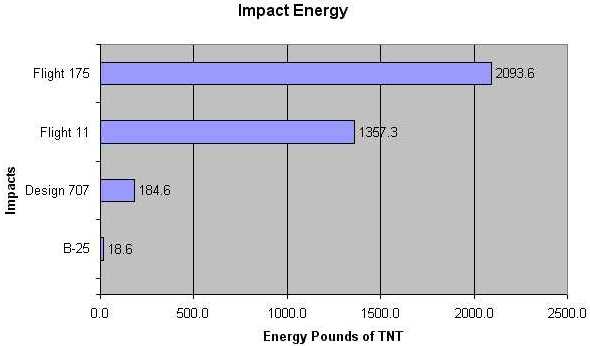
Think of the size of the bars from this chart as damage to the building due to the KE.
energy.jpg


Robertson knows the impacts on 9/11 were 7 to 11 times greater than the design he worked on. Those impacts on 9/11 damaged the systems in the core which defeated the fire protection system and stripped the wallboard isolation off the core. KE calculations can be done, I have done them, you have done them, Robertson did them.

In Robertson's calculations he clearly saw the low speed, low fuel, lost 707 only inflicting minor damage to the WTC towers.

707energy.jpg

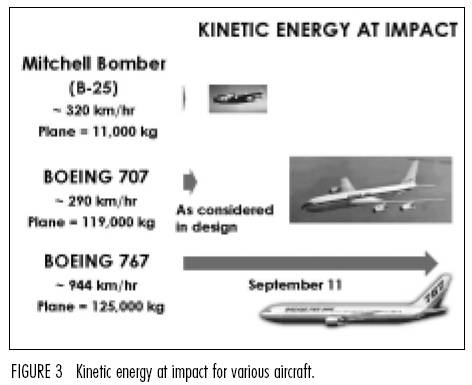
This is from a paper Robertson did. Darn, he did a design, and it was for an impact at a KE of 187 pounds of TNT!

The impacts on 9/11 were 1300 to 2093 pounds of TNT, not 187 pounds.

He gave this talk, he published these diagrams; he did expect the towers to survive a 707 lost in the fog trying to land. The most likely accident; as a pilot and an engineer, that is the most likely accident!
 
Last edited:
My impression has always been that the towers were not designed to withstand an airliner crash specifically, but at some point in the development of the design, that thought came to someone, who did some quick calculations, and figured that their already-designed building could take a hit by a 707. Is there any evidence that there was more thought put into it than that?

I doubt that anyone ever even thought about the effect of fuel during that crash, they were just finding reasons to be satisfied with their design, and looking to assure the public about the safety. In other words, I don't think it was a design goal.
 
While there aren't calculations, there is an interesting article by Les Robertson here -

http://www.nae.edu/nae/bridgecom.nsf/weblinks/NAEW-63AS9S/$FILE/Bridge-v32n1.pdf?OpenElement

It explains a little bit about the thought behind it. I wouldn't say that CurtC's take in the post above is unlikely, however. It's a lot easier to figure out what the force / kinetic energy would be if given some rather simple figures like the weight / mass of the object and its velocity, and then compare it to what you have for the wind load, than to try and model (especially back then) what all the post-impact scenarios might be.
 
Actually that is the way I see it also. It's like opening a bottle on an edge of a kitchen counter and concluding that the countertop was designed to be a bottle opener.

There were no design criteria that specified that the building had to withstand an airplane impact.
 
You know Martini is not the original designer; Robertson is; Robertson is the expert in this case!

The airliner was not fully fueled for the design impact of the 707. It was a slow speed lost in the fog, landing fuel. That puts the plane in a low fuel state.

The design impact was 5 to 7 times less then the impacts of 9/11.

Darn, a factor of over 5! The old phrase speed kills come to mind as we look at the impact of the 707 vs the terrorist fully fueled 767s.

So the towers did survive the equal of 5 to 7 impacts all rolled into one high speed impact on 9/11.

The fuel was 10,000 gallons, the heat equal of 315 tons of TNT! (wonder if that would start uncontrolled fires that could weaken steel? Yes {real experts answer their own questions})

The fires were not fought, the fires were started by 10,000 gallons of fuel, the fires had a big giant hole to feed the fuel of the WTC with Oxygen. The smoke was not really that black, it was so massive to be like a dark cloud. The fires grew and weaken the steel. The massive impacts displaced the wall board protecting the core and exterior sections. Darn, there went the 2 hour safety factor of the fire proofing, blown away. (do not believe fire does not destroy steel buildings; the steel only portions of the Madrid fire exploded in a way and fell all over the place; destroyed; fact is large structural wood does better in fires than steel)

IMPACTS:
B-25 – 41 pounds of TNT (big one)
Design – 184 pounds of TNT (WTC design for 707 impact)
Flight 11 – 1311 pounds of TNT
Flight 175 – 2066 pounds of TNT

B-25 at Empire State Building impact 84,967,480 joules (41 pounds of TNT {you mentioned this one, what a small impact!!!!SMALL})


Want some more from the engineer that built the WTC?

The original structural engineering Leslie E. Robertson design for an aircraft impact, but it was a slow speed landing configuration, less energy at impact than the 9/11 impacts!

The original structural engineering Leslie E. Robertson said it was the 10,000 gallons of fuel they failed to consider (besides the order of magnitude larger crash). Based on the design of the WTC, it is amazing the towers remained standing as long as they did, surviving a impact blast 10 times greater than design.


Leslie E. Robertson, , said:
"The twin towers of the World Trade Center were designed to resist safely the impacting by the largest aircraft of that time...the intercontinental version
of the Boeing 707. In no small measure because of the high level of
competence of the men and women of LERA, each of the towers resisted the
impact of an aircraft larger than the 707. Yes, fire brought down the towers,
but the structural integrity created by the engineers of LERA allowed perhaps thousands of persons to evacuate the buildings prior to the fire-induced collapse." http://www.engr.psu.edu/ae/WTC/LesRobertson.html


Leslie E. Robertson, , said: on being hit by a commercial jet -
" It appears that about 25,000 people safely exited the buildings, almost all
of them from below the impact floors; almost everyone above the impact floors perished, either from the impact and fire or from the subsequent collapse. The structures of the buildings were heroic in some ways but less so in others. The buildings survived the impact of the Boeing 767 aircraft, an impact very much greater than had been contemplated in our design (a slow-flying Boeing 707 lost in the fog and seeking a landing field). Therefore, the robustness of the towers was exemplary. At the same time, the fires raging in the inner reaches of the buildings undermined their strength. In time, the unimaginable happened . . . wounded by the impact of the aircraft and bleeding from the fires, both of the towers of the World Trade Center collapsed."

http://www.nae.edu/nae/bridgecom.nsf/weblinks/CGOZ-58NLCB?OpenDocument


Leslie E. Robertson, , said: more on design for jet impact –
" The two towers were the first structures outside of the military and nuclear
industries designed to resist the impact of a jet airliner, the Boeing 707. It
was assumed that the jetliner would be lost in the fog, seeking to land at JFK
or at Newark. To the best of our knowledge, little was known about the effects of a fire from such an aircraft, and no designs were prepared for that
circumstance. Indeed, at that time, no fireproofing systems were available to
control the effects of such fires."

http://www.nae.edu/nae/bridgecom.nsf/weblinks/CGOZ-58NLCB?OpenDocument

More on Robertson -

http://interactive.wsj.com/fr/emailthis/retrieve.cgi?d=SB1002665463810757240.djm

[URL]http://www.engr.psu.edu/ae/WTC/LERPresentation.htm[/URL]

Robertson desgined for a 707, going slow, low on fuel, lost in the fog.

The two towers were the first structures outside of the military and nuclear industries designed to resist the impact of a jet airliner, the Boeing 707. It was assumed that the jetliner would be lost in the fog, seeking to land at JFK or at Newark. To the best of our knowledge, little was known about the effects of a fire from such an aircraft, and no designs were prepared for that circumstance. Indeed, at that time, no fireproofing systems were available to control the effects of such fires.
Take note of the assumptions! These are the specifications used in the design; not a high speed impact, a slow speed impact.

At the design impact, the fire control, the sprinklers (-- installed later --but water system used to fight fires by firemen, see below} would survive, the FDNY could fight the fire and WIN!

http://www.nae.edu/nae/bridgecom.nsf/weblinks/NAEW-63AS9S?OpenDocument Source for a paper by Robertson
http://www.nae.edu/nae/bridgecom.nsf/weblinks/NAEW-63AS9S/$FILE/Bridge-v32n1.pdf?OpenElement The source, "The Bridge"
 
Last edited:
And once again, I have to protest at the implications that the effect of an impact was considered in the development of the design. It was not. The design was allready developed and decided on when they looked into the effects of an airplane impact.

The difference is important. Under one criteria, the effects of an impact are considered early on in the process and actual design desicions based on that consideration. In the other, the design is already set and the impact calculation is just a cross check. No actual design decsions were based on those impact calculations.
 
Er, there were no sprinkler systems in the original design.
you know, I meant water system to fight the fire, edited for what I take for granted

And once again, I have to protest at the implications that the effect of an impact was considered in the development of the design. It was not. The design was allready developed and decided on when they looked into the effects of an airplane impact.

The difference is important. Under one criteria, the effects of an impact are considered early on in the process and actual design desicions based on that consideration. In the other, the design is already set and the impact calculation is just a cross check. No actual design decsions were based on those impact calculations.
No big deal, Robertson is only the lead Enegineer, he said this.
The two towers were the first structures outside of the military and nuclear industries designed to resist the impact of a jet airliner, the Boeing 707.
The lead structural engineer, said this, I guess you can turn it around and argue very successfully that aircraft impact was not designed for, but seems like the design was for an aircraft impact. That would be a good question for Robertson. I wonder why he said this to the National Academy of Engineering?


He was worried about the fuel, and said it would be a problem, however, the core would survive and the water system seems to be safe so FDNY could fight the fire, or at least have time to assess the damage and evacuate the building. Much like 9/11 except the impacts were 7 to 11 times greater.

http://www.nae.edu/nae/bridgecom.nsf/weblinks/NAEW-63AS9S/$FILE/Bridge-v32n1.pdf?OpenElement

I have read it again, the paper above, and it appears he means they "designed to resist the impact of a jet airliner". It appears the WTC did do very well with an impact of a plane, gee, the B-25 on the Empire State Building did some damage, the strong steel shell on the WTC would have almost stopped the impact of a slow aircraft, much of the plane may have fallen out side the building.

I see what you are saying, but why would Robertson now design for an aircraft impact? It is a possible accident that had happened. Kind of silly not to look at it after the largest building in the world had been hit. He would be negligent not to design for the impact of a plane. So he did design for the impact as he said he did.

This is his visual aid.
707energy.jpg
 
The towers were built to withstand the consequences of a boeing 707 crashing whilst coming into land, (landing speeds are below 180mph).

Back when the towers were designed there was much less in the way of navigational aids.


The planes which hit the towers, were not lost, and were not flying at landing speeds.

They were heavily fueled, and going at high speed to cause maximum damage.

The faster they go, the harder they hit, the more damage they do.
 
This is his visual aid.
[qimg]http://www.beachymon.com/photo/707energy.jpg[/qimg]

According to the numbers, that bar for the 767 is much longer than it should be. The kinetic energy of the 707 and 767 should be about a factor of 11 difference in magnitude, but the 767's bar above is about 18 times longer than the 707's.

Sorry, I can be a nitpicker, but it really looked way off to me.
energy.jpg

Here are the numbers for the impacts and design. I used the best numbers I could get on the design and on 9/11.

The speed is the key, and the fact a landing plane low on fuel would be the most likely accident to happen.

It is really 18 and 4/7. or so. It should be based on the energy, as above.
 
Last edited:
Using Les Robertson's numbers above for mass and velocity, I get:

5,003,950,000 Kg*Km/H = 5,003,950,000,000 KG*M/H = 1,389,986,111 joules

55,696,000,000 Kg*Km/H =55,696,000,000,000 KG*M/H = 15,471,111,111 joules

Which is a ratio of about 11:1, as CurtC said.

If you convert those to pounds of TNT - which I think is about 2.42 MJ per - you get 6393 and 574, which is still a ratio of about 11, obviously. Unless I've horribly mangled my calculations somewhere along the line - I'm rather curious as to why my numbers are each about 3x that of Beachnut's version.
 
Leslie Robertson:
One of my jobs was to look at all of the possible events that might take place in a highrise building. And of course there had been in New York two incidences of aircraft impact, the most famous one of course being on the Empire State Building. Now, we were looking at an aircraft not unlike the Mitchell bomber that ran into the Empire State Building. We were looking at aircraft that was lost in the fog, trying to land. It was a low-flying, slow-flying 707, which was the largest aircraft of its time. And so we made calculations, not anywhere near the level of sophistication that we could today. But inside of our ability, we made calculations of what happened when the airplane goes in and it takes out a huge section of the outside wall of the building. And we concluded that it would stand. It would suffer but it would stand. And the outside wall would have a big hole in it, and the building would be in place. What we didn't look at is what happens to all that fuel. And perhaps we could be faulted for that, for not doing so. But for whatever reason we didn't look at that question of what would happen to the fuel.
 
Well, despite some nitpicking on the figures here, would it be safe to say that we all agree that the towers were not designed to withstand the jetliner crashes as they actually occurred?
 

ISF - Join now!

Every member here is approved by hand. No bots, no spam, just people who care about evidence and honest debate.

Membership is free!

Create your free account

Back
Top Bottom