apollo16uvc
Scholar
- Joined
- Oct 10, 2018
- Messages
- 60
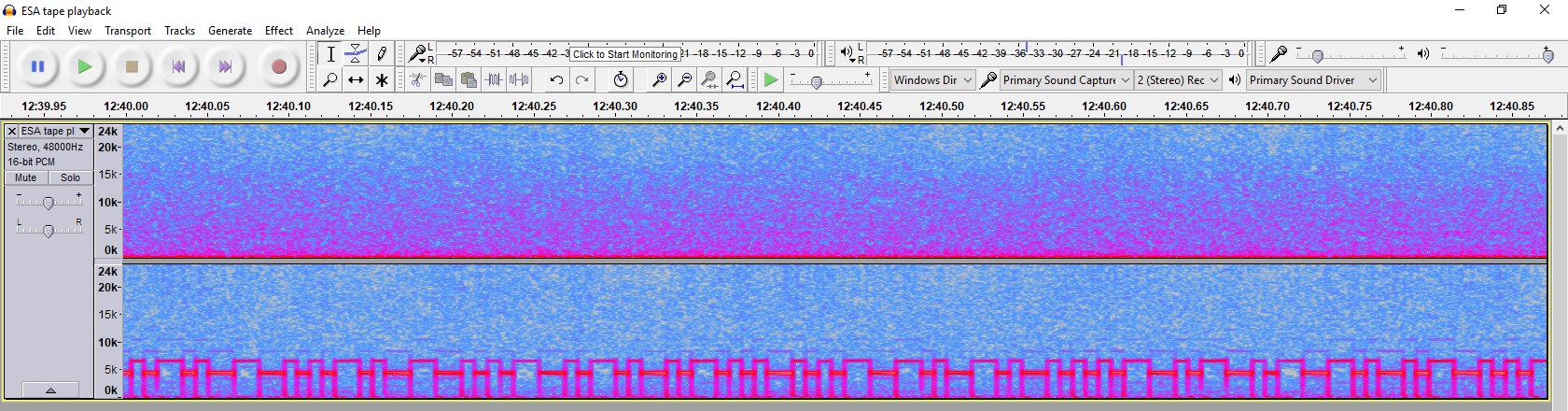
I am in contact with someone who will help me read NASA data tapes from the 60s to 70s. Lots of different people have come forward to help with the project in various ways. Chuck is reading the tapes for us.
Some quick looks at the tapes show they are from Apollo, Skylab and Pioneer 11.
They will be uploaded to archive.org as public domain. Here is a link to the archive: https://archive.org/details/SpaceData
Just for starters, we will explain what we know about the Skylab and Apollo 'switch action table' tapes.
SAT tape 1179 in our main drive:
[imgw=1024]https://archive.org/download/SpaceData/SwitchActionTp1179Mounted.JPG[/imgw]
Source: Chuck
Hans and Daschmid have been doing some great work on deciphering the Switch Action tapes. Here is some information we found recently.
What is in itallic comes from the tapes.
Here are some more educated guesses about the format:
Example of header:
R/L 40M67790-6 E/O 2T-0038 REV AS D/I 11/10/72 ECP 10-3205 E
- The headers at the top of each file imply this is controlled
engineering data. The strings starting with '40M' look like NASA
part numbers, and the E/O (Engineering Order), REV (Revision) and
ECP (Engineering Change Proposal) fields are familiar from other
NASA documents.
Example of other lines:
S 04 11 M DI 0083 SIB THRUST FAILURE IND L DO 0083 ON C H
- Columns 7-12: incrementing ID?
- Columns 13-22: appear to describe the primary hardware operation
associated with the measurement. There are a few different
formats, but I think:
{L,M} DI #### = Get Digital Input ####
{L,M} DO #### = Set Digital Ouput ####
D EE #### = Discrete Event Evaluator ####
The 'L'- and' M'-tags stand for the 'Launch Control Computer Complex' and 'Mobile Launcher'.
- The three character field starting at column 24 is the systems
area/responsible position for the measurement/command:
SIC - Saturn V 1st Stage
SIB - Saturn IB
SII - Saturn V 2nd Stage
IVB - Saturn V 3rd Stage
IU - Saturn Instrumentation Unit
INT - Integration
EDS - Emergency Detection System
LSE - Launch Support Equipment
NAV - Navigation
PL - Propellant Loading
PWR - Power
OAT - Overall Acceptance Test?
EDV - ?
- Colums 28-52: Measurement Nomenclature
- Colums 54-67: (sometimes) hardware operation to execute command
e.g, if "SIC TERM COUNTDOWN SEQ RESET L DO 0131 ON"
writing "ON" to Digital Output #131 would execute
"TERM COUNTDOWN SEQ RESET"
I think this is a reasonable guess at the formatting.
Lets look at some tapes from Apollo 16 and Skylab 2:
Looking at the headers from each:
Tape 2909, Block 3:
R/L 40M17360-11 E/O 8S-0405 REV D D/I 06/15/71 ECP 10-3148 E 511 BASELINE
Tape 1179, Block 12:
R/L 40M17360-11 E/O 8S-0413 REV M D/I 10/28/71 ECP 10-3206 E 511 FRT-1
'511' is AS-511, the launch vehicle for Apollo 16. 'FRT' is 'Flight Readiness Test'.
Detailed info on AS-511: https://ntrs.nasa.gov/archive/nasa/casi.ntrs.nasa.gov/19730025090.pdf
There's a table of prelaunch milestones on page 3-2 (46). AS-511 had its Flight Readiness Test on 3/7/1972 and was launched 4/16/1972. Considering the long lead times for checkout and configuring hardware (AS-511's S-IVB arrived at the Cape in July 1970), the dates on the tape seem reasonable. Note also that Tape 2909 has headers for revisions 'A'-'D' and 1179 has revisions 'E'-'M'
Tape 2090, Block 0:
R/L 40M67790-6 E/O 2T-000000 REV D/I ECP 10-
Block 2 ends with:
40M67790-6 206 BASELINE
Tape 1820, Block 54:
R/L 40M67790-6 E/O 2T-0038 REV AS D/I 11/10/72 ECP 10-3205 E
Block 56 ends with:
40M67790-6 206 BASELINE
Here '206' is SA-206, the launch vehicle for Skylab 2.
SA-206 flight manual: https://ntrs.nasa.gov/archive/nasa/casi.ntrs.nasa.gov/19740021163.pdf
SA-206 postlaunch evaluation: https://ntrs.nasa.gov/archive/nasa/casi.ntrs.nasa.gov/19730025087.pdf
Again the dates line up(With our tapes)
In the SA-206 postlaunch evaluation there's some discussion of an anomaly at launch, where the ground Digital Events Evaluator (DEE-6), recorded a momentary "thrust failure indication and cutoff start indication". These two discretes are present on the tape, although unfortunately the evaluation doesn't say which discretes they were:
D D EE 0083 SIB THRUST FAILURE IND
D D EE 0085 SIB CUTOFF START IND
I doubt now that this file was associated with the LVOS. Based on IBM's paper describing the system, it appears that it was first used on ASTP and wouldn't have been in use at the time the tapes were created:
https://ntrs.nasa.gov/archive/nasa/casi.ntrs.nasa.gov/19750051202.pdf
Very detailed information about the RCA-110A's and their interfacing equipment: https://ntrs.nasa.gov/archive/nasa/casi.ntrs.nasa.gov/19690001882.pdf
Example:
S 04 11 M DI 0083 SIB THRUST FAILURE IND L DO 0083 ON C H
Defines Switch Action #0411:
Mobile Launcher Digital Input #0083
name=SIB THRUST FAILURE IND
on receipt: SET LCC Digital Output #0083 to ON
There's a matching entry for L DO 0083 on our tape:
S 04 11 L DO 0083 SIB THRUST FAILURE IND NONE C H
Which would correspond to a light or other indicator on a Firing Room Console.
There's also a DEE entry, which I'm guessing tells the Digital Event Evaluator to log changes associated with that Digital Out:
D D EE 0083 SIB THRUST FAILURE IND
Check out these two extremely detailed docs:
Saturn Launch Computer Complex Programmer's Manual: http://www.ibiblio.org/apollo/Documents/SLCC_Programmers_Reference_Manual.pdf
AS-503 Verification Test Programs, 73V1201: http://www.ibiblio.org/apollo/Documents/AS-503VerificationProcedures.pdf
You won't find a definition of the the actual Switch Action Table tape format, but the tape is clearly describing the configuration information for the SLCC system.
On page 3-9/3-10 (56 in the PDF) of the programmer's manual, it mentions the "Discrete Executive":
"The Discrete Executive initiates logging at both computers. There are a number of different types of discrete tables each containing specific data. These tables are:
* LDO and MDO Profile table
* LCCC and MLC Discrete Status tables for IODC's 5 and 7
* General Discrete Log table (LDI, LDO, and MDI Changes)
* MDO Issue table"
Section 4.1.1 on 4-3 (p.66) describes "Launch Vehicle Input/Output, Discrete Input/Output" and give details on LDI/LDO's and MDI's/MDO's, which as suspected are LCCC/MLP Digital Input/Outputs.
73V1201 contains the test procedures for verifying the LCC computer software and interface to the launch vehicle are operating correctly. There's a lot of interesting details here, but first check out "Discrete Initialization and Modification (NT98/NT99)" (p.24). Section 5.2.2 (p.27) says:
"5.2.2 Place cards in the card reader to perform the following action table modification:
MDI 0010 0N - LDO 1200 issued ON
MDI 1200 0N - LDO 0010 issued 0N
LDI 0033 0N - MDO 0619 issued 0N
LDI 0619 0N - MDO 0033 issued ON"
That sounds an awful lot like our tapes. My guess is they're the input data for the NT98 Discrete Initialization Program, which unfortunately isn't described in detail. If anyone can locate the following documents, I bet we'd find what we need there:
Specification for the Operating System for the Saturn V Launch Computer Complex, Volume 1, Revision 1.
MSFC No. III-4-440-4
Operator Reference Manual for SLCC Progranrning System,
MSFC No. lII-4-440-5, IBM No. 68-F11-0003, dated 15 June 1968.
User Instructions for Saturn V Launch Computer Complex Operating System and Test Programs
MSFC No. III-4-462-1
There are numerous references to specific LDI/LDO/MDI/MDO numbers in the test procedures and while all of them don't match up with the data in the file, many do. On page 39 while testing the $DMON display monitor program, LDI0346 and MDI0459 are associated with the "ground camera arm switch" on the vehicle camera networks panel. Sure enough we can find this on the tape:
S 15 10 L DI 0346 INT GND CAMERAS ARM COMD M DO 0346 ON C B
S 15 10 M DO 0346 INT GND CAMERAS ARM COMD NONE C B
S 20 03 M DI 0459 INT GND CAMERA ARMED L DO 0459 ON C B
Another interesting example is the Launch Vehicle Data Adapter communication interfaces. See the "LVDA STATUS CODE CONVERSION CHART" on p.146. The LVDA sends back binary words on MDI0733-MDI0738, which we can find on the tapes:
S 31 13 M DI 0733 IU MODE CODE 1 IND L DO 0733 ON C G
S 31 14 M DI 0734 IU MODE CODE 2 IND L DO 0734 ON C G
S 31 15 M DI 0735 IU MODE CODE 3 IND L DO 0735 ON C G
S 31 16 M DI 0736 IU MODE CODE 4 IND L DO 0736 ON C G
S 31 17 M DI 0737 IU MODE CODE 5 IND L DO 0737 ON C G
S 31 18 M DI 0738 IU MODE CODE 6 IND L DO 0738 ON C G
For example, if MDI0736 and MDI0734 are ON that indicates "PREPARE TO LAUNCH WITH A PLATFORM"
My current thinking is that the tapes are describing the discrete I/O configuration of the two RCA-110A computers used to interface between the Launch Control Center and the Mobile Launcher. Switches and indicators on consoles in the Firing Room were wired into an RCA-110A computer (The "Saturn Launch Control Computer Complex"), and from there commands could be sent across a serial link to another RCA-110A in the Mobile Launcher. The Mobile Launcher computer communicated with relay racks and other equipment on the pad and LV, including the Saturn LVDC.
Some quick looks at the tapes show they are from Apollo, Skylab and Pioneer 11.
They will be uploaded to archive.org as public domain. Here is a link to the archive: https://archive.org/details/SpaceData
Just for starters, we will explain what we know about the Skylab and Apollo 'switch action table' tapes.
SAT tape 1179 in our main drive:
[imgw=1024]https://archive.org/download/SpaceData/SwitchActionTp1179Mounted.JPG[/imgw]
Source: Chuck
Hans and Daschmid have been doing some great work on deciphering the Switch Action tapes. Here is some information we found recently.
What is in itallic comes from the tapes.
Here are some more educated guesses about the format:
Example of header:
R/L 40M67790-6 E/O 2T-0038 REV AS D/I 11/10/72 ECP 10-3205 E
- The headers at the top of each file imply this is controlled
engineering data. The strings starting with '40M' look like NASA
part numbers, and the E/O (Engineering Order), REV (Revision) and
ECP (Engineering Change Proposal) fields are familiar from other
NASA documents.
Example of other lines:
S 04 11 M DI 0083 SIB THRUST FAILURE IND L DO 0083 ON C H
- Columns 7-12: incrementing ID?
- Columns 13-22: appear to describe the primary hardware operation
associated with the measurement. There are a few different
formats, but I think:
{L,M} DI #### = Get Digital Input ####
{L,M} DO #### = Set Digital Ouput ####
D EE #### = Discrete Event Evaluator ####
The 'L'- and' M'-tags stand for the 'Launch Control Computer Complex' and 'Mobile Launcher'.
- The three character field starting at column 24 is the systems
area/responsible position for the measurement/command:
SIC - Saturn V 1st Stage
SIB - Saturn IB
SII - Saturn V 2nd Stage
IVB - Saturn V 3rd Stage
IU - Saturn Instrumentation Unit
INT - Integration
EDS - Emergency Detection System
LSE - Launch Support Equipment
NAV - Navigation
PL - Propellant Loading
PWR - Power
OAT - Overall Acceptance Test?
EDV - ?
- Colums 28-52: Measurement Nomenclature
- Colums 54-67: (sometimes) hardware operation to execute command
e.g, if "SIC TERM COUNTDOWN SEQ RESET L DO 0131 ON"
writing "ON" to Digital Output #131 would execute
"TERM COUNTDOWN SEQ RESET"
I think this is a reasonable guess at the formatting.
Lets look at some tapes from Apollo 16 and Skylab 2:
Looking at the headers from each:
Tape 2909, Block 3:
R/L 40M17360-11 E/O 8S-0405 REV D D/I 06/15/71 ECP 10-3148 E 511 BASELINE
Tape 1179, Block 12:
R/L 40M17360-11 E/O 8S-0413 REV M D/I 10/28/71 ECP 10-3206 E 511 FRT-1
'511' is AS-511, the launch vehicle for Apollo 16. 'FRT' is 'Flight Readiness Test'.
Detailed info on AS-511: https://ntrs.nasa.gov/archive/nasa/casi.ntrs.nasa.gov/19730025090.pdf
There's a table of prelaunch milestones on page 3-2 (46). AS-511 had its Flight Readiness Test on 3/7/1972 and was launched 4/16/1972. Considering the long lead times for checkout and configuring hardware (AS-511's S-IVB arrived at the Cape in July 1970), the dates on the tape seem reasonable. Note also that Tape 2909 has headers for revisions 'A'-'D' and 1179 has revisions 'E'-'M'
Tape 2090, Block 0:
R/L 40M67790-6 E/O 2T-000000 REV D/I ECP 10-
Block 2 ends with:
40M67790-6 206 BASELINE
Tape 1820, Block 54:
R/L 40M67790-6 E/O 2T-0038 REV AS D/I 11/10/72 ECP 10-3205 E
Block 56 ends with:
40M67790-6 206 BASELINE
Here '206' is SA-206, the launch vehicle for Skylab 2.
SA-206 flight manual: https://ntrs.nasa.gov/archive/nasa/casi.ntrs.nasa.gov/19740021163.pdf
SA-206 postlaunch evaluation: https://ntrs.nasa.gov/archive/nasa/casi.ntrs.nasa.gov/19730025087.pdf
Again the dates line up(With our tapes)
In the SA-206 postlaunch evaluation there's some discussion of an anomaly at launch, where the ground Digital Events Evaluator (DEE-6), recorded a momentary "thrust failure indication and cutoff start indication". These two discretes are present on the tape, although unfortunately the evaluation doesn't say which discretes they were:
D D EE 0083 SIB THRUST FAILURE IND
D D EE 0085 SIB CUTOFF START IND
I doubt now that this file was associated with the LVOS. Based on IBM's paper describing the system, it appears that it was first used on ASTP and wouldn't have been in use at the time the tapes were created:
https://ntrs.nasa.gov/archive/nasa/casi.ntrs.nasa.gov/19750051202.pdf
Very detailed information about the RCA-110A's and their interfacing equipment: https://ntrs.nasa.gov/archive/nasa/casi.ntrs.nasa.gov/19690001882.pdf
Example:
S 04 11 M DI 0083 SIB THRUST FAILURE IND L DO 0083 ON C H
Defines Switch Action #0411:
Mobile Launcher Digital Input #0083
name=SIB THRUST FAILURE IND
on receipt: SET LCC Digital Output #0083 to ON
There's a matching entry for L DO 0083 on our tape:
S 04 11 L DO 0083 SIB THRUST FAILURE IND NONE C H
Which would correspond to a light or other indicator on a Firing Room Console.
There's also a DEE entry, which I'm guessing tells the Digital Event Evaluator to log changes associated with that Digital Out:
D D EE 0083 SIB THRUST FAILURE IND
Check out these two extremely detailed docs:
Saturn Launch Computer Complex Programmer's Manual: http://www.ibiblio.org/apollo/Documents/SLCC_Programmers_Reference_Manual.pdf
AS-503 Verification Test Programs, 73V1201: http://www.ibiblio.org/apollo/Documents/AS-503VerificationProcedures.pdf
You won't find a definition of the the actual Switch Action Table tape format, but the tape is clearly describing the configuration information for the SLCC system.
On page 3-9/3-10 (56 in the PDF) of the programmer's manual, it mentions the "Discrete Executive":
"The Discrete Executive initiates logging at both computers. There are a number of different types of discrete tables each containing specific data. These tables are:
* LDO and MDO Profile table
* LCCC and MLC Discrete Status tables for IODC's 5 and 7
* General Discrete Log table (LDI, LDO, and MDI Changes)
* MDO Issue table"
Section 4.1.1 on 4-3 (p.66) describes "Launch Vehicle Input/Output, Discrete Input/Output" and give details on LDI/LDO's and MDI's/MDO's, which as suspected are LCCC/MLP Digital Input/Outputs.
73V1201 contains the test procedures for verifying the LCC computer software and interface to the launch vehicle are operating correctly. There's a lot of interesting details here, but first check out "Discrete Initialization and Modification (NT98/NT99)" (p.24). Section 5.2.2 (p.27) says:
"5.2.2 Place cards in the card reader to perform the following action table modification:
MDI 0010 0N - LDO 1200 issued ON
MDI 1200 0N - LDO 0010 issued 0N
LDI 0033 0N - MDO 0619 issued 0N
LDI 0619 0N - MDO 0033 issued ON"
That sounds an awful lot like our tapes. My guess is they're the input data for the NT98 Discrete Initialization Program, which unfortunately isn't described in detail. If anyone can locate the following documents, I bet we'd find what we need there:
Specification for the Operating System for the Saturn V Launch Computer Complex, Volume 1, Revision 1.
MSFC No. III-4-440-4
Operator Reference Manual for SLCC Progranrning System,
MSFC No. lII-4-440-5, IBM No. 68-F11-0003, dated 15 June 1968.
User Instructions for Saturn V Launch Computer Complex Operating System and Test Programs
MSFC No. III-4-462-1
There are numerous references to specific LDI/LDO/MDI/MDO numbers in the test procedures and while all of them don't match up with the data in the file, many do. On page 39 while testing the $DMON display monitor program, LDI0346 and MDI0459 are associated with the "ground camera arm switch" on the vehicle camera networks panel. Sure enough we can find this on the tape:
S 15 10 L DI 0346 INT GND CAMERAS ARM COMD M DO 0346 ON C B
S 15 10 M DO 0346 INT GND CAMERAS ARM COMD NONE C B
S 20 03 M DI 0459 INT GND CAMERA ARMED L DO 0459 ON C B
Another interesting example is the Launch Vehicle Data Adapter communication interfaces. See the "LVDA STATUS CODE CONVERSION CHART" on p.146. The LVDA sends back binary words on MDI0733-MDI0738, which we can find on the tapes:
S 31 13 M DI 0733 IU MODE CODE 1 IND L DO 0733 ON C G
S 31 14 M DI 0734 IU MODE CODE 2 IND L DO 0734 ON C G
S 31 15 M DI 0735 IU MODE CODE 3 IND L DO 0735 ON C G
S 31 16 M DI 0736 IU MODE CODE 4 IND L DO 0736 ON C G
S 31 17 M DI 0737 IU MODE CODE 5 IND L DO 0737 ON C G
S 31 18 M DI 0738 IU MODE CODE 6 IND L DO 0738 ON C G
For example, if MDI0736 and MDI0734 are ON that indicates "PREPARE TO LAUNCH WITH A PLATFORM"
My current thinking is that the tapes are describing the discrete I/O configuration of the two RCA-110A computers used to interface between the Launch Control Center and the Mobile Launcher. Switches and indicators on consoles in the Firing Room were wired into an RCA-110A computer (The "Saturn Launch Control Computer Complex"), and from there commands could be sent across a serial link to another RCA-110A in the Mobile Launcher. The Mobile Launcher computer communicated with relay racks and other equipment on the pad and LV, including the Saturn LVDC.
Last edited: