Alan Lowey
Muse
- Joined
- Oct 4, 2013
- Messages
- 736
Sure is. This is actually the size of UFOs that airline pilots report funnily enough.The person who took that photo says it was the size of a jetliner.
That's a damn big dragonfly.

Sure is. This is actually the size of UFOs that airline pilots report funnily enough.The person who took that photo says it was the size of a jetliner.
That's a damn big dragonfly.
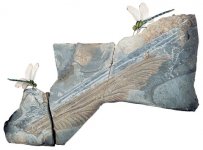
When Harvard curator of fossil insects Frank M. Carpenter dug up this wing in an Oklahoma prairie in 1940, he held a piece of the first evidence that insects had once been gigantic. The wing belonged to an ancestral dragonfly, Meganeuropsis americana, with a wingspan of almost two and a half feet.
According to Nancy Pick in The Rarest of the Rare, a book about Harvard’s natural history museum, Frank Carpenter and a colleague, in just 10 weeks in the summer of 1940, collected more than 5,000 fossil insects in Noble County, Oklahoma, including this one. The modern dragonflies have wingspans of about four inches; the wings of the largest of today’s dragonflies measure roughly six inches across.
This formidable creature lived during the Permian period, from 290 million to 248 million years ago, before birds existed, even before dinosaurs, when amphibians were the dominant life form. Parts of Oklahoma and Kansas were a tropical coastal wetland, alternately brackish and then fresh as the epeiric sea withdrew. Meganeuropsis swooped over the swamps, snatching insects from the air and seizing small amphibians. (Were it still extant, it would be a terror to mosquitoes.) The Permian ended abruptly with the greatest mass extinction ever known, perhaps caused by a blow to Earth by a comet or asteroid: 70 percent of all land dwellers were goners, Meganeuropsis among them.
Perched on the fossil wing, for a spot of color and to provide scale, are modern-day descendants known as Blue Darners or Southern Hawkers (Aeshna cyanea). Like others of their kin, they spent their larval stage in water, eating whatever they could get their mouths on. As adults, they could beat their two uncoupled pairs of wings independently, an ability that makes the dragonfly a marvel of flight engineering and a master of the air. It can pursue insect prey at high speeds (35 miles per hour or more, in some species). It can change course 180 degrees in a flash. It can hover.
The respiratory biology of the dragonfly, the way it diffuses oxygen through its body, puts an upper limit on body size, a limit Meganeuropsis appears to have ignored. A controversial theory scientists have proposed is that the Permian atmosphere must have been richer in oxygen than ours for this giant to fly; it could not have negotiated today’s thin air. This wing is at rest on permanent exhibit at Harvard’s Museum of Natural History.
Controversy has prevailed as to how insects of the Carboniferous period were able to grow so large. The way oxygen is diffused through the insect's body via its tracheal breathing system puts an upper limit on body size, which prehistoric insects seem to have well exceeded. It was originally proposed (Harlé & Harlé, 1911) that Meganeura was only able to fly because the atmosphere at that time contained more oxygen than the present 20%. This hypothesis was dismissed by fellow scientists, but has found approval more recently through further study into the relationship between gigantism and oxygen availability. If this hypothesis is correct, these insects would have been susceptible to falling oxygen levels and certainly could not survive in our modern atmosphere. Other research indicates that insects really do breathe, with "rapid cycles of tracheal compression and expansion". Recent analysis of the flight energetics of modern insects and birds suggests that both the oxygen levels and air density provide a bound on size.
A general problem with all oxygen-related explanations of the giant dragonflies is the circumstance that very large Meganeuridae with a wing span of 45 cm (1.5 ft) also occurred in the Upper Permian of Lodève in France, when the oxygen content of the atmosphere was already much lower than in the Carboniferous and Lower Permian.
Bechly (2004) suggested that the lack of aerial vertebrate predators allowed pterygote insects to evolve to maximum sizes during the Carboniferous and Permian periods, maybe accelerated by an evolutionary "arms race" for increase in body size between plant-feeding Palaeodictyoptera and Meganisoptera as their predators.


This is an interesting article The largest complete insect wing ever found
It is true that a giant dragonfly is not a "paranormal" or supernatural explanation, and is therefore more credible than, say, Old Nick right out of the gate when it comes to the culprit behind the footprints.
But at the same time, other non-supernatural explanations - for instance, small animals like rabbits whose tracks in melting snow look very similar to the "footprints" - are in turn more credible than giant dragonflies, because they're already widely known to exist and behave in the way necessary to cause the tracks.
The thing is, you've got an uphill battle here. You've got to not only establish the factual existence of the dragonflies, but you've got to explain why they would be structurally identical to smaller versions of themselves but display vastly different behaviors that don't seem to make sense. For instance, again taking them at face value, the witness reports of giant dragonflies do not describe them as hopping about on their claspers or flying during winter with repeated contact with the snow; so you must explain why you feel they are describing the same creature you are theorizing. Likewise, most blood-feeding insects keep the blood and other food they eat in their gut; you must explain why you think this food-blood would for instance be stored in other parts of the body where the insect's own hemolymph would be such as in the wing veins. Another problem would be how the insect keeps this blood warm enough to keep itself warm enough to be active during the winter.
Of course, when griffenflies ruled the air they really ruled the air. Flying vertebrates, birds, bats, and pterosaurs, would not evolve for at least another 100,000,000 years, so the skies were free of more active fliers that might have preyed on griffenflies.


Except deer or rabbits, judging by the photographs. Musk deer (extinct in Europe but could be an escapee from a zoo) or muntjac deer have the right size, footprint shape and stride length to make the tracks. Rabbits hopping in the way described by Pup and MikeG could also make the tracks.It's a fact that no known animal fits the evidence of the mystery tracks in the snow.

It's a fact that no known animal fits the evidence of the mystery tracks in the snow.
You do realise that the New Delhi bugman was a mass delusion right? Mass hysteria was to blame.
It's a fact that no known animal fits the evidence of the mystery tracks in the snow.
SHANWA, India (AP) -- It comes in the night, a flying sphere emitting red and blue lights that attacks villagers in this poor region, extensively burning those victims it does not kill.
At least that's what panic-stricken villagers say. At least seven people have died of unexplained injuries in the past week in Uttar Pradesh state.
"A mysterious flying object attacked him in the night," Raghuraj Pal said of his neighbor, Ramji Pal, who died recently in Shanwa. "His stomach was ripped open. He died two days later."
Many others have suffered scratches and surface wounds, which they say were inflicted while they slept. In the village of Darra, 53-year-old Kalawati said she was attacked last week and displayed blisters on her blackened forearms.
"It was like a big soccer ball with sparkling lights," said Kalawati, who uses only one name. "It burned my skin."
"I can't sleep because of pain," she said.
Doctors dismiss the stories as mass hysteria.
"More often than not the victims have unconsciously inflicted the symptoms themselves," said Narrotam Lal, a doctor at King George's Medical College in Lucknow, the state capital.
The police have another explanation: bugs.
"It is a three-and-a-half-inch-long winged insect" that leaves rashes and superficial wounds, Kavindra P. Singh, a superintendent of police, told the Press Trust of India news agency.
Police drew this conclusion after residents of one village found insects they had never seen before.
Villagers are unconvinced. In the most affected area, the Mirzapur district, 440 miles southeast of New Delhi, people have stopped sleeping outdoors despite the sweltering heat and frequent power outages.
Villagers also have formed protection squads that patrol Shanwa, beating drums and shouting slogans such as, "Everyone alert. Attackers beware."
Some accuse district officials of inaction and failing to capture the "aliens." One person died Thursday in nearby Sitapur when police fired shots to disperse a 10,000-strong crowd demanding that authorities capture the mysterious attackers.
"People just block the roads and attack the police for inaction each time there's a death or injury," said Amrit Abhijat, Mirzapur's district magistrate, who claims he has captured the UFO on film.
A 100,000,000 years is a long time for evolution to take place. A hundred million years! They ruled the skies. No other flying predators even existed at this time!
No, it's not. Did you see my posts and the photos that MikeG posted?
A hundred million years......and not a single fossil! Well, who'd would ever believe that? Amazing....