• Quick note - the problem with Youtube videos not embedding on the forum appears to have been fixed, thanks to ZiprHead. If you do still see problems let me know.

Deeper than primes

Status
Not open for further replies.
Please, just stop, Doron. The failures are completely your own, not those of anyone else. You are not helping your cause by continually exposing your inabilities.
Please, just start, jsfisher. The context-depended-only reasoning is your "death by entropy" closed box.You are not helping your cause by continually exposing your inabilities to get out of it.
 
And that concludes the non-rigorous proof that the number of all points, which satisfy the definition of the real number and which are positioned alongside a 1-dim object, is independent of the magnitude of such an object.
Nonsense.

Traditional mathematics asserts that a collection of |R| 0-dimensional elements can be equivalent to an element that has length > 0.

Care to demonstrate the essence of the "power of the continuum?" How does OM figure the length of this object?
The length of an element > 0 is determined by locality\non-locality co-existence. No collection 0-dimensional elements can do it without their co-existence with 1-dimensional elements, and only the 1-dimensional elements have the power of the continuum under this co-existence.
 
Last edited:
Please, just start, jsfisher. The context-depended-only reasoning is your "death by entropy" closed box.You are not helping your cause by continually exposing your inabilities to get out of it.


If only you had something you could present to prove you case....

Something, that is, other than the misunderstanding of simple concepts, circular reasoning, contradictory statements, and accusations that it really is everyone else who have the failings you so clearly demonstrate.

Got anything like that?
 
Nonsense.

Traditional mathematics asserts that a collection of |R| 0-dimensional elements can be equivalent to an element that has length > 0.
Why don't you include a quote from some source that makes the basis of your claim?
The length of an element > 0 is determined by locality\non-locality co-existence. No collection 0-dimensional elements can do it without their co-existence with 1-dimensional elements, and only the 1-dimensional elements have the power of the continuum under this co-existence.
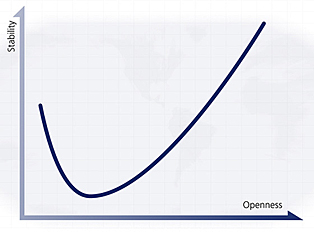
So go ahead and describe the way OM handles the task as opposed to the way traditional math does it. Here is another, easier object you can demonstrate the OM method on.

The-J-Curve_blanksm.jpg


Suppose the curve is randomly drawn and you need to know its length.
 
Why don't you include a quote from some source that makes the basis of your claim?
Any closed interval [a, b] of real numbers is Lebesgue measurable, and its Lebesgue measure is the length b−a. The open interval (a, b) has the same measure, since the difference between the two sets consists only of the end points a and b and has measure zero.
( http://en.wikipedia.org/wiki/Lebesgue_measure )
|b−a| > 0 even if [a,b] is (according to traditional math) no more than a set of 0-dimensional elements.

So go ahead and describe the way OM handles the task as opposed to the way traditional math does it.
Very simple. OM asserts that |b−a| > 0 is possible only by, at least, 1-dimensional\0-dimensional co-existence, where 1-dimensional element is the minimal non-local expression and 0-dimensional element is the minimal local expression of this co-existence.

Actually, without non-locality\locality co-existence, no Lebesgue measurable can be done, including 0 measurement, which is defined only w.r.t an element that its measurement > 0, exactly as an element that its measurement > 0 is defined only w.r.t an element that its measurement = 0.

It means that non-locality\locality are mutual AND independent w.r.t each other (their different ids are defined and saved under mutuality, such that being mutual AND independent means that the measured is not totally mutual AND not totally independent).

Being not totally mutual AND not totally independent is exactly the organic realm.

So according OM, the real line is at least the co-existence of 1-dimensional element AND 0-dimensional elements along it, such that no amount of 0-dimensional elements has the power of the continuum, which is at least length > 0 (a property that at least 1-dimensional element has under 1-dimensional\0-dimensional co-existence).

Suppose the curve is randomly drawn and you need to know its length.
It can be done only under 1-dimensional\0-dimensional co-existence.

---------------------

This co-existence does not exist by context-dependent-only reasoning.

For example, Cantor set elements are irreducible into disjoint points, simply because no 1-dimensional element is reducible to 0-dimensional element, so the assertion that Cantor set has Lebesgue measure 0 is false, and this fallacy is exactly the reflection of context-dependent-only reasoning on the result, which can't comprehend cross-contexts form like 1-dimensional element among 0-dimensional elements, which are context-dependent forms w.r.t it (by analogy, each point has a single location along the line, where the line does not have a single location w.r.t to any given point along it).

 
Last edited:
If only you had something you could present to prove you case....

Something, that is, other than the misunderstanding of simple concepts, circular reasoning, contradictory statements, and accusations that it really is everyone else who have the failings you so clearly demonstrate.

Got anything like that?

Hello, is there anybody at home to get the result of the following expression?: 1 - 0.999...[base 10] = 0.000...1[base 10] (where "...1" of 0.000...1 expression is the non-locality of the real-line that is simultaneously < AND = 1, which is a property that no point (locality) along the real-line has).

Until now there is no one at home to get it, exactly because only context-dependent reasoning is used.
 
Last edited:
Hello, is there anybody at home to get the result of the following expression?: 1 - 0.999...[base 10] = 0.000...1[base 10] (where "...1" of 0.000...1 expression is the non-locality of the real-line that is simultaneously < AND = 1, which is a property that no point (locality) along the real-line has).


That is not a result. It is something you invented to cover your ignorance. It is also inconsistent with Arithmetic since it leads almost immediately to a contradiction.

It is interesting, though, that you cherish contradiction. That puts much of your spewage in a proper context.
 
That is not a result. It is something you invented to cover your ignorance. It is also inconsistent with Arithmetic since it leads almost immediately to a contradiction.

It is interesting, though, that you cherish contradiction. That puts much of your spewage in a proper context.
It is not interesting, though, that you are limited to local-only reasoning, which gets non-locality as contradiction and therefore can't get non-local result as 0.000...1[base 10].

That puts much of your spewage in a proper context.
jsfisher that is only puts much of your context-dependent-only "death by entropy" reasoning.
 
Last edited:
It is not interesting, though, that you are limited to local-only reasoning, which gets non-locality as contradiction and therefore can't get non-local result as 0.000...1[base 10].

Well, yes, so far just about everything you have tried to present as "non-local" has led to a contradiction. Recognizing that it is contradictory isn't a limitation I have. Not seeing the contradiction, however, is definitely a limitation you have.

So, once again, Doron, you accuse others of limitations only you have.

Be the way, we have not forgotten, either, that you have been unable to define what this 0.000...1 notation nonsense is supposed to mean. Care to try again, or shall we just leave that on the pile of Doron's defined concept failures?
 
I am curious as to why people have encouraged doronshadmi by continuing to participate in this thread.

There is no longer any possibility of reaching him, or responding to any questions in a useful way. There is no chance that anyone will be led into error by his writings and need to be shown the way out. I don't think anything more can be learned from this. It hasn't been amusing for a very long time.

If people wish to continue, by all means do so, but I truly don't understand. Think of the time that you have invested in responding to his posts, and imagine how that time could have been spent otherwise.

Have a great day.
 
I am curious as to why people have encouraged doronshadmi by continuing to participate in this thread.

There is no longer any possibility of reaching him, or responding to any questions in a useful way. There is no chance that anyone will be led into error by his writings and need to be shown the way out. I don't think anything more can be learned from this. It hasn't been amusing for a very long time.

If people wish to continue, by all means do so, but I truly don't understand. Think of the time that you have invested in responding to his posts, and imagine how that time could have been spent otherwise.

Have a great day.
In a broad sense, anyone who keeps responding to Doron may not be regarded as an overly rational person, unless there are reasons that may not be apparent to a bystander. It's sort of similar to the situation where some theists would keep responding to the atheists and vice-versa. That exchange and the way it is done is a sorrowful display of God's abandonment of some of his children (lols), but some folks love to bicker and so they do.

You are limited to the local-only reasoning and therefore can't get the reasons behing this thread's continuum. How about that? LOL.
 
( http://en.wikipedia.org/wiki/Lebesgue_measure )
|b−a| > 0 even if [a,b] is (according to traditional math) no more than a set of 0-dimensional elements.
You've misinterpreted the meaning of the article. Just read this
In mathematics, Lebesgue integration, named after French mathematician Henri Lebesgue, refers to both the general theory of integration of a function with respect to a general measure, and to the specific case of integration of a function defined on a sub-domain of the real line or a higher dimensional Euclidean space with respect to the Lebesgue measure. This article focuses on the more general concept.
http://en.wikipedia.org/wiki/Lebesgue_integral

and see this: http://en.wikipedia.org/wiki/File:RandLintegrals.png

Lebesque measure just sets the stage for a bit different integration technique of some unwieldy functions.

It can be done only under 1-dimensional\0-dimensional co-existence.
Then do it.

The-J-Curve_blanksm.jpg


The 1-dim existence is represented by the curve with the length that you need to know, and the 0-dim existence is represented by the two endpoints. So you have the nice co-existence that you need to unleash the power of OM.
 
I am curious as to why people have encouraged doronshadmi by continuing to participate in this thread.

There is no longer any possibility of reaching him, or responding to any questions in a useful way. There is no chance that anyone will be led into error by his writings and need to be shown the way out. I don't think anything more can be learned from this. It hasn't been amusing for a very long time.

If people wish to continue, by all means do so, but I truly don't understand. Think of the time that you have invested in responding to his posts, and imagine how that time could have been spent otherwise.

Have a great day.


It amuses us, just as, presumably, it amuses you to post in a thread you're no longer interested in when you could have been doing something useful with that time.
 
It amuses us, just as, presumably, it amuses you to post in a thread you're no longer interested in when you could have been doing something useful with that time.


Then I am in awe at your ability to stay in the game so long and still be amused. The only eternal-thread originator who continually provides me with entertainment is Bjarne, and I think that his cows are the thing that keep me coming back.

Doronshadmi needs some cows.
 
Well, yes, so far just about everything you have tried to present as "non-local" has led to a contradiction.
Wrong.

So far just about everything you have tried to get as non-local by using locality, has led to a contradiction.

Be the way, we have not forgotten, either, that you have been unable to define what this 0.000...1 notation nonsense is supposed to mean. Care to try again, or shall we just leave that on the pile of Doron's defined concept failures?

You are still missing http://www.internationalskeptics.com/forums/showpost.php?p=7338074&postcount=15847 .

Care to try again, or shall we just leave that on the pile of jsfisher's closed box failures?
 
Last edited:
You've misinterpreted the meaning of the article. Just read this

http://en.wikipedia.org/wiki/Lebesgue_integral

and see this: http://en.wikipedia.org/wiki/File:RandLintegrals.png

Lebesque measure just sets the stage for a bit different integration technique of some unwieldy functions.


Then do it.

[qimg]http://upload.wikimedia.org/wikipedia/en/1/15/The-J-Curve_blanksm.jpg[/qimg]

The 1-dim existence is represented by the curve with the length that you need to know, and the 0-dim existence is represented by the two endpoints. So you have the nice co-existence that you need to unleash the power of OM.

epix, do you agree that your measured curve is 1-dim\0-dims co-existence?

Please answer only by yes or no.
 
Wrong.

So far just about everything you have tried to get as non-local by using locality, has led to a contradiction.

It has nothing to do with what I get. Once again, Doron, you accuse others of failings that are uniquely yours.


Didn't miss it at all. That would be were you asserted 1 and 0.999... represented different numbers and the difference was 0.000...1. That is also where you didn't say what number your undefined notation represented.

Everyone (except you) knows what the notation 0.999... represents. (It would be that well-know infinite sum of 9 times negative powers of 10.) No one (including you) knows what 0.000...1 is supposed to represent.
 
In mathematics, a Dedekind cut, named after Richard Dedekind, is a partition of the rational numbers into two non-empty parts A and B, such that all elements of A are less than all elements of B, and A contains no greatest element. The cut itself is, conceptually, the "gap" defined between A and B. In other words, A contains every rational number less than the cut, and B contains every rational number greater than the cut. The cut itself is in neither set.
( http://en.wikipedia.org/wiki/Dedekind_cut )

r is some rational number such that A={x:x<r} and B={x:x≥r}.

An irrational number z must be > all A members AND < all B members, in other words > and < are involved here such that < is actually the non-locality between z and all A members or the non-locality between z and all B members.

So Dedekind's cuts are actually based of 1-dim\0-dims co-existence.

The Dedekind cut resolves the contradiction between the continuous nature of the number line continuum and the discrete nature of the numbers themselves.
( http://en.wikipedia.org/wiki/Dedekind_cut )

The Dedekind cut resolves nothing.

1-dim\0-dims co-existence has no contradiction because no amount of 0-dims along 1-dim completely covers it exactly because the power of the continuum is at least a 1-dim element, which is notated by < between any arbitrary closer pair of 0-dims along it.

Traditional Math invents and solves problems that do not exist in the first place, in this case.
 
Last edited:
Status
Not open for further replies.

Back
Top Bottom