• Quick note - the problem with Youtube videos not embedding on the forum appears to have been fixed, thanks to ZiprHead. If you do still see problems let me know.

Deeper than primes

Status
Not open for further replies.
Yes it does. Only a point has the minimal needed term (exactly one location), which defines its exact position.

Minimal doesn’t mean only. So if you want to constrain your locations to only points, that’s up to you.

A line segment is non-local exactly because more than one location is used in order to define it.

That would be your “point” locations, so again your “non-local”, by your own assertion, requires and is dependent upon your “local” points.


X="local"

Furthermore, not-X is not necessarily the negation of X, not-X is "anything but X" where some of the possible cases is "the negation of X".

“not-X” is specifically the negation of “X” (that’s what “not” means). That you would simply like it to mean something else is just your problem.

So if “not-X is not necessarily the negation of X” then “not necessarily” is “not necessarily” the negation of ‘necessarily’. Looks like you just don’t necessarily know what you’re not saying.

Your limited understanding of negation, is one of the reasons the you don't get an expression like "non-local".

Your simple and deliberate misrepresentation of negation is why you claim above that negation is “not necessarily”, well, negation.


It is not about points, but about smaller dimensions > 0 and bigger dimensions > 0, for example : 1-dim is local w.r.t 2-dim and 2-dim is non-local w.r.t 1-dim (and also w.r.t 0-dim).

According to you above it is…

Only a point has the minimal needed term (exactly one location), which defines its exact position.


A line segment is non-local exactly because more than one location is used in order to define it.


0-dim is the smallest dim and it is local w.r.t to any other dim.

Again a lack of dimensions isn’t a dimension.


In other words, you do not distinguish between 0-dim and nothing.
This distinction is clearly seen in what I wrote here:

I used no such “other words” so stop lying and simply trying to posit aspects of your own failed reasoning onto others.


Things that exist at the same level existence (for example distinct points) are not necessarily ordered by some common rule.

This is not the case between different levels of existence, which are necessarily ordered between two extremes, which are nothing (anything but a thing) and fullness (total thing).

So you haven’t got that definition of your “successor” without ordering yet (You could have just said so). Please let us know when you do have it.

As I said. In term of existence, things of the same level of existence are not necessarily ordered, and this is not the case about " < 0 < x ≤ ∞ < "


So you don’t have a definition of your “predecessors” without ordering yet either (you could have just said that too). Please let us know when you do have it.


Try to get " < 0 < x ≤ ∞ < "

Try to get that “non-existence” is a “notation” even though you just don’t want to note it. So you now have…

“non-existence” “< 0 < x ≤ ∞ < "


No, there is Unity beyond " < 0 < x ≤ ∞ < "

So there is something “beyond” your “fullness” and it has a “successor” that you call “Unity”.

No, there is Unity beyond " < 0 < x ≤ ∞ < "

The question was…

“Are you claiming there is “Nothing” “beyond” your “Unity”?


You still do not comprehend Unity beyond " < 0 < x ≤ ∞ < " expression.

You still haven’t answered the question…

“Are you claiming there is “Nothing” “beyond” your “Unity”?


Unity is beyond complexity, where the complexity is expressed by at least two opposites, or any other form of interaction among distinct concepts (abstract or not).

Nope as you already asserted your “Unity” is simply beyond your own ability to express it accurately.
( http://www.internationalskeptics.com/forums/showpost.php?p=7115044&postcount=15223 )

According to The Man's reasoning "there is nothing between A and B" is equivalent to "there is difference between A and B"

His "reasoning" speaks for itself.

The nonsense “reasoning” remains simply yours Doron, no matter how much you’d simple like to ascribe it to others.

To alleviate your apparently deliberate confusion…

In the interval (1,1) "there is nothing between” 1 and 1 with no “difference between” 1 and 1. So clearly “there is nothing between” and “there is difference between” have only been equivocated by just you. As an interval with no difference and nothing between its limits has specifically been asserted to you before, you must just be lying to yourself and trying to lie to us, again.
 
Minimal doesn’t mean only. So if you want to constrain your locations to only points, that’s up to you.
0-dim is the minimal expression of Locality, such that any other dim > 0 is non-local w.r.t 0-dim, where 0-dim is local w.r.t all dims > 0.


That would be your “point” locations, so again your “non-local”, by your own assertion, requires and is dependent upon your “local” points.
By generalization, given x-dim < y-dim, x-dim is local w.r.t y-dim and y-dim is non-local w.r.t x-dim., even if x-dim is different than 0-dim.

You can't get this generalization, exactly as you are unable to understand that not-X is "anything but X", where some particular case of "anything but X" is "the negation of X".

“not-X” is specifically the negation of “X” (that’s what “not” means). That you would simply like it to mean something else is just your problem.

So if “not-X is not necessarily the negation of X” then “not necessarily” is “not necessarily” the negation of ‘necessarily’. Looks like you just don’t necessarily know what you’re not saying.
“not necessarily” is "anything but necessarily" where some case of "anything but necessarily" is "the negation of necessarily".

Looks like you are able to get “not necessarily” only in terms of "the negation of necessarily", but that is your forced limitation of the comprehensive meaning of “not necessarily”, which is "anything but necessarily".

Your simple and deliberate misrepresentation of negation is why you claim above that negation is “not necessarily”, well, negation.
You get only the particular case of "the negation of X" of "anything but X", where "anything but X" is the comprehensive meaning of "not-X".

Again, this is your forced limitation and entirely your problem, which is derived directly from your ignorence of the comprehensive meaning of not-X, which is "anything but X.

Again a lack of dimensions isn’t a dimension.
I agree with you. Therefore 0-dim is different than "a lack of dimensions".

I used no such “other words” so stop lying and simply trying to posit aspects of your own failed reasoning onto others.
The Man, you clearly do not distinguish between 0-dim and nothing.

So you haven’t got that definition of your “successor” without ordering yet (You could have just said so). Please let us know when you do have it.
Wrong. you simply can't comprehend the "anything but ordered" state of thinks that exist at the same level of existence.

So you don’t have a definition of your “predecessors” without ordering yet either (you could have just said that too). Please let us know when you do have it.
Please define the order at the level of nothing, which is "that has no predecessor".

Try to get that “non-existence” is a “notation” even though you just don’t want to note it. So you now have…

“non-existence” “< 0 < x ≤ ∞ < "
Another example of your weak reasoning.

In this case you are unable to deal with the actuality of nothing as expressed by “ < 0 < x ≤ ∞ < ", by forcing “non-existence” expression. In other words you have a fundamental abstraction problem.

So there is something “beyond” your “fullness” and it has a “successor” that you call “Unity”.
Wrong, you are unable to get Unity, which is beyond any expression (where “successor” is some expression).


The question was…

“Are you claiming there is “Nothing” “beyond” your “Unity”?

You still haven’t answered the question…

“Are you claiming there is “Nothing” “beyond” your “Unity”?
You still unable the do the needed abstraction in order to get Unity beyond any expression, what so ever.

Nope as you already asserted your “Unity” is simply beyond your own ability to express it accurately.
You still unable the do the needed abstraction in order to get Unity beyond any expression, what so ever.

The nonsense “reasoning” remains simply yours Doron, no matter how much you’d simple like to ascribe it to others.
Wrong The Man, your weak reasoning simply reflects its own ignorance on the considered subject.


To alleviate your apparently deliberate confusion…

In the interval (1,1) "there is nothing between” 1 and 1 with no “difference between” 1 and 1. So clearly “there is nothing between” and “there is difference between” have only been equivocated by just you. As an interval with no difference and nothing between its limits has specifically been asserted to you before, you must just be lying to yourself and trying to lie to us, again.
Now you demonstrate your inability you distinguish between (1) and (1,1).

At (1) there is nothing between 1 and 1.

At (1,1) there is redundancy (which is a kind of interval) between 1 and 1.
 
Last edited:
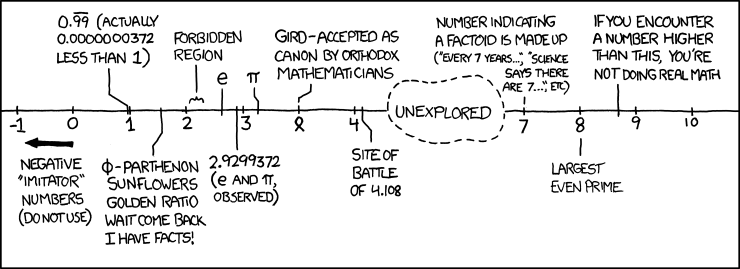
I think this will clear up a few things (including .000...1). :)

number_line.png
 
In terms of SRT ,which uses metric space, "... length of an object is variable depending on the observer" ( http://en.wikipedia.org/wiki/Length ).

In that case it has to be stressed that:

1) The observer (or its agent) is a factor of the measured result.

2) 0-dim is an absolute measured result.

3) Any k>0-dim is a relative measured result.

4) Nothing is below measurement.

5) Fullness is above measurement.

6) Unity is beyond 1 to 5 expressions.
 
The normal English meaning. What have you shown using OM that could not be done with conventional maths? What is it good for?
It is good for establishing the mathematical science on Unity, such that its developments are no longer used for destruction.
 
It is good for establishing the mathematical science on Unity, such that its developments are no longer used for destruction.

And in practice? The only way I can see that happening is by replacing maths which works with OM which doesn't.

Please give an example of what you mean.
 
And in practice? The only way I can see that happening is by replacing maths which works with OM which doesn't.

Please give an example of what you mean.

You already gave an example of your :boxedin: to get OM by saying:
The only way I can see that happening is by replacing maths which works with OM which doesn't.
In other words, all along this thread you do not look beyond your :boxedin: and as a result you simply blind to any given example that was given by me right from the first post of this thread.
 
Last edited:
Let us take for example the following diagram:
The cardinality of the real number line is the same as a finite open interval of the real number line

proofwowords.png
http://mathoverflow.net/questions/8846/proofs-without-words

Although the number of points or sub-segments is the same, the length of the represented lines is not the same.

So what makes the difference between Cardinality (which is the same) and Length (which is not the same)?
 
Last edited:
Let us take for example the following diagram:

http://mathoverflow.net/questions/8846/proofs-without-words

Although the number of points or sub-segments is the same, the length of the represented lines is not the same.

So what makes the difference between Cardinality (which is the same) and Length (which is not the same)?
Note the difference between symbols 0 and 1 and follow an analogy:

aleph0 , aleph1 <==> location = '0-dim measure' , distance = '1-dim measure'
 
Note the difference between symbols 0 and 1 and follow an analogy:

aleph0 , aleph1 <==> location = '0-dim measure' , distance = '1-dim measure'
Note that only aleph1 is considered in the case of the real-line, where aleph1 is Cardinality, which is the number of the objects that is the same for both line segments, where Length (between the considered line segments) is different.

So once again, please use Taditional Math in order to rigorously define the difference between Cardinality (which is the same for both line segments) and Length (which is not the same for the considered line segments).
 
Last edited:
Note that only aleph1 is considered in the case of the real-line, where aleph1 is Cardinality, which is the number of the objects that is the same for both line segments, where Length (between the considered line segments) is different.

So once again, please use Taditional Math in order to rigorously define the difference between Cardinality (which is the same for both line segments) and Length (which is not the same for the considered line segments).
Length is a function of 2 points and location is a function of 1 point. So 2-1 = 1-0 ==> aleph1, aleph 0.

All points must be located in k-space, otherwise no action.

 
Status
Not open for further replies.

Back
Top Bottom