• Quick note - the problem with Youtube videos not embedding on the forum appears to have been fixed, thanks to ZiprHead. If you do still see problems let me know.

Deeper than primes

Status
Not open for further replies.
...but since you are using only context-dependent reasoning you can't get it.


I see you have added yet another insult to your repertoire. Name-calling is so much easier than actually supporting your arguments, eh?

This one is worth a closer look, though. You must claim to employ context-independent reasoning, then, if the rest of us are deficient because of our context-dependency. Well, that would be consistent your irrational asserts, now, wouldn't it? If you completely ignore context (that is what context independent means, after all) then you are free to conclude the answer is 4 without ever troubling yourself whether the problem is 2+2 or something else entirely.

It explains so much. Do continue.

Doron, by his own admission, uses out of context reasoning.
 
Last edited:
No, you haven't done that yet. You've asserted it, but you haven't proven it. All you have demonstrated in all of this meaningless smoke and mirrors is that sets do not include elements they do not include.
Let us do it by baby steps.

There is a stadium.

In order to enter to this stadium, one needs a ticket with unique code.

Each unique code is an infinitely long string of <0,1> bits and we assume that a complete set of such codes is {000..., ... , 111...}.

Following this assumption, we think that all the persons (where each one of them has a ticket with a unique code) are in the stadium.

There is a clever person called Cantor who wishes to check if all the persons that have tickets with unique codes, are actually in the stadium.

He makes a list of all the persons in the stadium, according to their unique infinitely long <0,1> unique codes.

He looks at the list and gets the following idea:

“I can construct a unique code of infinitely long string of <0,1> bits, as follows:

1) I look at the first bit of the first unique <0,1> code and define the first bit of the constructed <0,1> unique code to be different than the given bit of the first unique <0,1> code in the list.

2) I look at the second bit of the second unique <0,1> code and define the second bit of the constructed <0,1> unique code to be different than the given bit of the second unique <0,1> code in the list.

I do it infinitely many times and get a unique code of infinitely long string of <0,1> bits.

According to its construction, this <0,1> code is different by at least one bit than any given <0,1> code that exists in the list, so I can conclude that the constructed <0,1> unique code is not in the list.

It means that there is at least one person with a ticket of unique code of infinitely long string of <0,1> bits, which is not in the stadium.

I can change the order of the list and even add the new code to the list, but still I can construct a unique code of infinitely long string of <0,1> bits, which is not in the list, and this is an invariant fact.”


According to this invariant fact we conclude that set {000..., ..., 111...} is incomplete, or in other words, the stadium is not completely full.
 
Last edited:
Doron, by his own admission, uses out of context reasoning.
No, it is both cross-contexts AND context-dependent reasoning.

Let us examine the concept of Completeness.

I think that in order to be considered as a complete thing, the considered thing is some how isolated form the rest of things, such that it is not influenced by them and also has no influence on them.

This notion of completeness maybe gives the filling of control and full understanding of the considered subject (whether this subject is abstract or not), but I do not think that completeness is an expression of real Complexity.

In my opinion real Complexity can't be developed among collections of complete things.

For example: even noble gas' atoms ( http://en.wikipedia.org/wiki/Noble_gas ) have thermodynamic interactions.

In other words, in a real complex environment, things are not really isolated of each other, and by this sense they are incomplete (they are opened to further influences).

Let us examine the current paradigm of the mathematical science. By this paradigm, each mathematical discipline is a context-dependent deductive framework of collection of unproved decelerations called axioms.

Being context-dependent means that each deductive framework is by default an isolated and complete universe of its own.

By this paradigm, any discovered\invented linkage among two deductive frameworks is considered as a "happy accident" which demonstrates the partial property of each deductive framework under more comprehensive framework.

Instead of "happy accidents" between context-dependent deductive frameworks, I think that a cross-contexts research has to systematically be developed, in order to consistently discover\invent the possible deeper relations between, so called, context-dependent deductive frameworks of the mathematical science.

Furthermore, without a cross-contexts research, the term "mathematical branches" is misleading, because by the current paradigm of context-dependent deductive frameworks, they can't be really considered as "branches of a one tree".

As I get it, real complexity is more like a one organism, and less like a collection of context-dependent deductive frameworks.

Let us take for example our body. The cells of one of our fingers and the cells of one of our eyes are disjoint but they are also organs of a one organism, so from one hand the finger and the eye are context-dependent things, but on the other hand there is a cross-context linkage between them at the level of the whole body as a one organism.

But also our body is not isolated form the surrounded environment, and so on ...
 
Last edited:
Let us do it by baby steps.

There is a stadium.

You have never been any good with analogies, Doron, but whatever....

In order to enter...unique code...infinitely long string of <0,1> bits...we assume that a complete set of such codes is {000..., ... , 111...}....

You didn't say which infinity was involved in that long string. It doesn't matter, though.

There is a clever person called Cantor who wishes to check if all the persons that have tickets with unique codes, are actually in the stadium.

He makes a list of all the persons in the stadium, according to their unique infinitely long <0,1> unique codes.

That will be quite a long list. There will be more items in the list then there are bits in each string. You did know that, right Doron?

He looks at the list and gets the following idea:

“I can construct a unique code of infinitely long string of <0,1> bits, as follows:

1) I look at the first bit of the first unique <0,1> code...2) I look at the second bit of the second unique <0,1> code...I do it infinitely many times and get a unique code of infinitely long string of <0,1> bits."

And, since there are fewer bits in these infinitely long strings than there are items on the list, there's a whole bunch more list items that were never considered.

According to its construction, this <0,1> code is different by at least one bit than any given <0,1> code that exists in the list, so I can conclude that the constructed <0,1> unique code is not in the list.

No, Cantor is smarter than that. He'd know full well the constructed item was just further down the list.
 
<0,1> is the minimal needed form in order to translate any given object of a given collection into a unique code.

So you’re simply going to ignore that fact that no one asked you “to show an object that has the properties of a given collection but it is not in the range of the given collection.” as you falsely claimed before?


By doing this we are able to show a universal property of any given collection, which can't be seen form the level of each collection separately (The Man calls this separation "as defined" or in other words, he can't get the notion of cross-context level among context-dependent levels).

Where did I call any “separation "as defined"”. Stop lying and simply trying to ascribe your own nonsense to others. Does your “unique code” change what is or is not a member of that set? If it does then you are no longer talking about the same set, if not then it is still the same set, as defined. Your “unique code” is, as usual, entirely superfluous.


<0,1> form is used as the universal code for any given collection, as follows:

If it is only you that uses it then it certainly isn’t “the universal code for any given collection”, unless you simply think of yourself as the, well, universe.


1) Each <0,1> form is an infinitely long unique code between 00000.... and 11111... , where 00000.... and 11111... are also unique codes.

2) We read each unique code from left to right.


Please read (1) above, in order to realize that you are wrong.


----------------------


Some examples of <0,1> translations:


A) Natural numbers (notated as N) <0,1> translation (where by Peano axioms, 0 is a natural number ( http://en.wikipedia.org/wiki/Peano_axioms )):

00000000000... ↔ 0
10000000000... ↔ 1
01000000000... ↔ 2
00100000000... ↔ 3
00010000000... ↔ 4
00001000000... ↔ 5

etc. ad infinitum ...

B) The power set of N ( notated as P(N) ) that includes {},{1,2,3,...} and any object between {} and {1,2,3,...}, is translatable to <0,1> form, for example:

{
00000000000... ↔ { },
11000000000... ↔ {1,2},
10000000000... ↔ {1},
10101010100... ↔ odd numbers {1,3,5,...},
10100000000... ↔ {1,3},
01010101010... ↔ even numbers {2,4,6,...},
01000000000... ↔ {2},
01100000000... ↔ {2,3},
00100000000... ↔ {3},
11111111111... ↔ N numbers {1,2,3,...},
...
}

etc. ad infinitum ...


C) The power set of P(N) ( notated as P(P(N)) ) that includes {} , {{},{{}},{1},{2},{3},{4},{5},{6},...} and any object between {} and {{},{{}},{1},{2},{3},{4},{5},{6},...}, is translatable to <0,1> form, for example:

{
000000000000... ↔ {},
100000000000... ↔ {{}},
010000000000... ↔ {{1}},
001000000000... ↔ {{2}},
000100000000... ↔ {{3}},
110000000000... ↔ {{},{1}},
101000000000... ↔ {{},{2}},
100100000000... ↔ {{},{3}},
111111111111... ↔ {{},{{}},{1},{2},{3},{4},{5},{6},{7},{8},{9},...},
...
}

etc. ad infinitum ...


A,B,C,... <0,1> translation is true by induction.

Given X, P(X), P(P(X)), ... , ...P(P(P(X)))... that are translatable to <0,1> collections of unique forms, it is shown that the inverse of the diagonal of the collection of the <0,1> unique forms, is not in the range of the given collection.

Since the inverse of the diagonal of the collection of the <0,1> unique forms has the same property of the unique forms of the given collection AND it is not in the range of the given collection, we conclude that any given collection of <0,1> unique forms is incomplete.

What “property” exactly are you claiming your “inverse of the diagonal of the collection of the <0,1> unique forms has”. Certainly there is a property even you claim it does not have; it is not a member of the set in question. So again Doron what member of the set is not a member of that set, that is the only property (membership) relevant to a set being complete (includes all the members of that set)?

EDIT:

Some examples (by universality only the <0,1> unique forms are significant):

00000000000...
10000000000...
01000000000...
00100000000...
00010000000...
00001000000...

where the <0,1> distinct form that is not in the range starts with 1111111..., in this case.


{
00000000000...
11000000000...
10000000000...
10101010100...
10100000000...
01010101010...
01000000000...
01100000000...
00100000000...
11111111111...
...
}

where the <0,1> distinct form that is not in the range starts with 1011101110..., in this case.

{
00000000000...
10000000000...
01000000000...
00100000000...
00010000000...
11000000000...
10100000000...
10010000000...
11111111111...
...
}

where the <0,1> distinct form that is not in the range starts with 111111110..., in this case.

-----------------------

jsfisher and The Man still can't grasp the incompleteness of any given collection, which is translatable to <0,1> unique forms.

Doron you still can’t show any member of a set that is not a member of that set, so all sets are, by definition, complete. Even by your own assertion as you claim your “inverse of the diagonal of the collection” “is not in the range of the given collection”. Again if by “incomplete” you simply mean that no set includes everything, well that is simply trivial.


EDIT:

Again The Man:

You still can't get the beauty of the complementarity of the invariat and the variant under a one framework.

For example: If you change the order of some collection of <0,1> unique forms, you get different <0,1> inverse form of the diagonal of that collection, which is not in the range of that given collection.

So your assertion is that more of your “inverse form of the diagonal of that collection” that are not members of “that collection” are, well, not members of “that collection”? You continue to simply belabor the trivial Doron.


Yet, not being in the range is invariant w.r.t any ordered case of collections of <0,1> forms.

Are you claiming there is a set of all your “inverse form of the diagonal of that collection, which is not in the range of that given collection” that does not vary?

Actually given any defined formula, it is invariant w.r.t any particular solution of it.

We have been over this before Doron, formula can and often do vary, based on the input data while still resulting in the very same solution. In other words Doron, the formula can vary and the solution can be invariant. Obviously “You still can't get the beauty of the complementarity of the invariat and the variant under a one framework” nor the subjectivity of the application of those ascriptions which can be, well, variant.
 
There is a clever person called Cantor who wishes to check if all the persons that have tickets with unique codes, are actually in the stadium.

He makes a list of all the persons in the stadium, according to their unique infinitely long <0,1> unique codes.

He looks at the list and gets the following idea:

“I can construct a unique code of infinitely long string of <0,1> bits, as follows:

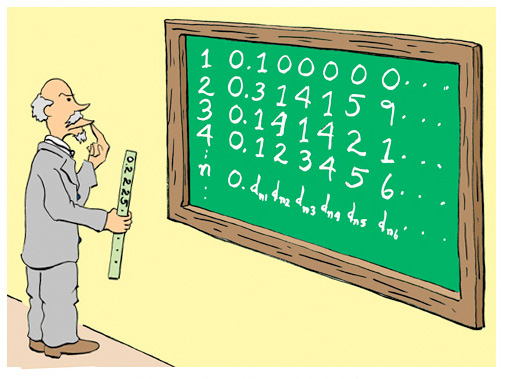
It doesn't go like that. Cantor just proved what was intuitively obvious.

georgeanddiagonal.jpg


Cantor, or anyone else, would never conceive the silly idea of corresponding natural numbers with any binary form organized in a matrix in order to alter its numerical diagonal to declare a complete set incomplete.
 
That will be quite a long list. There will be more items in the list then there are bits in each string. You did know that, right Doron?
The the inverse of the diagonal that is explicitly not in the range of {000..., ... ,111...} demonstrates the incompleteness {000..., ... ,111...}, exactly because both (number of <0,1> bits)^2 list) AND (2^(number of <0,1> bits) are based on common construction method under set {000..., ... ,111...}).

The same principle holds also with finite cases of sets that are constructed by <0,1> forms.

You did know that, right jsfisher?
 
Last edited:
So you’re simply going to ignore that fact that no one asked you “to show an object that has the properties of a given collection but it is not in the range of the given collection.” as you falsely claimed before?
This is exactly the reason why you do not understand my answer, because by your "as defined" only context-dependent reasoning, this question does not exist.

Where did I call any “separation "as defined"”. Stop lying and simply trying to ascribe your own nonsense to others.
The Man, you are not aware of the fact that your reasoning is only context-dependent, and your "as defined" in http://www.internationalskeptics.com/forums/showpost.php?p=6893125&postcount=14275 clearly demonstrates it.
Does your “unique code” change what is or is not a member of that set? If it does then you are no longer talking about the same set, if not then it is still the same set, as defined. Your “unique code” is, as usual, entirely superfluous.
Once again you are using "as defined" without the awareness that you are using this term by only context-dependent reasoning.

If it is only you that uses it then it certainly isn’t “the universal code for any given collection”, unless you simply think of yourself as the, well, universe.
This is a typical view of a person that uses only context-dependent reasoning. He will get anything only in terms of this reasoning, by missing again and again and again ... any cross-contexts reasoning, which is universal by nature.

What “property” exactly are you claiming your “inverse of the diagonal of the collection of the <0,1> unique forms has”.
Simply being <0,1> unique form that is not in the range of the collection (finite or not) of <0,1> unique forms. Again, (number of <0,1> bits)^2 list) AND (2^(number of <0,1> bits) are based on common construction of <0,1> unique forms.

Certainly there is a property even you claim it does not have; it is not a member of the set in question. So again Doron what member of the set is not a member of that set, that is the only property (membership) relevant to a set being complete (includes all the members of that set)?
Your "membership" "in question" is another demonstration of your only context-dependent reasoning, which naturally can't comprehend the universality of cross-contexts reasoning.

Doron you still can’t show any member of a set that is not a member of that set,
By understanding the universality of set {000..., ... , 111...}, it is shown (by using the diagonal method) that {000..., ... , 111...} is incomplete.

Please read also http://www.internationalskeptics.com/forums/showpost.php?p=6900038&postcount=14315 .

so all sets are, by definition, complete.
1) The is no such a thing like a collection of all sets.

2) Your "by definition" is based only on context-dependent reasoning.

Even by your own assertion as you claim your “inverse of the diagonal of the collection” “is not in the range of the given collection”.
Unlike you, it is done by using a cross-contexts reasoning.

Again if by “incomplete” you simply mean that no set includes everything, well that is simply trivial.
Let us generalize it, any given collection of unique objects is incomplete exactly because the universal collection of unique <0,1> forms {000..., ..., 111... } always has an unique <0,1> form that is not in the range of {000..., ..., 111... }.

So your assertion is that more of your “inverse form of the diagonal of that collection” that are not members of “that collection” are, well, not members of “that collection”? You continue to simply belabor the trivial Doron.
We are not talking about any particular object. By cross-contexts reasoning, it is simply shown that any given collection of unique objects is incomplete exactly because the universal collection of unique <0,1> forms {000..., ..., 111... } always has an unique <0,1> form that is not in the range of {000..., ..., 111... }.

Are you claiming there is a set of all your “inverse form of the diagonal of that collection, which is not in the range of that given collection” that does not vary?
No, the term all, if related to any collection (finite or not) of at least <0,1> unique forms, is invalid, exactly because by using the diagonal method, we are able to construct an object that is not in the list, such that X and P(X) objects have the same properties, P(X) and P(P(X)) objects have the same properties, P(P(X)) and P(P(P(X))) objects have the same properties, etc... ad infinitum.

We have been over this before Doron, formula can and often do vary, based on the input data while still resulting in the very same solution. In other words Doron, the formula can vary and the solution can be invariant. Obviously “You still can't get the beauty of the complementarity of the invariat and the variant under a one framework” nor the subjectivity of the application of those ascriptions which can be, well, variant.
Thank you for your correction, but it does not change the fact that both invariant AND variant properties are involved.

Furthermore, given a formula, it is considered as formula as long as it is invariant w.r.t any particular (and therefore variant) I/O of its data.
 
Last edited:
It doesn't go like that. Cantor just proved what was intuitively obvious.

[qimg]http://www.coopertoons.com/education/diagonal/georgeanddiagonal.jpg[/qimg]

Cantor, or anyone else, would never conceive the silly idea of corresponding natural numbers with any binary form organized in a matrix in order to alter its numerical diagonal to declare a complete set incomplete.
You still do not get the cross-contexts universality of set {000..., ... , 111...} which is not related to any particular number system and not to any particular <0,1> object out of the range.

{000..., ... , 111...} is a generalization of any collection of unique objects.

We are not talking about any particular object. By cross-contexts reasoning, it is simply shown that any given collection of unique objects is incomplete exactly because the universal collection of unique <0,1> forms {000..., ..., 111... } always has an unique <0,1> form that is not in the range of {000..., ..., 111... }.

epix, you are not aware of http://www.internationalskeptics.com/forums/showpost.php?p=6897030&postcount=14305 because you are using only context-dependent reasoning, which actually determines what you recognize as "intuitively obvious".
 
Last edited:
The Man said:
What “property” exactly are you claiming your “inverse of the diagonal of the collection of the <0,1> unique forms has”.

Here is some collection of P({apple, orange, lemon}) unique objects, that was generalized to <0,1>^|{apple, orange, lemon}| unique objects:

{
000 ↔ {}
001 ↔ {apple}
010 ↔ {orange}
011 ↔ {lemon}
100 ↔ {apple,orange}
101 ↔ {apple,lemon}
110 ↔ {orange,lemon}
111 ↔ {apple, orange, lemon}
}

As can be seen the generalized <0,1>^3 forms have the same structure, whether they are used as P(X) or X objects, for example:

P(X)=
{
000,
001,
010,
011,
100,
101,
110,
111
}

X=
(
{
100,
110,
111
} → 000
or
{
101,
010,
000
} → 001
Etc…
)

By this generalization X and P(X) objects have the same properties (the same structural principle), P(X) and P(P(X)) objects have the same properties, ... , ...P(P(X))... and ...P(P(P(X)))... objects have the same properties, etc... ad infinitum, such that the inverse of the diagonal over {000..., ..., 111...} is a self evident truth of its incompleteness.
 
Last edited:
Some correction:

The Man said:
What “property” exactly are you claiming your “inverse of the diagonal of the collection of the <0,1> unique forms has”.
Simply being <0,1> unique form that is not in the range of the collection (finite or not) of <0,1> unique forms. Again, (number of <0,1> bits)^2 list) AND (2^(number of <0,1> bits) list) are based on common construction of <0,1> unique forms.
 
And, since there are fewer bits in these infinitely long strings than there are items on the list, there's a whole bunch more list items that were never considered.
1) Each powerset is in turn a set and it also has a powerset, etc... ad infinitum.

2) The strings of a set and its power set, etc... ad infinitum, have the same structure.

3) The set of all powersets does not exist.

By (1),(2),(3) {000..., ... , 111...} is universal for any collection of unique codes, and by using the diagonal method along this set, it is shown that there is always an explicit object that has the structure of any arbitrary X or P(X) {000..., ... , 111...} unique <0,1> codes, which is not in the range of {000..., ... , 111...}.

In other words, {000..., ... , 111...} is incomplete.
 
Last edited:
Status
Not open for further replies.

Back
Top Bottom