The point is, the whole structure of Mathematics, depending on the
set theory is not in accordance with what we are doing. The intersection of two same objects is a different object: is surely shattering to mathematicians.
I think it can be solved. I mean to answer the question who made such a claim and where the inspiration came from.
The standard set theory issues easily verifiable counter-claim.
A = 12345
B = 12345
A ∩ B = 12345 ∩ 12345 = 12345
It means that the mysterious person defines intersection different way to arrive at the "math-shattering" conclusion. It looks that the function of that special intersection is virtually identical with the highway intersection of the form X.
Suppose there are two highways built one after another. Highway 39 was built first and then came Highway 27. You CANNOT switch from 39 to 27 without entering the intersection of both highways. So let's denote this fact by ODD numbers, which 39 and 27 are. It follows that the part of both highways called intersection - a place where you can switch from 39 to 27 and vice versa - must be an even number.
Now let [] be the symbol for intersection.
39 [] 27 = 3[92]7
The intersection of Highway 39 and Highway 27 is now defined as 92. Since 92 is EVEN number, you CAN make the switch from one highway to another there.
Since CAN doesn't equal MUST, there are two options upon entering Intersection 92: either you turn and switch the roads (YES), or you don't (NO). Since YES applies to '+' and NO to '-', both options can be numerically expressed using 92 as
YES: 9 + 2 = 11
NO: 9 - 2 = 7
Since 11=K and 7=G in the alphabet, the initials of the mystery person are K.G. or G.K.
Here the binary (logical opposites) analytic part pretty much ends to make room for the real-life analysis that mathematicians, scientists, and engineers use all the time. It's called the "hunch analysis," and I have a hunch that the initials belong to
Now the second part: Where did the inspiration that made Dr. Ghosh to switch from the standard definition of set intersection http://en.wikipedia.org/wiki/Intersection_(set_theory)
to his special definition come from?
Well, we mentioned only one intersection where Dr. Gosh could make the switch: it was Intersection 92 - the place where Highway 39 and Highway 27 meet. 3[92]7.
Due to
39 = "number of books in The Old Testament 27 = "number of books in The New Testament
the inspiration must have come from someone who thinks that
OLD is to ODD as NEW is to ODD.
(The atheists always say that religion isn't logical, but they seem to have a great deal of difficulty to make a brief and effective point.)
Doron's latest crank good buddy denies Doron's bogus claim that 1 and 0.999... are different numbers. Oh, dear!! Now, Kaushik Ghosh does practice his own sort of insanity, but at least he knows more about limits than Doron.
On the other hand, he does have this as a foundational argument:
We consider a homogeneous linear array of marbles touching each other. If we now shrink the volume of each marble keeping them in contact (so that the array is always homogeneous) then in the limit that the volume of the marbles is zero we will get a single point.
This may be true for any finite array of marbles. It is not true for an infinite array. Maybe being so wrong so quickly in his writings is what Doron finds so attractive.
Continuing, just a few paragraphs later, we find this dementia:
An arbitrary real rational number may be expressed as r = n.x1x2x3...xp where n is an integer, xi = 0,...9 for i < p, xj = 0 for j > p, p may be arbitrarily large but finite and xp <> 0, i.e., the sequence of the decimal places is finite.
In Ghosh's world, 1/7 is not a rational number. Who knew?
So, Doron, is he right or wrong? Do 1 and 0.999... represent the same number? Is 1/7 rational? At what point does an infinite linear array of shrinking marbles switch from having infinite extent to being just a point?
Well, we mentioned only one intersection where Dr. Gosh could make the switch: it was Intersection 92 - the place where Highway 39 and Highway 27 meet. 3[92]7.
Due to
39 = "number of books in The Old Testament 27 = "number of books in The New Testament
the inspiration must have come from someone who thinks that
I'm afraid that there is no solution stuffed with rigor. Picture this: Ghosh is waiting in the intersection for his extra-earthly contact to bring him the math-shattering formula. Would his contact arrive driving alongside Highway 39 or Highway 27?
Both options are mutually exclusive and so you can expect binary operations to enter the solution. The binary numbers used are 1 and 0; the "binary letters" are consonants and vowels. Since there are 21 consonants and 5 vowels in the alphabet, it follows that
1>0 <=> c>v
and that c=1 and v=0.
That leads to the binary transformation of Ghosh's name:
GHOSH = 11011
The extra-earhtly guide understands this very well. It cannot approach Ghosh by driving alongside Highway 39, coz
11011(binary) = 27(decimal)
and therefore must drive alongside Highway 27. But since Highway 27 = 27 books of The New Testament, the Ghosh's mentor come from the second part of the Bible.
Do you know how many guys are "driving alongside The New Testament?"
That's right. A lot. And one of them is sharing his "wisdom" with Ghosh. That part of the search is not entirely supported by binary logic, so it's not that straightforward. You need to redefine the intersection, coz there would be TWO persons talking. The big clue is what Ghosh said, namely, "The intersection of TWO same objects is a different object." That does the trick.
But you better work on the conjecture. No tricks there - just the old-fashioned "traditional" math.
From: Doron Shadmi <[email protected]>
Subject: A FEW COMMENTS ON "A FEW COMMENTS ON CLASSICAL ELECTRODYNAMICS"
To: [email protected]
Date: Thursday, 14 April, 2011, 7:45 AM
We will consider the fact that real numbers form a dense set: for real numbers only the concept of ”two numbers separated by an interval” or “two numbers are same” have meaning but “two numbers adjacent” is not defined.
According to my observations “two numbers adjacent” is the result of an ever smaller 1-dimensional element, which is irreducible to any one of the ever closer 0-dimensional elements along it, simply because a 1-dimensional element is at most an ever smaller element with respect to the smallest element, which is an 0-dimensional element, known as a point, in this case.
The same principle is found between 2-dimensional element with respect to 1 and 0 dimensional elements.
In general, given any n>0 dimensional element, it is en ever smaller element with respect to any dimensional element < n.
The smallest n-dimensional elements (where n>0) can be found only if there is a finite amount of them in some researched framework.
But this is not the case if there are ifnitiely many n-dimensional elements (where n>0) in some researched framework.
In that case the following generalization holds:
Given any n>0 dimensional element, it is en ever smaller element with respect to any dimensional element < n.
From: Kaushik Ghosh <[email protected]>
To: Doron Shadmi <[email protected]>
Sent: Saturday, April 16, 2011 9:12 AM
Subject: Re: A FEW COMMENTS ON "A FEW COMMENTS ON CLASSICAL ELECTRODYNAMICS"
Dear Mr. Shadmi,
Thank you for your mail. Actually what you have said is related with breaking the dense set character of the real numbers. This is discussed in reference 32,33,34 in my article. You need to adopt something like this if you want to consider a line as a collection of points and give completeness to the real number system.
When you do not consider the line as a collection of points you dont have to
break the dense set character of the real numbers for completeness. Both the line-elements and the real numbers form dense set. But whether there will exist a one-to-one relation between them (which I have naively said) is to be researched.
It would be better if you look at v139, I have finished SUPP:III there. v138
contains some mistakes in that section.
From: Doron Shadmi <[email protected]>
Subject: Re: A FEW COMMENTS ON "A FEW COMMENTS ON CLASSICAL ELECTRODYNAMICS"
To: "Kaushik Ghosh" <[email protected]>
Date: Sunday, 2 October, 2011, 12:50 PM
...
the Real-line has a non-empty collection of non-local numbers between 0 dimensional space and 1 dimensional space.
From: Kaushik Ghosh <[email protected]>
To: Doron Shadmi <[email protected]>
Sent: Monday, October 24, 2011 8:14 PM
Subject: Re: A FEW COMMENTS ON "A FEW COMMENTS ON CLASSICAL ELECTRODYNAMICS"
Dear Mr. Shadmi,
Can you explain in more detail what you mean by the statement:
the Real-line has a non-empty collection of non-local numbers between 0 dimensional space and 1 dimensional space.
This will be something related with the completeness of the real number system.
From: Doron Shadmi <[email protected]>
Subject: Re: A FEW COMMENTS ON "A FEW COMMENTS ON CLASSICAL ELECTRODYNAMICS"
To: "Kaushik Ghosh" <[email protected]>
Date: Tuesday, 25 October, 2011, 8:51 AM
Dear Dr. Ghosh,
First, thank you for your reply.
As I observe it, by using verbal_symbolic AND visual_spatial brain's skills, one enables to distinguish between "defined by" and "made of".
Without a loss of generality 1-space is a "host" space (mathematical or physical) with respect to a 0-space,
where 0-space is a "hosted" space (mathematical or physical) with respect to 1-space, where the terms "host"\"hosted" is used in order to clarify that the involved spaces are defined by each other in terms of verbal_symbolic brain's skills, but they are not made of each other in terms of visual_spatial brain's skills (one realizes that "host" or "hosted" (mathematical or physical) are different types of elements (where an element is a non-composed thing)).
Also without a loss of generality, given an infinitely long 1-space, no segment along it (where a segment is a composed object (0-space element AND 1-space element are its (atomic) building blocks) is extensible into an infinitely long 1-space OR reducible into 0-space.
In the case of the non-extensibility of a given segment into an infinitely long 1-space, the "hosted" is a collection of at least two 0-spaces.
In the case of the irreducibility of a given segment into 0-space, the "hosted" is a single 0-space.
A given complex phenomenon can based on finitely or infinitely many "host"\"hosted" building-blocks, such that it is not extensible OR reducible into their non-composed (atomic) state.
The tool that measures the non-extensibility OR irreducibility of a composed object into a non-composed (atomic) state is called non-local number, which expresses the inability of a composed object to reach the non-composed state(by using expressions that are based on verbal_symbolic AND visual_spatial brain's skills).
From: Kaushik Ghosh <[email protected]>
To: Doron Shadmi <[email protected]>
Sent: Saturday, November 26, 2011 9:14 PM
Subject: Re: A FEW COMMENTS ON "A FEW COMMENTS ON CLASSICAL ELECTRODYNAMICS"
Dear Mr. Shadmi,
You are right. You can look at the point contraction mapping th. in this regard.
If possible pl. let me know whether you are doing any thing new and related.
Lastly, thank you for your communications that I have been able to publish
two article in IJPAM.
From: Doron Shadmi <[email protected]>
To: Kaushik Ghosh <[email protected]>
Sent: Saturday, December 3, 2011 10:12 PM
Subject: Re: A FEW COMMENTS ON "A FEW COMMENTS ON CLASSICAL ELECTRODYNAMICS"
Dear Dr. Ghosh,
Your view about dimensional spaces is in agreement with my view on this subject.
I believe that you are aware of the fact that by the current paradigm higher dimensional spaces are not elements, but they are collections of lower dimensional spaces.
So you and I actually disagree with the current paradigm (and I am very interested in the success of your research).
In that case the current community of mathematicians will try to find any reason in order to show that your work is worthless, including personal attacks on your reasoning's ability.
I shared your work with other mathematicians, and instead of replying about your work, they used this part:
XVII. SAMAPTA
Any one, who had thept any aspect of this article and/or unduly disturbed the author seriously using e.m radiation in a biological way (telepathy) during the last six years, in particular while the article was getting prepared, or/and encouraged to do so is a descendant of Avatar of Dharmaraj.
in order to claim that your work is worthless.
So my question is this:
Do you claim that few people were disturbing your personal life by using telepathy?
Again, I am asking these questions exactly because I am interested in the success of your research, and therefore I wish that other scientists will take your research seriously.
From: Kaushik Ghosh <[email protected]>
To: Doron Shadmi <[email protected]>
Sent: Sunday, December 4, 2011 3:06 PM
Subject: Re: A FEW COMMENTS ON "A FEW COMMENTS ON CLASSICAL ELECTRODYNAMICS"
Dear Mr. Shadmi,
Firstly the attached manuscripts have been accepted in IJPAM
each with two reviewers. So there are a few persons who agree
with us.
The point is, the whole structure of Mathematics, depending on the
set theory is not in accordance with what we are doing. The intersection
of two same objects is a different object: is surely shattering to matehmaticians.
The other article which brings out a contradiction to the "tensorial
character of the connection coefficients" is also severe to a conservative
mathematician. Since when I had started writing these things I had
been suspended by the arxiv.
But it is also fact that there had always been a few people bothered
about these issues. Regarding the second article you can look at
the book by Wald (cited in the article). You will never be able to
convince all people.
Lastly, regarding those silly comments. You tell them there is nothing
like that in the past 3/4 years and surely some people used to disturb me
at that time with reference to
a few mistakes in the article. I now know that they came to know about
these things from those who read the article. Hence the telepathy....
things were silly in this context. I was unable to understand that a few persons
are reading the versions (> 5) which did not come out in the arxiv.
I will try to talk with people after the article will get published.
So, Doron, is he right or wrong? Do 1 and 0.999... represent the same number? Is 1/7 rational? At what point does an infinite linear array of shrinking marbles switch from having infinite extent to being just a point?
Yes, we all know that, and if and when he starts peddling his crankery, here, I'll be happy to engage him. But that's not currently the case. Currently, it is doronshadmi who is peddling his crankery, here. So, I ask again the question you continue to dodge:
So, Doron, is he right or wrong? Do 1 and 0.999... represent the same number? Is 1/7 rational? At what point does an infinite linear array of shrinking marbles switch from having infinite extent to being just a point?
I know how to send attachments by email, but I wonder how to do it when you send them via telepathy.
This is a part which deserves some attention, coz you can learn a few things about association. The starting point is the acronym IJPAM, which could be somewhat decoded given the context where it appears. Do you know something about the evolution of species, Doron? If not, then it's time to learn: We evolve specie IJPAM using intelligent design.
IJPAM ---> I AM J.P.
Now you have only two letters to decode and those are the initials J.P. Whom do the initials belong to?
It depends on the context, but in this case there is none. That's the end, but not for those who suspect that the evolution is not a solely the work of the nature. If you need some context to create the list of possible solutions to the initials J.P. that is supposed to evolve into a full name, you need to create the context. But how?
Well, the initials J.P. are not standalone; they are preceded by I AM. That wouldn't do much good with college graduates, but just as an example that I AM, or "I am," can narrow the long list of possibilities, interpret I not as a Latin letter, but as a Roman numeral. In that case, the re-assignment yields
I AM => 1 AM
Now you can narrow the list of possibilities and consider only the folks with initials J.P. who were born at 1 AM, for example. But this is not just an example of creating a context from a data that are not explicitly bred to become the context; it is very instrumental in creating the context to J.P. with respect to the evolution process.
Evolution can be observed through similarity. You find a fossil 12543 in sediment A and fossil 12345 in sediment B. If you make the comparison
12543 <=> 12345
and you know that sediment A is older than sediment B, you can consider the degree of similarity between both fossils and draw a conclusion to the origin of the well-organized specimen 12345. Unfortunately, no matter how much you dig around, there are no fossils that would show the intermediate evolutionary steps. But the degree of similarity between 12543 and 12345 is good enough for a theory to be taught in schools.
We know that the original specie IJPAM was "homogeneous" - there were no spaces between the letters. Then it evolved into a reorganized form with spaces: I AM P.J. with two periods. We don't know what or who is P.J. but we got lucky by digging and finding an intermediate evolutionary step 1 AM P.J. Mind you that 'I' and '1' are very similar and this "DNA" was found a few millions years later in species Roman and Arabic. In this view, even though we don't know what P.J. stand for, we can settle for less and make a very educated guess that AM stands for Ante Meridiem. Let's analyze this part of the fossil:
Is it possible that the genetic block AM could evolve from Ante Meridiem into something else?
Given the short time, the answer is no, but you can help it - if you are not the nature. We are going to design a clever evolutionary step:
1 AM = 13 Hours
13 Hours is not the step; it's a concept:
If 1 AM = 13 Hours then AM = Arithmetic Modular
That amounts to a significant scientific discovery: there is a meaningful relation between Ante Meridiem and Arithmetic Modular.
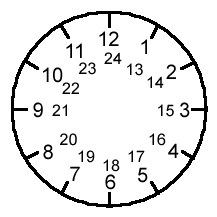
The drawing pretty much shows what modular arithmetic is all about. For example, if you organize alphabet in the circular fashion, the numbers that reflect upon the order of letters will take on different values. Obviously, the letters A and M are in the focus. Since the short hand on the face of clock goes twice around, there are two assignments to A and M.
A = 1 = 27 (1+26)
M = 13 = 39 (13+26]
Now looking at the "evolutionary clock," do we go to the past or to the future? Since A=27 and M=39, we go to the past. That's because
there are 27 books in The New Testament and 39 books in The Old Testament. Since Old precedes New, and OldNew=3927, and AM=2739 modulo 26, we must go the other way - we go to the past.
Now here is the instrumental association that eluded the Vatican Th.D.s.
The difference between "The Old Testament" and "The New Testament" are obviously the adjectives OLD and NEW. These adjectives are time related so are the acronyms AM and PM. Given the Bible, would you chose AM or PM?
Would you write AM on the cover of the Bible or PM?
I don't know. It can go either way.
So now we can make the last two evolutionary steps:
IJPAM ---> I AM P.J.---> I am J.P. ---> I am John Paul
Like that pope, John Paul II? Or is it John Paul I?
There is always a set of choices, but they are not equal to each other.
So that's the opener of the IJPAM "telepathic" message. There is no logical mistake in it, and that scares me. Fortunately, we are extremely ignorant species in this department, so there is no reason to be afraid of.
IJPAM is a collection of five letters and so let's put it among the equals.
We consider a homogeneous linear array of marbles touching each other. If we now shrink the volume of each marble keeping them in contact (so that the array is always homogeneous) then in the limit that the volume of the marbles is zero we will get a single point.
Can you explain this in some detail? The description "in the limit that the volume of the marbles is zero we will get a single point" is not a language even high school math would speak with. Values called limits are being approached by other values - limits are approached by them but are never reached. (Or do you think you can long-divide 1 by 7 and one nice day the process of division will end?) That means if the volume of a sphere is approaching zero, the process cannot affect the dimensionality of the object, yet as you say there may be an instance where some change in the volume of a 3-D object would transform it into 0-D object, which is the geometric point. That's what I'm curious about. Surely, I can draw circle O with center point C. If I "shrink" (no pun intended) the radius so that r=0, then the circumference curve of the circle disappears and what remains in the drawing is the center point C and the switch from 1-D to 0-D has been made. That's a naive idea, but there is a good chance that Dr. Ghosh had that on his peculiar mind. Lols.
I think your example of a single circle provides a reasonable place to start. The extra dimension a marble brings doesn't change the limit. With two "touching" circles, as the radii shrink towards zero not only does each circle collapse towards a single point at the circle's center, the two centers migrate towards each other in order to keep the circles touching.
Have 17 or 100 or 16,777,216 circles laid out on a line with adjacent circles touching, and as the radii shrink, the length of the linear array of circles also shrinks. It doesn't matter how many circles (or marbles) you have, if the number is finite the limit is a point.
This doesn't work at all for an infinite number of circles (or marbles), and thus why Ghosh (and Doron) leap to an incorrect conclusion.
A given space with finite curvature degree exists even if no space with infinite curvature degree exists.
A given space with infinite curvature degree exists even if no space with finite curvature degree exists.
If the finite AND infinite space's curvatures degrees are not associated, no collection of more than one space with infinite curvature degree can be found.
The considered space (no matter what curvature degree is considered) is not limited to Geometry.
If the finite AND infinite space's curvatures degrees are associated, no collection of spaces with infinite curvature degrees can be a space with finite curvature degree.
This inability is resulted by a collection of spaces with infinite curvature degrees that are not totally cover the entire space with a given finite curvature degree, no matter what Cardinality the collection of spaces with infinite curvature degrees has.
This beauty is easily understood, if one knows (by using verbal_symbolic AND visual_spatial mind's skills) the non-locality of a given space with finite curvature degree w.r.t a given space with infinite curvature degree, and the locality of a given space with infinite curvature degree w.r.t a given space with finite curvature degree.
I also wish to say that local minds are seating on their butt and expect that the whole universe will come to their rigid box, instead of really go out in order to meat things that are at AND beyond their spot.
So, Doron, is he right or wrong? Do 1 and 0.999... represent the same number? Is 1/7 rational? At what point does an infinite linear array of shrinking marbles switch from having infinite extent to being just a point?
I think your example of a single circle provides a reasonable place to start. The extra dimension a marble brings doesn't change the limit. With two "touching" circles, as the radii shrink towards zero not only does each circle collapse towards a single point at the circle's center, the two centers migrate towards each other in order to keep the circles touching.
Given two touching (tangentially) circles with center points C1 and C2 and radii R1 and R2, it's impossible that C1 and C2 "intersect" each other, coz if zero is the limit of both radii, then R1>0 and R2>0 at all time and therefore there exists line segment C1_C2 where |C1 - C2|> 0.
If you leave out the limit and allow both radii reach zero, then intuitively C1 - C2 = 0, and if you allow both radii go from r=1 to r=0
then the single center point should be at either [1,0] or [3,0]. The problem is the "shrinking" process, coz for f(x) or g(x) where r=0, there is no real solution, so you can't prove the position of the single center point if you are in R. If you switch to C, then you still get two positions for one center point. You would have to disregard lots of math and go purely intuitively on the issue. That means you won't be able to define the single center point - especially in the finite number of circles which are organized alongside the circumference of another circle.
Have 17 or 100 or 16,777,216 circles laid out on a line with adjacent circles touching, and as the radii shrink, the length of the linear array of circles also shrinks. It doesn't matter how many circles (or marbles) you have, if the number is finite the limit is a point.
This doesn't work at all for an infinite number of circles (or marbles), and thus why Ghosh (and Doron) leap to an incorrect conclusion.
Or some other point. How the shrinking circles stay touching would need to be defined precisely; however, having the two shrinking circles moving towards each other equally and symmetrically is probably the most natural scenario, in which case the central point at the limit would be [2,0].
Let's say we start with N circles of radius r where N is some integer. The length of the linear array of those (touching) circles is 2Nr. As the circles shrink, r approaches 0 and the length, 2Nr also approaches 0. At the limit, the circles collapse to a single point.
For an infinite expanse of circles of radius r, the length is unbounded. The circles cover the entirety of a straight line. As r approaches 0, the circles grow smaller and in a sense are packed more tightly, but they continue to have an infinite expanse, covering the entirety of the straight line. The limit as r approaches 0, then, is not a single point, but the entire line.
"As r approaches 0, the circles grow smaller and in a sense are packed more tightly, but they continue to have an infinite expanse, covering the entirety of the straight line. The limit as r approaches 0, then, is not a single point, but the entire line."
1. "r approaches 0" is different than "r is 0".
2. If "r approaches 0" then and only then a collection of r (weather it is finite or not) covering the entirety of the straight line, in the sense of the sum of a given length, but even in this case the sum of a given length does not have of the power of the continuum of being one and only one non-composed (atomic) element, exactly as a puzzle of many "hosted" sub-spaces does not have the power of the continuum of the "host" space (the "host" space is not the sum of "hosted" sub-spaces).
3. "packed more tightly" has nothing to do with r = 0 (which is not less than totally packed).
4. "The limit as r approaches 0", is not actually be at the limit, and we are talking on not less than actually be at the limit, that if actually fulfilled, the result is exactly one and only one totally curved (totally packed) element, (no matter if the initial state is involved with finite or infinite collection of r>0 objects).
This site uses cookies to help personalise content, tailor your experience and to keep you logged in if you register.
By continuing to use this site, you are consenting to our use of cookies.