Cont: Deeper than primes - Continuation 2

Status
Not open for further replies.
The axiom of infinity (in words):
there is a set I (the set which is postulated to be infinite), such that the empty set is in I and such that whenever any x is a member of I, the set formed by taking the union of x with its singleton {x} is also a member of I. Such a set is sometimes called an inductive set.

Such an induction is limited to members with finite cardinality (i.e. the natural numbers).

Let's use The Infinite Binary Tree (without loss of generality) as follows:

The idea is to define x>0 of 2x as a placeholder for any given level with more than one node, such that the finite cardinal 1 is used as a successor in order to represent 2x cardinal numbers, by unique sequences with x bits for each one of them.

By doing so x can be any cardinal number, finite or infinite, and we get a binary tree which is not bounded by any x.
 
Last edited:
The last 3 posts represent totally ordered cardinal numbers, such that cardinal number 1 is their successor, no matter what is the cardinal number of the placeholder, that is used to represent them.

---------------------------------------------

Such observation is not accepted by mathematicians that define infinite cardinal numbers in terms of limit-cardinals, which means that given an infinite cardinal, no addition operation with some cardinal taken from any level below it, is used as a successor of this infinite cardinal, for example:

0 + 2n = 0,
1 + 20 = 1,
2 + 21 = 2,
3 + 22 = 3,

...

etc.

In this case the following holds:

By carefully observe this diagram I realized that every sequence of bits in its left side, has a complement in its right side and vise versa, such that no matter how many bits are involved, the complement property is invariant, which guarantees the uniqueness of each sequence along the tree.

By carefully observe these notions I have found the following:

The first finite level (the one that includes two bits) of The Infinite Binary, is covered by a cardinal number (represented by bits) that is represented by 1 places.

The term “covered by” means that 21 numbers (represented by bits) can be represented by 1 places.

Generally, the number of places is determined by number x , which is used as the power value of any expression of the form 2x .

The second finite level of The Infinite Binary, is covered by a cardinal number that is represented by 2 places.

The third finite level of The Infinite Binary, is covered by a cardinal number that is represented by 3 places.
...

The first infinite level of The Infinite Binary is covered by an infinite cardinal that is represented by 0 places (it means that 0 places can represent up to 20 cardinal numbers).
...

The second infinite level of The Infinite Binary is covered by an infinite cardinal that is represented by 1 places (it means that 1 places can represent up to 21 cardinal numbers).

By this observation 1 > 20, since 1 is a limit-cardinal of anything that is involved with 0 .

...

The third infinite level of The Infinite Binary is covered by an infinite cardinal that is represented by 2 places (it means that 2 places can represent can represent up to 22 cardinal numbers).

...

etc.

---------------------

Since the observation above holds for any base (finite or infinite, where the invariant complementary property is taken as an average between trees' left and right sides) GCH is solved.

So The Infinite Binary Tree is some case without loss of generality.
 
Last edited:
Strong limit cardinals, GCH and infinite trees

This post is an improved version of the previous post.

By carefully observe this diagram I realized (by exclude the root, which is not defined by any bit) that every sequence of bits in its left side, has a complement in its right side and vise versa, such that no matter how many bits are involved, the complement property is invariant, which guarantees the uniqueness of each sequence along the tree.

By carefully observe these notions I have found the following:

The first finite level (the one that includes two bits) of The Infinite Binary, is covered by a cardinal number (represented by bits) that is represented by 1 places.

The term “covered by” means that 21 cardinal numbers (represented by bits) can be represented by 1 places.

Generally, the number of places is determined by number x , which is used as the power value of any expression of the form 2x, whether x is finite or infinite cardinal number.

The second finite level of The Infinite Binary, is covered by a cardinal number that is represented by 2 places.

The third finite level of The Infinite Binary, is covered by a cardinal number that is represented by 3 places.
...

The first infinite level of The Infinite Binary is covered by an infinite cardinal that is represented by 0 places (it means that 0 places can represent up to 20 cardinal numbers).
...

The second infinite level of The Infinite Binary is covered by an infinite cardinal that is represented by 1 places (it means that 1 places can represent up to 21 cardinal numbers).

By this observation 1 > 20, since 1 is a limit-cardinal of anything that is involved with 0, exactly as 0 is a strong limit-cardinal of anything that is involved with n (where n is any finite cardinal number).

...

The third infinite level of The Infinite Binary is covered by an infinite cardinal that is represented by 2 places (it means that 2 places can represent can represent up to 22 cardinal numbers).

...

etc.

Some examples:

0 + 2n = 0,
1 + 20 = 1,
2 + 21 = 2,
3 + 22 = 3,

...

etc.

---------------------

Since the observation above holds for any base (finite or infinite, where the invariant complementary property is taken as an average between trees' left and right sides) GCH is solved.

So The Infinite Binary Tree is some case without loss of generality.
 
Last edited:
Strong limit cardinal numbers and infinite trees

By carefully observe this diagram I realized (by exclude the root, which is not defined by any bit) that every sequence of bits in its left side, has a complement in its right side and vise versa, such that no matter how many bits are involved, the complement property is invariant, which guarantees the uniqueness of each sequence along the tree.

By carefully observe these notions I have found the following:

The first finite level (the one that includes two bits) of The Infinite Binary, is covered by a finite cardinal number that is represented by 1 place (1 place is needed in order to represent the members of {0, 1}).

Generally, the number of places is determined by number x , which is used as the power value of any expression of the form 2x, whether x is finite or infinite cardinal number.

The second finite level of The Infinite Binary, is covered by a finite cardinal number that is represented by 2 places (2 places are needed in order to represent the members of {00, 01, 10, 11}).

The third finite level of The Infinite Binary, is covered by a finite cardinal number that is represented by 3 places (3 places are needed in order to represent the members of {000, 001, 010, 011, 100, 101, 110, 111).
...

The first infinite level of The Infinite Binary is covered by an infinite strong limit cardinal (please look at https://en.wikipedia.org/wiki/Limit_cardinal) that is represented by 0 places (0 places are needed in order to represent the 20 members of the power set of S0, where each one of its unique members has 0 bits).
...

The second infinite level of The Infinite Binary is covered by an infinite strong limit cardinal that is represented by 1 places (1 places are needed in order to represent the 21 members of the power set of S1, where each one of its unique members has 1 bits).

By this observation 1 > 20, since 1 is a strong limit cardinal of anything that is involved with 0, exactly as 0 is a strong limit-cardinal of anything that is involved with n (where n is any finite cardinal number).

...

The third infinite level of The Infinite Binary is covered by an infinite cardinal that is represented by 2 places (2 places are needed in order to represent the 22 members of the power set of S2, where each one of its unique members has 2 bits).

...

etc.

Some examples:

0 + 2n = 0,
1 + 20 = 1,
2 + 21 = 2,
3 + 22 = 3,

...

etc.

---------------------

Since the observation above holds for any base (finite or infinite, where the invariant complementary property is taken as an average between trees' left and right sides) The Infinite Binary Tree is some case without loss of generality.
 
Last edited:
As observed in http://www.internationalskeptics.com/forums/showpost.php?p=12029582&postcount=2784 the cardinality of the places that are needed in order to represent each unique sequence (whether it has finite or infinite members) is equal to x, which is used as a placeholder of the power value of any expression of the form [base]x, whether x is finite or infinite cardinal number, where [base] is a placeholder for any cardinal number > 1 .

Moreover, even if strong limit cardinals are defined as inaccessible to the members of the set of cardinals below them (for example: the members of {0, 1 ,2, 3, 4, 5, ...} are inaccessible to 0), the members of the set of these strong limit cardinals are inaccessible to a strong limit cardinal above them (for example: the members of {0 ,1, 2, 3, 4, ...} are inaccessible to 0).

...

etc.

So, a collection of members with a common property can be taken as a whole, yet it is incomplete since it is inaccessible to a given limit above it, and this inaccessibility is essential to each one of the members with the common property in the given collection.

------------------------

So the notion of inaccessibility as an essential property of collections, actually goes beyond the multiple (the domain of collections), and we do not need the transfinite universe in order to deal with this essential property, as follows:

As I understand it, useful science is actually done by achieving results that can be tested and used beyond some particular observation.

It means that the observation is not-one-of-many observation, which naturally can be used as the substance of any one-of-many observation (not-one-of-many observation AND one-of-many observation will be explained later by using the model of Möbius strip).

I find Mathematics as one of the most powerful tools that enable to develop the natural linkage among not-one-of-many observation AND one-of-many observation.

In my opinion, in order to actually be such a tool, mathematicians can't partially use their own brain during mathematical activity.

Unfortunately, for the past 250 years almost every mathematical work has to be translated into verbal-symbolic form in order to be accepted as a valid mathematical work.

As I see it, in order to correct it, both visual_spatial AND verbal_symbolic brain skills have to be used during mathematical activity, where mathematical results are accepted as the association among both visual_spatial AND verbal_symbolic brain skills.

For example, let's use both visual_spatial AND verbal_symbolic brain skills in order to define the natural linkage among not-one-of-many observation AND one-of-many observation.

The minimal amount of one-of-many things is two things.

Question: What enables the knowledge that there are two things, in the first place?

By using almost only verbal_symbolic brain skills, this question is not asked at the basis of fundamental mathematical concept like Set, where {5,pi} is some example (without loss of generality) of two things (the outer "{" and "}" is not mathematically defined).

So, by Modern Mathematics (which is currntly mostly verbal_symbolic_only framework) the ability to gather at least two things is arbitrarily done.

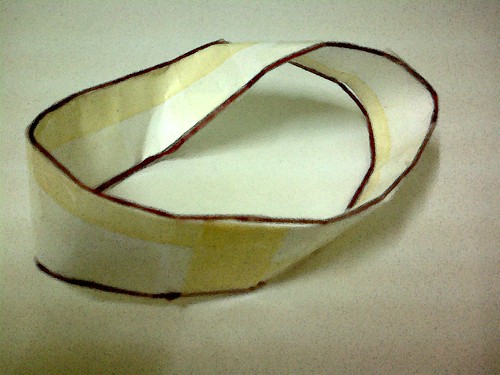
A simple visual_spatial AND verbal_symbolic tool, which naturally enables to answer to this question (by also define the outer "{" and "}" as an essential thing of fundamental mathematical concept like Set), is Möbius strip:

7381415562_770125d33a_d.jpg


By locally observe it, it has two edges (represented here by brown color), where each edge is one-of-many thing.

This observation is actually possible because also global observation is done, which provides the knowledge that there is one edge along the Möbius strip (which is not-one-of-many thing) where this knowledge is represented by the the outer "{" and "}" (which is not any one-of-many thing between them).

The visual_spatial knowledge of not-one-of-many thing (represented here by one edge along the Möbius strip), which is also represented by the outer "{" and "}", actually enables to gather one-of-many things like 5,pi into a set (for example: {5,pi}).

So, fundamental mathematical concept like Set is not rigorously defined, unless both visual_spatial AND verbal_symbolic brain skills are used.

The model of Möbius strip naturally demonstrates the linkage among being aware of one thing at once (the visual_spatial brain skill) as the substance of being aware of multiple things step-by-step (the verbal_symbolic brain skill).

Moreover, this awareness (may be known also as Unity consciousness) is exactly the core of useful scientific work, which actually achieving results that can be tested and used beyond some particular observation.

Furthermore, the observed, the observer and the tool of observation are actually one thing, which is not the sum of its expressions, and as a fundamental result we get non-entropic realm, which is essentially open to new expressions (infinitely many things can't be defined by a fixed limit, fixed cardinality, etc., as unfortunately done by the current main stream of Modern Mathematics).

Generally, by this notion one's awareness is fully activated only by simultaneously using his\her visual_spatial AND verbal_symbolic brain skills.

As I understand it ,without it, no actual scientific progression is possible.


I do not think that mathematical work that is done by using only verbal_symbolic brain skills (where visual_spatial brain skills are used only as tools for demonstration, and not as fundamental entities of mathematical work) enables to actually gather the observed, the observer and the tool of observation into Unity consciousness.

Moreover, in my opinion, the challenge is to develop natural Unity consciousness among us as human beings directly within our biological systems, instead of seeking after our external agents in terms of Artificial Intelligence.

Uncertainty by this notion, is exactly the field of creativity for any brain that enables to define the linkage among Simplicity and Complexity in daily life (where the simple is not the trivial and the complex is not the complicated, such that the wrong pair is trivial_complicated and the right pair is simple_complex).

------------------------

According to latest scientific researches (for example: [1],[2],[3],[4],[5],6]) visual_spatial AND verbal_symbolic brain skills are activated during mathematical work.

I wish to share with you some model (some analogy based on visual_spatial AND verbal_symbolic brain skills) that demonstrates the linkage between Logic and Physics.

The attached schema (https://c1.staticflickr.com/4/3929/15309487328_d8023ed9f0_b.jpg) illustrates the possible associations between Bose-Einstein statistics (even function) and Fermi-Dirac statistics (odd function) and the mathematical concepts of contradiction (expressed as sine-like wave) and tautology (expressed as cosine-like wave).

By this model contradiction is the separator among universes, where each universe has its own tautology (its own natural constants and, so called, the laws of nature).

The simplest form in this model is illustrated by non-composed endless straight line, which is essentially not the sum of its vibrations simply because being non-composed endless straight line is independent of its sine-like/cosine-like vibrations, yet they are depend on it.

This asymmetry of dependency defines a non-entropic realm since no amount of vibrations is the non-composed line in itself.

Being aware of the non-composed line during its vibrations, is actually Unity consciousness that is, in my opinion, the ultimate goal of life phenomena, that has no limits to its developed expressions, exactly because no amount of vibrations is the non-composed line in itself.

By not being limited by contradiction and tautology, life phenomena is beyond AND among the expressed universes, such that they become harmonious organs of an organism, which is ever developed exactly because no organ harms the developments of the other organs, since the development is naturally derived from cross-universes' source, which is their cause.

From this notion, Mathematics is a fulfilled tool only if it supports the development of Unity consciousness among the expressed universes, such that they become ever developed organs of one harmonious self aware realm.

As I see it, Contemporary Mathematics that defines collections of infinitely many members by using fixed sizes like |N|, |R| , or defines the sum of infinitely many numbers, or multiplication of infinitely many (0,1] members by a single finite result, blocks the ever developed nature of multiplicity and the direct awareness of Unity as the cause of multiplicity, which can't express the full potential of Unity, since, unlike Unity, multiplicity is limited by contradiction and tautology.

I wish to clarify something.

Given a non-composed endless straight line and a point not on that line, there are endless larger non-composed circles that are smaller than that line, and there are endless smaller non-composed circles that are larger than that point.

Yet pi is a proportion among the endless larger and the endless smaller non-composed circles.

So a fixed value can be related to infinitely many things as long as it is not used to define their amount, their sum or any other fixed value that contradicts their property of being endless larger or endless smaller things.

For more details, please search for Nicholas of Cusa.

Here is an example of a mathematical work that is done by using visual_spatial AND verbal_symbolic brain skills:

Please observe the diagram in http://farm5.staticflickr.com/4015/4430320710_686e9e991b.jpg.

X>0 AND X>2(a+b+c+d+...) are inseparable in the following diagram (where X is the constant positive value of the infinitely many orange figures in that diagram, whether they are straight (the first orange figure) or bent (the rest infinitely many orange figures, which their endpoints are projected upon the straight orange figure, and define 2(a+b+c+d+...) as an endless collection of added positive values that are < X, exactly because no infinitely many orange figures with constant value X>0 can have value 0)).

By using mathematics that is done only by verbal_symbolic brain skills, X=2(a+b+c+d+...), which means that X>0 AND X>2(a+b+c+d+...) are separable in the considered diagram, which (in my opinion) it is the result of separating visual_spatial and verbal_symbolic brain skills during mathematical work.

As I see it, Mathematics is actually fulfilled in case that (by using visual_spatial AND verbal_symbolic brain skills) it also goes beyond contradiction and tautology, and enables one to directly be aware of Unity as their cause (or in terms of Physics, it enables one to directly be aware of Unity as the cause of Bose-Einstein statistics (even function) and Fermi-Dirac statistics (odd function)).

Direct awareness of Unity is not achieved at the realm of thoughts process, which is closed under multiplicity.

As I get it, one enables to transcend multiplicity by being aware of finer vibrations' levels of thoughts' process without being restricted to their semantics (they are taken only in terms of different levels of vibrations)) which enables quantum leap into the non-composed source of multiplicity and quantum leap back to multiplicity.

More such bidirectional quantum leaps are exercised in one's brain, more one's brain enables the awareness of Unity as the source of multiplicity during daily life.

In my opinion, Mathematical science has to deeply be involved in such exercises in order to really be fulfilled, where reasoning at the level of thoughts (which is restricted by contradiction and tautology, like any multiple phenomena) as currently done by Contemporary Mathematics, can't fulfill the actual abilities of this science among human beings.

 
Last edited:
The usefulness of order and complementarity among two-valued logical oprators

Please observe the example of the following 16 two-valued logical operators on propositions p and q.

As can be seen they are ordered from contradiction to tautology or backwards.

Moreover, each two-valued logical operator has a complement.

Boolean algebra is a generalization of Power set algebra, but as can be seen in Wikipedia the order and complemntarity (as seen in the example of two-valued logical operators) are not defined.

Are there formal mathematical researches that are focusing on the order and complementarity among uncountable two-valued logical operators (please provide concrete examples)?
 
Last edited:
Yet pi is a proportion among the endless larger and the endless smaller non-composed circles.

So a fixed value can be related to infinitely many things as long as it is not used to define their amount, their sum or any other fixed value that contradicts their property of being endless larger or endless smaller things.

Ok, so circles come in all sizes, but all of them have the same proportion between area and squared radius, namely pi. That's fifth grade curriculum. :p
 
Last edited:
There are no "all of them" if endless smaller or endless larger circles are considered, therefore it is definitely not fifth grade curriculum.
Let me rephrase it without "all": A circle's area divided by the square of its radius equals pi. Relating a fixed value to infinitely many things isn't such a big deal: I hereby relate the word "fish" to the rational numbers. That was easy.

Not easy to understand. Why did you mix boolean expressions with implications, and what were you thinking? And what does "p not implies q" mean? Is it "p doesn't imply q" or "p implies not-q"?
 
Last edited:
In that case you have no argument.
My argument is that this is fifth grade stuff. The area of a circle equals pi times the radius squared. Regardless of circle size.


I replied to it in my previous post, where I asked you for some clarification. You answered with another hyperlink to the post I had commented on, and a Wikipedia link that may or may not be relevant. No clarification.
 
Given a non-composed endless straight line and a point not on that line, there are endless larger non-composed circles that are smaller than that line, and there are endless smaller non-composed circles that are larger than that point.
I want to learn this properly, so I hope it's OK that I ask a couple of questions:

Are there any composed endless straight lines, and what's the difference between them and the non-composed ones?

Are there any composed circles, and what's the difference between them and the non-composed ones?

What do you mean when you say that a circle is smaller than a line?
 
I want to learn this properly, so I hope it's OK that I ask a couple of questions:
Questions and answers are like two legs for any abstract or non-abstract research.

Are there any composed endless straight lines, and what's the difference between them and the non-composed ones?
In my model there is one and only one non-composed endless line that is vibrating upon infinitely many smaller or larger scales.

A composed line is defined by collection parts, where a non-compsed line does not have parts.

Are there any composed circles, and what's the difference between them and the non-composed ones?
The same as explained about lines.

What do you mean when you say that a circle is smaller than a line?
Any non-composed circle is smaller than the endless non-composed straight line.

------------------------

Still not even a single word from you about my question in http://www.internationalskeptics.com/forums/showpost.php?p=12037194&postcount=2788.
 
Last edited:
Whole yet incomplete

Ok, here is my answer to http://www.internationalskeptics.com/forums/showpost.php?p=12037194&postcount=2788

First some wikipedia quote:
The boots-and-socks metaphor was given in 1919 by Russell 1993, pp. 125–127. He suggested that a millionaire might have ℵ0 pairs of boots and ℵ0 pairs of socks.

Among boots we can distinguish right and left, and therefore we can make a selection of one out of each pair, namely, we can choose all the right boots or all the left boots; but with socks no such principle of selection suggests itself, and we cannot be sure, unless we assume the multiplicative axiom, that there is any class consisting of one sock out of each pair.

Russell generally used the term "multiplicative axiom" for the axiom of choice. Referring to the ordering of a countably infinite set of pairs of objects, he wrote:

There is no difficulty in doing this with the boots. The pairs are given as forming an ℵ0, and therefore as the field of a progression. Within each pair, take the left boot first and the right second, keeping the order of the pair unchanged; in this way we obtain a progression of all the boots. But with the socks we shall have to choose arbitrarily, with each pair, which to put first; and an infinite number of arbitrary choices is an impossibility. Unless we can find a rule for selecting, i.e. a relation which is a selector, we do not know that a selection is even theoretically possible.

Russell then suggests using the location of the centre of mass of each sock as a selector.


The axiom of incompleteness:

Let ... be the inaccessibility of sequence S to target T.

By using an infinite tree of two-valued logical operators, we construct the following infinite sequences (where each sequence is a distinguished two-valued logical operator) such that they are ordered and complements of each other (like pairs of boots), yet they are inaccessible to a given target, as follows:

...000
...001
...010

...

...101
...110
...111

As constructively seen, each infinite sequence has:

a) An immediate predecessor or successor (where ...000 has no predecessor and ...111 has no successor).

b) A complement in the other side of the considered tree of infinite two-valued logical operators.

c) ... defines the inaccessibility of each sequence to the tree's root.

d) ... defines the inaccessibility of each sequence to the tree's centre.

So AC is not used, and unlike Russel's notion that is limited to ℵ0 bits, the inaccessibility a given S to a given T, is not limited by any particular infinite cardinality.

------------------

Please pay attention that an infinite tree of two-valued logical operators is taken as a whole from ...000 up to ...111, yet it is incomplete by its inaccessibility to its root an its centre.

Actually we get a constructive proof of Godell's incompleteness theorems, which directly shows that given infinite logical operators, there are always logical operators (truth values) that are inaccessible to a given target.
 
Last edited:
Wholeness and Incompleteness, understand Mathematics in constructive terms

Ok, let's put the last posts in one typo free (I hope) comprehensive post.

---------------------------

I read Foundations of mathematics: an optimistic message.

I wish to share with you my view on the issue at hand.

Please observe the example of the following 16 two-valued logical operators on propositions p and q.

As can be seen they are ordered from contradiction to tautology or backwards.

Moreover, each two-valued logical operator has a complement.

Boolean algebra is a generalization of Power set algebra, but as can be seen in Wikipedia the order and complemntarity (as seen in the example of two-valued logical operators) are not defined (by generalization I mean that x (which is used as the power value of the form 2x) is a placeholder for any cardinal number, whether it is finite or infinite).

I did not find formal mathematical researches that use the order and complementarity among infinitely many two-valued logical operators (I think that it is important, since by doing so order and comlementarity enable to constructively distinguish between logical operators without the need of AC, even if uncountable logical operators are involved).

My work on the issue at hand (in case of infinite sequences) is as follows:

First some wikipedia quote:

The boots-and-socks metaphor was given in 1919 by Russell 1993, pp. 125–127. He suggested that a millionaire might have 0 pairs of boots and 0 pairs of socks.

Among boots we can distinguish right and left, and therefore we can make a selection of one out of each pair, namely, we can choose all the right boots or all the left boots; but with socks no such principle of selection suggests itself, and we cannot be sure, unless we assume the multiplicative axiom, that there is any class consisting of one sock out of each pair.

Russell generally used the term "multiplicative axiom" for the axiom of choice. Referring to the ordering of a countably infinite set of pairs of objects, he wrote:

There is no difficulty in doing this with the boots. The pairs are given as forming an 0, and therefore as the field of a progression. Within each pair, take the left boot first and the right second, keeping the order of the pair unchanged; in this way we obtain a progression of all the boots. But with the socks we shall have to choose arbitrarily, with each pair, which to put first; and an infinite number of arbitrary choices is an impossibility. Unless we can find a rule for selecting, i.e. a relation which is a selector, we do not know that a selection is even theoretically possible.

Russell then suggests using the location of the centre of mass of each sock as a selector.


-----------------------------------------


The axiom of incompleteness:

Let ... be the inaccessibility of sequence S to target T.

By using an infinite tree of two-valued logical operators, we construct the following infinite sequences (where each sequence is a distinguished two-valued logical operator) such that they are ordered and complements of each other (like pairs of boots) yet they are inaccessible to a given target, as follows:

...000
...001
...010

...

...101
...110
...111

As constructively seen, each infinite sequence has:

a) An immediate predecessor or successor (where ...000 has no predecessor and ...111 has no successor).

b) A complement in the other side of the considered tree of infinite two-valued logical operators.

c) ... defines the inaccessibility of each sequence to the tree's root.

d) ... defines the inaccessibility of each sequence to the tree's centre.

So AC is not used and, unlike Russel's notion that is limited to 0 bits, the inaccessibility of a given S to a given T, is not limited by any particular infinite cardinality.

------------------

Please pay attention that an infinite tree of two-valued logical operators is taken as a whole from ...000 up to ...111 and it has a root (notated as "Unity") yet it is incomplete by its inaccessibility to its root and its centre.

Actually we get a constructive proof of Godell's incompleteness theorems, which directly shows that given infinite logical operators, there are always logical operators (truth values) that are inaccessible to a given target, even if 2P bits (where P > 0) are involved.

------------------

My optimistic view of Mathematics development is its wholeness in spite of its incompleteness.

Furthermore, in my opinion, incompleteness is an essential signature of openness and endless creativity of Mathematics as a whole.
 
Last edited:
Actual Infinity and the Pythagorean Theorem

By the Pythagorean Theorem a2+b2=c2
Let a2 be infinite and let b2 be finite and > 0.

In that case c2 (which is infinite) > a2 (which is infinite) by finite b2 > 0, and we can't claim that finite values are inaccessible to infinite values (or in other words, finite values have impact on infinite values).

In other words, the notion of actual infinity as used in Cantorean set theories, can't be used in case of The Pythagorean Theorem.

Instead, potential infinity (an endless increased value) is used.

So Cantorean set theories can't be considered as the foundations of any possible interesting mathematical framework.
 
Last edited:
By the Pythagorean Theorem a2+b2=c2

...for the measures of the sides A and B of a right triangle with hypotenuse C, in an Euclidean plane. (Details can be such important things sometimes. Best to not exclude them unnecessarily.)

Let a2 be infinite and let b2 be finite and > 0.

Then it wouldn't be a triangle in an Euclidean plane, now would it.

In that case c2 (which is infinite) > a2 (which is infinite)

This does not follow. You've tried to apply a theorem outside its domain, and you've tried to exploit normal arithmetic outside its domain.
 
Status
Not open for further replies.

Back
Top Bottom