Little 10 Toes
Master Poster

Define "Archimedean property". Use non-doron definitions.


I am using the standard definition of Archimedean property (https://en.wikipedia.org/wiki/Archimedean_property) in this case, and my number system does not satisfy it.Define "Archimedean property". Use non-doron definitions.

If one takes the Archimedean property as a religious dogma, then what is written above is inevitable.

The Archimedean property has nothing to do with the fact that you don't understand what the phrase "countably infinite" means.
Try again.

Amongst all the wrong, this one may be correctable: radix.
The Archimedean property has nothing to do with the fact that you don't understand what the phrase "countably infinite" means.
MetalPig, it is known (by using the standard notions about, what is known as transfinite numbers) that one can't distinguish between, for example, aleph0+1 and aleph0.All of them have a 1 and infinitely many 0s left of the radix point, so there is no meaningful way of telling if my 1,000,... is bigger or smaller than your 1,000,...
Putting a space in front of the number doesn't usually change the value. If it does in your numbers system, your system is silly.
...
By the Archimedean property there are no infinitely large or infinitely small elements, (where in the considered case an element is understood as number).
...
You might want to look a bit closer at what this actually means before you declare your (still ill-defined) number system to be non-Archimedean.
Moreover jsfisher, let's not forget the following...
By the Archimedean property there are no infinitely large or infinitely small elements, (where in the considered case an element is understood as number).
If one takes the Archimedean property as a religious dogma, one simply can't deal with infinitely large numbers as a replacement of transfinite cardinal numbers like aleph0, which is the cardinality of the set of natural numbers, according to the Archimedean property.
If your answer is yes, then please explain why aleph0+1 must be indistinguishable of aleph0 in order to understand them in terms of a non-silly number system?
Moreover jsfisher, let's not forget the following:
It has to be stressed that (There is no infinite position) AND (There are infinitely many such positions) - as said in http://www.internationalskeptics.com/forums/showpost.php?p=11246979&postcount=1080 - is a logical contradiction
Once again no detailed reply about the last discussion.You needn't worry. No one has forgotten how wrong you were.
No dear Nonpareil, the tuna sandwich is beyond the range of (what you call) the set of all natural numbers, exactly as s that is mapped with 10111010011... is beyond the range of all the s members in the following denationalization:"let's borrow the tuna sandwich from our earlier set and add it to the set of all natural numbers, so we've now got a set with aleph-null+1 terms."
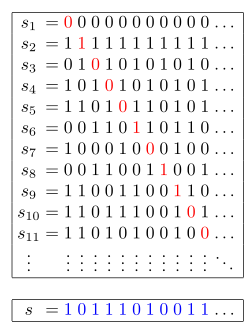
No dear Nonpareil, the tuna sandwich is beyond the range of the set of all natural numbers
...
if s is added to the set of all natural numbers
...
There is not such thing like a complete infinite set, in the first place, but you don't care about this fact.Thank you for demonstrating so readily that you neither understood nor care to understand the information given to you.
What you add to an infinite set does not matter. So long as the addition is finite, it does not alter the size of the set.
There is not such thing like a complete infinite set, in the first place, but you don't care about this fact.
s isn't a natural number according to the notion that there is a complete set of natural numbers, exactly because such notion is based on the Archimedean property, which according to it there is no infinitely large number like 1,000,000,000,...Why would one do that? S isn't a natural number
I do not reject the existence of infinitely large numbers, as you do.Why didn't you just say you reject the Axiom of Infinity in the first place. Makes for a dull set theory, though.