Cont: Deeper than primes - Continuation 2

Status
Not open for further replies.
...non-response snipped...


Doron, you have yet to show how the valuation of 0.999... invokes the continuum.

Hand-waving at snowflakes doesn't help. Asserting the reals are not complete does the exact opposite of help.
 
Asserting the reals are not complete does the exact opposite of help.
The reals are complete (they have exactly |R| number of values along the tower of power line) but it does not mean that |R| is the biggest cardinality along the tower of power line.

Please stop ...snipping... if you really wish to continue our discussion.

Thank you.
 
Last edited:
Mathematical expression like n = 1 to ∞ is indeed hand-waving of the concept of Infinity.

Huh? How else would you note down an enumeration from 1 to ∞?

And what has an enumeration to do with the concept of infinity (notice, no capital I, it is not a deity or some shady woo-concept).

Infinity is really, really simple; it has no end; 'In' as in 'the opposite of' and 'fin' as in 'end'.

Literally it means endless. How hard can this be?
 
Doron, you have yet to show how the valuation of 0.999... invokes the continuum.
 
Doron, you have yet to show how the valuation of 0.999... invokes the continuum.
All you have to do is to observe 0.999... (which is an |N| thing) from |R|.

jsfisher, your are an essential factor to show how the valuation of 0.999... invokes the continuum.

As long as you exclude yourself, you simply can't observe it.
 
All you have to do is to observe 0.999... (which is an |N| thing) from |R|.

All you have to do, then, is explain how this gibberish is semantically intelligible, and how the continuum is invoked for the valuation of 0.999..., and how any of this has to do with Mathematics.

ETA: Hint: "observe...from |R|".
 
Last edited:
All you have to do, then, is explain how this gibberish is semantically intelligible, and how the continuum is invoked for the valuation of 0.999..., and how any of this has to do with Mathematics.

You still exclude yourself as an essential factor of |R| observation of the real-line.

Without your |R| observation of the real-line, you simply unable to know why 0.999... (which is an |N| thing) < 1 by 0.000...1 (the needed knowledge about 0.000...1 is found in http://www.internationalskeptics.com/forums/showpost.php?p=10306748&postcount=4282).

ETA: Hint: "observe...from |R|".
This is exactly the hint for you.
 
Last edited:
You still exclude yourself as an essential factor of |R| observation of the real-line.

Without your |R| observation of the real-line, you simply unable to know why 0.999... (which is an |N| thing) < 1 by 0.000...1 (the needed knowledge about 0.000...1 is found in http://www.internationalskeptics.com/forums/showpost.php?p=10306748&postcount=4282).


This is exactly the hint for you.

Awesome, Doron's age-old "I know what I am, but what are you? I am from rubber, you are from glue, anything you say bounces off me and sticks to you!" Kindergarten tactics.

If he does not answer I will start reporting those and the previous posts for breach of contract; he is not furthering the discussion; he just wants to win the fight.
 
Awesome, Doron's age-old "I know what I am, but what are you? I am from rubber, you are from glue, anything you say bounces off me and sticks to you!" Kindergarten tactics.

If he does not answer I will start reporting those and the previous posts for breach of contract; he is not furthering the discussion; he just wants to win the fight.

There is no discussion coming from Doron because it is all like an LSD trip. There are colors like no colors anyone else has ever seen. He cannot describe things; none of it is real.
 
There is no discussion coming from Doron because it is all like an LSD trip. There are colors like no colors anyone else has ever seen. He cannot describe things; none of it is real.

jsfisher, just observe the real-line from cardinality |R|.

If you do that, then and only then you will awake up from your only_|N| trip.

Simple as that.
 
Last edited:
Let's correct what I wrote in http://www.internationalskeptics.com/forums/showpost.php?p=10305716&postcount=4275.

The right one is this:

--------------------------------------

By using |R| size observation:

0.999...10 < 1 by 0.000...110

0.888...9 < 1 by 0.000...19

The difference between 0.000...110 and 0.000...19 is given by direct proportionality, according to the following formula:

abs( (1/9)/(1/10) ) (the result can't be expressed by any particular base, because this ratio is done between bases).

The general formula for all n>1 natural numbers is:

base j = 2 to n
base k = 2 to n

abs( (1/(base j)) / (1/(base k)) ), such that j ≤ k.

 
Last edited:
Let's correct what I wrote in http://www.internationalskeptics.com/forums/showpost.php?p=10305716&postcount=4275.

The right one is this:

--------------------------------------

By using |R| size observation:

0.999...10 < 1 by 0.000...110

0.888...9 < 1 by 0.000...19

The difference between 0.000...110 and 0.000...19 is given by direct proportionality, according to the following formula:

abs( (1/9)/(1/10) ) (the result can't be expressed by any particular base, because this ratio is done between bases).

The general formula for all n>1 natural numbers is:

base j = 2 to n
base k = 2 to n

abs( (1/(base j)) / (1/(base k)) ), such that j ≤ k.

And what is the use of this? Besides it being convoluted and based on the *WRONG*ful notion of there being a finite digit in an infinite series.

Also, this formula yields a rather weird result when j equals k... namely 1.

So the difference between two exact same numbers in the exact same base is 1?

If that is not proof of Doron's inability to do mathematics, then I do not know what more is needed.
 
The proportionality of a given value to itself is 1.

abs( (1/(base j)) / (1/(base k)) ), such that j ≤ k calculates the value of proportionality within (0,1], such that a value < 1 means less self proportionality that can be translated into greater difference between two given values by the following formula:

n is some natural number > 1

base j = 2 to n
base k = 2 to n

1/abs( (1/(base j)) / (1/(base k)) ), such that j ≤ k (the result can't be expressed by any particular base, because this ratio is done between bases).
 
Last edited:
The proportionality of a given value to itself is 1.

abs( (1/(base j)) / (1/(base k)) ), such that j ≤ k calculates the value of proportionality within (0,1], such that a value < 1 means less self proportionality that can be translated into greater difference between two given values by the following formula:

n is some natural number > 1

base j = 2 to n
base k = 2 to n

1/abs( (1/(base j)) / (1/(base k)) ), such that j ≤ k (the result can't be expressed by any particular base, because this ratio is done between bases).

Again, you are not supposed to be reading my posts; you are ignoring me. Keep this up and you'll be reported for categorically breaking the agreement.

Now, if you mean ratio, then do not use the word difference. Difference means the distance along a line that two values are apart.
Please be more rigorous in your use of language, it is so hobby-ish if you just 'do something'.

Furthermore, if the result can not be expressed in any particular base, then you can not define
within (0,1], such that a value < 1 means less self proportionality that can be translated into greater difference between two given values by the following formula

And again, you use the word difference where you want to use ratio.

Shoddy work that promises not much good for the rest of the dreamcastle that is being built on this...
 
Difference between values is not necessarily distance in terms of metric space.

For example, the different proportion between two values can be translated into greater values by the following formula:

n is some natural number > 1

base j = 2 to n
base k = 2 to n

1/abs( (1/(base j)) / (1/(base k)) ), such that j ≤ k (the result can't be expressed by any particular base, because this ratio is done between bases, so the formula itself is the result).
 
By using |R| size observation:

0.999...10 < 1 by 0.000...110
Simple counter example:

1/9 = 0.111...
2/9 = 0.222...
3/9 = 0.333...
...
9/9 = 0.999... = 1

Another approach:

9 * 1/9 = 9/9 = 1
9 * 0.111... = 0.999... = 1

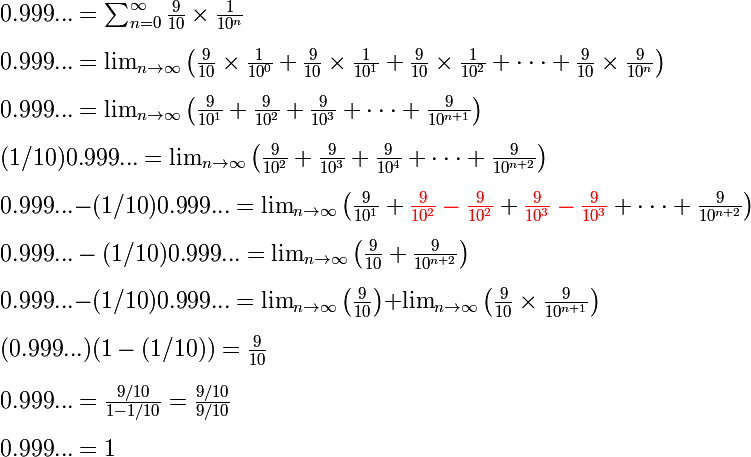
Once more, with more rigor (I've tried to make each step as explicit and obvious as possible):

9repeatingequal1proof_zps2404921b.png


A similar proof exists for 0.888...9, as well as all other fixed point decimals. Every fixed point decimal in any base has an infinite decimal infinite decimal representation in that base:

0.1210 = 0.11999999...10
0.2510 = 0.2499999...10
0.3459 = 0.3448888888...9
100111.1101012 = 100111.1101001111111111...2
1.09 = 0.88888...9

To put it another way, every closed interval [n,m] has exactly zero length when n is fixed point decimal and m is it's infinite decimal expansion.

I know you have an intuitive belief that there must be some infinitesimal quanity between 0.999... and 1, but intuition is no substitute for a mathematical proof. How would you construct that quantity, and how do you show it is greater than 0? Can you show something more rigorous than an informal "size observation"?

The difference between 0.000...110 and 0.000...19 is given by direct proportionality, according to the following formula:

abs( (1/9)/(1/10) )
This is not correct. The "proportionality" you mention is at best a statement about the rate of convergence between the sequences { 0.910 + 0.0910 + 0.00910 + ... } and { 0.89 + 0.089 + 0.089 +0.89 }, not their limit. They both converge to 1, implying 0.999...10 - 0.888...9 = 0.
 
Simple counter example:

1/9 = 0.111...
2/9 = 0.222...
3/9 = 0.333...
...
9/9 = 0.999... = 1

Another approach:

9 * 1/9 = 9/9 = 1
9 * 0.111... = 0.999... = 1

Once more, with more rigor (I've tried to make each step as explicit and obvious as possible):

[qimg]http://i346.photobucket.com/albums/p412/julietrosenthal/9repeatingequal1proof_zps2404921b.png[/qimg]

A similar proof exists for 0.888...9, as well as all other fixed point decimals. Every fixed point decimal in any base has an infinite decimal infinite decimal representation in that base:

0.1210 = 0.11999999...10
0.2510 = 0.2499999...10
0.3459 = 0.3448888888...9
100111.1101012 = 100111.1101001111111111...2
1.09 = 0.88888...9

To put it another way, every closed interval [n,m] has exactly zero length when n is fixed point decimal and m is it's infinite decimal expansion.

I know you have an intuitive belief that there must be some infinitesimal quanity between 0.999... and 1, but intuition is no substitute for a mathematical proof. How would you construct that quantity, and how do you show it is greater than 0? Can you show something more rigorous than an informal "size observation"?


This is not correct. The "proportionality" you mention is at best a statement about the rate of convergence between the sequences { 0.910 + 0.0910 + 0.00910 + ... } and { 0.89 + 0.089 + 0.089 +0.89 }, not their limit. They both converge to 1, implying 0.999...10 - 0.888...9 = 0.
Hey Dessi,

Your reply is right if you are using |N| observation of the real-line.

I use |R| observation of the real-line, as given in http://www.internationalskeptics.com/forums/showpost.php?p=10306748&postcount=4282, where the correction of the example there is given in http://www.internationalskeptics.com/forums/showpost.php?p=10324522&postcount=34.

I know you have an intuitive belief that there must be some infinitesimal quanity between 0.999... and 1, but intuition is no substitute for a mathematical proof. How would you construct that quantity, and how do you show it is greater than 0? Can you show something more rigorous than an informal "size observation"?
I use |N|<|R|, which is based on a rigorous mathematical proof.

------------------

Please also read very carefully all of what is written in http://www.internationalskeptics.com/forums/showpost.php?p=10316119&postcount=4298, http://www.internationalskeptics.com/forums/showpost.php?p=10318064&postcount=1 (some correction of this post: "X/4J)*4J, where j=1 to |N|" has to be "X/4J)*4J, where j=1 to |N|, such that |N| is not a value along the real-line") , http://www.internationalskeptics.com/forums/showpost.php?p=10318141&postcount=3 and http://www.internationalskeptics.com/forums/showpost.php?p=10318337&postcount=7, if you wish to reply to them.

Thank you.
 
Last edited:
Status
Not open for further replies.

Back
Top Bottom