• Quick note - the problem with Youtube videos not embedding on the forum appears to have been fixed, thanks to ZiprHead. If you do still see problems let me know.

Cont: Dear Users… (A thread for Sysadmin, Technical Support, and Help Desk people) Part 11

Quite true. Excel is effectively a bunch of relational tables. So you can "sort of" cobble it together to make it run as a fairly effective database. And that's often enough for the single user with a basic requirement.

But if you want to get into the full database mode - fully linked tables with different types of linkages, views, sharing and locking, transaction logging & rollbacks, etc. - Excel ain't it. For that, you need...Access! :D

No matter what the problem, MS Access is not the right answer.

:P
 
Access, like all of the Office suite, is very good at what it is designed for. But most people don't use the right tool for the job at hand, and so they get a reputation for being **** at the things that they're not designed for, but for which people use them anyway.
 
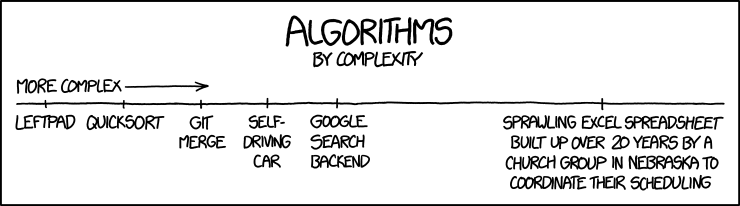
Speaking of the (mis)use of spreadsheets:

algorithms.png


Source: XKCD 1667: Algorithms by Complexity
(Mods: xkcd expressly allows hot-linking images)
 
Access, like all of the Office suite, is very good at what it is designed for. But most people don't use the right tool for the job at hand, and so they get a reputation for being **** at the things that they're not designed for, but for which people use them anyway.
I actually feel sorry for the designers of Access. Used within its limitations, it's a pretty useful tool. But it falls right between two stools - not simple enough for the average user so they prefer Excel instead, and not enough built-in database-y features to make it robust and useful for a business. It's like they mashed up the least useful features of SQL and Excel, then made it non-standard enough to be annoying to make it work. Then Microsoft made it non-backwards compatible through the versions. :mad:

Which is why our business made their own home-grown asset management tool in Access, and why it stopped working suddenly, and why I have an extra old PC on my desk with Access 2013 on it that nobody can share.

Yay! :rolleyes:
 
I actually feel sorry for the designers of Access. Used within its limitations, it's a pretty useful tool. But it falls right between two stools - not simple enough for the average user so they prefer Excel instead, and not enough built-in database-y features to make it robust and useful for a business. It's like they mashed up the least useful features of SQL and Excel, then made it non-standard enough to be annoying to make it work. Then Microsoft made it non-backwards compatible through the versions. :mad:

Which is why our business made their own home-grown asset management tool in Access, and why it stopped working suddenly, and why I have an extra old PC on my desk with Access 2013 on it that nobody can share.

Yay! :rolleyes:
Access was supposed to be split into two versions a few years ago, Office team politics did for the plan.
 
Microsoft.

Make up your mind if scrolling "up" goes backwards in time or scrolling "down" goes backwards in time.

In Teams I scroll up to see older messages. In Outlook I scroll down to see older e-mails.
 
Exactly. Excel is great at what it is designed for - number crunching.

What really annoys me is where someone has used Excel for text-only data. Excel is for numbers! If you want to use words, use... well... Word. The Table functions in Word are fantastic.

Use the right tool for the job, damn it!

I have more than one user that uses PowerPoint as their defacto word processor/desktop publisher.
 
I have more than one user that uses PowerPoint as their defacto word processor/desktop publisher.

That is not uncommon. The other half produces documents for an investment bank, 90% of them are created and then edited in Powerpoint, it's the same in many other banks.
 
Yep - it is dBASE II or nothing!

Yep...

I had to maintain systems written in dBase II, III and IV, and something called 'Clipper' which may have been a dBase bolt-on, too long ago to remember now.

Those systems replaced systems written in Enable and Enable OA.

You can only imagine my relief when I started using real SQL on 'big iron'.

(And my dismay when I had to go back to MSSQL on toy hardware again).

By the time I was nearing retirement, MSSQL was my standard 'go-to' for database stuff and even ended up writing stuff that was 'wrapped' for some of our services.

It was funny how often people would confuse dBase with DB2 (or vice-versa) depending on the architecture they were familiar with.

(I still have a fondness for the performance tuning available with DB2).

"Files and indexes on separate devices you say? How about tables and records being physically laid out on disc platters so that read heads are reading multiple records at the same time?"

And that has started me pining for teradata, (sigh) again.
 
(I still have a fondness for the performance tuning available with DB2).

"Files and indexes on separate devices you say? How about tables and records being physically laid out on disc platters so that read heads are reading multiple records at the same time?"

And that has started me pining for teradata, (sigh) again.

I did a sql programming course with <Big bank>. When we came to. EXPLAIN the lecturer said I don't understand this chapter so I'll skip it. That explained a lot of problems I'd seen with developers at that bank. Gave him a crap review an bought a book.
 
I did a sql programming course with . When we came to. EXPLAIN the lecturer said I don't understand this chapter so I'll skip it. That explained a lot of problems I'd seen with developers at that bank. Gave him a crap review an bought a book.
Explain is the hardest part. It would be good if they could get it to present the information in a form humans could understand rather than just a machine.
 
Meh, let everybody use whatever works for them. So long as they don't try to bother me with their nonsense, it's all good.
 
Yep...

I had to maintain systems written in dBase II, III and IV, and something called 'Clipper' which may have been a dBase bolt-on, too long ago to remember now.

Those systems replaced systems written in Enable and Enable OA.

You can only imagine my relief when I started using real SQL on 'big iron'.

(And my dismay when I had to go back to MSSQL on toy hardware again).

By the time I was nearing retirement, MSSQL was my standard 'go-to' for database stuff and even ended up writing stuff that was 'wrapped' for some of our services.

It was funny how often people would confuse dBase with DB2 (or vice-versa) depending on the architecture they were familiar with.

(I still have a fondness for the performance tuning available with DB2).

"Files and indexes on separate devices you say? How about tables and records being physically laid out on disc platters so that read heads are reading multiple records at the same time?"

And that has started me pining for teradata, (sigh) again.

I'm now using SQLite for most of my projects that need a database. It's super fast and no external server needed because it's distributed as a linkable library. Its SQL dialect is limited in some areas, and its lack of a real server process a la MariaDB or MSSQL would limit its usefulness in a multi-user environment, but for personal projects it's a joy to work with.

One potential downside is the system combines data and indexes into a single file, which means if the file gets corrupted the best you can do is attempt a recovery using available tools, or restore from backup. In practice this has not been a problem.

I would not recommend it for mission critical use. I'm unsure how well it holds up in scenarios where there are lots of updates and reads occurring from multiple sources simultaneously. It doesn't have built-in log transport or mirroring, but one might be able to use the underlying file system or logical volume management to improve robustness.

The SQLiteBrowser program is a very useful tool for working with SQLite databases. However, it doesn't have a front-end forms builder that Access has, so one need to use different tools such as LibreOffice Base for that.
 
Last edited:
I count myself very lucky that I have never had a DBA job. The whole field looks like an absolute nightmare.
Oh it is.
Almost twenty years ago I did a project with <state agency> who relied on, for their core 'business' operations, a database written for DOS in the mid '80s and not just unsupported but actually impossible to find the owner of.They had retired, septuagenarian, developer who maintained and modified their code.
 
I count myself very lucky that I have never had a DBA job. The whole field looks like an absolute nightmare.

All the DBAs I encounter seem very energetic and excited people. But I tend to only see them when I'm running massive queries and locking tables and draining resources and causing a company-wide slowdown. They talk so fast, and make many animated facial expressions! It's a joy to watch.
 

Back
Top Bottom