• Quick note - the problem with Youtube videos not embedding on the forum appears to have been fixed, thanks to ZiprHead. If you do still see problems let me know.

Damned audiophiles

So if insanely expensive speaker and power cables make such a big difference, why do musicians and recording studios still use basic industry standard cords?

HMMMM????

Seriously. I'm surprised we haven't read about how this or that speaker wire reveals the original cable errors in the studio.

I thought I was going overkill with my stereo system when I built a custom 1/4 wave groundplane antenna to microcast my music to the garage.
 
Please don't hate me because I'm an audiophile...

As I write this I'm playing Kraftwerk's Tour De France on one of my two turntables (a heavily modded Michell Gyrodec, my other is a restored Thoren's 124 MarkII) through a tube amp and open baffle speakers. lovely. Like most audiophiles I know, I'm a tinkerer and a DYIer and like most audiophiles I know, don't buy into the cable crap or other silly stuff from such luminaries as Machina Dynamica. Most of us got into this at an early age because of a profound love of music and went from there. Yes we are forever chasing the elusive perfect sound but tend to stick to what does make an audible and measurable difference, sadly this has attracted not only those with more money than brains but those who pray upon them as well. I've made all my own cabling using anything from pure silver to cat5 wire. Do I hear a difference? Nope. But I had fun making them! I've listened to others systems where money was no object and frankly just scratch my head when their owners swear up and down that they can tell the difference between cables. Utter nonsense. You'll find most audiophiles feel the same way and, in my experience, take whats written in most audio publications with a grain of salt.
Why a turntable? It's what I grew up with, they're beautifully engineered and if something goes wrong I can generally fix it.
There. I've outed myself. :o
 
I have audiophile listed in my signature. I am not ashamed! This is where I listen to music and surf

4937178587_d0ab92c45d_z.jpg
 
Please don't hate me because I'm an audiophile...

As I write this I'm playing Kraftwerk's Tour De France on one of my two turntables (a heavily modded Michell Gyrodec, my other is a restored Thoren's 124 MarkII) through a tube amp and open baffle speakers. lovely. Like most audiophiles I know, I'm a tinkerer and a DYIer and like most audiophiles I know, don't buy into the cable crap or other silly stuff from such luminaries as Machina Dynamica. Most of us got into this at an early age because of a profound love of music and went from there. Yes we are forever chasing the elusive perfect sound but tend to stick to what does make an audible and measurable difference, sadly this has attracted not only those with more money than brains but those who pray upon them as well. I've made all my own cabling using anything from pure silver to cat5 wire. Do I hear a difference? Nope. But I had fun making them! I've listened to others systems where money was no object and frankly just scratch my head when their owners swear up and down that they can tell the difference between cables. Utter nonsense. You'll find most audiophiles feel the same way and, in my experience, take whats written in most audio publications with a grain of salt.
Why a turntable? It's what I grew up with, they're beautifully engineered and if something goes wrong I can generally fix it.
There. I've outed myself. :o


I make my own CAT5 cables too, because it's cheaper than buying them and I can make the cables just as long as I need for the particular run. I've also cut and assembled my own guitar cables, microphone cables, and TV coax cables.

I'd stay away from silver wire for cables though. It doesn't conduct electricity nearly as well as copper, and it's an absurd waste of money.
 
im just starting down the road of audiophiles although im going the diy route

my dads hobby is electronics and in last few years he built himself an outstanding line level crossover amplifier and speaker set. a couple of months ago we found out that his fight with cancer is on the last leg and he's not going to win it

so i have thrown myself at learning nigh on everything to build a high fi/def amp from scratch and i've nearly finished one of the boxes

its has
4 x 150w mosfet amp (including dc protection, soft start, and clip meters and bridgeable to 2x600w)

i've got all the components rdy to assemble for
2 x 100w symasym amps (dc protection, soft start and clip meters)

once thats built im going to look into building the speakers

will try to put up some pic's of my progress this weekend (everything is at my parents)
 
I make my own CAT5 cables too, because it's cheaper than buying them and I can make the cables just as long as I need for the particular run. I've also cut and assembled my own guitar cables, microphone cables, and TV coax cables.

I'd stay away from silver wire for cables though. It doesn't conduct electricity nearly as well as copper, and it's an absurd waste of money.

Yes, but in a pinch, if you are short on copper, an extra 15,000 tons of silver can push your project past the finish line.
 
I make my own CAT5 cables too, because it's cheaper than buying them and I can make the cables just as long as I need for the particular run.

I don't think he meant making his own CAT5 cables but, rather, making his own audio cables using CAT5 cables as the raw materials. There's a way I've seen that you can make them by plaiting the innards of CAT5 cables. It's been a while since I looked and I can't remember the specifics, but I looked in to it because at work at one time we had tonnes of CAT5 we didn't have a need for and fewer audio cables than we needed. I briefly considered it, but it didn't seem worth the investment of time.

In truth, I can't imagine many situations where a decent gauge power flex won't do just fine.
 
im just starting down the road of audiophiles although im going the diy route

my dads hobby is electronics and in last few years he built himself an outstanding line level crossover amplifier and speaker set. a couple of months ago we found out that his fight with cancer is on the last leg and he's not going to win it

so i have thrown myself at learning nigh on everything to build a high fi/def amp from scratch and i've nearly finished one of the boxes

its has
4 x 150w mosfet amp (including dc protection, soft start, and clip meters and bridgeable to 2x600w)

i've got all the components rdy to assemble for
2 x 100w symasym amps (dc protection, soft start and clip meters)

once thats built im going to look into building the speakers

will try to put up some pic's of my progress this weekend (everything is at my parents)

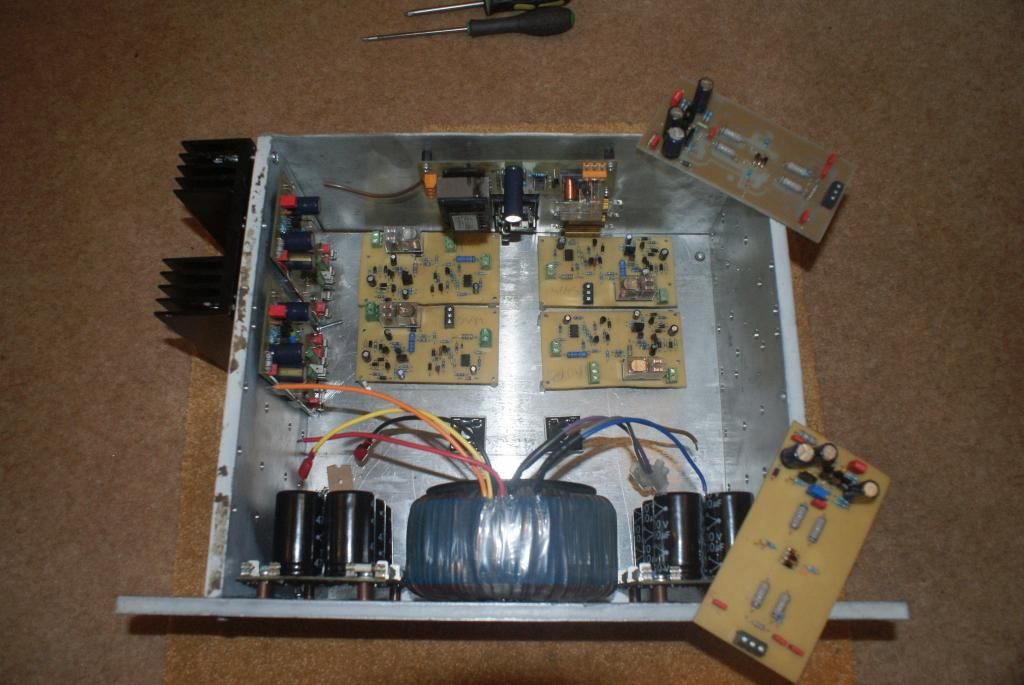
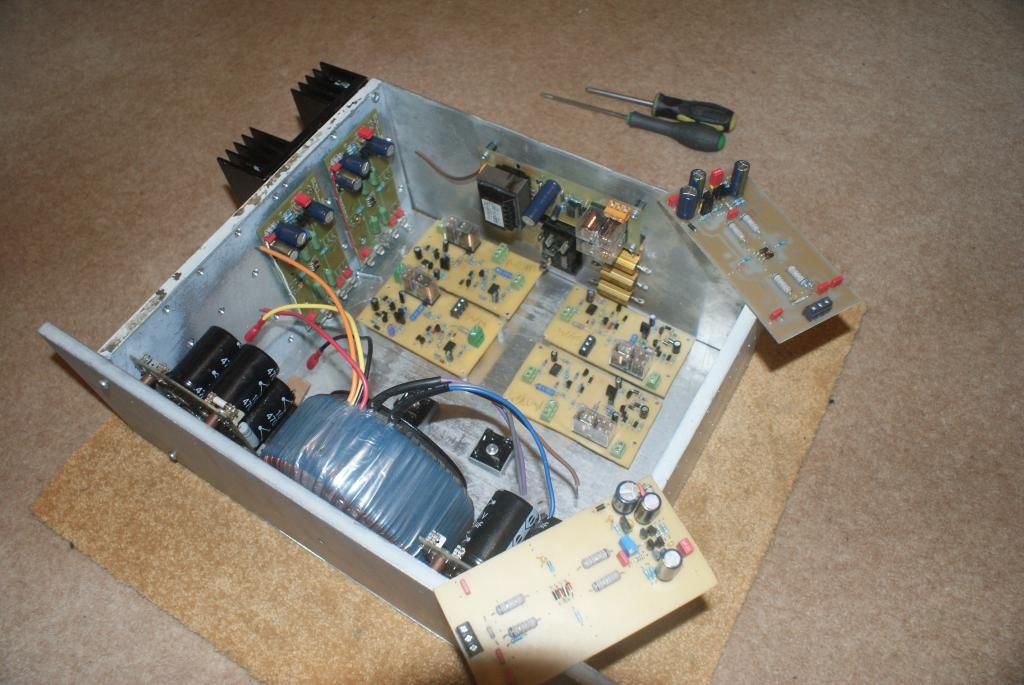
heres nearly everything in situ apart from 2 boards waiting for parts and 3 heatsinks waiting to be drilled/ tapped

the box is made out of scrap 10mm aluminium plate and 3mm top, back and sides

just about to strip it down, clean it up, permanently fix the heat sink and drill/ tap the other 3 heat sinks

then its ready to be sprayed black and fully assembled

im going to get front plates professionally made, powder coated and engraved

DSC03864.jpg


DSC03866.jpg


had to learn everything for this from printing and etching circuit boards to tapping the many many holes needed to put this thing together
 
im just starting down the road of audiophiles although im going the diy route

my dads hobby is electronics and in last few years he built himself an outstanding line level crossover amplifier and speaker set. a couple of months ago we found out that his fight with cancer is on the last leg and he's not going to win it

so i have thrown myself at learning nigh on everything to build a high fi/def amp from scratch and i've nearly finished one of the boxes

its has
4 x 150w mosfet amp (including dc protection, soft start, and clip meters and bridgeable to 2x600w)

i've got all the components rdy to assemble for
2 x 100w symasym amps (dc protection, soft start and clip meters)

once thats built im going to look into building the speakers

will try to put up some pic's of my progress this weekend (everything is at my parents)

Sorry to hear your news and great work. I have made my own cables and had a go at a simple headphone amp, but burnt myself and the volume control with my soldering iron, so gave up!
 
I make my own CAT5 cables too, because it's cheaper than buying them and I can make the cables just as long as I need for the particular run. I've also cut and assembled my own guitar cables, microphone cables, and TV coax cables.

I'd stay away from silver wire for cables though. It doesn't conduct electricity nearly as well as copper, and it's an absurd waste of money.

I'm a goldsmith/gemmologist by trade, I draw my own wire etc. so making my own silver interconnects is amazingly inexpensive which is why when I look at ads pushing them for horrific prices I feel I'm in the wrong business...:)


I'd stay away from silver wire for cables though. It doesn't conduct electricity nearly as well as copper, and it's an absurd waste of money.

Sure it does though not by much. In WWII many silver coins in circulation were removed and redirected for the war effort. A lot of silver went into the Manhatten Project simply because it was a better conductor than copper. It isn't much better though.
 
h

had to learn everything for this from printing and etching circuit boards to tapping the many many holes needed to put this thing together

I have MASSIVE respect for people who make stuff, any stuff, and nothing but disdain for people who spend horrific piles of money for things they don't really comprehend.

I'm sorry to hear about your dad. Is this project a way of connecting with him or spending time together in his final days?

It's looking really good, by the way. I'm sure you'll enjoy the results and learn a lot in the process. Thanks for sharing.
 
There is a huge pile of whackadoodledandy in audio, especially in high-end audio stuff.

Zip cord of a proper size is fine for speakers. Cords from Monoprice.com are just fine for signals unless you live next to a radio station. If your equipment needs a "special audiophile power cable" then your equipment really needs a better power supply, not a better cable.

Amplifiers are cooked, fried, and done. There really isn't a problem with any decently designed amplifier attached to a decent set of speakers that don't have a brain-dead impedence curve.

I am known to be picky about audio, having worked in it for 40+ years, and having just given an honorary talk at the last Audio Engineering Society convention (see http://www.aes.org/events/133/press/?ID=181 ) I have the professional chops to prove that, and more.

And I use a DVD player for my CD's. I load most of my CD's on my computer, use FLAC, and play them using a standard FLAC player over an outboard DAC on my laptop. I have several other CD players, given timing and level issues, they all sound the same, except for the broken one.

The biggest problem nowdays? It's a tossup between bad recordings (overcompressed to death) and loudspeakers (which are the one remaining technical physics challenge for basic 2 channel playback).

If you want to know way more about what I think than you probably do, go to www.aes.org/sections/pnw/ppt.htm , start with "why you hear what you hear" and then "hearing tutorial", and on from there to "soundfields vs. signal processing" and "loudness tutorial".
 
Also, if you have Matlab you can easily create your own CD to test players and DtoA converters. Find the highest frequency you can hear then create a tone just above that. Record this at various levels and the spurious audible noise from jitter can be fairly easily discerned. Add two of these tones 100 to 2000 hz apart to check for non-linearities in the DtoA. You can also use a ripped track to add various levels of "jitter" to a known recording to see how much jitter margin you need.

I suspect for most CDs it's well below audio threshold.

It wouldn't surprise me if there isn't some free stuff on the web that people have already produced.

And if you have Matlab and a mic, you can capture system responses to the resolution of your microphone, using the scripts at www.aes.org/sections/pnw n the "fft" link on the left side. You can also get the scripts, test signal, recordings of the lectures in the workshop, and so on in the same place. And you can load Octave instead, from the octave folks, for freeware that's pretty good as a matlab clone, but it does hae warts, if you don't have matlab, too.
 
All it takes for two amps to sound "different" is about a 1dB difference in volume setting between the two - less than your ear can discern. (I don't remember the actual dB rating - i pulled 1dB out of my posterier - the point is a very small amount you will not notice as "hey, this one is turned up louder")

More like .2 dB. Just FYI.
 
And I use a DVD player for my CD's. I load most of my CD's on my computer, use FLAC, and play them using a standard FLAC player over an outboard DAC on my laptop. I have several other CD players, given timing and level issues, they all sound the same, except for the broken one.

Like you, I use a computer to store and play back my music. I looked into a variety of lossless codecs when I started, but in the end I just went with MP3 in itunes. For my purposes it's just fine, since I'm transmitting the sound using a Ramsey FM25 so I can hear it in any room, in the shop, or in the yard. So that pretty much negates any improvements from lossless storage. My wife calls the home radio station my "thousand dollar computer speakers." But everyone in the family likes it!

Building the system has taught me quite a bit about sound processing.

Of all the products the audiophile sites posted in this thread sell the one that irritates me the most is the overpriced power cables. I've put a variety of different power supplies on an oscilloscope. A diode bridge, a couple of capacitors and a voltage regulator and your output is going to be DC, plain and simple. But then, one site was recommending the use of "hospital grade" electrical outlets, which is totally nonsense unless you regularly yank the cords of your overpriced audio system out of the wall from 3 feet away.
 
The "Coconut Audio" guy has a page up with pics and descriptions of his "experiments": http://www.coconut-audio.com/hifijustice/experiments.htm

http://youtu.be/5hfYJsQAhl0

I loved this quote

"Removing low-level detail
Both the AC noise and Valhalla remove a lot of low-level detail which makes the background appear dead black. The AC noise makes it edgier which gives the illusion of more blackness. The Valhalla hides low-level detail which makes it cleaner, it also transforms the edginess into smooth whiteness.
The end result is more blackness and whiteness than neutral."
 
And if you have Matlab and a mic, you can capture system responses to the resolution of your microphone, using the scripts at www.aes.org/sections/pnw n the "fft" link on the left side. You can also get the scripts, test signal, recordings of the lectures in the workshop, and so on in the same place. And you can load Octave instead, from the octave folks, for freeware that's pretty good as a matlab clone, but it does hae warts, if you don't have matlab, too.

JJ,

Nice stuff at aes.org.

About 10 years ago I captured a couple revolutions of runup blank from a vinyl lp. By adding a repeating segment to a CD's ripped wav file the result is a very pleasing (to those of us used to vinyl) sound.

I've been using ffts recently in some stuff I'm doing on lens/imager registration. It involves extracting specific frequencies, magnitudes, and phase shifts in a "comb" distribution from parts of an image with a view towards indentifying the various errors. It's lotsa fun and Matlab makes it easy to build simulation models and test lots of theories quickly.

As for sound, I have also recorded about 10 mins, from my pc's spkrs, of a 15khz, 2ms ping, at 1 second intervals on 5 Olympus 710M pocket recorders. All 5 had sample clocks that matched within 3ppm which floored me. They were also quite stable over time. I was kicking around the idea of distributing them around a conference table. By capturing all the mics signals and resyncing the data using an inaudible chirp, it then is a pretty simple process to zero in and boost whoever is talking in a post processing session. At least with the processor power these days.
 

Back
Top Bottom