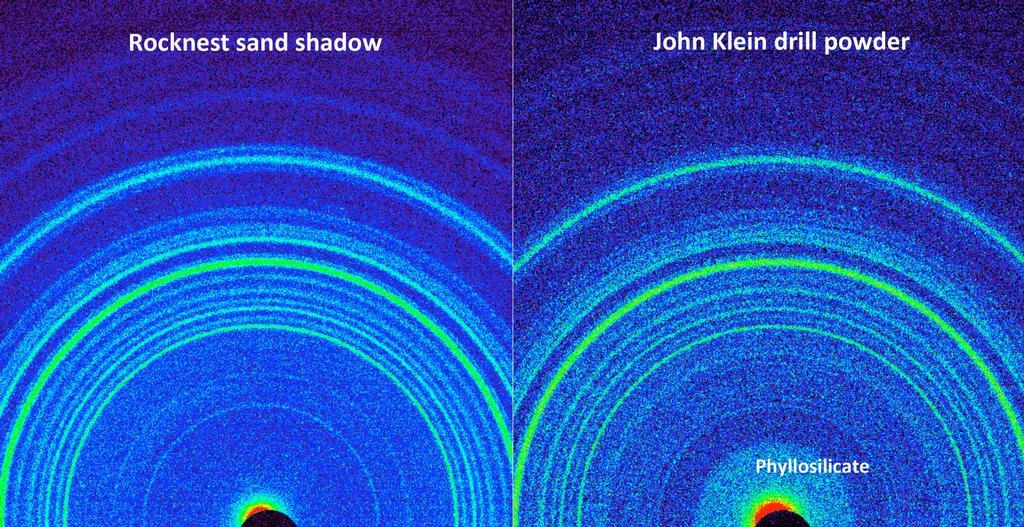
Some notes from today's rover update:
Micheal Myers:
The rover is now fully commissioned. With the completion of the drilling and drill sample analysis, all firsts have been acomplished.
The rover is the current interation of of the overall Mars Exploration Program which, using experience and data gathered from past missions, is targeting discrete regions of the planet - both current and historic - for possible habitats for life. Each mission and finding seems to broaden the possibility for these habitats.
Gale crater was selected as a target of interest in this overall scheme based on morphologocal and geochemical data gathered from orbit. Gale Crater led to the discovery of an ancient streambed. This streambed was followed down to Yellowknife Bay.
Mineral found in Yellowknife Bay have indicated a near-neutral envoirnment with slightly saltly liquid water.
CheMin:
The drill sample powder from the John Klein rock was grey-green, indicating that it wasn't heavily oxidized, providing a possibility that organic material (if present) could have been preserved. CheMin analysis of the drill sample indicated a basic minerology very similar to the igneous surface sands and regolith, with the addition of phyllosilicates - the sample being 20=30% smectite which is a water-forming mineral. The abundance of salts like halite and calcium sulfaltes instead of the iron and magnesium sulfayes which were found at Meridiani point to a near neutral pH enviornment. The best terrestrial analouse for the materials found at Yellowknife exist as lakebed sediments in southern Australia.
SAM:
The five major gases detected in the drill sample by the SAM and TLS instruments:
Water: The large amount of water detected was given off at very high temeratures - between 500-1500 degrees Farenheight - which is good confirmation of the phyllosilicate clays such as smectite found by CheMin. This water that is bound in the clay minerals and released when the sample is heated.
Oxygen: This is being interpreted as the product of the decomposition of perchlorate which is interesting.
CO2: This is not completely understood - it could be generated during the analysis or could be the result of decomposition of a carbonate. The SAM team will be following up with this.
Sulfur Dioxide/Hydrogen Sulfide: This is fascinating due to the sample being much more reduced or oxidized than the surface samples.
TLS:
A key finding from the TLS was a very low deuterium/hydrogen ratio in the water sample as compared with surface samples - the surface sample ratio thought to be a result of water being lost to space.
Organics:
Some chloromethane compounds were found with the disclaimer that, being the first drill sample, there could also very well be a product of terrestrial contamination.
Hopefully one of our resident geolosits will correct any errors I have introduced here. As always, the full upadte (this one is woth the time to watch) can be found at
JPL's UStream channel.