• Quick note - the problem with Youtube videos not embedding on the forum appears to have been fixed, thanks to ZiprHead. If you do still see problems let me know.

Cryptomundo Incorporated formed

if thats comedy, this is schadenfreude
http://www.bigfootencounters.com/interviews/peter2.htm
I have discovered a few other words that you can subsitute for UFO and Bigfoot as well. but the forum software keeps turning them into *****

:D:D
I must admit I had to look up the term 'schadenfreude'. My present-day interest in Bigfoot is one huge case of schadenfreude. ;)

Funny you point out the Perter Gutilla page on BE. He's completely out of his mind, yet IMO one of the more interesting characters in Bigfootdom. I feel the same way about Robert Morgan, and he's also certifiable. I mean, if there is no Bigfoot the beast, Bigfoot the obsession is whatever I want 'it' to be and apparently I like my Bigfoot well spoken but bonkers.
 
You are a professional cryptozoologist, Loren? Well how nice for you.


Professional Cryptozoologist Loren Coleman sits in his armchair and misidentifies common well-known species.

Runaway Bay's "Chupacabra": Dead Dog


Loren Coleman said:
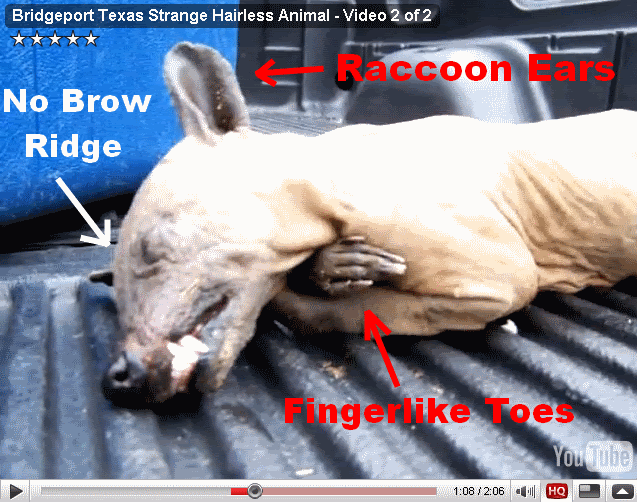
Not a "hairless raccoon," but a hairless dead dog. Feet are not for climbing trees, but dog's feet. Back legs are not abnormally long.


No, Loren. It is a hairless raccoon.

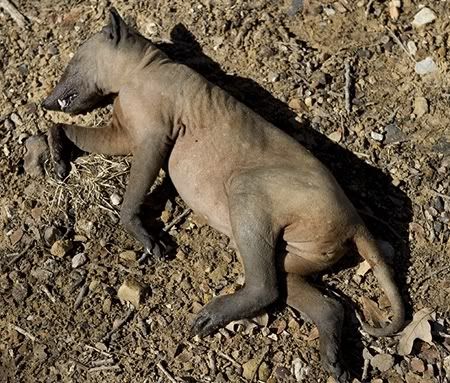
552e893b.jpg
 
Local news - Alleged chupacabra found in Runaway Bay

He showed the animal to several people in town and took it to a veterinarian in Bridgeport, but no one was able to identify the species.


Same local news update - State debunks Bay chupacabra

A biologist with Texas Parks and Wildlife Department confirmed this morning that the Runaway Bay chupacabra is a hairless raccoon. Jennifer Barrow, wildlife biologist, said all the feet, skull and dental formation all matched a raccoon.


Debunked chupacabras and dog at the same time.
 
Professional Cryptozoologist Loren Coleman sits in his armchair and misidentifies common well-known species.

I'm more inclined to go with one of them thar Mexican hairless dogs than a raccoon. Check out especially the length and shape of the ears and muzzle.

Meantime, we should probably get some government $$ to study whatever is killing all of these chupacabras.
 
No, Loren. It is a hairless raccoon.

From Loren...

Loren @ Cryptomumble said:
Not a “hairless raccoon,” but a hairless dead dog.

Feet are not for climbing trees, but dog’s feet.

Back legs are not abnormally long.


I find no malice in the guys that posted the video, but just honest curiosity. However, what has become of their questions is well on its way to joining the usual media “Chupa” circus.

Sorry but this is another Texas “chupacabra” that translates into, not the traditional spike-haired, bipedal Puerto Rican Chupacabras, but, instead, another American misidentified canid.

Bald raccoons bite Coleman again.

Obtaining an undergraduate degree from Southern Illinois University at Carbondale, Coleman majored in anthropology, minored in zoology, and did some summer work in archaeology. He received a graduate degree in psychiatric social work from Simmons College in Boston. Coleman was admitted to the Ph.D. programs, and took doctoral coursework in social anthropology at Brandies University, and in sociology at the University of New Hampshire’s Anthropology/Sociology Department. His dedication to fatherhood made his decision to first raise his sons, teach, and write, an easy one.

Apparently, zoology does not need to be a strong point for a professional cryptozoologist.
 
Hmm, that's surprising. But dental formula is the standard so it must be a raccoon.

There are other features that clearly indicate it is raccoon. The legs, feet and toes. The skull shape (esp. forehead to nose profile) and ear shape.

Attached are Mexican Hairless Dogs...
 

Attachments

  • 25021059.JPG
    25021059.JPG
    17.5 KB · Views: 0
  • Mex hairless.jpg
    Mex hairless.jpg
    81.8 KB · Views: 0
There are other features that clearly indicate it is raccoon. The legs, feet and toes. The skull shape (esp. forehead to nose profile) and ear shape.

No way this is a Mexican Hairless Dog. Look at this image of a raccoon's hand. Now go to the 00:37 seconds mark of video 2 of the dead animal...


That's an exact match. The hind limbs match, as well. There are some weird things, though. If you google raccoon skull, you will see the dentition matches, but the snout of the dead animal appears to be more elongate than compared to the skulls. This may simply be because of the soft tissue structure of the nose on the living animals.

Here is a video of a bald raccoon on Toronto...


There are definitely similarities, but one thing odd is that you'll note that Baldy has the appropriate dark pigmented skin around the eyes and hands as a raccoon would. The dead animal in Texas does not. Also, the ears of the Texas animal seem quite large, but still the morphology looks to be that of a raccoon.
 
In my interpretation, the video made it look more doglike, especially the ears looking longish and kinda floppy. I couldn't see the feet clearly enough to make a call one way or the other. Maybe I need bifocals - could be Loren's problem too.
 
Re: feet. Not everyone keeps their dog's claws trimmed as neatly as I do, and there are a lot of dogs out there with freaky looking dewclaws. I know what my dog's dewclaws look like, but she's a proper dog (Lab), not one of these little mutant, hairless, Chihuahua-chupacabra things.

But I'm in agreement - close inspection of raccoon and canine morphology confirms raccoon in this case - no need for dental formulae to make this call.
 
I have a working hypothesis. Sometime before November 2005 Susie Lockheed takes Sam from their home in Santa Barbara, CA to visit someone in Texas (Sam died in that Nov). During the evening of the visit Sam somehow gets outside where he finds a female raccoon eating from a dog dish there. A tussle ensues, Sam becomes excited, there is some unpleasantness, four years later the genetically unviable offspring is found dead near hole 14 of the Runaway Bay golf course.

Who's with me?
 
Last edited:
I have a working hypothesis. Sometime before November 2005 Susie Lockheed takes Sam from their home in Santa Barbara, CA to visit someone in Texas (Sam died in that Nov). During the evening of the visit Sam somehow gets outside where he finds a female raccoon eating from a dog dish there. A tussle ensues, Sam becomes excited, there is some unpleasantness, four years later the genetically unviable offspring is found dead near hole 14 of the Runaway Bay golf course.

Who's with me?

Due to the Graphic Nature of an excited Sam...
A nice pleasant picture will take it's place

283964b56727e32d59.jpg
 
In the comments of Loren's little drama queen episode over idoubtit's piece on the last ten years of cryptozoology Fhqwhgads wrote an excellent post that i will repost here partially...

I've said almost exactly the same before. Cryptozoology is not a profession, it's a hobby. No-one who actually researches and discovers new animals describes themselves as a cryptozoologist, they're always zoologists, biologists, or something along those lines. In theory, cryptozoology could be a genuine subset of zoology focussing on newly discovered animals, however, the way those who describe themselves as cryptozoologists act clearly puts it in the pseudoscience category.

Except that it's actually even worse than that. Pseudoscientists can often make a good living off whatever their chosen woo is. Alternative medicine is a particularly obvious example there. But as you and Fhqwhgads note, that's not the case for cryptozoologists. Sure, some make money from selling things like books and hiking tours, but I'm not aware of any that actually make any profit from the study of previously unknown species.

Somebody will have to direct me towards a single animal discovery you've ever made or any contribution whatsoever to the factual knowledge of a previously unknown species of animal.

*crickets*

No, I don't think he's discovered any new crickets.;)
 
As expected, professional cryptozoologist Loren Coleman has removed all evidence of his explicit denial of the Runaway Bay "chupacabras" being a raccoon. Check the blog here.

This is what Loren wrote on the 18th...

Loren Coleman @ Cryptomumble Jan 18 said:
Not a “hairless raccoon,” but a hairless dead dog.

Feet are not for climbing trees, but dog’s feet.

Back legs are not abnormally long.


I find no malice in the guys that posted the video, but just honest curiosity. However, what has become of their questions is well on its way to joining the usual media “Chupa” circus.

Sorry but this is another Texas “chupacabra” that translates into, not the traditional spike-haired, bipedal Puerto Rican Chupacabras, but, instead, another American misidentified canid.

It's a good thing Loren reads the JREF. This is what he has written for the 20th...

Loren Coleman @ Cryptomumble Jan 20 said:
I find no malice in the guys that posted the video, but just honest curiosity. However, what has become of their questions is well on its way to joining the usual media “Chupa” circus.

Sorry but this is another Texas “chupacabra” that translates into, not the traditional spike-haired, bipedal Puerto Rican Chupacabras, but, instead, another American misidentified canid. Or, apparently in this case, a dead procyonid.

Loren makes no acknowledgement of his earlier proclamation of the creature not being a raccoon whatsoever. It took me five minutes to google "raccoon skull", "raccoon paw", and "hairless raccoon" to confirm the animal was a raccoon. The teeth and paws were an obvious match. I have no zoology training at all and neither do I call myself a professional cryptozoologist while Coleman can't even tell the difference between a dog and a raccoon. Oh, was I completely wrong in telling my readers that the animal wasn't a raccoon? Alrighty, then. Delete, delete, delete, aaand problem solved. He won't even write dead raccoon, but rather uses the raccoon's genus name, procyonid.

Yes, I would venture to say that this professional cryptozoologist's minor in zoology is particularly minor.
 
He won't even write dead raccoon, but rather uses the raccoon's genus name, procyonid.

Not exactly. Procyonid (from Procyonidae) is the family, not the genus. I don't know why he chose this since it also includes kinkajous, ringtails, coatis and more. He could have just said it was a raccoon with the safe presumption of it being Common Raccoon (Procyon lotor) since it was found in Texas.
 
Not exactly. Procyonid (from Procyonidae) is the family, not the genus. I don't know why he chose this since it also includes kinkajous, ringtails, coatis and more. He could have just said it was a raccoon with the safe presumption of it being Common Raccoon (Procyon lotor) since it was found in Texas.

Becaused he didn't feel like titling the blog entry Runaway Bay’s “Chupacabra”: Dead Raccoon only two days after mister swift professional cryptozoologist told us that it was not a dead raccoon.
 
We have a little superstar. Too bad he's dead.
 

Attachments

  • 0119_dead_raccoon.jpg
    0119_dead_raccoon.jpg
    40.5 KB · Views: 11

Back
Top Bottom