Creationist argument about DNA and information

If you wish to return to our efforts to establish some common ground, from which we (you and I) can have a rational, meaningful discussion of "Science cannot explain X, therefore goddidit", then please do what you said you'd do (forest, trees, that sort of thing), and respond directly to my last post on this.


If you want to have a rational, meaningful discussion about ‘science can’t explain ‘X’ therefore goddidit’….

…perhaps you should stop unilaterally deciding that fundamentally relevant topics are conveniently out of bounds.

Whether we do or do not ‘discover’ the laws of physics.

…nope…not going to discuss that.

Whether there is any explicit relationship between the laws of physics and reality.

…nope…not going to discuss that.

And you just flat out ignored all this:

This
This
This
This
(etc.)

Here's what you wrote: "Quite obviously…the laws of physics have a direct causal relationship with the neural and cognitive activity that generates them."

And here's my response: "No, they don't. This is a mis-statement of what science - and "the laws of physics" - is. And, I might note, one you seem to be rather fond of making."

To me you are using the - WWDS? - fallacy of equivocation. In this case you significantly changed your claim, and misrepresented what I wrote. I have no time for such intellectually dishonest tactics.


I changed my claim???

The claim is very simple: All cognitive activity is explicitly associated with specific neural activity. IOW…cognitive activity is a function of neural activity.

Is there something in the slightest bit controversial or dubious about this statement? If so, perhaps you could point out where it is.

Since the laws of physics are an expression of cognitive activity…they must also be somehow related to specific neural activity. Neural activity is represented through bio-chemistry.

…thus, the laws of physics must have some manner of direct causal connection to explicit bio chemistry.

Obviously this is extremely simplistic…but it is also just as obviously…Science!

…and…the laws of physics, being cognitive activity, also fall within the purview of the range of study known as cognitive psychology.

Science…IOW.

…not philosophy.

Yes, it is an axiom of science that nature behaves in regular ways. Being an axiom it is not amenable to deductive certainty, but we can reason inductively that it seems to behave so.


No, but, we cannot say for sure that such instances do not or cannot exist, say beyond our light cone or at singularities or very close to, at or before the Big Bang.


…seems to…everywhere…except in singular areas that would be, by any definition and understanding, quite reasonably beyond any application of the laws of physics (or any understanding of any kind).

Thus…it is quite reasonable to conclude that- for all intents and purposes - everything-all-the-time can be represented by the laws of physics. IOW…regularity occurs everywhere according to exactly the same paradigm.

Sure - all laws of physics (models of reality) are invalid beyond their domain of applicability. I can't think of a single theory which does not have a finite domain of applicability.


…I’m assuming you did not notice that I said laws…with an ‘s’. Only a complete idiot could insist that any law be applicable outside its domain.

We observe reality and make imperfect models to describe what we observe.

Oh I see - it was a rhetorical question - you didn't really want my answer. I would like to request that the definition of inexorable is added to the long list of definitions of terms, which you use, but which you steadfastly refuse to define.
No, it's a blatant strawman.


…speaking of stawmen…why are you so reluctant to simply answer the question?

Where...do…we…get…the…laws…of…physics…from (your ‘answer’ does nothing more than beg the question)?

IOW…do we discover them?

Yes…or…no?

If you do not understand what is meant by ‘discover’, just go have a look in my earlier response to Jean Tate. I described it quite clearly there.

If that question is too explicit then try this one:

Does the available evidence support the conclusion that we discover them?

There is a relationship between what nature does and the laws of physics. Nature does what it does, and we observe it and develop imperfect models to describe what we observe. We call those the laws of physics. Whether that is a "direct" relationship or not depends on your definition of the word "direct". (Note that there is a narrower definition for a scientific law than we are using here - in the "laws of physics" I include hypotheses, theories, formulae, and laws as strictly defined - for the purposes of this discussion - I use the term that way because you have done so.)


…so is it appropriate to conclude that it seems as if there is, in fact, a direct relationship between the laws of physics and the reality that they describe?

I honestly cannot understand how anyone anywhere anyhow could ever come to any other conclusion. You have already agreed that, outside of a few singular cases (pre big-bang, outside of whatever we can receive any kind of signal from) everything can be described / predicted by these laws. You have yet to decide whether or not we ‘discover’ them…but no other conclusion can be logically arrived at since they are a direct function of something we, ourselves, do not create…(both subjectively and objectively)

….therefore there is no reasonable conclusion but that there appears to be a direct relationship (neurally the relationship is unconditionally direct but given it’s opaque nature it is not regarded as such).

When you shout words at me, it seems to be a reliable sign that you are talking nonsense. Remeber INDISPUTABLE? If the laws of physics "describe and predict EVERYTHING (for all intents and purposes) with all-but unconditional precision and accuracy", then the work of scientists is done. Since we all know that there is ever so much about the way the world goes that we don't know, then we can safely conclude that your assertion is tosh.


Whether I SHOUT words at you are sneak them in through ESP is irrelevant to the argument. That being…that EvErYtHiNg is, in fact, described and predicted by the laws of physics (for all intents and purposes). I’ve already asked you to present some area where they are invalid…

…all you could come up with is ‘before anything existed …and possibly outside of whatever we know of that exists’.

Like I said…for all intents and purposes. Why do you even bother with this idiotic challenges when they are so obviously academic! Nobody is going to claim that we know what laws applied pre-big bang or if there even is anything beyond what we can adjudicate. That is why I keep adding the qualification: ‘for all intents and purposes.’

Unconditional precision and accuracy and unqualified success, eh? Maybe science in some parallel universe can be described like that but not in this one.


…and this. Yet another example of a blatant strawman. The point is…as I’ve repeated endlessly…that the laws apply to just about everything from here to eternity and back (…is it really necessary to point out that this is a metaphor????). The entire world is quite literally inundated with evidence that supports the conclusion: The laws of physics work and they work extremely extremely extremely well.

What that means…is that our capacity for intellectual activity is extremely robust (cognition)…and our capacity to direct this intellectual activity at our environment is also extremely robust.

What that means is simply that the evidence in favor of a direct explicit relationship between our capacity to observe and what we observe is extremely robust.

…there is a relationship. The only thing lacking is the capacity to formalize it.

No, that's your strawman. (By the way, the laws that apply to the most minute, and the laws that apply to the most immense that we currently have are different laws and they are not compatible under certain conditions - so much for unqualified success, eh?)


…no, that’s your strawman. Like I said…is there anywhere that the laws of physics are invalid (apart from those areas where desperation might encourage a refuge; before or beyond the existence of anything).

“As people say, this is comforting possibility, but there is no reason to believe that, nothing in this theory tells us that. There is no limit for the validity of Quantum mechanics and we and other groups are actually exploring how far can we go and I’m sure we will go to sizes that our quite surprising.”

Anton Zeilinger
 
Last edited:
If you want to have a rational, meaningful discussion about ‘science can’t explain ‘X’ therefore goddidit’….

…perhaps you should stop unilaterally deciding that fundamentally relevant topics are conveniently out of bounds.

Whether we do or do not ‘discover’ the laws of physics.

…nope…not going to discuss that.

Whether there is any explicit relationship between the laws of physics and reality.

…nope…not going to discuss that.

And you just flat out ignored all this:

This
This
This
This
(etc.)


I changed my claim???

The claim is very simple: All cognitive activity is explicitly associated with specific neural activity. IOW…cognitive activity is a function of neural activity.

Is there something in the slightest bit controversial or dubious about this statement? If so, perhaps you could point out where it is.

Since the laws of physics are an expression of cognitive activity…they must also be somehow related to specific neural activity. Neural activity is represented through bio-chemistry.

…thus, the laws of physics must have some manner of direct causal connection to explicit bio chemistry.

Obviously this is extremely simplistic…but it is also just as obviously…Science!

…and…the laws of physics, being cognitive activity, also fall within the purview of the range of study known as cognitive psychology.

Science…IOW.

…not philosophy.


…seems to…everywhere…except in singular areas that would be, by any definition and understanding, quite reasonably beyond any application of the laws of physics (or any understanding of any kind).

Thus…it is quite reasonable to conclude that- for all intents and purposes - everything-all-the-time can be represented by the laws of physics. IOW…regularity occurs everywhere according to exactly the same paradigm.


…I’m assuming you did not notice that I said laws…with an ‘s’. Only a complete idiot could insist that any law be applicable outside its domain.


…speaking of stawmen…why are you so reluctant to simply answer the question?

Where...do…we…get…the…laws…of…physics…from (your ‘answer’ does nothing more than beg the question)?

IOW…do we discover them?

Yes…or…no?

If you do not understand what is meant by ‘discover’, just go have a look in my earlier response to Jean Tate. I described it quite clearly there.

If that question is too explicit then try this one:

Does the available evidence support the conclusion that we discover them?


…so is it appropriate to conclude that it seems as if there is, in fact, a direct relationship between the laws of physics and the reality that they describe?

I honestly cannot understand how anyone anywhere anyhow could ever come to any other conclusion. You have already agreed that, outside of a few singular cases (pre big-bang, outside of whatever we can receive any kind of signal from) everything can be described / predicted by these laws. You have yet to decide whether or not we ‘discover’ them…but no other conclusion can be logically arrived at since they are a direct function of something we, ourselves, do not create…(both subjectively and objectively)

….therefore there is no reasonable conclusion but that there appears to be a direct relationship (neurally the relationship is unconditionally direct but given it’s opaque nature it is not regarded as such).


Whether I SHOUT words at you are sneak them in through ESP is irrelevant to the argument. That being…that EvErYtHiNg is, in fact, described and predicted by the laws of physics (for all intents and purposes). I’ve already asked you to present some area where they are invalid…

…all you could come up with is ‘before anything existed …and possibly outside of whatever we know of that exists’.

Like I said…for all intents and purposes. Why do you even bother with this idiotic challenges when they are so obviously academic! Nobody is going to claim that we know what laws applied pre-big bang or if there even is anything beyond what we can adjudicate. That is why I keep adding the qualification: ‘for all intents and purposes.’


…and this. Yet another example of a blatant strawman. The point is…as I’ve repeated endlessly…that the laws apply to just about everything from here to eternity and back (…is it really necessary to point out that this is a metaphor????). The entire world is quite literally inundated with evidence that supports the conclusion: The laws of physics work and they work extremely extremely extremely well.

What that means…is that our capacity for intellectual activity is extremely robust (cognition)…and our capacity to direct this intellectual activity at our environment is also extremely robust.

What that means is simply that the evidence in favor of a direct explicit relationship between our capacity to observe and what we observe is extremely robust.

…there is a relationship. The only thing lacking is the capacity to formalize it.


…no, that’s your strawman. Like I said…is there anywhere that the laws of physics are invalid (apart from those areas where desperation might encourage a refuge; before or beyond the existence of anything).

“As people say, this is comforting possibility, but there is no reason to believe that, nothing in this theory tells us that. There is no limit for the validity of Quantum mechanics and we and other groups are actually exploring how far can we go and I’m sure we will go to sizes that our quite surprising.”

Anton Zeilinger
Lots of straw here, which I'd like to capture, before you make any other edits, annnnoid.

I'm reminded of an episode of The Big Bang Theory, the TV show. In it Sheldon and Amy have an argument over whose intellect is greater, a physicist's (laws of physics explain everything) or a neurobiologist's (model can capture/reproduce the physicist's thinking) (I'm paraphrasing, of course). It was great fun, but bad Philosophy, and not remotely science. :D
 
But why don't we choose, say, blue-green algae, which was the dominant life-form on the planet for 2 billion years.

There, now that wasn't difficult, was it. No fallacy involved.


Begging The Question (Fallacy)--- in which the premises include the claim that the conclusion is true or (directly or indirectly) assume that the conclusion is true.
http://www.nizkor.org/features/fallacies/begging-the-question.html

We went from distinguishing the Living from the Non-Living, Orgel's First Rule---"proteins evolving" spontaneously; My retort of the Impossibility of forming a single "Functional" Protein to your "Self Replicating Objects" :boggled:

You skipped some steps :confused: How can you have "Self Replicators" when you can't form a Single 'Functional" Protein?

So...

1. Begging The Question Fallacy #1: where'd you get blue-green algae ("LIFE") ....?

2. Begging The Question Fallacy #2: "2 Billion Years". Please post the Formal Scientific Hypothesis the Experiment that Validates your claim....? I mean this is "Science', right?
Highlight the Independent Variable used in the TEST...?


regards
 
Begging The Question (Fallacy)--- in which the premises include the claim that the conclusion is true or (directly or indirectly) assume that the conclusion is true.
http://www.nizkor.org/features/fallacies/begging-the-question.html

<snip>
That's the basis of Danielscience, isn't it?

Or at least a key component. As shown by the way terms such as information, code, observer, impossibility, .... are used, in this very thread, right?

Thanks for clearing that up. :)
 
And Danielscience's answer will be half a page of irrelevant quote mining with little connection to the question, a repeat of "write down the science of evolution", and a shed-load of straw men, all tied together with poorly punctuated sneering and a surfeit of utterly unnecessary capital letters.


It all adds to the humour value though. There is something very satisfying in watching creationists, (especially the young-earth variety), make utter fools of themselves.

Their levels of wrongness are hilarious.

Politely correcting folk when they make innocent mistakes is always the better way, but creationists can't handle polite criticism. Their arguments are so juvenile that no one is in danger of being swayed by them. They have no interest in learning. This is why I reminded people earlier that Daniel was not here to discuss, but to play silly word games.

"Point & Laugh" is the correct attitude to adopt.

"Look at the silly man in the corner. He thinks Earth is six thousand years old and that Man lived alongside dinosaurs."

7d19d3ba443673ea8090e798a7e28ae8.jpg
 
Would a cell qualify?


How on Earth can a Cell "Qualify", when you can't even get ONE "Functional" Protein "Naturally", spontaneously?

My Word.


False conclusion. It does not mean that for a functional protein to exist, you need DNA.


So your rebuttal is "Na'ahh"?? Riveting! You wouldn't happen to be Pre-Law by chance?

You also might need some reading comprehension brush ups...

"The 20 amino acids that are found within proteins convey a vast array of chemical versatility. The precise amino acid content, and the sequence of those amino acids, of a specific protein, is determined by the sequence of the bases in the gene that encodes that protein. The chemical properties of the amino acids of proteins determine the biological activity of the protein. Proteins not only catalyze all (or most) of the reactions in living cells, they control virtually all cellular process."
http://www.biology.arizona.edu/bioch...ets/aa/aa.html


Amino acids can be created in other ways than through proteins, and proteins can be created in ways that do not involve DNA.


Huh?


That is what abiogenesis hypotheses have to work with. If you think it is not possible, name the law of physics that prevents it.


2nd Law of Thermodynamics. (You need some more??)

Also read everything following: "Can you show that first "Functional Protein" spontaneously for us?? Ya know, to SUPPORT your appeal...", HERE: http://www.internationalskeptics.com/forums/showpost.php?p=11194961&postcount=1437


And before you start, please note that nobody claims that cells arose in their finished form from start.


Really?? What exactly do they claim...Non-Life Life? :boggled:


Just like eyes or all the other creationist examples of "irreducible complexity" did not start in their present form.


Start an "Irreducible Complexity 'hogwash'" Thread...and when I get a moment, I'll stop by and Bludgeon it Senseless. I sure hope your arguments are a little better than Kenneth Miller's (lol, btw)


regards
 
That's the basis of Danielscience, isn't it?

Or at least a key component. As shown by the way terms such as information, code, observer, impossibility, .... are used, in this very thread, right?

Thanks for clearing that up. :)

It amounts to nothing more than manipulative semantics designed to reach a conclusion that is contradicted by good science. Discussion is a waste of time.
 
Lots of straw here, which I'd like to capture, before you make any other edits, annnnoid.

I'm reminded of an episode of The Big Bang Theory, the TV show. In it Sheldon and Amy have an argument over whose intellect is greater, a physicist's (laws of physics explain everything) or a neurobiologist's (model can capture/reproduce the physicist's thinking) (I'm paraphrasing, of course). It was great fun, but bad Philosophy, and not remotely science. :D
@annnnoid: if you want to discuss this stuff, please start a separate thread. It is not directly pertinent to the Danielscience this thread is about.

I will not respond further, in this thread, to what you post, unless it is directly related to Danielscience (OK, maybe one exception). :D
 
You are using manmade objects to show that non-manmade objects are intelligently designed.


Well (LOL) are manmade objects Intelligently Designed? How about Non-Man Made Objects??

How would you suggest I precede differentiating between Intelligent Design (Guided) and "Nature" (Unguided) if not by providing examples and juxtaposition of Intelligent Design vs "Nature" ?? :boggled:


"Who built it?" implies you already know it was built.


1. Well my EXACT Question was: "who/what Built (CREATED) the rock....?" from here: http://www.internationalskeptics.com/forums/showpost.php?p=11194555&postcount=1420

2. Yes, I do KNOW... no "Implies" necessary. It's called: The First Law of Thermodynamics.


Scientific enquiry has established the history of the formation of matter going back to the Big Bang.


How is the 'big bang' "science", Specifically....? Especially when it was conjured by a Catholic Priest. :rolleyes:

regards
 
<snip>
steenhk said:
That is what abiogenesis hypotheses have to work with. If you think it is not possible, name the law of physics that prevents it.
2nd Law of Thermodynamics. (You need some more??)

<snip>

I thought you said it was Gibbs Free Energy?

In any case, if cells can divide without violating the second law of thermodynamics (which is really a model, right? or perhaps a theory?), why would anything in any abiogenesis hypothesis do so? You think the scientists who work in this field are so ignorant that they do not incorporate it into their models?

So, in Danielscience, Fallacy of Ignorance is acceptable, right? :)
 
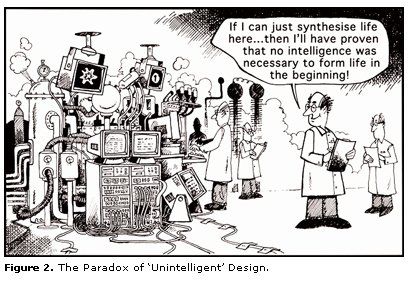
The OP is about DNA and information. We now have an upper bound on the minimum amount of information needed to make a living organism - about half a Megabyte.


What was the TEMPLATE used to make that Organism....?

And, Errr...was Intelligent Design involved? :rolleyes:

regards
 
What was the TEMPLATE used to make that Organism....?

And, Errr...was Intelligent Design involved? :rolleyes:

regards

Yes, there was a lot of intelligent design involved in that, but just because we are getting to the situation where humans can create life it doesn't mean that life required an intelligent agency.

The fact that I can dig a hole demonstrates that intelligent agency can create holes - it doesn't show that intelligent agency is required to create holes.
 
I thought you said it was Gibbs Free Energy?


:confused: Isn't Gibbs Free Energy a shining example of the 2nd Law of Thermodynamics??

oy vey10000...
Then, you have the mind numbing audacity to call me ignorant...

So, in Danielscience, Fallacy of Ignorance is acceptable, right?

Your display is tantamount to a Neurosurgical Candidate in a middle of an Interview, stating: "What's a Cerebellum??" :boggled:


In any case, if cells can divide without violating the second law of thermodynamics


Begging The Question (Fallacy): where'd you get Cells ??

Do you even know what you're arguing or your position, by chance? :eye-poppi


regards
 
Yes, there was a lot of intelligent design involved in that, but....


Then...

...just because we are getting to the situation where humans can create life it doesn't mean that life required an intelligent agency.


So it's this motif...

IntelligentScientists_zps39b1ebd6.jpg


The fact that I can dig a hole demonstrates that intelligent agency can create holes - it doesn't show that intelligent agency is required to create holes.


So you're comparing digging "A Hole" with constructing "LIFE", eh? :jaw-dropp

Look up False Comparison Fallacy (On Nuclear Steroids!!)

regards
 
Lots of straw here, which I'd like to capture, before you make any other edits, annnnoid.

I'm reminded of an episode of The Big Bang Theory, the TV show. In it Sheldon and Amy have an argument over whose intellect is greater, a physicist's (laws of physics explain everything) or a neurobiologist's (model can capture/reproduce the physicist's thinking) (I'm paraphrasing, of course). It was great fun, but bad Philosophy, and not remotely science. :D

That's the basis of Danielscience, isn't it?

Or at least a key component. As shown by the way terms such as information, code, observer, impossibility, .... are used, in this very thread, right?

Thanks for clearing that up. :)

Yes, Science uses models to describe the observed behaviour of the universe and make predictions based on that understanding. If an observation disagrees with the science, then either there was an error in the observation, or in the scientific theory to describe that behaviour.

"All models are wrong, some models are useful"

It does make the debate on definitions rather sterile.


It all adds to the humour value though. There is something very satisfying in watching creationists, (especially the young-earth variety), make utter fools of themselves.

Their levels of wrongness are hilarious.

Politely correcting folk when they make innocent mistakes is always the better way, but creationists can't handle polite criticism. Their arguments are so juvenile that no one is in danger of being swayed by them. They have no interest in learning. This is why I reminded people earlier that Daniel was not here to discuss, but to play silly word games.

"Point & Laugh" is the correct attitude to adopt.

"Look at the silly man in the corner. He thinks Earth is six thousand years old and that Man lived alongside dinosaurs."

7d19d3ba443673ea8090e798a7e28ae8.jpg

Yes, I still haven't seen an answer to my question about why one should ignore whatever a creator had written in the very rocks and starlight, whilst believing the stories that have been transmitted by generations of fallible humans.

Personally, if I believed in a creator, I'd consider it close to blasphemy to reject the evidence such a creator supplied and the gifts of intelligence and observation to analyse it.
 

Back
Top Bottom