• Quick note - the problem with Youtube videos not embedding on the forum appears to have been fixed, thanks to ZiprHead. If you do still see problems let me know.

Continuation - The PG Film - Bob Heironimus and Patty

Status
Not open for further replies.
RK,

You're confusing the heck out of me. I'm no mathematician so I don't understand how you can be 67% sure that the Patterson film shows a real Bigfoot and 90% sure there is no Bigfoot.

Do I understand you correctly on another issue: You overwhelmingly think there is no Bigfoot, but if there is, it is a supernatural entity and not a WoodApe/ForestPerson? Why even go that route at all, since the very idea is unverifiable?

One more personal question: Are you in your death throes as a Bigfoot believer and are trying to rejuvenate your enthusiasms for the idea of Bigfoot by arguing with skeptics, or are you hoping to have your enthusiasm killed off altogether here at ISF?
 
Edited by kmortis: 
Removed to comply with Rule 12
 
Last edited by a moderator:
I'm not saying that it's real, or that the PGF is an actual Bigfoot, I'm just saying that nobody can replicate those bulging calves complete with hamstrings, that's all I'm saying.

So where's Bigfoot? Where's Patty?

Uhmm...Tulpa!
 
Hi. I am of the opinion that if the P/G Film were proven a hoax tomorrow, it would not invalidate what I have seen regardless of some film. A lot of the Pattycakes, as they have been referenced, seem to think that if the film is not real, then Bigfoot is not real-and I realize that a lot of you here are not convinced Bigfoot is real period, I get that. What I DON'T get is the worship of the film (even though I think it is real, I do not worship it OR use it as the foundation of my continued interest in the subject or my basis of belief). Each piece of evidence must be able to stand on its own merits and not be worshipped as the absolute end-all be-all of Bigfoot, and that INCLUDES the P/G Film. I have been told, when I said that even if the film were proven to be a hoax it would not invalidate the subject, by Tom Yamarone that the film is a real Sasquatch and if it were proven a hoax it WOULD invalidate the subject. That to me is foolish and fanatical. I do have my questions about the film and am not absolutely convinced of its reality, and this is something I have oscillated about for years. At one time (just a few months ago) I was 100% convinced the film had to be real and would not hear any arguments to the contrary. However, thinking critically and reading the posts here about the film are knocking that percentage of belief in the film down to around 80%, and it may sink even further if there is bombshell information yet to come. Now, you may wonder, what questions do I have? Well, I will tell you:

1. If the film is indeed genuine, and has not been proven a hoax in nearly 5 decades, why does Bob Gimlin seem to duck interviews? This troubles me. He is a friend of mine and I have this concern, so you know that something is wrong when even I, a staunch Gimlin supporter for years, am bothered by this.

2. When was it shot? The timeline is something that bothers me-shoot it on a Friday, ship it off to Washington by plane, when the weather conditions were not favorable for such an undertaking, the post offices were closed Friday afternoon, so how could it have gotten to Yakima on a Saturday with no way for it to get there, unless the film was shot earlier and P & G lied about the timeline and when they actually shot it, which is starting to look much more likely.

3. Why will Bob Gimlin not take a polygraph? Sure, Roger took one in 1970 and allegedly passed it, but where are those results? Why has Bob Heironimus, the only highly-publicized name we know of to claim to have been in the suit, taken two and passed (and yes, I am aware of the inadmissible nature of polygraphs when it comes to judicial proceedings)? Did both polygraph experts conspire with Heironimus to doctor up his results, or could he possibly be (*gasp*) telling the truth?

4. Could the rumors of Patricia Patterson releasing a confession after her passing be true? These are things that need to be addressed.

I know all this seems strange coming from Bigfoot proponent Number 1 Henry May (Yes that is I), but these are things I have had bouncing around in my brain lately as regards the P/G Film. There is supposed to be some sort of celebration of the 50th anniversary in Willow Creek next year, but I have chosen not to go to it, not only because I have things to take care of here at home around that time, but also because I am having doubts about the film and its authenticity. Of course I am mature enough to know that the debunking of one film does not invalidate the entire subject, but I wonder how other Pattycakes would feel if their golden cow was shown to be a false idol.
 
Eight or ten years ago, or whenever that Coleman quote was made, I was a stronger believer in the PGF—at about the 95% level. I’ve acknowledged that I’ve moved in the direction of skepticism. So there's no conflict in my claims, just one manufactured by Gilbert Syndrome.

Roger-
Why have you come here after all of these years to start talking about the PGF?

Is it simply because your new found skepticism is leading you to talk with people who are not blinded by the Salt of the Earth Gimlin?

Also, as one of the more famous Bigfooters, have you heard any inside scoop about upcoming revelations about the PGF film? Re: Biscardi, Pat Patterson, a documentary about the hoax where the truth is told (including BobG &PatP endorsement), etc...
 
Roger-
Why have you come here after all of these years to start talking about the PGF?

Is it simply because your new found skepticism is leading you to talk with people who are not blinded by the Salt of the Earth Gimlin?

Also, as one of the more famous Bigfooters, have you heard any inside scoop about upcoming revelations about the PGF film? Re: Biscardi, Pat Patterson, a documentary about the hoax where the truth is told (including BobG &PatP endorsement), etc...

Is there a documentary of that sort coming out, or revelations about the film, Drew? Have you heard something I have not?
 
3. Why will Bob Gimlin not take a polygraph? Sure, Roger took one in 1970 and allegedly passed it, but where are those results? Why has Bob Heironimus, the only highly-publicized name we know of to claim to have been in the suit, taken two and passed (and yes, I am aware of the inadmissible nature of polygraphs when it comes to judicial proceedings)? Did both polygraph experts conspire with Heironimus to doctor up his results, or could he possibly be (*gasp*) telling the truth?
I wouldn't take either a polygraph result or a refusal to take one as meaning anything either way; polygraphs are terribly unreliable.
 
This post has taken me a long time to put together. My excuse is that I was engaged in “slow thinking” (Daniel Kaneman), which can be very tedious and time-consuming. (Mostly, though, I was just plain thinking and working slowly.) I use boldfacing below to ameliorate what would otherwise be a wall of text.

Picture #0.

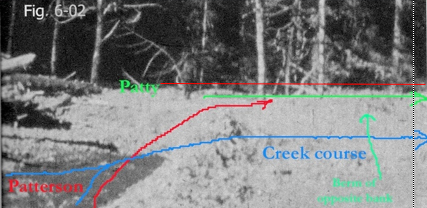
Below is what I’m calling “Picture 0”; it is Frame 003 (in Munns’s numbering system) from page 135 of his book, When Roger Met Patty. It has had annotations and lines (in red, green, and blue) added by Steven Streufert of Bigfoot Books in Willow Creek, an expert on the filmsite. (He’s one of the team that rediscovered the filmsite a few years ago.)

(BTW, in his annotated version of Frame 006, not posted here, Streufert marks Patterson’s “Approx. final camera position” as up against the berm, just to the left of the horizontal green arrowhead. It seems like a logical place to stop—no threatening lookback required.)


Picture%200_zpsmkn2y2cv.png


I was just keying on what they claimed was the butt.. It is clear in my frame, that as she walks to the right, the butt is going behind the berm...

The green line runs just under the top of the berm. I’ve inserted a horizontal red line, a bit above it, that just touches the highest edge of the berm. (I use similar red lines in subsequent frames to mark the berm’s upper edge.) Important points are these:

1. The berm’s highest point is about two or three feet to the right of what Skeptical Greg and I call “the tree.” (Patty’s shoulder-width gives a rough yardstick for my guesstimate.)
2. To its right, the berm’s edge actually declines slightly up to the horizontal green arrowhead. In Picture 2, this high point of the berm is visible near the picture’s right edge. This is important—in subsequent frames the berm flattens. It is an error to assume that the rise continues.
3. To the left of its highest point, the berm declines sharply up to “the tree.”
4. To the left of the tree, “the branch” (actually a leaning log, but that’s of no importance here) and “the log” (sometimes called the “horizontal log,” although it slants down about 12 degrees) can be seen.
5. The upper edge of “the log” can be seen above the berm. It is visible in all subsequent frames.
6. Dark bands can be seen around “the tree.” These are handy markers in subsequent frames. (The distance between them seems to vary (using Patty’s 3-footor-so shoulder width as a yardstick in closer-up frames), very roughly from 12 to 18 inches apart.)
7. My red line passes below Patty’s butt, a bit lower than Skeptical Greg‘s lower yellow line. Therefore, there is no prima facie case that only Patty’s upper back will be visible when she reaches the highest point of the berm (which is the same height as the red line), just to the right of “the tree.”

Below I analyze five more frames as Patty moves the right relative to the background. My conclusion is that the butt doesn’t go behind the berm, contra Skeptical Greg & Parcher.

I’m less sure now that Patty bends, or bends as sharply as I thought, mainly because of the blurriness and distortion of some pictures. But I still think it looks that way. However, I won’t include my belief that Patty bends at least a little in my compendium against Heironimus, because my case isn’t strong enough; because it is controversial, which would distract from the other Items therein; and because Gimlin, recently questioned by Tom Yamerone, says that Patty never "bent over or fell to the ground."

The lines I’ve drawn and their relative locations are meant partly for experts in photo analysis to consider. I’m unsure what some of their differences from one Picture to another mean. Indeed, some of the differences don’t make sense to me.


Pictures%201%20amp%202_zpslxan0ldp.png


Picture #1 Picture #2

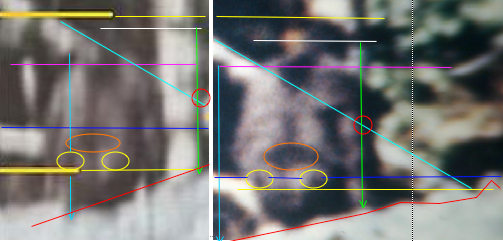
Picture 1 is Skeptical Greg‘s “standing” frame. Patty’s right arm is to the left of the tree. In Picture 2, her right arm is to the right of it. Either Patty has moved rightwards, or Patterson has moved leftwards, or both. Her head is outlined against the white tree behind it. (In all other Pictures, the outline of her head is hard to make out against the dark background.) My main impression, which I rely on in line-drawing in later Pictures, is that Patty’s head is relatively small and doesn’t rise far above her shoulder-line. (If Patty’s body below the waist were no longer visible in Picture 2, the head would need to be relatively large.)

Descriptions of the Lines in Pictures 1 & 2, from Top to Bottom & Left to Right

1. Lavender: Marks the underside of a slightly yellowish band around the tree.
2. Yellow: Skeptical Greg’s marker of the top of the head. (The thin portion of this line is my extension of Skeptical Greg‘s line.) I have scaled Picture 2 against Picture 1 so this line is at the same height and so the two pictures are the same height. This has apparently had the effect of enlarging Picture 2 relative to Picture 1 by about 9%. In Picture 2, the yellow line is slightly (5%?) closer to the lavender line (1) above it than in Picture 1.
3. White: Marks the halfway point up a black band around the tree. In Picture 2, it is about twice as far below the yellow line (the top-of-the-head) above it (2) than in Picture 1, possibly indicating that Patterson is getting closer to Patty, and/or that Patty and/or Patterson are on rising ground,
4. Pink: Marks Patty’s upper shoulder-line, measured near to the neck to avoid problems of fuzziness and lean. In Picture 2, this line is slightly closer (20%?) to the white line (marking the black tree-band) above it (3) than in Picture 1, again possibly indicating that Patterson is getting closer to Patty, and/or that Patty and/or Patterson are on rising ground.
5. Turquoise slanting line: Marks the upper edge of the branch. Its intersection (circled in red) with the green down-arrow (11 below), which marks the right edge of the tree, is lower in Picture 2 than in Picture 1. (This difference would probably be helpful in calibrating the two Pictures against each other, but I lack the expertise to do it.) Patty’s right shoulder is barely below this line in Picture 1, but well above it in Picture 2—possibly indicating that Patterson is getting closer to Patty, and/or that Patty and/or Patterson are on rising ground.
6. Blue: Marks the upper edge of the “horizontal” log in the background. (The log seems to slant down to the right a bit in Picture 2, and to be thinner for some reason.) Patty rises considerably upward relative to this line going from Picture 1 to Picture 2. The blue line is at Patty’s waist in Picture 1 and below 1/3 of Patty’s butt in Picture 2, in which it passes through the highest point of the berm on the right.
7. Orange oval: This is an oval that surrounds a black belt-like swatch on the back that appears in many frames. It seems to be just below Patty’s waistline. In Picture 1 its upper edge is below the upper edge of the log (marked by the blue line (4 above)); in Picture 2 it is well above the blue line. (However, it is lower in relation to the picture frame.) Again, this possibly indicates that Patterson is getting closer to Patty, and/or that Patty and/or Patterson are on rising ground,
8. Yellow ovals: Two small ovals surround pairs of dark patches on the butt just below the orange oval (7 above) and just above Skeptical Greg‘s yellow midline-of-the-butt line (9 below). In Picture 2 the pair is, like the orange oval above it, above the upper edge of the log, not below it. However, like it, the pair is lower in the picture frame of Picture 2 than of Picture 1.
9. Yellow: The lower yellow line is Skeptical Greg‘s midline-of-the-butt line. It has risen in relation to the log but fallen in relation to the picture frame, like lines 7 & 8 above.
10. Red slanting line: In Picture 1, an upward-slanting red line is drawn, roughly running along the top of the berm’s scalloped edge. It intersects Skeptical Greg‘s midline-of-the-butt line one Patty-width to her right, as indicated by the descending green arrow (12 below).
This suggests that if Patty moved in front of the tree, her right buttock would be invisible, along with the lower half of her left buttock, assuming the berm’s edge continued rising at the same rate. But Patty’s butt is still visible in Picture 2. My explanation is that Patty and/or Patterson is/are moving forward on rising ground, or that Patterson is standing up straighter.
In Picture 2, the red line also runs along the top of the berm’s scalloped edge, but at a lesser rising slant. (Note the location of the last-but-one upward ripple that it almost touches: this is where Patty’s right elbow will be in the “moonshot” image, Picture 5.)
11. Blue down-arrow: A vertical down-arrow appears in both Pictures, starting in the middle of the same landmark—a black blotch on the underside of the branch—and running to the edge of the berm. The arrow in Picture 1 is only 90% the length of the blue arrow in Picture 2.
12. Green down-arrow: A vertical down-arrow appears in both Pictures, starting at the right edge of the same landmark: the black band around the tree (marked by the white line (3 above)). The left arrow is only 90% the length of the right arrow.
13. Red Circle: This highlights the intersection of the turquoise slanting line (5 above, marking the upper edge of the branch) and the green line (11 above, marking the right edge of the tree). It is a reference point that I hope will be useful to more expert analysts than me.

Distances & Discussion:

Continuing from where the description of the red line (10) left off in item 10 above: in Picture 2, Patty’s right edge is to the right of the green down-arrow, and yet only Patty’s upper thighs have been occluded by the berm—that part corresponding to the portion that is below the red line in Picture 1. This is roughly only about 20% of the concealment that should have occurred, based on the slant-angle in Picture 1. This suggests that either Patty or Patterson or both are on rising ground, in which case the berm would block less of the view of Patty’s butt. From what I’ve read somewhere, the berm is only 12 or 18 inches high, so a slight rise-of-ground (say, six inches) under either party in the filming would suffice (I assume) to noticeably lower the relative position of the berm in the film’s frames.

Rising ground under Patty is suggested by the higher positions of the orange and yellow circle-pairs above the log in Picture 2, and by the greater distance of the top of her head above the tree’s black band (marked by the white line).

I assume that Skeptical Greg & Parcher are assuming that, since only the upper back is visible above the horizontal log (marked by the horizontal blue line (6)) in Picture 1, then only the upper back can be visible above the blue line in Picture 2; and what is below the line is just her lower back, not her butt.

But the lines I’ve drawn above argue against that interpretation. And it sure doesn’t look that way, does it? No one is going to claim, I trust, that Patty’s head in Picture 2 is actually her right shoulder, and that her head is hidden somewhere, which is what Parcher’s no-visible-butt interpretation would require. So, if Patty’s butt is going to disappear, it will have to happen in a subsequent Picture.

Here are a couple of puzzlers. In Picture 1, the distance down the vertical blue line to its intersection with the “horizontal” log (marked by the horizontal blue line (11) above) is only 60% of the distance in Picture 2. This suggests that in addition to closing the distance, something else was at work. Another oddity is that the log seems only two-thirds as thick in Picture 2 as in Picture 1–I can’t account for that. I hope someone who reads this will be able to crunch my numbers (or his own, if he prefers) and come up with a plausible explanation to make everything fit together.

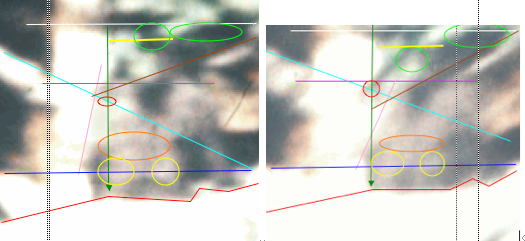
I now repeat Pictures 1 & 2, for comparative purposes, just above two blurrier images, Pictures 3 & (even blurrier) 4, in which Patty seems to be bending—but may not really be doing so. The first is at most (I guess) six frames (3/8 second) after Picture 2 and four frames before Picture 4 (1/4 second). (Patty regularly uses 11 frames to take one step.)

Pictures%201%20amp%202_zpslxan0ldp.png


Pictures%203%20amp%204_zpsp6kddm5w.png

Picture 3. Picture 4.

Comparison of Pictures 1 & 2 to Picture 3.

Patty’s apparent top-of-head (yellow line) was rising from Picture 1 to Picture 2, relative to the black tree-band (white line); and the shoulders (pink line) were rising relative to the “branch”( slanting turquoise line).

In Picture 3 this rising of the head and shoulders has reversed. The head’s yellow line is now below the black tree-band, and the shoulders’ pink line is now below the intersection of the “branch” and the tree, instead of well above it.

However markers of lower-body landmarks have risen relative to the log, such as the orange oval, the yellow circles, and Skeptical Greg‘s yellow line (the centerline across the butt; it is now coincident with the log’s blue line, so I have eliminated it). I suspect this is due to a combination of Patty walking on rising ground, both and Patterson getting closer to the background trees, and Patterson closing the distance to her. (Or there was a wrinkle in the Matrix.) (I’m an amateur at this business, so someone out there probably has a better explanation.)

Description & Discussion of the Lines in Picture 3.

The white line marks the middle of the tree’s black band. Davis’s lightening of this image has washed it out to a yellowish tinge similar to the band above it in Picture 2.

The yellow line marks the top of Patty’s head—it is my extension of Skeptical Greg‘s original line for that purpose. This is hard to estimate because of the black background behind it—this same background was to the right of her head in Picture 2. The yellow line is now below the white line, indicating she is getting closer to the tree, or she is walking on descending ground, or Patterson is on rising ground, or some combination thereof.

The leftmost green circle surrounds a part of this black background above the yellow line, as well as part of Patty’s head. The existence of this black background blob is made evident in Picture 4, when Patty’s head moves to the right, and the blob stands isolated. The rightmost green circle indicates the location of more black background material. My judgment of the location of the head vs. the background material is based on extrapolating by eye from the head’s size and position relative to the shoulder-line in Picture 2.

The shoulders (pink line) are at about the same position relative to other body landmarks as was the case in Picture 2. But they appear lower relative to the branch.

The slanted brown line marks the upper edge of a white streak in the background. (I’d call it a branch, except that it doesn’t show up in Picture 0.) I mark it so someone else can use it as an anchor to compare Pictures 3 and 4.

Another indication of Patty’s rise relative to the background is the greater portion of her body above the slanted turquoise line marking the upper edge of the branch. It now runs through her right elbow.

The intersection of the turquoise line and the blue line is slightly to the left of where Patty’s right elbow will be in Picture 5, the moonshot image.

I haven’t drawn Skeptical Greg‘s yellow line to mark the midline of the butt, because it would be coincident with the blue line. IOW, the butt has risen relative to the log.

The slanting rose line marks the right edge of Patty’s body: she seems to be starting to bend.

Washed out into white also were the two black dots on Patty’s butt (still circled in yellow), as well as 90% of the black back belt-like image, although I’ve placed an orange oval around what remains of it. It is now higher relative to the upper edge of log (indicated by a blue line) than in Picture 2.

The red line marking the edge of the berm flattens out, then rises in a zigzag pattern to the right-hand high point seen in Picture 0. The red line’s left end starts below the brownish background material in the lower left corner (which wasn’t covered by the berm).

The vertical green arrow marks the right edge of the tree, as in Picture 2. Notice that it ends at a bump in the edge of the berm, the same as in Picture 2.

Description & Discussion of Picture 4.

This picture is not only blurry but also distorted. The tan box in the background to the right of Patty’s shoulder is lower in Picture 4. (And slanted for some reason.) And the tree and the branch have “bloomed” (Parcher’s term): the branch seems about 50% thicker than in Picture 3, for instance. The tree in Picture 3 has only 70% the width of the tree in Picture 4.

Anyway, here’s a run-through of the changes in the lines. First, they have all moved up within the frame of the picture, indicating Patterson has lowered the aiming point of his camera.

The white, yellow, and pink lines (representing the tree’s black band, the top-of-the-head, and the shoulder-line) are in about the same relationship to one another as in Picture 3. But that’s largely because I assumed they would be so: the black background behind the head made it impossible for me to draw the yellow line based mostly on observation. (I also relied on there being a peak in Patty’s head to the rear, as is visible in other frames elsewhere in the film.)

The downward-slanting turquoise line (representing the slant of the branch) is higher up on Patty’s body (relative to the pink shoulder-line and the orange oval), perhaps because it has been artificially raised by a bloom on the branch.

It is hard to locate Patty’s outer left shoulder; perhaps white bloom has overlaid it. This may create a misleading impression of a greater lean in Picture 4, as indicated by the greater slant of its rose line than in Picture 3.

The blue line (marking the upper edge of the log) is still coincident with Skeptical Greg’s yellow midline-of-the-butt line and runs through the centers of the yellow circles that mark the high bumps on the rump.

The red line marks the scalloped upper edge of the berm. It is still (just) below the butt.

Description & Discussion of Picture 5.

Here, for context, are Pictures #3 & #4 again:

Pictures%203%20amp%204_zpsp6kddm5w.png


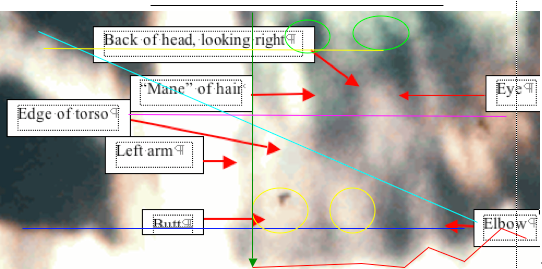
A couple of frames later, my similarly blurry, annotated “moonshot” image appears, which I’ve labeled Picture 5 here. Here is a run-through of the markers I’ve made on it.

Picture%205_zpsv8nuxyhh.png


The black tree-band is now 98% out of view, but I was able to estimate its location and mid-height from the remainder. For visibility, because it’s above the upper frame of the Picture, it is marked with a black line instead of a white one.

The yellow line, marking the top-of-the-head, is a bit lower relative to the black line (the tree’s band) than in Picture 4. I interpret this as indicating a bit of a forward lean coincident with a small rightward twist of the upper body (the left arm seems to be hidden) and a look over her right shoulder with her eye (labeled). The side of her face, the same color as her back below it, is visible for the first time in this picture-series. The chin is hidden below the right shoulder, where it runs into the pink shoulder-line. The mane of hair is to the left of the side of her face. (Unfortunately, much of this analysis rests on the weak reed of my top-of-the-head guesstimate.)

The lean is less than the amount I previously guessed (i.e., 35 to 45 degrees). I misjudged that because the lightening of the butt during enhancement made it look more prominent, as it would be in a lean of that many degrees. Now I guess the lean and twist (beyond whatever her lean is in Pictures 1 & 2) to be only 10–15 degrees or so. Such a small lean at a distance of over 100 feet mightn’t have been noticed by Gimlin.

An apparent butt crack is visible, thanks to Davis’s lightening of the image. It was also visible, less prominently, in Pictures 3 & 4. The crack strengthens the interpretation that what it is in the midst of is the butt. The butt looks similar in all five Pictures. I don’t see a break in the continuity of its appearance.

The pattern of the scalloped upper edge of the berm is visible on Patty’s butt. This edge is roughly tracked by the red line.

In the final frame used by Davis & Knights the butt is completely hidden by the sand berm.

Not at all. It’s there in the final frame (Picture 5) just as it was in the preceding Pictures. There’s not one pair of Pictures between which it disappears.

I continue to believe what I call an eye is one, and that this may have been the first lookback.

 
This post has taken me a long time to put together. My excuse is that I was engaged in “slow thinking” (Daniel Kaneman), which can be very tedious and time-consuming. (Mostly, though, I was just plain thinking and working slowly.) I use boldfacing below to ameliorate what would otherwise be a wall of text.

Picture #0.

Below is what I’m calling “Picture 0”; it is Frame 003 (in Munns’s numbering system) from page 135 of his book, When Roger Met Patty. It has had annotations and lines (in red, green, and blue) added by Steven Streufert of Bigfoot Books in Willow Creek, an expert on the filmsite. (He’s one of the team that rediscovered the filmsite a few years ago.)

(BTW, in his annotated version of Frame 006, not posted here, Streufert marks Patterson’s “Approx. final camera position” as up against the berm, just to the left of the horizontal green arrowhead. It seems like a logical place to stop—no threatening lookback required.)


[qimg]http://i7.photobucket.com/albums/y254/RogerKni/BF%20Patty%20Bending/Picture%200_zpsmkn2y2cv.png[/qimg]


The green line runs just under the top of the berm. I’ve inserted a horizontal red line, a bit above it, that just touches the highest edge of the berm. (I use similar red lines in subsequent frames to mark the berm’s upper edge.) Important points are these:

1. The berm’s highest point is about two or three feet to the right of what Skeptical Greg and I call “the tree.” (Patty’s shoulder-width gives a rough yardstick for my guesstimate.)
2. To its right, the berm’s edge actually declines slightly up to the horizontal green arrowhead. In Picture 2, this high point of the berm is visible near the picture’s right edge. This is important—in subsequent frames the berm flattens. It is an error to assume that the rise continues.
3. To the left of its highest point, the berm declines sharply up to “the tree.”
4. To the left of the tree, “the branch” (actually a leaning log, but that’s of no importance here) and “the log” (sometimes called the “horizontal log,” although it slants down about 12 degrees) can be seen.
5. The upper edge of “the log” can be seen above the berm. It is visible in all subsequent frames.
6. Dark bands can be seen around “the tree.” These are handy markers in subsequent frames. (The distance between them seems to vary (using Patty’s 3-footor-so shoulder width as a yardstick in closer-up frames), very roughly from 12 to 18 inches apart.)
7. My red line passes below Patty’s butt, a bit lower than Skeptical Greg‘s lower yellow line. Therefore, there is no prima facie case that only Patty’s upper back will be visible when she reaches the highest point of the berm (which is the same height as the red line), just to the right of “the tree.”

Below I analyze five more frames as Patty moves the right relative to the background. My conclusion is that the butt doesn’t go behind the berm, contra Skeptical Greg & Parcher.

I’m less sure now that Patty bends, or bends as sharply as I thought, mainly because of the blurriness and distortion of some pictures. But I still think it looks that way. However, I won’t include my belief that Patty bends at least a little in my compendium against Heironimus, because my case isn’t strong enough; because it is controversial, which would distract from the other Items therein; and because Gimlin, recently questioned by Tom Yamerone, says that Patty never "bent over or fell to the ground."

The lines I’ve drawn and their relative locations are meant partly for experts in photo analysis to consider. I’m unsure what some of their differences from one Picture to another mean. Indeed, some of the differences don’t make sense to me.


[qimg]http://i7.photobucket.com/albums/y254/RogerKni/BF%20Patty%20Bending/Pictures%201%20amp%202_zpslxan0ldp.png[/qimg]

Picture #1 Picture #2

Picture 1 is Skeptical Greg‘s “standing” frame. Patty’s right arm is to the left of the tree. In Picture 2, her right arm is to the right of it. Either Patty has moved rightwards, or Patterson has moved leftwards, or both. Her head is outlined against the white tree behind it. (In all other Pictures, the outline of her head is hard to make out against the dark background.) My main impression, which I rely on in line-drawing in later Pictures, is that Patty’s head is relatively small and doesn’t rise far above her shoulder-line. (If Patty’s body below the waist were no longer visible in Picture 2, the head would need to be relatively large.)

Descriptions of the Lines in Pictures 1 & 2, from Top to Bottom & Left to Right

1. Lavender: Marks the underside of a slightly yellowish band around the tree.
2. Yellow: Skeptical Greg’s marker of the top of the head. (The thin portion of this line is my extension of Skeptical Greg‘s line.) I have scaled Picture 2 against Picture 1 so this line is at the same height and so the two pictures are the same height. This has apparently had the effect of enlarging Picture 2 relative to Picture 1 by about 9%. In Picture 2, the yellow line is slightly (5%?) closer to the lavender line (1) above it than in Picture 1.
3. White: Marks the halfway point up a black band around the tree. In Picture 2, it is about twice as far below the yellow line (the top-of-the-head) above it (2) than in Picture 1, possibly indicating that Patterson is getting closer to Patty, and/or that Patty and/or Patterson are on rising ground,
4. Pink: Marks Patty’s upper shoulder-line, measured near to the neck to avoid problems of fuzziness and lean. In Picture 2, this line is slightly closer (20%?) to the white line (marking the black tree-band) above it (3) than in Picture 1, again possibly indicating that Patterson is getting closer to Patty, and/or that Patty and/or Patterson are on rising ground.
5. Turquoise slanting line: Marks the upper edge of the branch. Its intersection (circled in red) with the green down-arrow (11 below), which marks the right edge of the tree, is lower in Picture 2 than in Picture 1. (This difference would probably be helpful in calibrating the two Pictures against each other, but I lack the expertise to do it.) Patty’s right shoulder is barely below this line in Picture 1, but well above it in Picture 2—possibly indicating that Patterson is getting closer to Patty, and/or that Patty and/or Patterson are on rising ground.
6. Blue: Marks the upper edge of the “horizontal” log in the background. (The log seems to slant down to the right a bit in Picture 2, and to be thinner for some reason.) Patty rises considerably upward relative to this line going from Picture 1 to Picture 2. The blue line is at Patty’s waist in Picture 1 and below 1/3 of Patty’s butt in Picture 2, in which it passes through the highest point of the berm on the right.
7. Orange oval: This is an oval that surrounds a black belt-like swatch on the back that appears in many frames. It seems to be just below Patty’s waistline. In Picture 1 its upper edge is below the upper edge of the log (marked by the blue line (4 above)); in Picture 2 it is well above the blue line. (However, it is lower in relation to the picture frame.) Again, this possibly indicates that Patterson is getting closer to Patty, and/or that Patty and/or Patterson are on rising ground,
8. Yellow ovals: Two small ovals surround pairs of dark patches on the butt just below the orange oval (7 above) and just above Skeptical Greg‘s yellow midline-of-the-butt line (9 below). In Picture 2 the pair is, like the orange oval above it, above the upper edge of the log, not below it. However, like it, the pair is lower in the picture frame of Picture 2 than of Picture 1.
9. Yellow: The lower yellow line is Skeptical Greg‘s midline-of-the-butt line. It has risen in relation to the log but fallen in relation to the picture frame, like lines 7 & 8 above.
10. Red slanting line: In Picture 1, an upward-slanting red line is drawn, roughly running along the top of the berm’s scalloped edge. It intersects Skeptical Greg‘s midline-of-the-butt line one Patty-width to her right, as indicated by the descending green arrow (12 below).
This suggests that if Patty moved in front of the tree, her right buttock would be invisible, along with the lower half of her left buttock, assuming the berm’s edge continued rising at the same rate. But Patty’s butt is still visible in Picture 2. My explanation is that Patty and/or Patterson is/are moving forward on rising ground, or that Patterson is standing up straighter.
In Picture 2, the red line also runs along the top of the berm’s scalloped edge, but at a lesser rising slant. (Note the location of the last-but-one upward ripple that it almost touches: this is where Patty’s right elbow will be in the “moonshot” image, Picture 5.)
11. Blue down-arrow: A vertical down-arrow appears in both Pictures, starting in the middle of the same landmark—a black blotch on the underside of the branch—and running to the edge of the berm. The arrow in Picture 1 is only 90% the length of the blue arrow in Picture 2.
12. Green down-arrow: A vertical down-arrow appears in both Pictures, starting at the right edge of the same landmark: the black band around the tree (marked by the white line (3 above)). The left arrow is only 90% the length of the right arrow.
13. Red Circle: This highlights the intersection of the turquoise slanting line (5 above, marking the upper edge of the branch) and the green line (11 above, marking the right edge of the tree). It is a reference point that I hope will be useful to more expert analysts than me.

Distances & Discussion:

Continuing from where the description of the red line (10) left off in item 10 above: in Picture 2, Patty’s right edge is to the right of the green down-arrow, and yet only Patty’s upper thighs have been occluded by the berm—that part corresponding to the portion that is below the red line in Picture 1. This is roughly only about 20% of the concealment that should have occurred, based on the slant-angle in Picture 1. This suggests that either Patty or Patterson or both are on rising ground, in which case the berm would block less of the view of Patty’s butt. From what I’ve read somewhere, the berm is only 12 or 18 inches high, so a slight rise-of-ground (say, six inches) under either party in the filming would suffice (I assume) to noticeably lower the relative position of the berm in the film’s frames.

Rising ground under Patty is suggested by the higher positions of the orange and yellow circle-pairs above the log in Picture 2, and by the greater distance of the top of her head above the tree’s black band (marked by the white line).

I assume that Skeptical Greg & Parcher are assuming that, since only the upper back is visible above the horizontal log (marked by the horizontal blue line (6)) in Picture 1, then only the upper back can be visible above the blue line in Picture 2; and what is below the line is just her lower back, not her butt.

But the lines I’ve drawn above argue against that interpretation. And it sure doesn’t look that way, does it? No one is going to claim, I trust, that Patty’s head in Picture 2 is actually her right shoulder, and that her head is hidden somewhere, which is what Parcher’s no-visible-butt interpretation would require. So, if Patty’s butt is going to disappear, it will have to happen in a subsequent Picture.

Here are a couple of puzzlers. In Picture 1, the distance down the vertical blue line to its intersection with the “horizontal” log (marked by the horizontal blue line (11) above) is only 60% of the distance in Picture 2. This suggests that in addition to closing the distance, something else was at work. Another oddity is that the log seems only two-thirds as thick in Picture 2 as in Picture 1–I can’t account for that. I hope someone who reads this will be able to crunch my numbers (or his own, if he prefers) and come up with a plausible explanation to make everything fit together.

I now repeat Pictures 1 & 2, for comparative purposes, just above two blurrier images, Pictures 3 & (even blurrier) 4, in which Patty seems to be bending—but may not really be doing so. The first is at most (I guess) six frames (3/8 second) after Picture 2 and four frames before Picture 4 (1/4 second). (Patty regularly uses 11 frames to take one step.)

[qimg]http://i7.photobucket.com/albums/y254/RogerKni/BF%20Patty%20Bending/Pictures%201%20amp%202_zpslxan0ldp.png[/qimg]

[qimg]http://i7.photobucket.com/albums/y254/RogerKni/BF%20Patty%20Bending/Pictures%203%20amp%204_zpsp6kddm5w.png[/qimg]
Picture 3. Picture 4.

Comparison of Pictures 1 & 2 to Picture 3.

Patty’s apparent top-of-head (yellow line) was rising from Picture 1 to Picture 2, relative to the black tree-band (white line); and the shoulders (pink line) were rising relative to the “branch”( slanting turquoise line).

In Picture 3 this rising of the head and shoulders has reversed. The head’s yellow line is now below the black tree-band, and the shoulders’ pink line is now below the intersection of the “branch” and the tree, instead of well above it.

However markers of lower-body landmarks have risen relative to the log, such as the orange oval, the yellow circles, and Skeptical Greg‘s yellow line (the centerline across the butt; it is now coincident with the log’s blue line, so I have eliminated it). I suspect this is due to a combination of Patty walking on rising ground, both and Patterson getting closer to the background trees, and Patterson closing the distance to her. (Or there was a wrinkle in the Matrix.) (I’m an amateur at this business, so someone out there probably has a better explanation.)

Description & Discussion of the Lines in Picture 3.

The white line marks the middle of the tree’s black band. Davis’s lightening of this image has washed it out to a yellowish tinge similar to the band above it in Picture 2.

The yellow line marks the top of Patty’s head—it is my extension of Skeptical Greg‘s original line for that purpose. This is hard to estimate because of the black background behind it—this same background was to the right of her head in Picture 2. The yellow line is now below the white line, indicating she is getting closer to the tree, or she is walking on descending ground, or Patterson is on rising ground, or some combination thereof.

The leftmost green circle surrounds a part of this black background above the yellow line, as well as part of Patty’s head. The existence of this black background blob is made evident in Picture 4, when Patty’s head moves to the right, and the blob stands isolated. The rightmost green circle indicates the location of more black background material. My judgment of the location of the head vs. the background material is based on extrapolating by eye from the head’s size and position relative to the shoulder-line in Picture 2.

The shoulders (pink line) are at about the same position relative to other body landmarks as was the case in Picture 2. But they appear lower relative to the branch.

The slanted brown line marks the upper edge of a white streak in the background. (I’d call it a branch, except that it doesn’t show up in Picture 0.) I mark it so someone else can use it as an anchor to compare Pictures 3 and 4.

Another indication of Patty’s rise relative to the background is the greater portion of her body above the slanted turquoise line marking the upper edge of the branch. It now runs through her right elbow.

The intersection of the turquoise line and the blue line is slightly to the left of where Patty’s right elbow will be in Picture 5, the moonshot image.

I haven’t drawn Skeptical Greg‘s yellow line to mark the midline of the butt, because it would be coincident with the blue line. IOW, the butt has risen relative to the log.

The slanting rose line marks the right edge of Patty’s body: she seems to be starting to bend.

Washed out into white also were the two black dots on Patty’s butt (still circled in yellow), as well as 90% of the black back belt-like image, although I’ve placed an orange oval around what remains of it. It is now higher relative to the upper edge of log (indicated by a blue line) than in Picture 2.

The red line marking the edge of the berm flattens out, then rises in a zigzag pattern to the right-hand high point seen in Picture 0. The red line’s left end starts below the brownish background material in the lower left corner (which wasn’t covered by the berm).

The vertical green arrow marks the right edge of the tree, as in Picture 2. Notice that it ends at a bump in the edge of the berm, the same as in Picture 2.

Description & Discussion of Picture 4.

This picture is not only blurry but also distorted. The tan box in the background to the right of Patty’s shoulder is lower in Picture 4. (And slanted for some reason.) And the tree and the branch have “bloomed” (Parcher’s term): the branch seems about 50% thicker than in Picture 3, for instance. The tree in Picture 3 has only 70% the width of the tree in Picture 4.

Anyway, here’s a run-through of the changes in the lines. First, they have all moved up within the frame of the picture, indicating Patterson has lowered the aiming point of his camera.

The white, yellow, and pink lines (representing the tree’s black band, the top-of-the-head, and the shoulder-line) are in about the same relationship to one another as in Picture 3. But that’s largely because I assumed they would be so: the black background behind the head made it impossible for me to draw the yellow line based mostly on observation. (I also relied on there being a peak in Patty’s head to the rear, as is visible in other frames elsewhere in the film.)

The downward-slanting turquoise line (representing the slant of the branch) is higher up on Patty’s body (relative to the pink shoulder-line and the orange oval), perhaps because it has been artificially raised by a bloom on the branch.

It is hard to locate Patty’s outer left shoulder; perhaps white bloom has overlaid it. This may create a misleading impression of a greater lean in Picture 4, as indicated by the greater slant of its rose line than in Picture 3.

The blue line (marking the upper edge of the log) is still coincident with Skeptical Greg’s yellow midline-of-the-butt line and runs through the centers of the yellow circles that mark the high bumps on the rump.

The red line marks the scalloped upper edge of the berm. It is still (just) below the butt.

Description & Discussion of Picture 5.

Here, for context, are Pictures #3 & #4 again:

[qimg]http://i7.photobucket.com/albums/y254/RogerKni/BF%20Patty%20Bending/Pictures%203%20amp%204_zpsp6kddm5w.png[/qimg]

A couple of frames later, my similarly blurry, annotated “moonshot” image appears, which I’ve labeled Picture 5 here. Here is a run-through of the markers I’ve made on it.

[qimg]http://i7.photobucket.com/albums/y254/RogerKni/BF%20Patty%20Bending/Picture%205_zpsv8nuxyhh.png[/qimg]

The black tree-band is now 98% out of view, but I was able to estimate its location and mid-height from the remainder. For visibility, because it’s above the upper frame of the Picture, it is marked with a black line instead of a white one.

The yellow line, marking the top-of-the-head, is a bit lower relative to the black line (the tree’s band) than in Picture 4. I interpret this as indicating a bit of a forward lean coincident with a small rightward twist of the upper body (the left arm seems to be hidden) and a look over her right shoulder with her eye (labeled). The side of her face, the same color as her back below it, is visible for the first time in this picture-series. The chin is hidden below the right shoulder, where it runs into the pink shoulder-line. The mane of hair is to the left of the side of her face. (Unfortunately, much of this analysis rests on the weak reed of my top-of-the-head guesstimate.)

The lean is less than the amount I previously guessed (i.e., 35 to 45 degrees). I misjudged that because the lightening of the butt during enhancement made it look more prominent, as it would be in a lean of that many degrees. Now I guess the lean and twist (beyond whatever her lean is in Pictures 1 & 2) to be only 10–15 degrees or so. Such a small lean at a distance of over 100 feet mightn’t have been noticed by Gimlin.

An apparent butt crack is visible, thanks to Davis’s lightening of the image. It was also visible, less prominently, in Pictures 3 & 4. The crack strengthens the interpretation that what it is in the midst of is the butt. The butt looks similar in all five Pictures. I don’t see a break in the continuity of its appearance.

The pattern of the scalloped upper edge of the berm is visible on Patty’s butt. This edge is roughly tracked by the red line.


Not at all. It’s there in the final frame (Picture 5) just as it was in the preceding Pictures. There’s not one pair of Pictures between which it disappears.

I continue to believe what I call an eye is one, and that this may have been the first lookback.

Well, I for one am convinced. Turns out Patty is a real bigfoot, after all!

I'll be in my bunk.
 
https://www.blogger.com/profile/07852437322070677310

That's your film site expert?

Is he an expert on the PGF film site because he visited the site 48 years after the film was shot?

Streufert wasn't just a site visitor. He is rather, an expert in the details of the site, having studied it itself and what others had written of it and the photos they'd taken of it for years in conjunction with several other knowledgeable Bigfooters, including members of his site rediscovery team. The links below should give you an indication of the depth of his involvement. These include detailed maps of the site, based on his team's site surveys. The sidebar contains links to additional threads of his on the topic.

http://bigfootbooksblog.blogspot.com/2011/11/patterson-gimlin-film-site-rediscovered.html

http://bigfootbooksblog.blogspot.com/2012/01/pgf-bigfoot-film-site-mathematically.html
 
Last edited:
knowledgeable Bigfooters,

And what on earth is a "knowledgeable Bigfooter?" I'm presuming it's a fan of Bigfootery who knows what flavour crisps each member of the cast of Finding Bigfoot prefers with their sandwich.

Surely the word "knowledgeable" should never ever follow the word "Bigfooter" in any sane man's world.

Rule 1 re: "knowledge" should dictate that Bigfoot's quite obviously don't reside anywhere upon this world that we currently dick around on.
 
Status
Not open for further replies.

Back
Top Bottom