• Quick note - the problem with Youtube videos not embedding on the forum appears to have been fixed, thanks to ZiprHead. If you do still see problems let me know.

Commandments for Atheists?

So take this hypothetical:
Tomorrow you wake up and the societal consensus has evolved overnight so that it has now been ordained by consensus that it is not only moral, but rightful and required, that one must beat the crap out of someone weaker than them on a daily basis. Bullying in the extreme is codified and declared joyous and correct by all, atheists and theists alike. Those who do not follow this commandment to bully are fined and publicly humiliated before their peers. Would you join in the bullying? Why or why not?

Ah.

You mean, it would be like being a Catholic in Chicago, in the 50s, dealing with "those fotched-on Protestants".

What you have done is illustrate the disjunction between "moral" (as defined by society), and "right" (as defined by an individual). It would beeven worse if an "absolute source" of "morality" changed its mind so...which is what, in fact, happened at Vatican II. Suddenly, ecumenicism was "moral" and protestant-bashing was "immoral".

As when the C"JC"LDS had a "revelation" about polygyny, and about skin color and the priesthood.

Not much of a follower, me.
 
Recall that my original response was to the silly accusation that atheists "celebrate immorality" by lacking belief in a 'god' or any 'gods'.

Interesting how you create things out of thin air, kind of like a theist. Here is my original statement (bold added):

do atheists want to celebrate their lack of morality or moral guidelines? Because that is the impression I get from some of the responses here.

Amazing how you arrive from point A to B....
 
Ah.

You mean, it would be like being a Catholic in Chicago, in the 50s, dealing with "those fotched-on Protestants".

What you have done is illustrate the disjunction between "moral" (as defined by society), and "right" (as defined by an individual). It would beeven worse if an "absolute source" of "morality" changed its mind so...which is what, in fact, happened at Vatican II. Suddenly, ecumenicism was "moral" and protestant-bashing was "immoral".

As when the C"JC"LDS had a "revelation" about polygyny, and about skin color and the priesthood.

Not much of a follower, me.

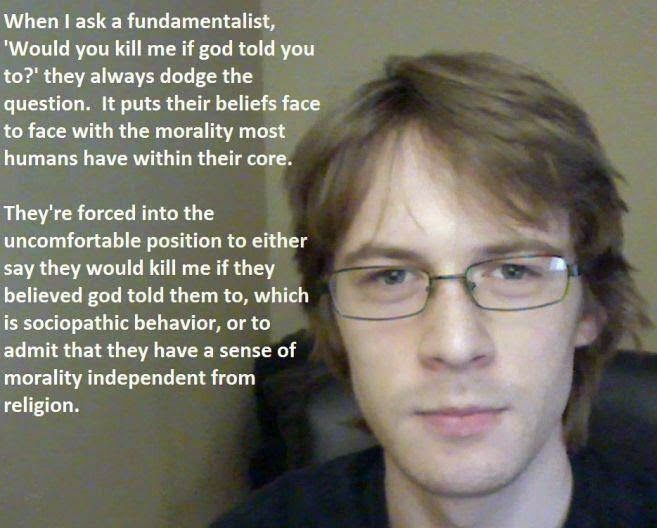
So, I take it you refuse to answer my question? That is the usual response given by believers....
 
kill_zps11ded851.jpg
 
So, I take it you refuse to answer my question? That is the usual response given by believers....

You must mean that you refuse to read my answer.

Just out of curiosity, what do you, personally, think "Not much of a follower, me," means? Do you presume to arrogate to define the format of an "acceptable" answer? How does that usually work out, for you?

It's OK. The rest of my post won't go away.
 
Last edited:
[qimg]http://i176.photobucket.com/albums/w194/orphia/Religion/kill_zps11ded851.jpg[/qimg]

That's pretty pathetic. I didn't even use that argument in my debate with my believer friend, cause I knew how pathetic it was. I just brought up the story of Abraham and Isaac, and mentioned to him how troubling it was to me as a child, and how troubling it was to me now, difference being I'm an adult so I can easily reject those childhood tales. But, as a theist, it would cause me no discomfort or embarrassment to answer that question very easily--yean, you kill, you do what God commands you to do. He is God, after all. Any theist who is going to maintain logical credibility has to concede that. If God is the source of morality, case closed! I've gone beyond that, of course, I'm asking if there is a scientific basis for morality. That has been debated elsewhere on this forum, so no real need to go off on that tangent here.
 
So take this hypothetical:
Tomorrow you wake up and the societal consensus has evolved overnight so that it has now been ordained by consensus that it is not only moral, but rightful and required, that one must beat the crap out of someone weaker than them on a daily basis. Bullying in the extreme is codified and declared joyous and correct by all, atheists and theists alike. Those who do not follow this commandment to bully are fined and publicly humiliated before their peers. Would you join in the bullying? Why or why not?

We have many examples of this throughout history. Why not look there for answers.
 
You must mean that you refuse to read my answer.

Just out of curiosity, what do you, personally, think "Not much of a follower, me," means? Do you presume to arrogate to define the format of an "acceptable" answer? How does that usually work out, for you?

It's OK. The rest of my post won't go away.

Sorry, I'm not a mind-reader. Are you saying "not much of a follower" means you would disregard the consensus, and do what you think is right?
 
Sorry, I'm not a mind-reader. Are you saying "not much of a follower" means you would disregard the consensus, and do what you think is right?

Apparently, not much of a text-reader, either.

Don't feel to badly about it; steep learning curves are to beexpected.

I am not a "follower"; I do what I, personally, consider to be the right thing.

Evidently, 'god' tell many people otherwise; or at least, they seem to think so.

Iso-normativity is a by-product.
 
Apparently, not much of a text-reader, either.

Don't feel to badly about it; steep learning curves are to beexpected.

I am not a "follower"; I do what I, personally, consider to be the right thing.

Evidently, 'god' tell many people otherwise; or at least, they seem to think so.

Iso-normativity is a by-product.

No need for insults, I'm interested in your responses. I haven't made up my mind on the subject, If I had there would be no need for me to be here, I'd be smug and content in my all-knowing greatness.

Now we're getting somewhere....
So, where does your 'personal' sense of what is right and wrong come from?
In my hypothetical, of course (which distinguishes it from historical examples) all of your friends, your parents, your teachers, all those who you look up to, all tell you it is now the correct thing to bully and abuse. Assuming you stay the course and are adamant in your righteousness, where does it come from? What makes you believe it is the correct thing to do? Is it just the vestiges of what you were taught as a child that you now are going to hold on to, because you feel you're now smarter than everyone around you? Or is it derived from some logical argument?

Again, (if you read my original statement carefully) I have some sympathy for your position; I'm just looking for a convincing argument from you.
 
No need for insults, I'm interested in your responses. I haven't made up my mind on the subject, If I had there would be no need for me to be here, I'd be smug and content in my all-knowing greatness.

You are, apparently, misusing the simple English plural noun, "insults".

You are, of course, free to do so; you should not, however, arrogate to blame another for it.

Now we're getting somewhere....

I am happy for you that you feel so.

So, where does your 'personal' sense of what is right and wrong come from?

A multiplicity of sources; none of which are 'god' (or 'gods'). In practice, a gestalt of experience, example (real life and fiction), and aspiration. Despite you accusation of "whimsy" (shall we talk of "insult"?).

Seasoned,of course, by pragmatism.

In my hypothetical, of course (which distinguishes it from historical examples) all of your friends, your parents, your teachers, all those who you look up to, all tell you it is now the correct thing to bully and abuse. Assuming you stay the course and are adamant in your righteousness, where does it come from?

Shall we talk of "insult"? Feel free to continue to denigrate; naetheless, what I will do I will to do, as far as possible. I have my standards.

You may characterize it as fixity of purpose, or adamance, or mere stubbornness. I characterize it as "doing the right thing".

What makes you believe it is the correct thing to do? Is it just the vestiges of what you were taught as a child that you now are going to hold on to, because you feel you're now smarter than everyone around you? Or is it derived from some logical argument?

Answered above. Thanks for stooping to another dig.

Again, (if you read my original statement carefully) I have some sympathy for your position; I'm just looking for a convincing argument from you.

Again, had you read my responses at all, you would know that you are not going to get what you say you are looking for, here. I would not deign to tell you what is "right" for you.

Not much of a follower; not really much of a leader; barely a herd being at all. Mostly just muddling through.
 
So take this hypothetical:
Tomorrow you wake up and the societal consensus has evolved overnight so that it has now been ordained by consensus that it is not only moral, but rightful and required, that one must beat the crap out of someone weaker than them on a daily basis. Bullying in the extreme is codified and declared joyous and correct by all, atheists and theists alike. Those who do not follow this commandment to bully are fined and publicly humiliated before their peers. Would you join in the bullying? Why or why not?

I'd wait til this society tore itself to pieces then pick up the pieces I like best.

Now what would you do in your scenario?
 
I'd like to hear your response to your hypothetical.

I don't have a great answer--if I did I wouldn't have asked the question. I'd like to think that I'd resist in any way possible, but that would probably be due to what I have been taught (remember that word, taught?) and as I said, I have already rejected much of what I was taught about religion. If you have anything interesting to add please feel free.
 
...I suppose accuracy is too much for which to be hoped...


Note:


The disjunction clarifies the differences among "wrong", "immoral", and "evil". "...[A]gainst the orders of your 'god'..." subsumes all three.


Note:


The fact that "morality", and "right and wrong" are both social constructs does not imply that the two concepts may be honestly equivocated. It is not at all difficult to craft scenaria in which the social concepts of "moral" and "right" are in conflict, demonstrating that they are not, in fact, thesame thing.

Note:


Here, I did, in fact, refer to "moral" and "right" together; in order to sidestep potential evasion. I did not, however, equivocate the two, nor do I.


Interesting construction. "Moral" is, in fact, functionally equivalent to "a certain sense" of "right"--by which it is clear that "right" and "moral" are not the same thing, despite their area of overlap. What about the rest of the senses of "right", the ones outside the overlap?

Is it "immoral" to violate the speed limit? Is it "right"?

Is it "moral" to pay as little tax as the law allows? Is it "wrong"?

Let's look at the definitions of "right" and "moral", shall we:

1right adjective \ˈrīt\
: morally or socially correct or acceptable
: agreeing with the facts or truth : accurate or correct

: speaking, acting, or judging in a way that agrees with the facts or truth

1mor·al adjective \ˈmȯr-əl, ˈmär-\
: concerning or relating to what is right and wrong in human behavior
: based on what you think is right and good

: considered right and good by most people : agreeing with a standard of right behavior

So you can see from the highlighted that they have functionally synonymous meanings as far as those definitions are relevant to this discussion.

Of course, right can also be used to talk about something that is correct in the sense that it accords with something that is true. For example, if you answer on a test that Paris is the capital of France you would be right. The point being that when you have polysemous words such as "right" not all definitions are in play (the right answer, right-handed, right on, right buttock). The word "right" is not equivalent to "moral" if we were talking about right buttocks because the concept of a moral buttock is meaningless. But in the context that we are talking about I see no reason to see right and moral as distinct unless you can provide a useful distinction. Could you please do that now and explain how you arrived at this useful distinction?


.In a discussion about whether lacking belief in a 'god' comprises "celebrating immorality", I did, in fact, raise up only one alternative. That there are, or may be, others does not invalidate the point; that I did not list those others in respinse to a particular accusation does not create a false dichotomy.

I see. Then sentences like this can be confusing:

Why is it now becoming "right", or "moral" to support (or at least grudgingly allow) marriage equality? Did 'god' change, or did societal consensus?

It does indeed seem like a false dichotomy to me, and based on a false premise.

Now, you say you do not eat meat. Is this because you don't like the taste or could it have something to do with ethics?

For example, do you consider it wrong to eat meat?
Why do you not consider it immoral to eat meat?
 
You are, apparently, misusing the simple English plural noun, "insults".

You are, of course, free to do so; you should not, however, arrogate to blame another for it.


I am happy for you that you feel so.


A multiplicity of sources; none of which are 'god' (or 'gods'). In practice, a gestalt of experience, example (real life and fiction), and aspiration. Despite you accusation of "whimsy" (shall we talk of "insult"?).

Seasoned,of course, by pragmatism.


Shall we talk of "insult"? Feel free to continue to denigrate; naetheless, what I will do I will to do, as far as possible. I have my standards.

You may characterize it as fixity of purpose, or adamance, or mere stubbornness. I characterize it as "doing the right thing".


Answered above. Thanks for stooping to another dig.


Again, had you read my responses at all, you would know that you are not going to get what you say you are looking for, here. I would not deign to tell you what is "right" for you.

Not much of a follower; not really much of a leader; barely a herd being at all. Mostly just muddling through.

Thanks for your response, I really do appreciate it. I'm not intending to denigrate, sorry you read it that way, I'm just reacting to the tone of your answers. It really comes off as sort of sad, especially your last sentence. Not really helpful when one is debating a believer who is all happy and cheerful due to his 'personal connection to Christ'. When you use words like 'Gestalt' ; 'experience' etc (I'll ignore pragmatic, since if you were pragmatic you would go along with the crowd in my hypothetical) it sounds to me like you are reluctantly acknowledging that there is no empirical basis for that which is right and wrong. That is your prerogative, I just find it unsatisfying. Could just be a difference in our backgrounds...:cool:
 
<snip of a great deal of working very hard to miss the point>

It does indeed seem like a false dichotomy to me, and based on a false premise.

Is there anything in your philosophy that is "moral", but not "right"?

Now, you say you do not eat meat.

Speakng of a "false premise"...

No. I do not "say" I don't eat meat. I "say" I am a vegetarian.

I do not, in fact, eat meat.

Is this because you don't like the taste or could it have something to do with ethics?

For example, do you consider it wrong to eat meat?
Why do you not consider it immoral to eat meat?

It is a choice I make. I choose not to eat meat, particularly the meat of animals raised in CAFOs. I do, in fact, make exceptions, for reasons of my own. I would not presume to tell you that it is "wrong", to eat meat; but I choose not to.

Notice that I do not need a 'god' to tell me not to do something I chose not to do.
 
Last edited:
Is it "immoral" to violate the speed limit? Is it "right"?

A great question. A whole thread could be wrapped around it :D
The answer of course, is that your speed is either illegal or legal. Whatever you might say about right vs moral (which like Angry I believe are synonymous) of course legality is seperate from morality. But it does represent a communal sense of values, so that's where it could get tricky. The believer, having recourse to the 'bible' or whatever, probably wouldn't hesitate in their response, since the ancient texts don't really get into speeding. But is there a right and wrong of proper driving etiquette? If you are driving 80 in a 60 zone along a lonesome stretch of straight desert in daylight, maybe no worries (although you are more likely to negligently bump off some poor unsuspecting jackrabbit...) But when driving through a street being crossed by numerous old ladies, maybe it would be more moral (and right ;) ) to slow down well below the advertised speed limit. :boggled:
 
Last edited:

Back
Top Bottom