Unsurprisingly, the article is utter BS. Let's start here:
These CMB observations are
consistent with the general relativistic
creationist models of Humphreys and
Gentry, which explain the current
state of the universe within a
creationist timeframe.
What the author (John Hartnett) fails to mention is that both Humphreys and Gentry wouldn't know a decent cosmological model if it kicked them in the nuts. Rather ironically, Hartnett himself later wrote an article in which he rejects every creationist attempt to explain the disparity between the observed age of the Universe and YEC. He then proposes his own solution. Like Humphreys' model, his solution is to have time pass at a radically slower rate on Earth than in the rest of the Universe. Thus, while the Universe experiences billions of years, only a very short time passes on Earth - these models are generically known as young Earth/old Universe. Unlike Humphreys' model, Hartnett's makes no failed predictions, and is not based on a complete failure to understand cosmology. How did Hartnett solve the numerous physical problems with Humphreys' model? Simple - he ignored physics altogether. In Hartnett's model, time runs slower on Earth not because of any physical source of time dilation, but simply because "the laws of physics are suspended". In other words, Hartnett simply miracles away the problem. His article, then, is nothing more than an admission that YECs have
no scientific answer to the conclusions of observational cosmology.
Returning to the article in question:
[CMB observations] are inconsistent with all big bang
cosmologies.
Utter nonsense. In fact, the Big Bang models predict observation spectacularly, as we shall see.
The Cosmological Principle, which assumes that the universe is unbounded, is an evolutionary assumption — an untestable hypothesis.
False. The cosmological principle Hartnett refers tois essentially that our corner of the Universe is nothing special - that all places in the Universe look pretty much alike. This is clearly untrue on small scales - there's a hell of a difference between here, and any point, say, exactly a lightyear away. But on large scales, the cosmological principle holds pretty well. One large chunk of Universe looks pretty much like another. This is not merely an assumption, there is observational evidence to support it.
This in itself is a problem, because cosmologists have stated that variations greater than 1 part in 10<sup>4</sup> are needed for galaxies and clusters to form in the cosmological time available to gravity
This assumes the non-existence of non-baryonic dark matter.
Structure formation begins with small density perturbations within an otherwise extremely homogeneous medium. Regions which are slightly overdense attract more material from outside and collapse under gravity, whille underdense regions rarefy. This eventually gives us large scale structure. However, in the early Universe matter and radiation are tightly coupled, and so as an overdense region collapses its temperature increases and radiation pressure acts to oppose the collapse. Because of this, until electrically neutral atoms form and matter and radiation largely decouple, structure formation cannot proceed. This is no problem at all for dark matter, however, which does not interact with radiation anyway.
...the blotches are not the result of some ‘clumpiness’ of the # radiation density soon after the big bang
Again, Hartnett simply gets it wrong. Geodesic mixing in an open Universe simply induces ellipticity in existing CMB anisotropies. It cannot produce the observed anisotropies from an initially isotropic spectrum.
According to McGaugh, recent Boomerang data, which contain the amplitudes in the angular power spectrum of the anisotropies in the CMB radiation, suggest that the universe is filled with normal (baryonic) matter, and not with exotic particles or cold dark matter (CDM).
Utter nonsense. BOOMERanG threw up the intriguing possibility of a no-CDM model, but it most certainly didn't require it. All BOOMERanG data is entirely consistent with CDM and
L-CDM models. What's more, the latest data from WMAP is in excellent agreement with these models.
Hartnett actually does a reasonable job laying out some of the evidence for dark matter. He correctly identifies some methods of 'weighing' galaxies, and correctly reports that the results suggest considerably more matter than is visible. There are other methods which support this conclusion, eg studies of gravitational lensing, so it's well worth noting that dark matter is indicated by numerous independent observations.
Hartnett goes on to quote McGaugh again...
Structure cannot grow gravitationally to the rich extent seen
today unless there is a nonbaryonic component that can already be significantly clumped at the time of recombination without leaving indiscriminately large fingerprints on the microwave background.’
...then rather bizarrely comments:
However, the large fingerprints
are just not observed
Well, duh. Hence, more evidence for non-baryonic dark matter. Hartnett seems to be implying that the abscence of these large fingerprints is a problem - it isn't. It's exactly what one would expect if CDM is a significant fraction of the Universe's density.
I'll skip the section on spiral galaxies, except to point out two things - firstly, that Hartnett's own model will need to explain them too, and secondly that creationists will typically use the fact that no one model has been pinned down with certainty to suggest some fundamental deficiency in the field, which is obvious nonsense.
Onwards:
If we believe in the experimental method and the principle of falsification, there is one glaring result of this analysis; either non-baryonic cold dark matter doesn’t exist, or big bang cosmology, on which the prediction is based, is wrong!
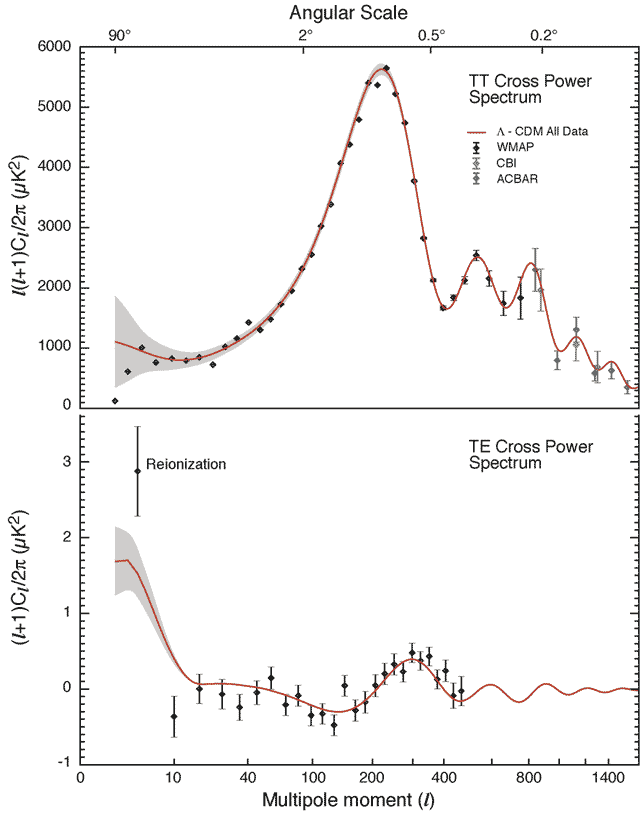
I could explain why his analysis is incorrect, and expand on my previous statement that CDM models are entirely consistent with BOOMERanG data. But why bother with all that, when I can just show you the latest data from WMAP, and a couple other sources, with the predictions of the concordance
L-CDM model overlaid:
I think that says it all, really. For all his protestations, Hartnett cannot overcome the simple fact that current observations agree spectacularly with models. Creationists, meanwhile, are still stuck on 'Goddidit'.