Does anyone know whether the U.S. Government considered a plan to set-up a clearinghouse for the cars traded in, wherein they could have been sold to foreign countries?How can you tell me it's the same thing to purposefully destroy 600,000 engines, completely unnecessarily, when those cars could have been left in the pool of wealth?

You are using an out of date browser. It may not display this or other websites correctly.
You should upgrade or use an alternative browser.
WRONG. On so many levels. Everything about what you just said is wrong.
Care to explain? Let's review...
Likewise, the "clunker" burns more gas,
This is true since new cars purchased under the program by definition get better MPG than the "clunkers". Of course I know you're going to argue that the new car will be driven more than the clunker therefore the new car will burn more gas but you can't provide any evidence for that claim and it requires quite a leap of faith to believe that it's true. You would have to provide some pretty solid statistics showing that the new car was driven more heavily by a factor that overrides any increase in MPG. I'm not buying it.
will cost more in repairs
Sure in the next couple of years or so the new cars will have a far lower maintenance cost than the clunker.
will lead to potential downtime,
"Potentially" yes it will. Most people replace cars before the end of their life because there comes a point when the inconvenience of potential breakdowns has a real cost associated with it. The effect of people being late to work or sitting waiting by the side of the road is a real loss of wealth in the same way that the broken window is. But wait you say, what about the lost business for the tow truck driver or repair shop. Now there's your broken window fallacy.
is probably not as safe as a newer car,
Yes, the new car is "probably" safer. This should be a pretty uncontroversial statement. And the safer car protects wealth as it prevents accidents (advanced traction control & braking features, etc), prevents injury and loss of life.
and overall will cost more to operate.
If you compare fuel and maintenance costs for the next one or two years, the newer car will clearly cost less to operate.
This is the equivalent of "less rent".
The lower cost of the new car is equivalent to the higher rent of the new apartment. In each case you're really only comparing the immediate effect over a limited period of a few years. You're not amortizing all of the cost and income over the life of the property. That's why the market might decide to tear down a historical and architecturally significant apartment that causes a real long term loss of wealth for society as a whole while providing a short term boost in rental income for the landlord. A boost which disappears a decade later when the fancy new apartment looks dated and run down and people wish they had never destroyed the historical building.
The broken window analogy doesn't work because the new car is an improvement over the old car and has a higher value, while a window is just a window.
This is a major point none of the broken windoids have addressed. In the parable, the window at the beginning of the story is identical to the window at the end of the story. This is not the case for a car that gets better MPG or a new building with more square footage.
Last edited:

To make sure we understand each other here, are you claiming GDP growth is not meaningful or a good thing?
No, GDP growth is not necessariliy a "good thing".
I also failed to prove how the Romans won the Second Peloponnesian War. You see, neither was within the scope of my post concerning how sometimes wealth destroyed results in a net positive.
Your post was about how CFC was a wonderful thing. A "stimulus" for the economy.
Since you know next to nothing about my personal politics, you probably shouldn't embarrass yourself by debating imaginary boogeymen.
I don't care about your personal politics. Your support for a ridiculous and wasteful government program reveals your latent statism.
And let the whining begin...
(as if I, or anyone who supports this doesn't also pay taxes)
I'm not whining, I'm angry as would anyone be who was robbed. Whether or not you pay taxes is irrelevant, and doesn't justify the program, or the myriad of other wasteful and corrupt things the government does.
kevinquinnyo
Graduate Poster
- Joined
- Jan 11, 2009
- Messages
- 1,584
"Potentially" yes it will. Most people replace cars before the end of their life because there comes a point when the inconvenience of potential breakdowns has a real cost associated with it. The effect of people being late to work or sitting waiting by the side of the road is a real loss of wealth in the same way that the broken window is. But wait you say, what about the lost business for the tow truck driver or repair shop. Now there's your broken window fallacy.
The lower cost of the new car is equivalent to the higher rent of the new apartment. In each case you're really only comparing the immediate effect over a limited period of a few years. You're not amortizing all of the cost and income over the life of the property. That's why the market might decide to tear down a historical and architecturally significant apartment that causes a real long term loss of wealth for society as a whole while providing a short term boost in rental income for the landlord. A boost which disappears a decade later when the fancy new apartment looks dated and run down and people wish they had never destroyed the historical building.
This is a major point none of the broken windoids have addressed. In the parable, the window at the beginning of the story is identical to the window at the end of the story. This is not the case for a car that gets better MPG or a new building with more square footage.
OMG.
Dude. The cars DID NOT have to be destroyed. A new car's existence does not exclude the existence of an old car.
Let me put it another way. The broken window parable wouldn't, itself be a broken window parable, if the window had, instead of been broken, been removed, and installed on a Habitat for Humanity home.
Do you understand this?
kevinquinnyo
Graduate Poster
- Joined
- Jan 11, 2009
- Messages
- 1,584
Also, if you can still edit, remove my name from the quotes in your post. Those are things you said, not me.
kevinquinnyo
Graduate Poster
- Joined
- Jan 11, 2009
- Messages
- 1,584
Does anyone know whether the U.S. Government considered a plan to set-up a clearinghouse for the cars traded in, wherein they could have been sold to foreign countries?
Why foreign countries? I mean why not anyone who was willing to buy them, foreign or not? Anything would have been better than just destroying them.
Honestly, if they really wanted to get more bang for the buck, environmentally, they should have just sold the cars and bought carbon offests.
None of it makes any sense.
Also, if you can still edit, remove my name from the quotes in your post. Those are things you said, not me.
 sorry. fixed.
The cars DID NOT have to be destroyed. A new car's existence does not exclude the existence of an old car.
Who said they did? The point is that it's not a big deal since the economic harm is far less than the economic benefit. In a perfect program the government would have taken possession of the cars and auctioned them off to offset the costs. I'm sure in that case you would be complaining about the administrative costs of the auction. The government simply can't win can it?
Let me put it another way. The broken window parable wouldn't, itself be a broken window parable, if the window had, instead of been broken, been removed, and installed on a Habitat for Humanity home.
What if it were broken and replaced with an energy efficient insulated window that halved the shopkeeper's heating and cooling bills? How would you account for the value in that case? I think "elbe" said it best in the other thread that Francesca linked to: the parable is supposed to encourage you to think about unseen variables yet the people who bring it up consistently and conveniently ignore more complex unseen variables.
Last edited:
kevinquinnyo
Graduate Poster
- Joined
- Jan 11, 2009
- Messages
- 1,584
Who said they did? The point is that it's not a big deal since the economic harm is far less than the economic benefit. In a perfect program the government would have taken possession of the cars and auctioned them off to offset the costs. I'm sure in that case you would be complaining about the administrative costs of the auction. The government simply can't win can it?
What if it were broken and replaced with an energy efficient insulated window that halved the shopkeeper's heating and cooling bills? How would you account for the value in that case? I think "elbe" said it best in the other thread that Francesca linked to: the parable is supposed to encourage you to think about unseen variables yet the people who bring it up consistently and conveniently ignore more complex unseen variables.
sigh. I already addressed this. It does not matter if you replaced it with a gold window with diamond trim that could let you see into the future when you look out of it. It does not matter.
The old window was DESTROYED, not sold back to the market.
And of course the parable is supposed to encourage you to think of unseen costs. That is exactly the point.
The unseen cost is what the shoemaker could have bought with the money that he had to pay the glazier.
In the case of cash for clunkers, the unseen cost is the productivity lost from a used pickup truck that could have been used by a 24 year old father of two who repairs roofs for a living, or as a fleet vehicle for a startup maid service, or a whatever the hell is not happening anyway, because the engines were destroyed.
That's the hidden cost. That's what Bastiat wanted you to see.
It does not matter if you replaced it with a gold window with diamond trim that could let you see into the future when you look out of it. It does not matter.
It absolutely matters. You're so blinded by ideology that you can't see it. But keep on believing in your fairy tales and children's parables and the rest of us will keep living in the real world.
kevinquinnyo
Graduate Poster
- Joined
- Jan 11, 2009
- Messages
- 1,584
It absolutely matters. You're so blinded by ideology that you can't see it. But keep on believing in your fairy tales and children's parables and the rest of us will keep living in the real world.
You think the parable is childish?
And no, it doesn't matter what you replace the window with. If the other window is arbitrated out of existence, then it's destruction of wealth.
And what ideology am I blinded by? I don't subscribe to any ideologies. I'm not a member of any political party, religion, philosophy, etc.
What I like is science, logic, and math. When those things go against your ideology, you accuse me of being an ideologue.
Francesca R
Girl

I think the cost of the scheme is quite visible, namely the payments made by government to buy and destroy clunkers. That is fully reflected in the general government balance. The opportunity cost is what else could have been done with that amount if it was not used up buying clunkers. The opportunity gain is (includes) the second round effect of new Q3 car sales that would not have happened in Q3 otherwise.In the case of cash for clunkers, the unseen cost is [ . . . ]
Agreed, but the argument that was made for disabling the cars traded in is that they were gas guzzlers that should be removed from U.S. streets. However, I would guess that, in many foreign countries, a lot of these cars would be highly desirable.Why foreign countries? I mean why not anyone who was willing to buy them, foreign or not? Anything would have been better than just destroying them.
IchabodPlain
Graduate Poster

- Joined
- Nov 24, 2007
- Messages
- 1,252
The problem I have with your analogy, is that in order to put a new buiilding on the exact same physical location, you must tear down the old building. The purchase of new cars does not exclude the old cars from existence. They did not HAVE to put liquid glass into the engines of the old ones.
The other thing to understand, is that when a developer/owner makes the cost benefit analysis, as you rightly put it, one of the things considered, is the cost of demolition, which is offset slightly by the benefit of recycle and salvage.
When a building is demolished, they strip out the copper pipes, electrical wiring, stainless steel, appliances, ductwork, hardwood floors, even the framing members can be recycled.
They squeeze every penny out of the existing value. Anything that is a liability is thrown out, or given away for free.
How can you tell me it's the same thing to purposefully destroy 600,000 engines, completely unnecessarily, when those cars could have been left in the pool of wealth?
I assume you've now conceded that sometimes wealth is destroyed when it is cost-beneficial?
Now you're onto the idea that "every penny is squeezed out of the existing value"
I note this is a shift in your argument, but that is OK. I can tell you, from first hand experience in the construction industry, that this is not exactly true. There is a labor cost for taking copper pipes, electrical wiring, etc out of the building. This means that only large enough pieces which will earn enough to justify that cost will be taken out. Of course you also have the drywall, concrete, insulation, etc which cannot be recycled, and is thrown out.
Indeed, most of the value in the cars traded in were recycled. For your comment about throwing steel into the ocean to have any relevance or truth, none of the materials would have been recycled.
Last edited:
sigh. I already addressed this. It does not matter if you replaced it with a gold window with diamond trim that could let you see into the future when you look out of it. It does not matter.
The old window was DESTROYED, not sold back to the market.
Actually, it does matter. If the new windows, for example, were cheap and efficient solar energy collectors, you would be better off replacing your old windows, no matter what was done to them.
IchabodPlain
Graduate Poster
- Joined
- Nov 24, 2007
- Messages
- 1,252
No, GDP growth is not necessariliy a "good thing".
Now they're not "necessarily" a good thing. Way to back-peddle from your initial claim.
Your post was about how CFC was a wonderful thing. A "stimulus" for the economy.
Actually, it dealt with showing how wealth is sometimes destroyed for a positive gain, then moving on to whether or not CFC yielded a positive gain. You'll notice it wasn't about the cost of inflation or about your silly taxation = theft meme.
I don't care about your personal politics. Your support for a ridiculous and wasteful government program reveals your latent statism.
Child.
I'm not whining, I'm angry as would anyone be who was robbed. Whether or not you pay taxes is irrelevant, and doesn't justify the program, or the myriad of other wasteful and corrupt things the government does.
More belly-aching. Just because you don't agree with the program does not mean you were robbed. Save the libertarian sanctimony for someone who gives a damn.
lomiller
Penultimate Amazing

- Joined
- Jul 31, 2007
- Messages
- 13,208
My earlier question about how we know the value of these older vehicles remains unanswered.
The problem is that some people insist we simply accept that they have value even though they have no objective way to know what that value is. They assume incorrectly that when the market assess the value of something that it’s working out some fundamental underlying property of that item, but this isn’t the case. Value it relative, and items are routinely destroyed when their sale vale as a unit drops below their value broken up for scrap. It gets more complicated, however, as there are opportunity costs on both sides of the equation and these will not be constant from actor to actor.
It’s not uncommon for people to hold onto and drive vehicles that have value no different then scrap simply because they need a vehicle now and can’t afford a better one even if it would be cheaper in the long run. This keeps a lot of vehicles on the road even though from a strictly “value” perspective they should be replaced with newer ones to realize the opportunity benefit of lower maintenance cost, lower fuel cost and lower environmental cost. Replacing these vehicles can easily realize an overall increase in wealth, even when it would not make sense for the individuals who own them to replace without incentive.
lomiller
Penultimate Amazing
- Joined
- Jul 31, 2007
- Messages
- 13,208
Actually, it does matter. If the new windows, for example, were cheap and efficient solar energy collectors, you would be better off replacing your old windows, no matter what was done to them.
Exactly, but what if you were afraid you would need that money for something else? In that case, you would likely forgo the wealth you could create by replacing them in order to conserve your capital. In this case, breaking the window forces you to make the upgrade, increases your own wealth and increases the wealth of the people who supply you with the windows.
Agreed, but the argument that was made for disabling the cars traded in is that they were gas guzzlers that should be removed from U.S. streets. However, I would guess that, in many foreign countries, a lot of these cars would be highly desirable.
Actually, another argument that was made -- apparently you missed it -- is that destroying the gas guzzlers was necessary to prevent fraud.
Germany was in the process of trying a similar new car stimulus, but did not put the requirement for scrapping the cars in. Instead, they did exactly what you suggested -- resold the cars in foreign countries for what they could get, which of course, was usually substantially less than the rebate value (hence the need for stimulus).
Then someone had the bright idea of smuggling the cars back into Germany and re-trading them in. So the German government found that a large percentage of its "resold" cars were simply coming back to Germany; the German government would "buy" the same car several times running.
I'm sure that if Obama had not put the "scrapping" provision in the legislation, the local Libertopian nutcases would be screaming about the obvious government waste in allowing people to trade the same car in several times on the used car market.
My earlier question about how we know the value of these older vehicles remains unanswered.
The problem is that some people insist we simply accept that they have value even though they have no objective way to know what that value is.
Even worse, they ignore the fact that even if you estimate a ludicrously high value for the destroyed vehicles, the program was still a net boost to the economy. The program spent $2.877 billion in rebates, $100 in administrative costs, and if you estimate the absolute max value of the destroyed vehicles as $2.877 billion (ignoring any remaining scrap value), the total cost was $5.8 billion for a return of $14 billion in GDP growth. Not bad at all.
Bob Blaylock
Forklift Operator

Yes, the new car is "probably" safer. This should be a pretty uncontroversial statement. And the safer car protects wealth as it prevents accidents (advanced traction control & braking features, etc), prevents injury and loss of life.
It seems useful to point out that newer cars aren't necessarily more efficient nor safer than their older counterparts.
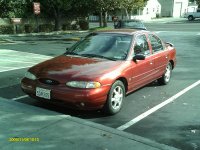
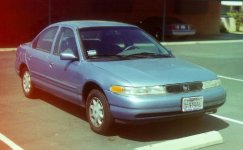
This statement of yours caught my attention, as I was thinking about my own recent mishap. I was rear-ended a few weeks ago, and my car was totaled. The old car was a 1996 Mercury Mystique, with a 4-cylinder engine, and anti-lock brakes (ABS). To replace it, I now have a 1997 Ford Contour (which is essentially the same car as a Mercury Mystique). This car is a year newer, but it does not have ABS, which means it is not as safe as the older car was. It also has the bigger V6 engine, so it burns more gasoline and probably pollutes more. So far, I'm getting about 17-19 MPG with the new car; I was getting about 20-25 with the old car.
 |