Challenge: Demonstrate Sagging floor Trusses Pulling in Perimeter Columns

@ozeco,
Thanks for that, yes, one thing that gets in the way,imo, whenever one strives to deduce greater detail in such an event , is determining the extent by which approximations and simplification will affect calculated outcomes. Thus working on the single isolated column may not lend itself well to gleaning minute detail since this is a perimeter wall of columns and a membrane of concrete and trusses.
There are those on both sides of the debate that have made adjustment in this regard.

What I have not seen, to much satisfaction, is any alternative proposition to initial perimeter column bowing being a result of floor membrane , as opposed to strictly truss, heating , followed by the effect of eccentric (thanks ozeco for the proper term) loading.

This of course leads directly to the elephant in the room that is being ignored;
even if NIST is wildly off in the detail of pull in and core vs. perimeter first, the over riding factor in determining whether or not collapse was the result of fire damage with contribution from impact damage, or by some other mechanism, has to be the lack of evidence of any other mechanism being present.
 
thanks again ozeco, your summing up easily fits the mental image I had concerning prestressing concrete. Material will be subject to tension forces »»» design in a force in the opposite direction.

IIRC you can do the opposite as well to increase the compressive strength of concrete by putting the rebar in some compression when pouring and keeping it in compression until fully cured.

However I read about that probably 30 years ago and time has a habit of increasing entropy in memory.
iow It could be all futzed up
 
@ozeco,
Thanks for that, yes, one thing that gets in the way,imo, whenever one strives to deduce greater detail in such an event , is determining the extent by which approximations and simplification will affect calculated outcomes. Thus working on the single isolated column may not lend itself well to gleaning minute detail since this is a perimeter wall of columns and a membrane of concrete and trusses.
There are those on both sides of the debate that have made adjustment in this regard.

What I have not seen, to much satisfaction, is any alternative proposition to initial perimeter column bowing being a result of floor membrane , as opposed to strictly truss, heating , followed by the effect of eccentric (thanks ozeco for the proper term) loading.

This of course leads directly to the elephant in the room that is being ignored;
even if NIST is wildly off in the detail of pull in and core vs. perimeter first, the over riding factor in determining whether or not collapse was the result of fire damage with contribution from impact damage, or by some other mechanism, has to be the lack of evidence of any other mechanism being present.

Only being ignored by those who wish to stretch out the debate. Acknowledgement of the lack of evidence of any other initiation mechanism than what was observed would turn the argument one-sided "real quick-like".
 
Last edited:
Only being ignored by those who wish to stretch out the debate. Acknowledgement of the lack of evidence of any other initiation mechanism thank what was observed would turn the argument one-sided "real quick-like".

This is what frustrates me most with some posters. Major Tom, femr2 and now enik do seem bright enough and, in the case of the first two, have put together pretty detailed descriptions of the events.
(Tony Szamboti loses out when he assumes column on column axial impact)
femr will not even venture into what the implications of his work might be and not much in that regard from Major Tom either.
There is no docuementary or physical evidence for CD though Tom might argue that "ejections " might qualify.
 
Last edited:
No, that would take too long, lemmie sum up...
Temptation resisted nicely.
clap.gif


A neat "sum up."

So I wont bring in the topic of "prestressed beams"
:blush:


:runaway
 
I moved a series of posts to Abandon All Hope because they were off-topic and derailing in this thread, but they would be fine in another thread or other threads on the appropriate subject matter(s), so please feel free to resurrect those posts in appropriate threads.
Posted By: LashL
 
Last edited:
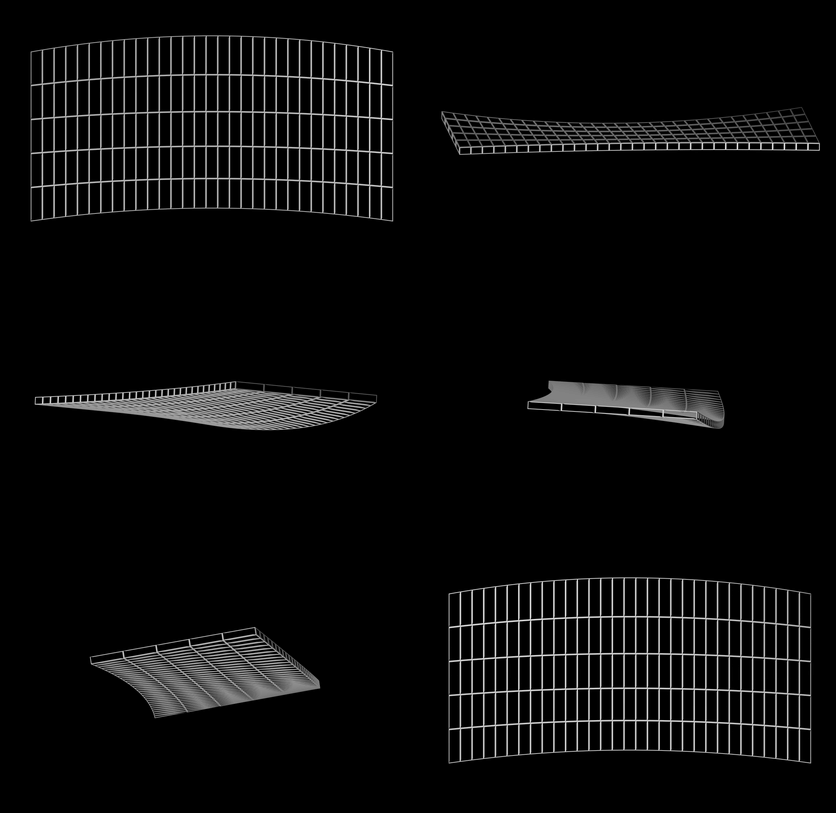
The floor grilling would look something like this:

617303571.gif


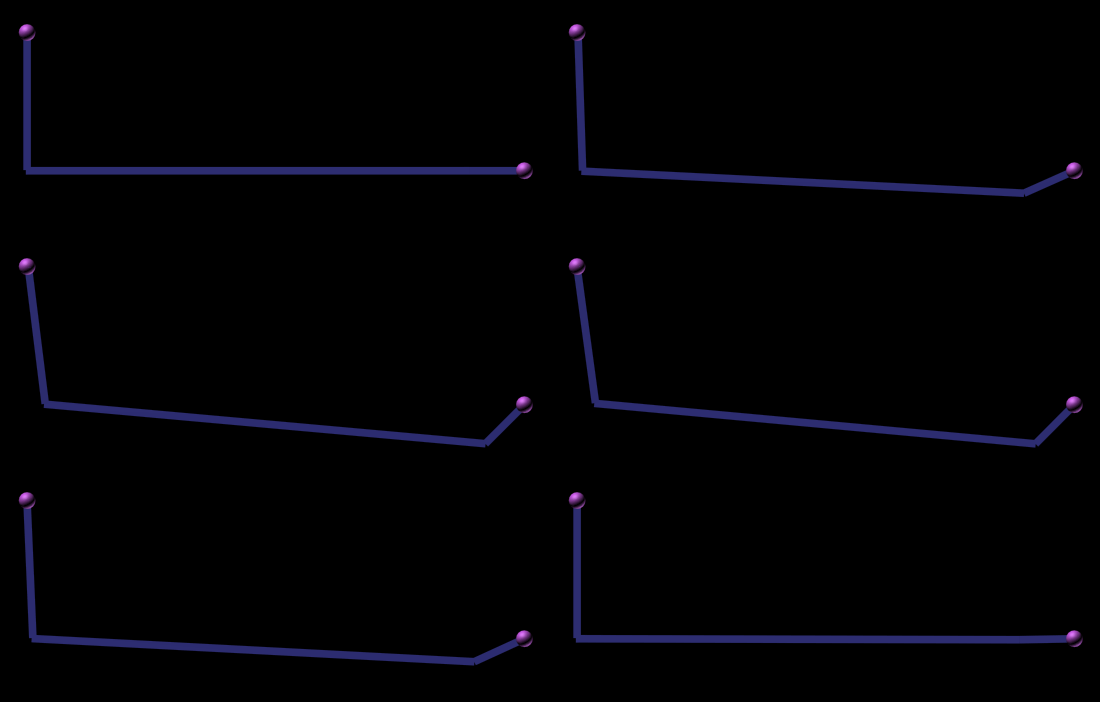
A pull-in mechanism may take this form:

160048563.gif


Maybe a pivot mechanism based on a simple geometry would be a bit more realistic, like this:

south_wall_pul_lin.gif

The point was made that the grill diagram of the floor pan does not take into account that the trusses at both ends of the floors did not go to core columns which MT does not seem to take into account.

The questions have been asked as to by what mechanism the trusses would deform as illustrated in the two above diagrams, but these have gone unanswered, at least in this thread.
 
...The questions have been asked as to by what mechanism the trusses would deform as illustrated in the two above diagrams, but these have gone unanswered, at least in this thread.
The easiest way to create the falling "1000rowCC" column would be to cut it with explosives. But we know that did not happen. (To be more pedantic - there is not now and never has been even a plausible hypothesis for CD. "Did not happen" is good enough for this discussion.)

The other way is that collapse initriation starts with the core column. BUT it is hard to see how the alleged geometry could work. The geometry requires that the distance of fall of the end be several times the magnitude of the resulting "pull in" of the perimeter.

Collapse of a core column would not seem likely to involve several feet of descent as part of a cascade failure before the perimeter and other columns started to fail.

So the geometry is not as self evident as it is portrayed.
 
…Deflection without compression force is 4.6in.
Can you provide some hand calculations to support this value?

…Deflection with compression force is 15.0in.
Your printout shows 14.837, is this a value reaching stability by the program using second order effects from combined bending and axial forces? Or does the program stop calculating due to not converging on a value? If in fact the column is buckling, does the program send out a high deformation or buckling warning? Or does it leave it to the person running the program for interpretation as buckling?

RISA is FEA. It's one of the most common packages used in structural engineering.
Can you do a 60’ floor truss analysis to determine the amount of horizontal (pull in) force developed from a sagging truss?

And that's a good way to look at it. I don't understand how someone could say that it should be obvious the opposite would happen.
What minimum lateral deflection would you expect to achieve buckling? 0.5", 1", 5", 7", 10"?

Here is an analysis with a 5" lateral deflection (which is greater than your 4.6"). The column does not buckle.

Here is an analysis with a 10" lateral deflection. The column buckles.

Youtube links in case the upper videos do not work.
Five inch deflection link
Ten inch deflection link
 
Last edited:
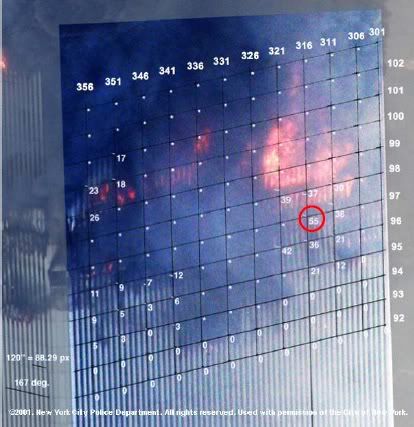
Untitled-6.jpg


I believe all these values have been calculated for an unbraced 3 story column. This WTC1 picture ~ 2-3 minutes before collapse shows 2 column lines at 311,316 with bowing > 10" for 4 contiguous stories, making the fixed ends 5 stories apart.
 
Last edited:
The easiest way to create the falling "1000rowCC"


So the geometry is not as self evident as it is portrayed.

Rows 500, 600, 900 and 1000 especially at the lower reaches of the tower defined shafts and so displacement and unresisted drop was possible down there... less so up top. The bracing in the long axis of these rows was connected outside not between the columns as well.

these 4 rows were the - 32 columns in all are the ones which would be the suspect ones. The ones under the antenna in the center were puny by comparison.
 
Can you provide some hand calculations to support this value?

Your printout shows 14.837, is this a value reaching stability by the program using second order effects from combined bending and axial forces? Or does the program stop calculating due to not converging on a value? If in fact the column is buckling, does the program send out a high deformation or buckling warning? Or does it leave it to the person running the program for interpretation as buckling?

Can you do a 60’ floor truss analysis to determine the amount of horizontal (pull in) force developed from a sagging truss?

What minimum lateral deflection would you expect to achieve buckling? 0.5", 1", 5", 7", 10"?

Here is an analysis with a 5" lateral deflection (which is greater than your 4.6"). The column does not buckle.

Here is an analysis with a 10" lateral deflection. The column buckles.

Youtube links in case the upper videos do not work.
Five inch deflection link
Ten inch deflection link

I'd be happy to answer your questions if you would first explain what each one has to do with your challenge.
 
I'd be happy to answer your questions if you would first explain what each one has to do with your challenge.
Hand calculations to verify FEA results are important, wouldn’t you agree?

My questions regarding your RISA output are due to the fact we got very different results.

The 60’ truss question was checking on RISA capability.

The minimum lateral deflection question goes back to your questioning a statement I made earlier regarding the word “obvious”.
 

Back
Top Bottom