Chain of Custody

Are they teardrops or spheres? Get your story straight.

Still waiting on your apology, by the way.

They are spheres pulled into a tear drop shape from extreme pressure due to surface tention.

I will appoligize to JREF for what exactly? Asking questions and having an opinion. Yeah right.
 
SLT, you are funny:rolleyes:
Shortly: as for paint solubility tests: when you go to some hobby market, do you expect that they will have in stock only one kind of paint? Really??? Still, this is actually what was expected by Bentham team: that only one kind of paint exists in this world, so it is good enough to compare solubility of their (evil nanothermite) chips with the solubility of some accidentally chosen paint;):):rolleyes:

No, there was no explicit note in the Bentham paper which refuses to admit that two red primers were used in WTC. Still, authors simply should very seriously consider those paints as clear candidates for origin of their red chips. No such serious attempt was made.

1. You have not provided any "irrelevant experiments".
2. If there is no note in the paper saying they refuse to admit there was two red paints, why are you saying that the refused to admit it then?
 
WOW! So you are saying that steel in NOT an alloy of iron with added carbon for flexibilty? Sure about that?

Do you know when they swiched to steel from iron in constuction? Do you know why?

if you are actually saying that steel does not have carbon added to it for flexibilty show me a citiation that says that.

;):DHappy hunting bud.
http://en.wikipedia.org/wiki/Carbon_steel

As the carbon content rises, steel has the ability to become harder and stronger through heat treating, but this also makes it less ductile. Regardless of the heat treatment, a higher carbon content reduces weldability. In carbon steels, the higher carbon content lowers the melting point.[2]

Do you need someone to explain the words?
 
Last edited:
If there is no note in the paper saying they refuse to admit there was two red paints, why are you saying that the refused to admit it then?

If I were a betting man, I'd say he's learning how to make claims from you. You know, unsourced.
 
1. You have not provided any "irrelevant experiments".
2. If there is no note in the paper saying they refuse to admit there was two red paints, why are you saying that the refused to admit it then?

1. Experiment, which compared solubility of chips with just one accidental paint is clearly and sadly irrelevant.
2. I wrote: "But, they still (at present, I.K.) refuse to admit that more (at least two) red paints could be sources of red chips in the dust." Try to read what is written.
 
WOW! So you are saying that steel in NOT an alloy of iron with added carbon for flexibilty? Sure about that?

Do you know when they swiched to steel from iron in constuction? Do you know why?

if you are actually saying that steel does not have carbon added to it for flexibilty show me a citiation that says that.

;):DHappy hunting bud.
I'm a metallurgist. I have a degree in metallurgy and materials engineering. I decided to quit posting on 9/11 threads because of people like you. People who have no clue what they are talking about because ultimately it is pointless trying to educate you. However, just now and again a poster who is monumentally ignorant but doesn't know it will post something silly as you just did and won't have the grace to check out what I've said.

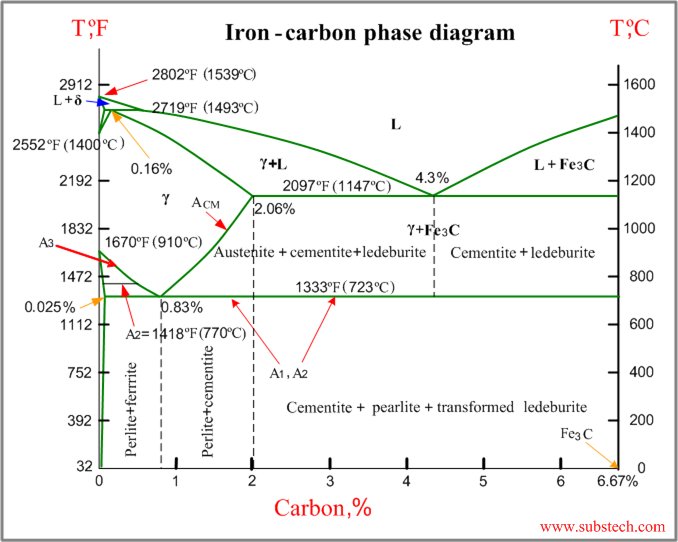
You do realise that when people talk about iron in iron working they are actually referring to cast irons and not pure iron. Nope didn't think so. Iron in those terms has more than 2% carbon by weight upto 4% and thus making the material far harder and more brittle, less ductile and less flexible than steel.

White cast iron for example cannot be easily machined it's too brittle due to high concentrations of cementite (iron carbide Fe3C)

The reduction in carbon content to produce steels (carbon lower than 2% but above 0.02%) allows greater ductility and flexibility aswell as strength. Pure Iron is considered to be soft and ductile and Iron with less than 0.02%C are wrought irons (can't be hardened by heat treatment).

fetch.php


Please detail in your own words how the addition of carbon to iron makes steel flexible. Specifically I expect you to detail solid solution strengthening (interstitial and substitutional) and dispersion strengthening and how they relate to the increased flexibility of steel over pure iron as you say they must be. This will be good for a laugh because I don't think you even know what the word flexible means when it comes to materials science. It's upto you to show how the addition of carbon increases "flexibility" because you are claiming it. I'd also love to see how you think that the process of carburising can increase flexibility. However I'll cite sources talking about the role of carbon in iron showing that I am right and you are woefully wrong.

http://www.chemguide.co.uk/inorganic/extraction/iron.html See wrought, mild and high carbon steel section.

http://www.keytometals.com/page.aspx?ID=CheckArticle&site=kts&NM=164 Read section on Carbon and nitrogen in solution in α- and γ- iron


We'll leave it there because I know I won't get an answer and we'll leave the iron-carbon phase equilibrium diagram/TTT curves and heat-treatment and processing because I think it may just be a little over your head.

 
Oh and by the way I can take a 3 samples of steel all of the same chemical composition (i.e. same carbon content) and change the material properties via differing heat treatments to give 3 samples with differing flexibility.
 
WOW! So you are saying that steel in NOT an alloy of iron with added carbon for flexibilty? Sure about that?

Do you know when they swiched to steel from iron in constuction? Do you know why?

if you are actually saying that steel does not have carbon added to it for flexibilty show me a citiation that says that.

;):DHappy hunting bud.

First hit on google:

Carbon and other elements act as a hardening agent,
 
Oh and by the way I can take a 3 samples of steel all of the same chemical composition (i.e. same carbon content) and change the material properties via differing heat treatments to give 3 samples with differing flexibility.

The kid said he took welding in High School. Isn't that good enough?


(By "took" I think he means "will take" when he gets there)
 
I'm a metallurgist. I have a degree in metallurgy and materials engineering. I decided to quit posting on 9/11 threads because of people like you. People who have no clue what they are talking about because ultimately it is pointless trying to educate you. However, just now and again a poster who is monumentally ignorant but doesn't know it will post something silly as you just did and won't have the grace to check out what I've said.

You do realise that when people talk about iron in iron working they are actually referring to cast irons and not pure iron. Nope didn't think so. Iron in those terms has more than 2% carbon by weight upto 4% and thus making the material far harder and more brittle, less ductile and less flexible than steel.

White cast iron for example cannot be easily machined it's too brittle due to high concentrations of cementite (iron carbide Fe3C)

The reduction in carbon content to produce steels (carbon lower than 2% but above 0.02%) allows greater ductility and flexibility aswell as strength. Pure Iron is considered to be soft and ductile and Iron with less than 0.02%C are wrought irons (can't be hardened by heat treatment).

[qimg]http://www.substech.com/dokuwiki/lib/exe/fetch.php?w=&h=&cache=cache&media=iron-carbon_diagram.png[/qimg]

Please detail in your own words how the addition of carbon to iron makes steel flexible. Specifically I expect you to detail solid solution strengthening (interstitial and substitutional) and dispersion strengthening and how they relate to the increased flexibility of steel over pure iron as you say they must be. This will be good for a laugh because I don't think you even know what the word flexible means when it comes to materials science. It's upto you to show how the addition of carbon increases "flexibility" because you are claiming it. I'd also love to see how you think that the process of carburising can increase flexibility. However I'll cite sources talking about the role of carbon in iron showing that I am right and you are woefully wrong.

http://www.chemguide.co.uk/inorganic/extraction/iron.html See wrought, mild and high carbon steel section.

http://www.keytometals.com/page.aspx?ID=CheckArticle&site=kts&NM=164 Read section on Carbon and nitrogen in solution in α- and γ- iron


We'll leave it there because I know I won't get an answer and we'll leave the iron-carbon phase equilibrium diagram/TTT curves and heat-treatment and processing because I think it may just be a little over your head.


The main ingredient is carbon. Carbon is what makes iron into steel. Other chemicals are added, like chromium, which makes stainless steel. Different amounts of carbon can change the properties. Adding a lot of carbon makes high-carbon steel, which is hard and flexible, used to make knife blades and (lower quality) springs. Adding molybdenum (and chrome, I think) makes chromoly steel, very flexible and strong steel often used in the racing industry.


http://wiki.answers.com/Q/What_is_a..._and_give_different_proportions#ixzz1kUqDnyGB

Edited by jhunter1163: 
Edited for civility.
 
Last edited by a moderator:
WOW! So you are saying that steel in NOT an alloy of iron with added carbon for flexibilty? Sure about that?

Do you know when they swiched to steel from iron in constuction? Do you know why?

if you are actually saying that steel does not have carbon added to it for flexibilty show me a citiation that says that.

;):DHappy hunting bud.
How much carbon is in WTC steel?

tear drop? got photos?

You got a wiki degree of silly. You know as much about steel as you do 911, maybe more about steel. What engineering school did you get all this super stuff from? Wiki?

There is no valid chain of custody for the Jones delusional nan0-thermite scam. There is no evidence of thermite on any WTC steel. It is cute you cute and paste wiki answers, answers by the people for the people. Did you write the answer?
 
Last edited:
First hit on google:

Carbon and other elements act as a hardening agent,

I love how you cut the sentence down so the word flexible is not shown. my first hit came up this:

The main ingredient is carbon. Carbon is what makes iron into steel. Other chemicals are added, like chromium, which makes stainless steel. Different amounts of carbon can change the properties. Adding a lot of carbon makes high-carbon steel, which is hard and flexible, used to make knife blades and (lower quality) springs. Adding molybdenum (and chrome, I think) makes chromoly steel, very flexible and strong steel often used in the racing industry.


Read more: http://wiki.answers.com/Q/What_is_a..._and_give_different_proportions#ixzz1kUqDnyGB
 
So I have proven through citation that carbon added to iron makes steel flexible.

So I have proven through citation that carbon added to iron makes steel flexible.
 

ISF - Join now!

Every member here is approved by hand. No bots, no spam, just people who care about evidence and honest debate.

Membership is free!

Create your free account

Back
Top Bottom