Carl Weinberg: A financial crisis is inevitable in Japan

It could shift the basis of taxation back to land, as it did in the Meiji period, and the period following WW2; in both instances it was able to sustain massive gains for prolonged periods of time. But, that doesn't enrich the greedy privileged class of landowners, so it would be a fight. Of course, this solution is common to pretty much all the world; as long as production is taxed and spent on services and infrastructure which act to increase land values, and there is no means in place of recouping that externality, the result is a massive transfer of wealth to idle hands. Obviously, such a scheme isn't sustainable over the long term.

Interesting point. There are property taxes here, although it's just one of many forms of taxation. I paid property taxes of about 0.25% to 0.30% of the value of my property. I suppose that's fairly cheap as far as property taxes go.
 
Interesting point. There are property taxes here, although it's just one of many forms of taxation. I paid property taxes of about 0.25% to 0.30% of the value of my property. I suppose that's fairly cheap as far as property taxes go.
Indeed. Since WW2, privileged interests succeeded in constantly lowering the rate of property taxation, culminating in the a land bubble in the late 80's of such a massive scale that the grounds of the Imperial Palace in Tokyo were said to be worth as much as all the land in California.

Amusingly, California itself succeeded in drastically lowering property taxes in 1978, forever consigning the state to economic problems similar to Japan. The way out should be clear to those who are willing to see.
 
A conuncrum about Japan is that while the government is deeply in debt, the private sector (corporations and households--particularly households--is hugely in surplus, and by a lot more than the government is in debt. This means that, overall, Japan is a big net creditor of the rest of the world, despite its government being a big net debtor. But because most of that government debt is held by Japanese holders, it is the Japanese private sector that the government is in debt to, not so much other countries (and Japan holds far more US governmemt debt than the US holds of Japanese government debt, for example).
In the worst case, this allows the possibility for the Japanese government to institute a one-time wealth tax to pay off its debt. After all, the people it is indebted to are the same who fall under its power of taxation.

As long as the Japanese private sector runs a surplus much larger than the public sector's deficit, Japan is safe as houses.
 
Yeah, but the ability to tax isn't really an indicator of credit quality--it's possession of a claim on income that is. So that means the creditworthiness of JGB debt is directly linked to the ability of the economy to grow. A sudden large tax increase, whether on income, consumption* or assets (I am not aware of the latter being mooted at all) would risk damaging that, and may bring on market concern rather than alleviate it.

* The VAT rise in 1997 aborted an economic recovery under way at the time, and arguably did more harm than good to the debt burden.
 
Yeah, but the ability to tax isn't really an indicator of credit quality--it's possession of a claim on income that is. So that means the creditworthiness of JGB debt is directly linked to the ability of the economy to grow. A sudden large tax increase, whether on income, consumption* or assets (I am not aware of the latter being mooted at all) would risk damaging that, and may bring on market concern rather than alleviate it.
Income and consumption taxes stiffle economic activity. But in a country with a large savingsglut, like Japan, a wealth tax does not. The money is just sitting there, even barely collecting interest.

Since a wealth tax punishes savers, it may even stimulate economic activity as it induces people to spend their money, instead of having it collected by the government.

Credit quality is simply an entity's ability to pay back or service its debt. As long as your debt is owed to the same people who's assets you have a claim on, it's like being indebted to yourself.
 
Wealth tax, property tax, land-value tax even . . . would very likely depress spending in Japan. The huge household savings pool is deferred consumption for the large fraction of retired / soon to retire people, whose average life expectancy after retirement is pushing three decades.

(Incidentally, since these folks are also a very influential cohort of the electorate in the country, you can conclude that neither Hatoyama nor any successor is going to flirt with these sorts of taxes)
 
Wealth tax, property tax, land-value tax even . . . would very likely depress spending in Japan. The huge household savings pool is deferred consumption for the large fraction of retired / soon to retire people, whose average life expectancy after retirement is pushing three decades.
It's easy enough to work out exemption schemes for those deeply entrenched in the current system (ie, those who are retired or near retiring). For the rest of the population, however, a land value tax would drastically reduce the cost of using land (for both production and living), reduce speculation in land, and facilitate the transfer of land into productive hands. Relieved of the full burden of income taxation, the Japanese would have more to spend on goods that cost less. Production thus stimulated, the debt would cease to be an issue.

(Incidentally, since these folks are also a very influential cohort of the electorate in the country, you can conclude that neither Hatoyama nor any successor is going to flirt with these sorts of taxes)
That's been the normal course of history: beneficiaries of privilege tend to be myopic, and will cling to their privilege even as it drives the nation into the ground. Japan's die is likely cast.
 
The huge household savings pool is deferred consumption for the large fraction of retired / soon to retire people, whose average life expectancy after retirement is pushing three decades.
Maybe. I expect only part of it is deferred concumption, the remainder will be up for inheritance.

(Incidentally, since these folks are also a very influential cohort of the electorate in the country, you can conclude that neither Hatoyama nor any successor is going to flirt with these sorts of taxes)
Not while they have a choice. But if they are no longer able to sell government debt at affordable rates there'll be few alternatives.
 
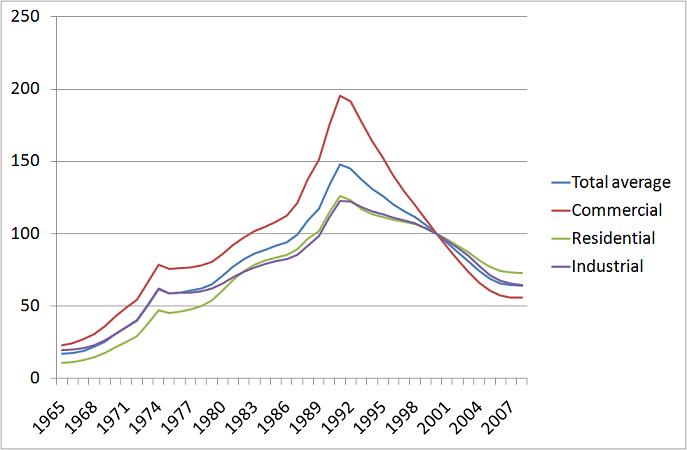
a land value tax would [ . . . ] reduce speculation in land
Doesn't look like there's much of that to be reduced.

(All urban land value index: http://www.stat.go.jp/english/data/nenkan/1431-17.htm )

127464af8718a6946c.jpg
 
Doesn't look like there's much of that to be reduced.

(All urban land value index: http://www.stat.go.jp/english/data/nenkan/1431-17.htm )

[qimg]http://www.internationalskeptics.com/forums/imagehosting/127464af8718a6946c.jpg[/qimg]
You'd be surprised. Anyhow, the tax would not only reduce outright speculation, but would also compel more intensive development. A slumlord isn't an outright speculator in land, but the effect on the aggregate wealth of the economy is similar. The problem with traditional taxation is that it undermines its own tax base. A land tax avoids this by having the opposite effect: it acts to allocate land to its highest and best use, thereby stimulating production.
 
You'd be surprised. Anyhow, the tax would not only reduce outright speculation, but would also compel more intensive development. A slumlord isn't an outright speculator in land, but the effect on the aggregate wealth of the economy is similar. The problem with traditional taxation is that it undermines its own tax base. A land tax avoids this by having the opposite effect: it acts to allocate land to its highest and best use, thereby stimulating production.

I don't understand how taxing land as opposed to income would change anything. Wouldn't taxing land have a wage reducing effect to the point that it balanced out the benefits of no income tax?
 
Last edited:
And believe me, it will come to that before any change is made.

IOW, you agree with Weinberg that a crisis is inevitable, right?
I mean, you think that there is a way to solve it in theory but you don't think that it will be solved in practice before there is a crisis, right?
 
I don't understand how taxing land as opposed to income would change anything. Wouldn't taxing land have a wage reducing effect to the point that it balanced out the benefits of no income tax?

A tax on income is a tax on productive economic activity.
If the basic assumptions of economics are true, the more you tax something, the less you get of it.
This is why people like to tax "sinful" behaviour.
If you can tax booze and tobacco and gambling instead of productive work, presumably you will get more of the latter and less of the former. There are limits to this, of course.
 
Last edited:
The problem with traditional taxation is that it undermines its own tax base.
As does LVT, as I'm pretty sure you've agreed before. Either the tax is passed through to production income, or the logical result is that the government ends up owning all land as private owners sell out to them, and as such it generates no further tax revenue, and government is back to taxing things that it doesn't own, which are labour and private capital income.

LVT has little to do with Japan's issues, or their solution.

"If the only tool you have is a hammer, pretty soon every problem looks like a nail."

Substitute "Land Value tax" for "Hammer" as needed.
 
IOW, you agree with Weinberg that a crisis is inevitable, right?
I mean, you think that there is a way to solve it in theory but you don't think that it will be solved in practice before there is a crisis, right?
Pretty much. Obviously, I'm not psychic or anything, but the historical record of this sort of crisis aversion is not good.
 
As does LVT, as I'm pretty sure you've agreed before.
No, I don't believe I have. There are limits to the LVT; you can only collect the full land rent. But up to that point, it does not undermine its own basis of taxation. When you tax production, you immediately start reducing production.

Either the tax is passed through to production income,
Impossible at rates 100% or below. But then, if you were to tax land rents at more than 100%, it wouldn't really be a land value tax at all.

or the logical result is that the government ends up owning all land as private owners sell out to them, and as such it generates no further tax revenue, and government is back to taxing things that it doesn't own, which are labour and private capital income.
This is wrong on two separate levels. First of all, I don't understand why private owners would sell to the government; presumably, owners who did not intend to use land would sell to other individuals who did. The tax would be based on how much individuals were willing to pay to use land, as that's what land rent is.

Secondly, the government of Hong Kong actually does own the land there, and the land generates substantial revenue (though substantially less than it could if their lease system were restructured).

LVT has little to do with Japan's issues, or their solution.
Right: the largest land bubble in recorded history, and the resulting stagnation since it deflated, has nothing to do with the private collection of land rents! Just ignore that neither the bubble nor the corresponding downturn would have taken place under a scheme where even a majority of land rents were collected for public use.
 
No, I don't believe I have. There are limits to the LVT; you can only collect the full land rent. But up to that point, it does not undermine its own basis of taxation. When you tax production, you immediately start reducing production.
Well I think you've expressed the view that private ownership of land (in the absence of--say--a 100% tax on rent) is unjustifiable/exploitative. Therefore you would set up a system where, effectively, all land is nationalised. At that point, there is no private rent that can be collected and your basis for "tax collection" is simply that government owns all land and government can charge what rent it likes in lieu of tax.

Impossible at rates 100% or below. But then, if you were to tax land rents at more than 100%, it wouldn't really be a land value tax at all.
If land tax is 100% of land rent, then private land value drops to zero and private land rent drops to zero. It amounts to state appropriation of all land, not tax. And that removes all market mechanisms for allocating land to use, or leaving it idle. And there is nothing necessarily wrong with leaving some land idle. Using it for "tax" reasons when market price mechanisms would not justify this is wasteful.

This is wrong on two separate levels. First of all, I don't understand why private owners would sell to the government; presumably, owners who did not intend to use land would sell to other individuals who did.
Evidently you don't. But that doesn't make it wrong, it makes you wrong. And usage rights and ownership rights are quite separable and transferable--except that there is no non-arbitrary way to separately assess site value from the value of internal and external site improvements if you abolish the market. People might want to use land; nobody would want to own land. Thus, again, this is not "tax", it is non-market state appropriation of land capital.

Sure governments may be able to get rich indeed via monopoly ownership of land and the ability to charge usage fees as they liked. If they did it sensibly they might even not distort/kill economic efficiency. But it is a step backwards, away from a market mechanism.

Secondly, the government of Hong Kong actually does own the land there, and the land generates substantial revenue (though substantially less than it could if their lease system were restructured).
Not from LVT they don't, since nobody owns the LV.

Right: the largest land bubble in recorded history, and the resulting stagnation since it deflated, has nothing to do with the private collection of land rents!
Oh sure real estate bubbles and crashes can arise from private land ownership. But state ownership is no magic bullet for efficiency. It is laughable that you regard it as the curer of all ills from economic meltdown to real estate bubbles to a sore finger and a runny nose. Your posts have a "one trick pony" characteristic in that regard.

As for "exempting" retired and near retired in Japan from your desired "tax"--that's probably more than a quarter of the population. So at a stroke you impose a huge cost on the shrinking labour force which is struggling enough as it is. That is not exactly the first thing Japan needs, suggesting you don't exactly know the first thing about it.

 

ISF - Join now!

Every member here is approved by hand. No bots, no spam, just people who care about evidence and honest debate.

Membership is free!

Create your free account

Back
Top Bottom