• Quick note - the problem with Youtube videos not embedding on the forum appears to have been fixed, thanks to ZiprHead. If you do still see problems let me know.

Cancer: Cured?

dogjones

Graduate Poster
Joined
Oct 3, 2005
Messages
1,303


Only the usual: needs replication, needs clinical testing. Tumors in actual patients might have additional layers of immunity-blocking.

I wonder about the possibility of systemic side effects that would mimic, or in the worst case trigger, auto-immune disorders like MS. Not that that would make the treatment unusable against an otherwise lethal condition.
 
Considering I've heard doctors say over and over that there is no such thing as "a cure for cancer", I'm skeptical. What they mean, of course, is that cancer is a blanket term for a host of different afflictions (breast, prostate, lung, etc. are all different afflictions.) Hoping this is true though.
 
You know what else kills every kind of cancer? Fire.

The trick isn't finding something that kills every cancer, the trick is finding something that kills it and leaves normal cells alone, or finding a way to deliver the drug to only cancer cells.

They even admit in the linked article that the drug causes the immune system to target healthy cells. Hopefully they're right that it has a much more severe effect on cancer cells.
 
This protein is produced in healthy blood cells but researchers at Stanford University found that cancer cells produced an inordinate amount of the protein thus tricking the immune system into not destroying the harmful cells.

If Stanford literally cures cancer I'll no longer be upset at them for beating my poor poor Lobos last weekend. :rolleyes:

Seriously, this doesn't sound like a "cure for cancer" but something that may prove very effective in treating it.

Edit: that article is just about a year old BTW.
 
Last edited:
Stanford is starting Stage 1 clinical trials this year.. It's going to be years before a treatment is available for everybody - assuming that it passes all safety tests and trials of course.
But what's the betting that the medical scammers running "cancer cure" clinics out of Mexico will be offering a course of Miracle-CD47® by the summer?
 
You know what else kills every kind of cancer? Fire.

The trick isn't finding something that kills every cancer, the trick is finding something that kills it and leaves normal cells alone, or finding a way to deliver the drug to only cancer cells.

They even admit in the linked article that the drug causes the immune system to target healthy cells. Hopefully they're right that it has a much more severe effect on cancer cells.

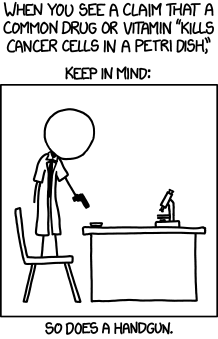
There is always a relvant xkcd strip ;).

cells.png


Hot linking allowed by xkcd
 
You know what else kills every kind of cancer? Fire.

The trick isn't finding something that kills every cancer, the trick is finding something that kills it and leaves normal cells alone, or finding a way to deliver the drug to only cancer cells.

They even admit in the linked article that the drug causes the immune system to target healthy cells. Hopefully they're right that it has a much more severe effect on cancer cells.

Yes. They did start by setting the mice on fire and got quite good results. For some reason the FDA had a problem with scaling this up to humans.
 
Considering I've heard doctors say over and over that there is no such thing as "a cure for cancer", I'm skeptical. What they mean, of course, is that cancer is a blanket term for a host of different afflictions (breast, prostate, lung, etc. are all different afflictions.)

True, but if all cancer cells exhibit some difference with healthy cells, it might be possible to stick a protein to them that inhibits their functions and essentially kills them.

I've heard about this a few months ago. If this is true, it would be a tremendous leap forward for healthcare in the world. With AIDS cures a hopeful prospect, that leave heart diseases as a major problem.
 
This "news" was reported in the scientific literature some months ago and the underlying science behind it has been known for many years. As you can tell from the lack of public excitement the original work generated something of a yawn from the research community. It's gaining some traction with these latest, more promising studies but the concept of this as a magic bullet for cancer is way, way overblown.

As noted above, we're a long way from demonstrating clinical utility of this approach in humans and even if we do it's unclear how effective it will be. I wouldn't go out and start smoking or hanging around radiation sources just yet. We're not quite ready to cure you of the consequences.
 

It's sounded promising for 30 years, actually.

The three drawbacks appear to be:
  • dependence on action from immune system in a person who is already very weak or immunosuppressed
  • tumour adaptation (previous drugs have failed because they just shift the tumour mass to strains that stop displaying CD47)
  • damage to healthy tissue - this is a type of chemotherapy and the idea is that it needs to kill the tumour before it kills the patient
 
One of the biggest one-two punches against cancer (and a host of other human miseries) are effective early screen procedures which are cheap enough to widely apply frequently, and insurance companies intent upon not just allowing such early screenings and treatment, but demanding that clients receive annual screenings and treatments.
 
One of the biggest one-two punches against cancer (and a host of other human miseries) are effective early screen procedures which are cheap enough to widely apply frequently, and insurance companies intent upon not just allowing such early screenings and treatment, but demanding that clients receive annual screenings and treatments.

I'm not sure that's true, actually (depends on what you mean by 'effective' I guess)

One of my quackbusting targets is testing for patients who have no clinical indications or strong family history.
 
I'm not sure that's true, actually (depends on what you mean by 'effective' I guess)

One of my quackbusting targets is testing for patients who have no clinical indications or strong family history.

Well, there are certainly many conditions and diseases that are only strongly correlated to genetic propensity or heavy environmental exposure to known carcinogens, and it would be wasteful to demand continuous tight screening for those afflictions in populations that are neither genetically susceptible or environmentally exposed. That said, there are still many common ailments that inexpensive and reliable screening could catch in their earliest phases allowing remedial and effective treatment before the irreversible damages that often accompany such diseases exasperate and complicate later stage treatments.
 
Well, there are certainly many conditions and diseases that are only strongly correlated to genetic propensity or heavy environmental exposure to known carcinogens, and it would be wasteful to demand continuous tight screening for those afflictions in populations that are neither genetically susceptible or environmentally exposed. That said, there are still many common ailments that inexpensive and reliable screening could catch in their earliest phases allowing remedial and effective treatment before the irreversible damages that often accompany such diseases exasperate and complicate later stage treatments.

Yes, but that's an incorrect way to weigh the risks and benefits - by working backwards from the successes (benefits) only.

The comparison should be the risks associated with testing vs the risks associated with not testing. Generally, if there's no indication (symptoms, high genetic predisposition), testing is considered riskier than not testing. The magnitude of risk depends on the actual conditions and tests, but the trend is pretty toward negative.

My wife has practiced in several countries and she feels the attitude is very dependent on legal protection of the MD rather than evidence for the test's justification. ie: a test is 'necessary' if it covers the MDs liability even if it is statistically more likely to harm than help the patient.
 
What blutoski said.

I think it's harder to kill cancer cells that mimic a lot of their human cells they mutated from than people realize. Attacking a cluster of differentiation (CD) means that immunologically the immune system would recognize that cell as something that needs to be destroyed. So, what happens to all the other cells that express that same CD?

We'll see.

~Dr. Imago
 
I have a strange feeling that this cure for cancer will cause cancer. Similar how anti anxiety or anti depressant drugs side effects can make you nervous or feel like comitting suicide! What?!
.
Jim Kelly had oral cancer i believe in a state of remission, but a news release by his wife said it has kicked back in, and its a very agressive cancer. He is scheduled for surgery Thursday.
.
My next door neighbor has mouth cancer, they treated it, didnt totally work so they had to cut out parts of his mouth insides and tongue. Now its into his throat a lady friend told me. Now i see he hasnt been home for 2 days. What a horrible type of cancer. He cant eat right. He cant swallow unless he chases it down with more food. I asked him what does he do when he gets to the last piece of food. I think he uses bread. He is 80. Poor guy. What a way to go.
Be easier to be aboard a jumbo jet and die of no air pressure, lack of oxygen, or a sudden crash landing, imo.
 
I have a strange feeling that this cure for cancer will cause cancer. Similar how anti anxiety or anti depressant drugs side effects can make you nervous or feel like comitting suicide! What?!
.
Jim Kelly had oral cancer i believe in a state of remission, but a news release by his wife said it has kicked back in, and its a very agressive cancer. He is scheduled for surgery Thursday.
.
My next door neighbor has mouth cancer, they treated it, didnt totally work so they had to cut out parts of his mouth insides and tongue. Now its into his throat a lady friend told me. Now i see he hasnt been home for 2 days. What a horrible type of cancer. He cant eat right. He cant swallow unless he chases it down with more food. I asked him what does he do when he gets to the last piece of food. I think he uses bread. He is 80. Poor guy. What a way to go.
Be easier to be aboard a jumbo jet and die of no air pressure, lack of oxygen, or a sudden crash landing, imo.
Or just attach a breather to a tank of Nitrogen.Calm, quiet sleep...........
 
Jim Kelly had oral cancer i believe in a state of remission, but a news release by his wife said it has kicked back in, and its a very agressive cancer.

aggressive cancers can sometimes be easier to treat than indolent. Don't read too much into the term.
 

Back
Top Bottom