Cancel student loan debt?

It's probably time to consider whether college or other higher education beyond high school should just be free.

We don't really have an economy anymore where a normal person with just a high school degree can make a decent living, which absolutely was true in the past.

The first result of free college would be: ordinary jobs requiring postgraduate degrees.
 
To me at least, the higher tuition rates are the elephant in the room. All of us thinking about what our cohort paid for college is meaningless in the current situation. The current generations, our kids and grandkids, are facing vastly higher college costs than we did.

The two phenomena (higher tuition and massive student loan debt) are not unrelated.

Why is tuition rising? Basically, because colleges are offering more costly services. Why are people willing to pay for those services? Because they are young and stupid and are spending someone else's money anyway. Someone 18 years old who has never paid rent isn't going to appreciate the difference between having 50,000 dollars in debt at the end of four year, versus having 100,000 dollars in debt at the end of four years, but he can appreciate a better student athletic center right now.

I looked into this issue a few years back, as my kid prepared to enter school, wondering what has changed that caused college costs to exceed inflation. The basic answer is administration and student services. There are more employees per student than there used to be, because there's no check on costs. The people making the decisions to spend the money are the students themselves in the form of loans. Late-stage adolescents aren't known for their long term planning ability.
 
The first result of free college would be: ordinary jobs requiring postgraduate degrees.

Perhaps in some areas, but not in others. Not all qualification barriers are the result of pointless gatekeeping.

But that's a good point regardless. There aren't enough "skilled labor" jobs for everyone. Perhaps it's time to consider whether unskilled labor jobs deserve to be paid more than a poverty wage.

Income inequality is often discussed in moralizing terms, that low income people don't deserve better wages and that high income people earned a their comfort. That may be personally gratifying to some, but it's no way to structure a society.
 
Last edited:
Well, the lender whose debt is being serviced is consuming in the economy, so that evens out.

The real problem is that younger generations aren't producing in the economy, which is why they aren't able to service their loans.

Absolute Nonsense. The real problem is they are not being paid well enough to service the loans.
 
Perhaps in some areas, but not in others. Not all qualification barriers are the result of pointless gatekeeping.

Yeah, and all we need to do to prove it is spend hundreds of billions of dollars of taxpayor money while throwing ourselves upon the goodwill and nobility of for-profit corporations! Let's do that and see how it works out.
 
I can't see how this plan, or broader plans to deal with the crippling costs of higher education in this country, wouldn't be a boon to the economy.

If forgiving debt is such a boon to the economy, why not forgive all debt? Construction loans, auto loans, small business loans... Forgive it all. The money that was supposed to come back to the lender will instead go forward into the economy until it circles all the way around to the lender again. Where conservatives had trickle-down theory, progressives have trickle-around theory.


A large, sweeping action like this might be exactly the thing needed to drag this issue to the forefront of public debate.
Whatever happened to the bully pulpit? A large, sweeping, stupid action just to get people to talk about whether or not it's a good idea seems like highly irresponsible government. If there needs to be a public debate about this, Biden can just start debating it. He doesn't need to start throwing millions and billions of dollars around. If there's one thing we've learned from the Trump presidency, it's that tweeting gets noticed and costs the taxpayers nothing. Let Biden tweet his reform plan every week, see what kind of debate he can get going *before* doing large sweeping actions with public money. And if he can't get any debate going, any support for his reforms, then maybe that's a sign that he should keep his hands off the levers of the economy.
 
Yeah, and all we need to do to prove it is spend hundreds of billions of dollars of taxpayor money while throwing ourselves upon the goodwill and nobility of for-profit corporations! Let's do that and see how it works out.

I don't think free higher education would solve the problems of income inequality alone, but it would be a good piece of a larger social reform.

It wouldn't be more of a waste of taxpayer money than just letting the rich hoard their wealth.
 
I think the problem is that employers probably see intelligence to be a trait that is preferred in an employee (depending on your definition of "intelligent"... able to learn new facts, function under pressure as during exams, etc.), so they use a college degree as an indicator that yes, the employee is smart (even if the degree isn't relevant to the job at hand). Granted, not all "smart" people went to college, and not everyone who went to college is particularly "smart" (I heard Wharton produced a real moron for example), but there is probably SOME correlation there.

Otherwise, how can a prospective employee convince a prospective employer "Yes, I'm smart... I didn't just spend my youth eating lead paint chips"
Trial periods after hiring, application tests. Both would serve far better for actually determining whether the candidate can do the actual job than possession of a degree from somewhere, even if college degree programs weren't plagued with grade inflation.

Who would you rather have working for your insurance company, Candidate A who passed an insurance work test with a 95% score and did well in their week-long trial period, or Candidate B who says she has a piece of paper (you'll have to verify it) from Generic College of Somewhere that proves she got acceptable grades in several courses about German literature?
First of all, a week-long trial period doesn't sound anywhere near long enough to determine how "smart" an employee might be...If its a job with any sort of complexity, they might need to spend that much simply on the training, before the employer can really see how good the employee is.

Secondly, even if it is just a one week trial period, that is still potentially thousands of dollars spent on salary, training, paperwork, etc. All to hire someone who may be a complete moron. I could certainly understand the desire for employers to want to avoid that sort of risk.

Lastly, you make it seem like your "insurance work test vs. generic college graduate" is a mutually exclusive set of options. I suspect if you are an employer you would probably prefer both... a generic college degree (which the employer can probably check for very quickly, and which they hope would filter out at least some of the less intelligent applicants), followed by training and work test (as a verification that yes, the person is capable).
 
It seems more like a "we can do this so we should" vs's an actual need. Beyond the college grads that paid their loans, it actively hurts non college educated and trade workers that already have it rough. It seems to reward the worst actors and penalize the best, which seems like bad policy and incredibly bad in regards to future voting.


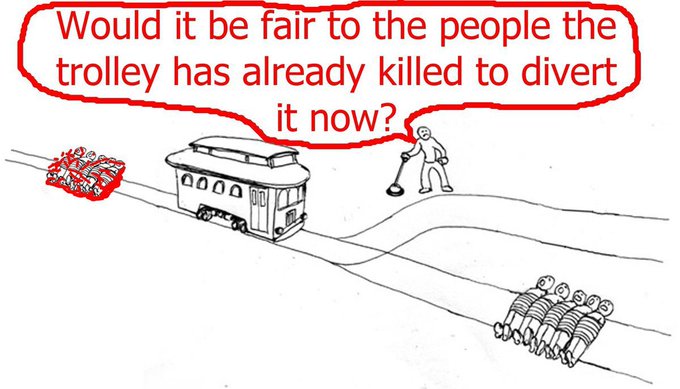
Em8dSApW8AAEr3_


(Via Twitter).
 
If forgiving debt is such a boon to the economy, why not forgive all debt? Construction loans, auto loans, small business loans... Forgive it all. The money that was supposed to come back to the lender will instead go forward into the economy until it circles all the way around to the lender again. Where conservatives had trickle-down theory, progressives have trickle-around theory.

All of these types of loans are regularly forgiven when it becomes clear that the borrower can't repay them through a process known as bankruptcy, something that is uniquely denied to student loan borrowers. The student loan crisis is a unique problem because it has been historically been treated uniquely. Trying to generalize the issue is absurd.
 
I think the problem is that employers probably see intelligence to be a trait that is preferred in an employee (depending on your definition of "intelligent"... able to learn new facts, function under pressure as during exams, etc.), so they use a college degree as an indicator that yes, the employee is smart (even if the degree isn't relevant to the job at hand). Granted, not all "smart" people went to college, and not everyone who went to college is particularly "smart" (I heard Wharton produced a real moron for example), but there is probably SOME correlation there.

Otherwise, how can a prospective employee convince a prospective employer "Yes, I'm smart... I didn't just spend my youth eating lead paint chips", especially early in their work history. Doing well in an interview may only show the prospective employee is charismatic/able to bluff well, and employment history can be hard to follow up on.

A recruiter explained to me that a degree was how they could cover their ass if an applicant didn't perform well on the job. "He had the credentials".
 
Hoard their wealth? Where? Under their mattresses?

I humbly suggest that the Devos family's fleet of yachts is not an efficient use of the nation's wealth, even factoring in the boat mechanics and barnacle scrapers that manage to pull a wage from their existence.
 
If forgiving debt is such a boon to the economy, why not forgive all debt? Construction loans, auto loans, small business loans... Forgive it all.

What a toddler-tantrum of an argument.

We can discuss forgiving college debt because it's public debt, it's within the federal government's authority to forgive. The other debts you mention are private debts and therefore not.
 
The first result of free college would be: ordinary jobs requiring postgraduate degrees.

Yep. How it nobody gets that?

If everyone goes to college... college will just be the new high school.

And yes we will have a more educated society which is a good thing, again it's basically a truism, but we aren't giving anyone any personal advantage.

And again if our goal is simply "a more educated society" then pumping money into the "Pay a huge amount of money to go sit in a special room for 2-6 years at the very beginning of your adult life" is the absolute least efficient and most pointless way of doing that.
 
Upon more thinking, there's a nugget of truth about the concern of dramatically inflating the pool of skilled workers. While "go to trade school" might be great advice for an individual looking to improve their income earning potential, it's not advice that scales to society wide levels.

Seems unlikely to me that employer demand would keep up with an intentional policy of increasing the skills of the workforce. If every capable high school graduate were given trade school training, for example, wages for the skilled trades would likely drop because of the glut of plumbers, welders, etc available for hire.

It's probably worth reconsidering why it's acceptable that unskilled trades receive less than a subsistence wage. If a job is worth doing, it's worth paying a living wage.

Why should this country subsidize employers who pay less than a living wage? That's what we're doing when we accept a minimum wage that will require full time (or more) workers to rely on welfare to survive. It's an artificial boon to the ownership classes that allows them to receive labor for less than the real cost of survival.
 
The two phenomena (higher tuition and massive student loan debt) are not unrelated.

Why is tuition rising? Basically, because colleges are offering more costly services.

That's part of it certainly - a big part. But there is also much less tax-supported subsidy.

College is more expensive than it's ever been, and the 5 reasons why suggest it's only going to get worse
prices at public colleges and universities rise faster when government funding per student sees little growth or is slowing down. In the 2015-16 school year, appropriations — money given to a school by the government — per full-time enrolled student were 11% lower than 10 years before, when adjusted for inflation.

State Higher Education Funding Cuts Have Pushed Costs to Students, Worsened Inequality
Overall state funding for public two- and four-year colleges in the school year ending in 2018 was more than $6.6 billion below what it was in 2008
Between school years 2008 to 2018, after adjusting for inflation:[2]

41 states spent less per student.
On average, states spent $1,220, or 13 percent, less per student.
Per-student funding fell by more than 30 percent in six states: Alabama, Arizona, Louisiana, Mississippi, Oklahoma, and Pennsylvania.
Between school years 2017 to 2018, after adjusting for inflation:

27 states spent less per student. In 15 of these states, funding also fell the previous year.
23 states spent more per student.
Overall, per-student funding essentially remained flat.[3]

Notice that, like many things in our society, our willingness to support government subsidy is inversely related to the use of that subsidy by minorities.
At the same time, this growing burden on students and families coincided with a multi-decade increase in the number of students from communities of color attending college. In 1980, students of color — that is Black, Hispanic/Latino, Asian, Pacific Islander, and American Indian students — made up roughly 17 percent of students at public colleges. By 2010, that number had more than doubled to over 36 percent, and today over 40 percent of students attending public two- and four- year colleges are students of color.[18]

Goodness - that's a good in depth article on the subject. Don't read what I'm writing - just read this article:

State Higher Education Funding Cuts Have Pushed Costs to Students, Worsened Inequality
 
It's probably time to consider whether college or other higher education beyond high school should just be free.

We don't really have an economy anymore where a normal person with just a high school degree can make a decent living, which absolutely was true in the past. The free public school education (K-12) that we provide today does not provide the same opportunity that it did in the past.

If it's necessary to have specific job skills to make a living wage, be that college education or training in a skilled trade, wouldn't it be beneficial for the entire society to make such schooling publicly available to all those who are academically qualified? What benefit is there to preventing people without money from acquiring the training to improve their productivity and income?

There was a time when it was in some places. For example, state tuition was free at state colleges in California before Ronald Reagan was governor. If you were accepted, the state paid for it.

I'm all in favor of state trade schools and career education training being free. But beyond that I'm skeptical. What I really want to put a halt to is the for profit scams schools.
 

Back
Top Bottom