
• Security incident: ISF was recently accessed by intruders. Please change your password, and change it anywhere else you used it. Read more

Can you build an object that floats above another object using permanent magnets?

A good way to visualize the sphere setup:

Normally we treat bar magnets as though they were little solenoids, and then we mentally use the Biot-Savart law to find the field. However, you can get exactly the same field behavior by imagining that (a) magnetic monopoles exist and (b) a bar magnet is just a little magnetic dipole with a + monopole at the north pole and a - monopole at the south pole.

OK, now build your sphere out of these monopole-based bar magnets. The nice thing is that now you can solve the magnetic field configuration using Gauss's Law (easy) rather than Biot-Savart or field lines (hard). What does Gauss's Law tell us? Well, we've just built two spheres: first, a uniform sphere of +monopoles (all the south poles). Gauss's Law tells us that the field inside of this sphere is zero, and outside looks like a point charge with a 1/R^2 field. Second, a uniform (slightly larger) sphere of -monopoles (all of the north poles). The field inside this sphere is also zero, outside is also -1/R^2, and please note the sign change. The total field is the sum of the fields of both spheres: zero inside, zero outside because the spheres cancel one another, and nonzero only within the magnets.
 
Now imagine that all of those little mirrors are the north poles of magnets. No matter how the ball turns, you're still looking at the north pole of a magnet. And the inside of the bowl is the same. How could the ball and bowl possibly attract, no matter how the ball turns?

I understand what you mean, and it is a bit counterintuitive, but every magnet has two poles. Imagine that the magnetic fields are loops that stretch from the north to south ends of the magnets. Putting them closer together, no matter how tightly, will never be able to remove that looping and so eventually the situation described by Gagglenash would occur. Their behavior would approach that of an unmagnetized object overall as you pushed them sufficiently close, but with a little space between them you should be able to see the sort of behavior described here.

ETA: Figures a simultaneous post would explain that better...
 
It occurs to me that there is a bit of qualification that might need to be added to this. Doesn't Earnshaw's thm refer to things that are controlled only by E&M and/or gravity? In this example, we are gluing some magnets to a bowl (which is a molecular scale electrostatic attraction of course) to fix them in place. I thought Earnshaw was basically describing what would happen if we were to allow all of the magnets to move freely. I suppose that we could say that the particles that make up the bowl and glue are always in motion...

If not then I don't see why an electrically charged particle couldn't sit stationary in the center of a fixed position sphere with the same polarity. Similarly I have a set of magnetic rings that rest on a stick. They are of various strengths and so they sit at various separations without moving, though again, their movement is constrained by the stick.
 
Here. This is a screen capture from a video just recently posted to another thread here.

[qimg]http://www.smacaw.com/randi/mirrorball.jpg[/qimg]

Now imagine that all of those little mirrors are the north poles of magnets. No matter how the ball turns, you're still looking at the north pole of a magnet. And the inside of the bowl is the same. How could the ball and bowl possibly attract, no matter how the ball turns?

The field lines from the 'inner' poles wouldn't be contained within the ball, they'd still loop around outside to the 'outer' poles.

Dave
 
It occurs to me that there is a bit of qualification that might need to be added to this. Doesn't Earnshaw's thm refer to things that are controlled only by E&M and/or gravity? In this example, we are gluing some magnets to a bowl (which is a molecular scale electrostatic attraction of course) to fix them in place.

Earnshaw's tells us that no matter what E&M+gravitational fields you set up, there is no way that field can stably support any configuration of point charges, ferro/para/electromagnets, and masses. Your bowl (held together with glue and other non-EM forces) is setting up a field in its interior. Nothing can hover in that field.
 
A good way to visualize the sphere setup:

Normally we treat bar magnets as though they were little solenoids, and then we mentally use the Biot-Savart law to find the field. However, you can get exactly the same field behavior by imagining that (a) magnetic monopoles exist and (b) a bar magnet is just a little magnetic dipole with a + monopole at the north pole and a - monopole at the south pole.

OK, now build your sphere out of these monopole-based bar magnets. The nice thing is that now you can solve the magnetic field configuration using Gauss's Law (easy) rather than Biot-Savart or field lines (hard). What does Gauss's Law tell us? Well, we've just built two spheres: first, a uniform sphere of +monopoles (all the south poles). Gauss's Law tells us that the field inside of this sphere is zero, and outside looks like a point charge with a 1/R^2 field. Second, a uniform (slightly larger) sphere of -monopoles (all of the north poles). The field inside this sphere is also zero, outside is also -1/R^2, and please note the sign change. The total field is the sum of the fields of both spheres: zero inside, zero outside because the spheres cancel one another, and nonzero only within the magnets.

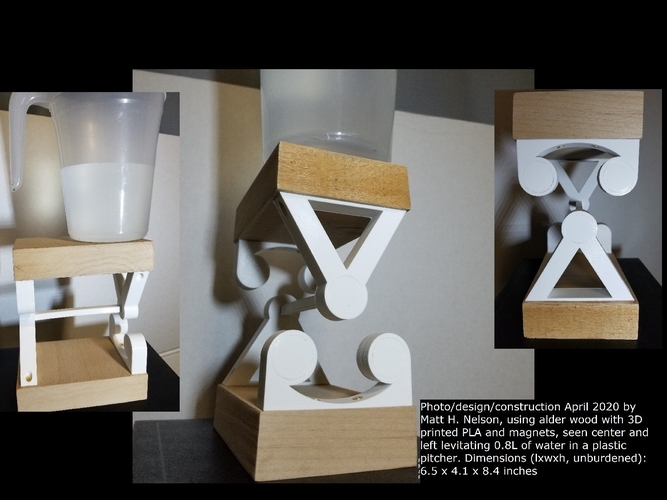
I concur.
 
container_magnetic-levitation-system-by-matt-nelson-april-2020-3d-printing-300081.jpg


It's technically "pseudo-levitation," as you can learn here:
https://www.kjmagnetics.com/blog.asp?p=mendocino-motor-1

...but I'm still calling my invention the world's first levitating platform using permanent magnets. Find 3D printing and build details here:
https://pinshape.com/items/64771-3d-printed-magnetic-levitation-system-by-matt-nelson-april-2020 -- Ebay link at the bottom of the description!

Photo collection here: https://www.flickr.com/photos/29547300@N03/49795971967 -- since the pinshape site lacks a good photo editor.
 
[qimg]https://assets.pinshape.com/uploads/image/file/300081/container_magnetic-levitation-system-by-matt-nelson-april-2020-3d-printing-300081.jpg[/qimg]

It's technically "pseudo-levitation," as you can learn here:
https://www.kjmagnetics.com/blog.asp?p=mendocino-motor-1

...but I'm still calling my invention the world's first levitating platform using permanent magnets. Find 3D printing and build details here:
https://pinshape.com/items/64771-3d-printed-magnetic-levitation-system-by-matt-nelson-april-2020 -- Ebay link at the bottom of the description!

Photo collection here: https://www.flickr.com/photos/29547300@N03/49795971967 -- since the pinshape site lacks a good photo editor.

Congratulations, you have reinvented the Magnetic bearingWP.

The reason it's not considered 'levitation' is that it requires mechanical constraint between the base and platform. In your case, it's the axle in the middle. This axle restrains any translation of the platform, and also restrains two of the three possible rotation axes.

Still looks cool, though.
 
A while back I was playing with a collection of small, ordinary magnets and marveling at how they attract and repel each other, and I began to wonder about something: With those magnets and some ordinary building materials, such as glue, wooden sticks, and so on, would it be possible to build two objects, such that one of the objects would float in a stable position above the other object without touching anything?

One example that I thought of but never tried is to completely cover the outside of a ball with magnets, all with their north poles facing outward, and line the inside of a bowl with more magnets, all with their north poles facing inward. If the ball was then dropped into the bowl, it seems to me that it should eventually come to rest in the center of the bowl, suspended in mid-air.

Would that work? Is there some other configuration that would work? If not, why not? If so, why do you never see anything like that?

Sure it is possible to do such a thing, because I have done such a thing.

Many years ago when Radio-Shack used to sell cool electronic stuff for hobbyists and tinkers, such as myself, they sold these 'ring magnets'.

They were about 1.5" in diameter, 1/4" thick with a 3/8" hole in the center.

Anyway, I found if they were placed on a pencil so that they repelled, then the pencil could be turned vertically and several magnets could float as based on their repulsion.

Another magnet thing was to tie one end of a piece of string to a heavy object, then tie the other end of the string to a paperclip. Then, one could position a strong magnet just past the paperclip and the paperclip would stay suspended by the attractive forces produced by the magnetic field.

Are these the sort of things that you are referring to?
 
Last edited:
Sure it is possible to do such a thing, because I have done such a thing.

Many years ago when Radio-Shack used to sell cool electronic stuff for hobbyists and tinkers, such as myself, they sold these 'ring magnets'.

They were about 1.5" in diameter, 1/4" thick with a 3/8" hole in the center.

Anyway, I found if they were placed on a pencil so that they repelled, then the pencil could be turned vertically and several magnets could float as based on their repulsion.

Another magnet thing was to tie one end of a piece of string to a heavy object, then tie the other end of the string to a paperclip. Then, one could position a strong magnet just past the paperclip and the paperclip would stay suspended by the attractive forces produced by the magnetic field.

Are these the sort of things that you are referring to?
Towlie hasn't posted here in almost ten years.

And no, these aren't the sort of things he's referring to.

For one thing, the pencil trick works with permanent magnets because the pencil keeps the rings in place.

And the paperclip trick works because it's not a permanent magnet. Towlie's scenario of permanent magnets, freely floating without constraints other than their own magnetic fields, is prohibited by Ernshaw's theorem. What you're describing are other scenarios, not prohibited by Ernshaw, but also not meeting Towlie's requirements.

Thanks much!

I see what you are saying and you are quite correct.
 
Thanks much!

I see what you are saying and you are quite correct.

I missed (or completely forgot about) this thread in its first incarnation. It looks like my intuitive response, based on having tried to do it as a kid playing with magnets, that levitation without any mechanical constraints (or some kind of feedback loop) is impossible, is correct.
 
Congratulations, you have reinvented the Magnetic bearingWP.

The reason it's not considered 'levitation' is that it requires mechanical constraint between the base and platform. In your case, it's the axle in the middle. This axle restrains any translation of the platform, and also restrains two of the three possible rotation axes.

Still looks cool, though.

Thanks.

You said I reinvented the magnetic bearing, but you left out tons of other magnetic levitation inventions if you are using a spinning bearing to compare.

The "axle" descriptor is inaccurate since there is no spin or wheel. I'm calling it a beam.

Here's a setup using smaller magnets for the 2-pieces, with longer beams half as wide:

Levitating_Shelf_Matt_Nelson.jpg
 
A good way to visualize the sphere setup:

Normally we treat bar magnets as though they were little solenoids, and then we mentally use the Biot-Savart law to find the field. However, you can get exactly the same field behavior by imagining that (a) magnetic monopoles exist and (b) a bar magnet is just a little magnetic dipole with a + monopole at the north pole and a - monopole at the south pole.

OK, now build your sphere out of these monopole-based bar magnets. The nice thing is that now you can solve the magnetic field configuration using Gauss's Law (easy) rather than Biot-Savart or field lines (hard). What does Gauss's Law tell us? Well, we've just built two spheres: first, a uniform sphere of +monopoles (all the south poles). Gauss's Law tells us that the field inside of this sphere is zero, and outside looks like a point charge with a 1/R^2 field. Second, a uniform (slightly larger) sphere of -monopoles (all of the north poles). The field inside this sphere is also zero, outside is also -1/R^2, and please note the sign change. The total field is the sum of the fields of both spheres: zero inside, zero outside because the spheres cancel one another, and nonzero only within the magnets.

Quoting a great response to both highlight it, and also note that I really miss ben m's contributions here.
 

ISF - Join now!

Every member here is approved by hand. No bots, no spam, just people who care about evidence and honest debate.

Membership is free!

Create your free account

Back
Top Bottom